| Author | Message | ||||||||||||||||||||||||||||||||||||||||||||||||||||
     State of Gravity updates |
State of the 'Gravity-G' message - to be continued... 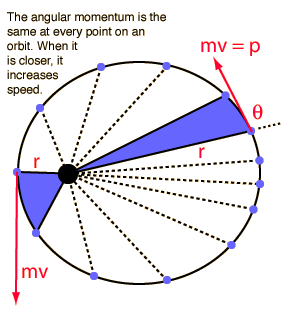 (interactive) (interactive) Angular momentum of a particle Once men believed the earth is flat... then they understood why the horizon is curved... This page will highlight new developments concerning the possible 'variable G' discoveries forthcoming, such that will seriously impact current understandings in astronomy and cosmology, as well as basic physical tenets such as 'conservation' of energy and angular momentum, paving the way for new research on gravitic energy propulsion mechanisms - in violation of the mass-energy equivalence. At present this forum is unable to accept new unsolicited contributions or postings, but Humancafe editors can post ideas submitted by email: humancafe@aol.com * * * To recap the variable-G hypothesis presented here, this is what has come of it thus far: 1. The Pound-Rebka Harvard gravitational redshift experiment can be shown to approximate the Hubble Constant for distant cosmic light redshift, if gravity-G 'constant' is at about 10X-6 range, or about 5 orders of magnitude greater than measured on Earth. This was done independent of any other algorithmic derivations, simply a deduction based on experimental results. This is an introductory list that begins to hint at variable-G Newton's 'constant' away from our planet's known gravity constant, thus paving the way for verifying what this 'constant on a curve' might be for our solar system and beyond. How to measure? Stay tuned... | ||||||||||||||||||||||||||||||||||||||||||||||||||||
| How to measure G? |
Inching forward towards understanding 'variable G' gravity: How to measure? Dark matter theory challenged (by MOND) by gassy galaxies result -- BBC Science News 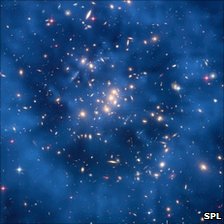 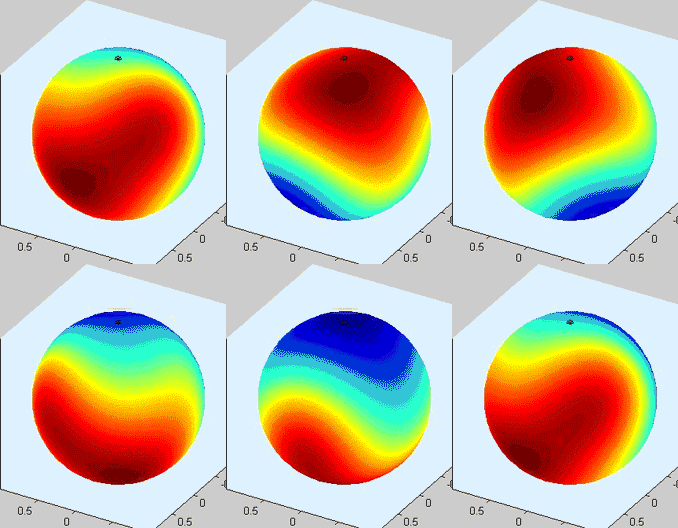 (interactive) (interactive) Lambda-CDM theory holds that dark matter "haloes" surround galaxies and clusters, and polhode motion* Not necessarily understood yet, but they are getting some hints that G is not the same everywhere. Puzzling they keep calling high G non-luminescent matter 'dark matter' as if it were something exotic and different, though this high-G matter may in fact exhibit different electro-magnetic properties from matter here. 'Dark matter' regions may be at the atomic level more like what you find in high spin neutron stars, so called, than ordinary matter. There should be a way to measure for variable-G here close to Earth, IMHO. * * * So let us examine a possibility: 1) If p = mv, and m is growing in mass from (Equivalence principle) greater value (Newton's) gravity G, the p must be growing in value. 2) And, if L= r x p, and p is growing with G, and p = mv, then L = mvr, must also be equivalent. 3) Therefore, if m = m in both cases (same material mass), here and far out in higher G space, then higher per Equivalence nominal m in p = mv at constant v will equal higher p; but higher-G m in space (away from Earth) will convert the same nominal m into 'local G' equivalence (same mass), so that L = r x p becomes higher L per higher p. (BTW, this breaks 'conservation of momentum', in a traditional sense, but 'conserves' it through the Equivalence principle.) 4) Now, if higher L = mvr, then per equivalent mass m in both cases (still 'same' mass), the resulting v should be higher in proportion to the higher-G. And this can be measured simply anyplace in space, at any distance from the Sun to measure for variable-G, where in higher G, the spin should increase. 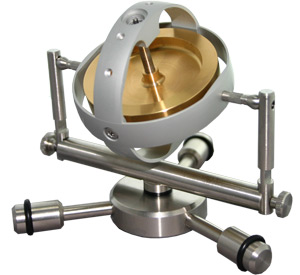 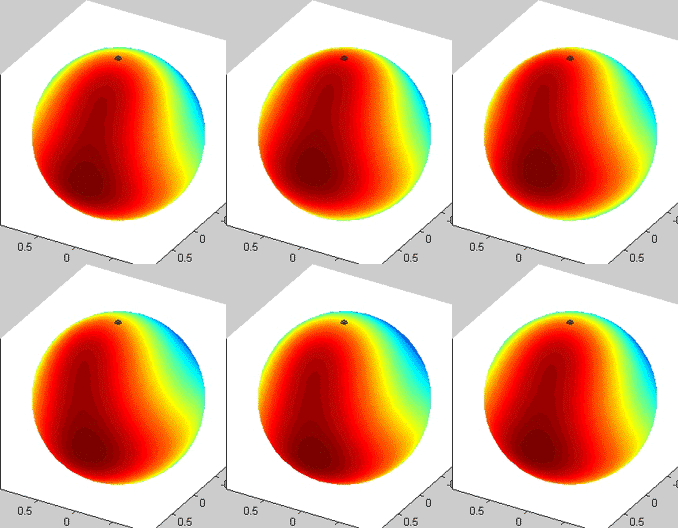 (interactive) (interactive) Simple gyroscope This can be further collaborated with how distant space probes traveling in the solar system are discovered to either spin-up or spin-down. Depending upon the direction of the probes, and their either right-hand or left-hand spin, assuming there is a galactic local 'Coriolis' effect, then as probes travel through varying G increasing with distance from the Sun, there should be anecdotal evidence of these spin variations. To date, this is still inconclusive. But a dedicated test for variable-spin in space would be one way to test for variable-G. This can even be an experiment performed on Mars, or any other distant body away from Earth's known 1 G. Lower G should (factoring in right/left hand rule) spin down, while higher G should spin up. Ivan *(Please note, the Gravity Probe-B polhode images is for effect only, not directly relevant to variable-G.)  Some updates on Probe B: Funding cut, Physics World, 2008 Update Einstein Relativity Mission, they found 'something', 2009 Relativity Mission Probe B decommissioned, 2010 Or, what did they find, really? | ||||||||||||||||||||||||||||||||||||||||||||||||||||
| Holographic technicolor SUSY? |
Oooops!! ... Sorry SUSY! What if Supersymmetry is wrong? 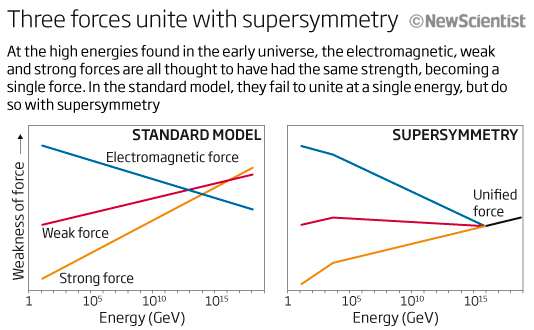 (interactive - arxiv.org paper) (interactive - arxiv.org paper) Perhaps Holographic technicolor model may do it?
Still whistling in the dark, but inching closer to gravity as a function of quantum space, making it a G-variable inversely proportion to quantum energy? Ivan | ||||||||||||||||||||||||||||||||||||||||||||||||||||
| Gravity shmarity... |
Gravity shmarity... We're not there yet. NewScientist: Dark matter could make planets habitable...? 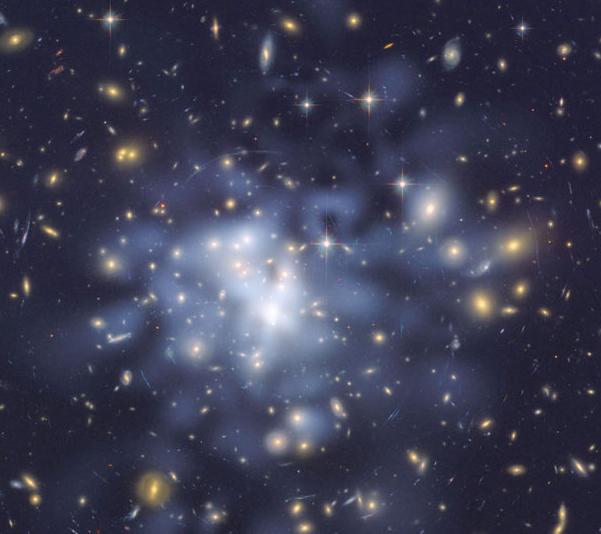 (interactive) (interactive) Space.com article, related
This is truly a confusing piece of science reporting. 'Dark matter' so-called may be no more than higher-G atomic mass, which interacts gravitationally with other atomic mass, and is found only in the dark spaces far between hot energy generating stars, or enveloping galaxies in distant halos where the aggregate star energy is weak. It does not migrate into the planet's interior, except as a hybrid version of the micro-black hole at the planet's center, which in its spin lends motion to both inner core, interior plate tectonics and atmospheric winds. A planet far removed from its host star would exhibit higher gravity-G, so would inhabit a region of 'dark matter' per higher G mass-equivalence, but that is all. The rest of it is pure fantasy, science fiction at it's best.  Also see: Dark matter no-show at sensitive underground lab... deep under a mountain lab, no mysterious 'dark matter' detected? The Universe is much more simple... Think about it. Still hunting for that 'mysterious' Dark Matter: Dark matter particles may be heavyweights after all - NewScientist Also see: Mass of the Universe | ||||||||||||||||||||||||||||||||||||||||||||||||||||
| Beyond Multi-verse |
How many multi-verses does it take to make a Universe? Or, beyond a reasonable understanding of the Cosmos with modern String theory? Is the Search for Immutable Laws of Nature a Wild-Goose Chase? - Discover Magazine, April 2010 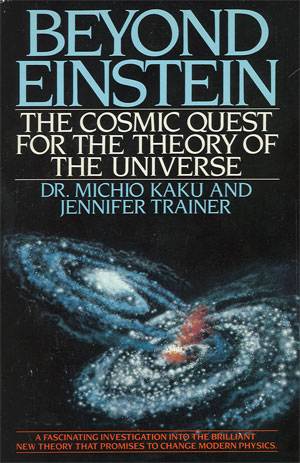 (interactive) (interactive) Beyond Einstein We tend to think in terms of universal laws of physics, but our modern physics has taken us over the deep end where there may not be any 'universal' laws of physics unified into an understandable whole, but rather there may be many laws variable over time, and not necessarily unified into one whole theorem, perhaps many 'multi-verses' of physics. That is how far adrift we have come, that the basic theorem that reality is understandable, and scientifically testable with this understanding, is perhaps beyond such simplicity of thought; but rather is so complex and metaphorical, or probabilistic, that to unite universal physics into One universe is beyond the ability of the mind. But is this true? Or is this multi-verse, String theory universe the real wild-goose chase? Think how much simpler if instead of unifying all physics with a Big Bang inflation origin, thus squeezing the whole universe into a grapefruit sized reality before time and space existed; how about if we tweak a little the basic underlying fundamental assumption of all this, including fundamental to both Eisntein's General Relativity and String Theory, that rather than a 'universal' law of gravity we have a variable law of gravity? So the universe is not 'homogenic and isotropic' throughout, but is variable gravity-G dependent, in fact dependent upon the electromagnetic energy environment defining its gravitational environment, or a universe of the Gravity-G variable. Then, magically, it all starts to fall into place. There are no Strings, but there is an inverse relationship between radiant e.m. energy and the gravitational 'constant' G. There is no 'clock ambiguity', but there is light redshift at the Hubble constant from a much higher G (5 orders of magnitude higher) in deep intergalactic space defining 'gravitational' redshift (per Pound-Rebka experiment) that defines why distant cosmic light is redshifted; and not because of Doppler space expansion. Ditto for the Big Bang, that there was none if there is no space expansion, no Lambda constant, no original singularity from which all space-time sprung 13.7 billion years ago. In fact, the universe may be hundreds of orders of magnitudes older than that, and it all falls into place if we tweak gravity rather than time. Isn't this a much simpler universe, one that is understandable in-toto as a whole theorem? Time to stop chasing the (cosmic) wind? Or chasing 'gravity waves'? What's to look for? It gets crazier by the minute, in that 'early universe': Did the Universe Begin As a Simple 1-D Line?, testable with 'gravity waves'. Also see: Why String Theory is not Scientific Theory 20 Years in Cosmology by Vladimir S. Netchitailo (2021)
| ||||||||||||||||||||||||||||||||||||||||||||||||||||
| Puzzling Pluto atmosphere |
Pluto's Atmosphere Found Poisonous and Surprisingly High 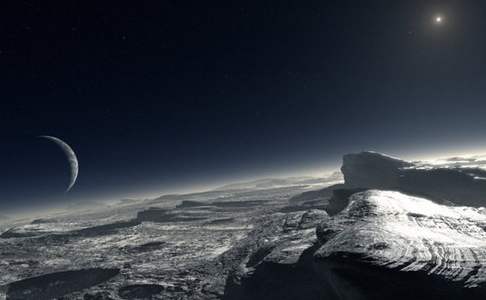 (interactive) (interactive) Pluto's atmosphere has cold carbon monoxide gas (Space.com, April 2011)
This is not surprising, given that Pluto is at about 32 AU, which also means its gravity 'constant' is about 32 G, all of which adds up to its ability to hold a large atmosphere for such a tiny planetoid (smaller than our Moon), so fit all the pieces as they should. Higher G means more 'stickiness' at the gaseous molecular level, so the atmopsphere can be much taller than same for lower G. Look at the gas giants, or Titan, for example. Same principle at work on Pluto. Puzzling Pluto still a mystery... stay tuned... Charon atmosphere in next? Also see: First ring system around asteroid: Chariklo found to have two rings - surprising news, but not so surprising if factor in Chariklo's ~15 AU orbital distance from Sun, which means about 15 G gravity equivalence, so rings can form on this tiny body... but only (if... if) we live in a Variable-G universe. ;-) Closing in on Pluto-Charon orbits: NASA probe sees Pluto and its moon Charon like never before - NASA, August 2014 Also see: Pluto Density Anomaly | ||||||||||||||||||||||||||||||||||||||||||||||||||||
| Earth's G seasonal? |
What if gravity-G changes with the seasons? - by Marcus Chown, New Scientist, Wed, 15 Apr 2009 (Scott.net) 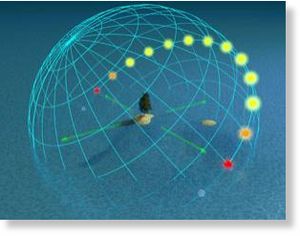 (interactive) (interactive)
Echoes of seasonal planetary spin? (See: http://www.humancafe.com/discus/messages/88/185.html#POST4580 for earlier discussions.) Okay, here is the line-up as how this 'seasonal-G' should play out: 1. In a variable-G environment where gravity 'constant' grows at the rate of 1G per 1 AU, it should register slightly greater at planet's aphelion, and slightly smaller at perihelion in its orbit around the Sun. This is only a slightly variable phenomenon because the Earth-Sun system of gravity and spin equal out nearly totally: Orbital velocity accelerates slightly at perihelion, but slows at aphelion; counter to where spin accelerates slightly in (higher G aphelion), and slows slightly in (lower G) perihelion. But these things are all measurable, and if Newton's G is a variable as hypothesized (and perhaps confirmed by Pioneer Anomaly), it should show up in our measuring instruments when clocking both gravity-G and planetary spin, seasonally. If so, then we have one more chink in the search for understanding gravity, that it is not a 'universal constant' (as Einstein, Newton, Strings Quantum-G, et al thought... Why did they in the first place?), but a variable G, which changes our understanding the universe totally... We're inching closer on this mysterious "X-field". Ivan (Ps: Plasma spin may simulate in microcosm what is happening at Earth's, or any hot body's including the Sun, at its center. It could be that simple, modified by orbital Energy density and interior heat differentials, as affected by orbital location. Could Earth's hot interior be magnetic field generating spinning plasma? Not a solid metallic core? Interesting idea.. .. it must be hell down there!) | ||||||||||||||||||||||||||||||||||||||||||||||||||||
| Roswell UFO 'gravity' quest |
Roswell and greater New Mexico - in search of 'Modified Vector Dynamics' - and friends.  Taos Pueblo - Wiki (click image for article) Why did I travel the length and breadth of New Mexico this past week? I really came to see the Taos Pueblo Indian Corn Dance held by women in celebration of the spirits favoring a good harvest, such as now encouraged by the Tiwa Farms project there. In fact, it was a beautifully performed dance held at the four directions of the pueblo, accompanied by men chanting and drumming, a moving experience even if under threatening skies and occasional fine rain that covered us. If calling for harvest, rain is a good thing. But alas, pictures were strictly forbidden during this special and sacred dance, so none can be shown here.  Taos Indian corn harvest  San Ildefonso Pueblo Corn Dancers (interactive)  Saint Francis Church, rear - Taos NM But I also came to see friends and visit old haunts. Having lived in New Mexico's Santa Fe area for nearly 7 years, it was a familiar place for me, rich in memories. Seeing friends helps bring back those pleasant times to mind, the beautiful landscapes, the dramatic skies and storms, green chili, and that old wild-west exploration spirit where new ideas can still flourish without ridicule, and spirituality is tied into nearly all there is there, from stones to healing hands. That is and always had been the draw of the mystery of New Mexico, as much for Georgia O'Keefe as it was for Robert Oppenheimer. I found the same draw.  La Puebla - Penitente Church  Where Cinzia and I met in La Puebla badlands - our personal 'mecca' (She was warned the place was dangerous!)  Santuario de Chimayo - has healing soil (interactive) Another reason I traveled from Taos all the way down, via Santa Fe and Albuquerque, to Roswell and White Sands in the south was to follow developments that happened over six decades ago. This was the time when the atomic bomb was developed and tested at White Sands, and when alleged UFO were crashing both near Roswell and nearby Socorro, as well as up at Aztec in the Four Corners area of New Mexico. What intrigues me is, how could they (if they exist) power their crafts with such incredible speeds and agility? My search into this phenomenon is not so much as to whether or not these events happened, which to me is inconsequential, but how such a system of propulsion could possibly work; that is what I wanted to research. Going to Roswell's UFO Museum, especially it's research library, perhaps was my true ulterior motive for this research into 'technology' now unexplained, or scoffed at.  Sunset over Los Alamos - from Santa Fe Forest  Lightning over Santa Fe night - on iPhone  Santa Fe is a city of art, even graffiti! What did they power their (alleged) craft with? Some ideas already came to mind in earlier musings on 'alternative physics' of gyroscopes precession. By various routes this led me to Roswell, and in particular to John Searl's work, though he is discredited (in my opinion) by failure to produce falsifiable results.  'Nowhere' New Mexico, a ranch road  Display at UFO Museum... They're here! 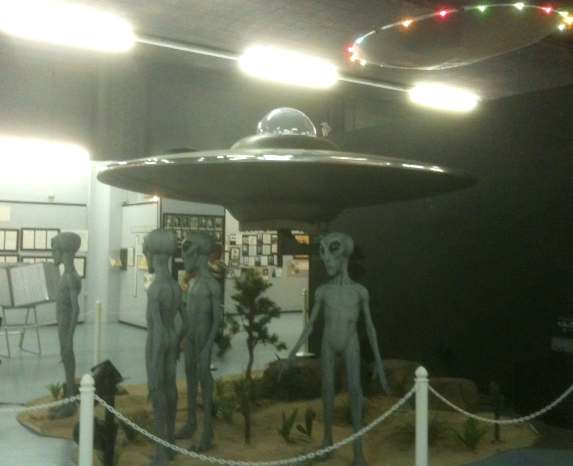 Also display, with periodic 'light and smoke' shows   UFO Museum marquee at Roswell NM (sorry if tilt, can't right it, but okay on others)  I'm kitch at this shop (tilt?) I'm kitch at this shop (tilt?) 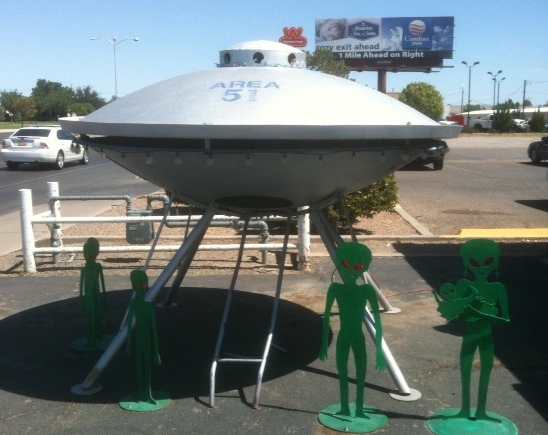 Roswell farewell The research library at Roswell UFO Museum was the most interesting part of the exhibit. But there I failed to find any substantial material for my MoVeD research. Though, upon suggesting John Searl the librarian was able to produce a rather comprehensive report, catalogued and shelved, within the short time I was there. But was Searl on the right track with spinning magnetics? I don't believe so. It looks more like 'static electricity' was generated by his 'rings'. 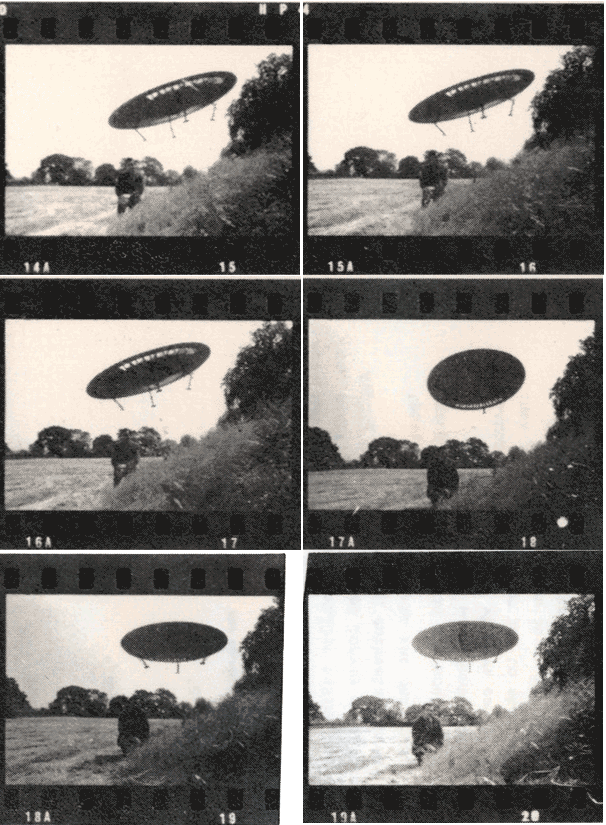 John Searl's 'alleged' early flying saucer After Roswell, where I also met my friend George D. for breakfast at IHOP, we had fun talk about the 'incident' back in 1947; he knew some of the people who allegedly were there to witness; I then set off for final leg of my travels, White Sands National Monument.  Not snow... it's all sand!  My foot on white sand So there it is. My research into Modified-Vector-Dynamics continues, and three motorized high spin gyroscopes just arrived from England. We shall see...  Rio Grande river at Albuquerque This just in: First space flight from New Mexico spaceport, May 22, 2021 (watch video) https://www.virgingalactic.com/watch/ Farewell New Mexico, until next time. It was a beautiful visit. | ||||||||||||||||||||||||||||||||||||||||||||||||||||
| Reverse engineered UFO? |
Is this really true? Or clueless fiction? 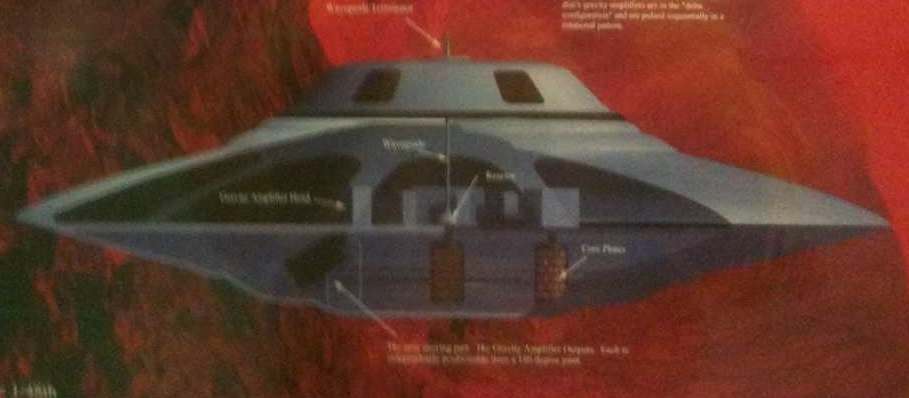 (interactive - click image for Wiki reference) Lazar's alleged 'reverse engineered' analysis of how this ET craft works (he even if sincere may not really understand what he saw). Power generating source may be accurate, where matter/anti-matter annihilation may be used to produce electricity, but propulsion of three on-board engines is probably wrong, IMO. The most probable cause is "modified vector of G-force" (pro-gravity) generated by the three cylindrical engines. iPhone photo taken at Roswell UFO Museum, sorry for poor quality due to lighting conditions. - IDA See videos at Skytrackers.com page, for your entertainment. [PS: In the experimental tests below, I figured out a way to eliminate the serious 'wobble' encountered earlier, and the MOVED G-force effect became about 4X more pronounced, which gave me insight into how this mythical UFO engine (if it exists, maybe it's really one of ours?) might possibly work.] | ||||||||||||||||||||||||||||||||||||||||||||||||||||
| Modified Vector Dynamics - abstract |
Modified Vector Dynamics© (MOVED). - Patent submitted: US 20130186711 A1 by Ivan D. Alexander (first tests July-August, 2011) ABSTRACT: When internal gyroscope mass is put into spin (via internal motor), a natural precessional lateral vector force results from Earth's gravitation g force acting upon it. This effected precession causes natural spin to outer sphere, within which gyroscope is housed, that is counter to direction of internal gyro spin. When the outer sphere housing gyroscope is spun externally in direction of precession spin with added external force, the lateral precession is made perpendicular to itself and now exerts a vector force on the gyroscope/external-sphere along the axis, so motion results. This resulting motion is the redirected g vector force of Earth's gravitational pull, which is now shifted from vertical to horizontal, causing the whole apparatus to move in the direction of resulting force; what is here called "Modified Vector Dynamics G-force" (as illustrated in the schematic drawing). This new vector force is able to produce motion, that is believed to be consistent and accelerative, in any direction it is directed. This is a usable force of propulsion employing Earth's gravity to power this G-force motor, in effect a pro-gravity force drive. (Patent filed August 2011, published 25 July, 2013) 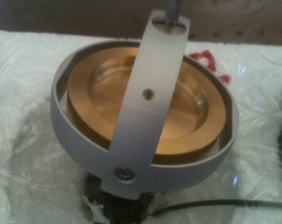 Gyro used (supplied by Gyroscope.com) (To be continued...) Further references: Gyroscope V-force precession Spin is..? Atom and inertia. Axiomatic Equation paper. Torus physics Why it works References authored by Ivan D. Alexander - Humancafe forums | ||||||||||||||||||||||||||||||||||||||||||||||||||||
| MOVED test test |
Modified Vector Dynamics (MOVED) Gravity Force© prototype test  MOVED G-force motor prototype (illustration only, not real prototype experiment) When this motorized gyros sphere (above) was tested, by suspending it on freely moving strings, and powered up it had limited results: When spun slowly (in direction of natural precession), it wobbled erratically like wanting to break free of its moorings; but when spun faster, it stabilized and tended to thrust (slightly) in direction of its axis. This was result expected, though disappointing in that it was ever so slight, so for now results are inconclusive. However, should this principle be perfected and amplified, it may be an important source of future propulsion force by 'redirecting' vector gravity acting up on it into a "forward-backward" vector depending on direction of spin. It is the author's future aim to modify how interior gyros are positioned to better balance and amplify this modified vector effect. The ultimate purpose is to create a powerful motor of locomotion employing 'redirected' gravity (not anti-gravity, but pro-gravity) with Earth as a base reference plane upon which it gains its thrust energy. Out in space, especially if gravity G is greater in the outer solar system, this vector effect should be substantially stronger (background space-gravity potential in relation to Sun), which would yield a constantly accelerating thrust making the outer planets easily accessible. Out in deep space, far from any hot star, this effect could be orders of magnitudes greater than within our solar system, making deep space exploration (star travel) potentially a human reality. However, this is still all very long into the future. For now, just getting it off the ground is our humble goal. In fact, this crude mechanism may be ultimately unworkable, except as an example of principles at work. The real product would be powered by electrically stimulated bands of contained hydraulized electricity vortices fired in continuous succession to provide powerful thrust. This may be what actually powers alien space craft, such as witnessed by (all discredited) observers. (Bob Lazar may know something of this, perhaps?) We're looking at harnessing "gravity in a bottle" if this works, to achieve what we now do crudely with 'gravity assist' maneuvers in space flight… Stay tuned… IDA Follow up on tests for above mechanism: The sphere containing three motorized gyroscopes was tested in three configurations, all with the sphere free hanging with axis of spherical spin parallel to the Earth plane ( _|_ to Earth's g): first test gyros axes were at ~45 degree angle to sphere's axis; second test was with gyros parallel to sphere axis; third test was with gyros perpendicular to sphere's axis. In the first, when gyros were powered up and fully spinning (12000 rpm), and sphere was spun in either direction of precession or against it, it wobbled violently; but when spun faster, it stabilized. In the second test, the wobble was minimal, faster spin was same. In third test, wobble was most pronounced at slow spin, but moderated at faster spin, though not completely. In the second test, at higher spin there 'appeared' some movement in direction of sphere's axis, either forward or back depending on direction of spin, but this was so faint as to be virtually undetectable, so at this time that test remains 'inconclusive'. (The other two tests were too dominated by wobble effect to be noticeable.) Due to the difficulty of properly balancing this crude apparatus, other effects may have been present but not noticed at this time. In effect, all three tests gave Null results as per expectations, though there were surprising results of motion not anticipated. A separate test was conducted for all three configurations were performed as above on the sphere free hanging from a single filament (see picture) to test for natural precession (for clockwise spinning gyros as seen from above); in all three tests precession was counter-clockwise (as seen from above); when sphere was spun it exhibited similar responses to the above horizontal tests: wobble at slow spin, more stable at higher spin. Standing back from it all, there appears to be a 're-directed' gyroscopic vector force at work in all these tests, in response to Earth's g acting upon both the spinning gyroscopes and sphere (what powers precession as a first cause). This is most obvious is the third and first tests, where low spin resulted in violent wobble of the whole apparatus. One explanation could be that Earth's g was being re-directed into the natural precession of each gyroscope, which translates into aggregate precession for the sphere (counter-clockwise), which then resulted in sideways motion of the whole apparatus; but this sideways motion was mitigated by faster spin, which gave the sphere new gyroscopic stability as a whole. This same effect was less evident in the second test because all three gyros were parallel to each other and parallel to the axis of spin for the sphere, as well as Earth's plane ( _|_ to Earth's g). The result then is less sideways motion but instead re-directed along the axis, or in perpendicular to normal precession, so little if any wobble occurred.* However, if so, the effect was not immediately obvious, so this for now is still only a guess. The important point here, given these three tests, is that Earth's g has been re-channeled via positioning of gyroscopic action to give us dynamic force in another direction than normal precession. This, of course, is what was sought for, though not totally satisfied in that the direction of vectors resulting from spin proved more complex than expected. Therefore, though 'something' happened, tests proved inconclusive. We know which way Earth's gravity is vectored… (Viz., If Earth's g enters the system, where does it come out?) What direction does the re-directed vector take in each of the three tests? More tests for this 'redirected' vectors effect are needed. *Significant footnote: Upon further test of gyros positioned perpendicular to sphere axis, it was observed that spin globe one way 'forces' gyro stems out, while spinning counter forces them to retract in; this could be first real evidence of perpendicular (MOVED) force to lateral gyroscopic action. Assuming that, per earlier tests, gyro dynamics regardless of position are universal in the aggregate where whole apparatus acts as if it were precessing, this find may indicate that we are on right track, and gyro action shifts from lateral to vertical along gyro axis, with Earth plane g as reference base. Therefore, earlier reported 'wobble' now makes sense. This is what MOVED G-force is searching for: Secret of the Flying Saucers. Are we on right track? Also see: The Eric Laithwaite's 1974 Lecture "The Engineer Through the Looking Glass" incredible videos of gyro demo lecture, compliments of Intalek.com [PPS: Additional testing, this time with a sensitive hanging scale, showed that earlier reported observed "rise and fall" of spinning gyros inside a spinning, or counter spinning, globe had similar, albeit very faint but measurable results. Though they turned out counter-intuitive (as by example of 'action & reaction' on a gyro suspended from a string and twirled either with or against natural precession, though opposite by 'pushing on a string'), the results were consistent. This may be significant, so should warrant more testing (perhaps related to chronofield effect test). But the question remains the same: Can it ever be usable as a force?... It would need HUGE amplification, if so.] Patent published 25 July, 2013: US 20130186711 for MOVED G-force motor (but we're not there yet). NOTE: Ideally, the rotating cylinder would hold bands of electrically stimulated spinning fluids, which would 'kick' in the MOVED-G manner transferring acceleration along axis of cylinder spin with each pulse. Such pulses would be many per second, while motor cylinder is in continuous spin, thus transferring acceleration along motor axis continuously. It is our belief that same can be achieved with fast rotating plasma, which could allow thousands of 'pulses' per second, to effect a strong continuous transfer of acceleration along motor axis, which would make it a powerful machine of lift and directional, accelerative motion. The interrupted electrical charge returns kinetic motion to neutral after each pulse, while new charge kicks in new acceleration, continuously. If so, this can be a very powerful form of continuous accelerative locomotion useful not only 'under the hood', but also for airlift and space travel. IDA | ||||||||||||||||||||||||||||||||||||||||||||||||||||
| The Pluto Effect |
The Pluto Effect 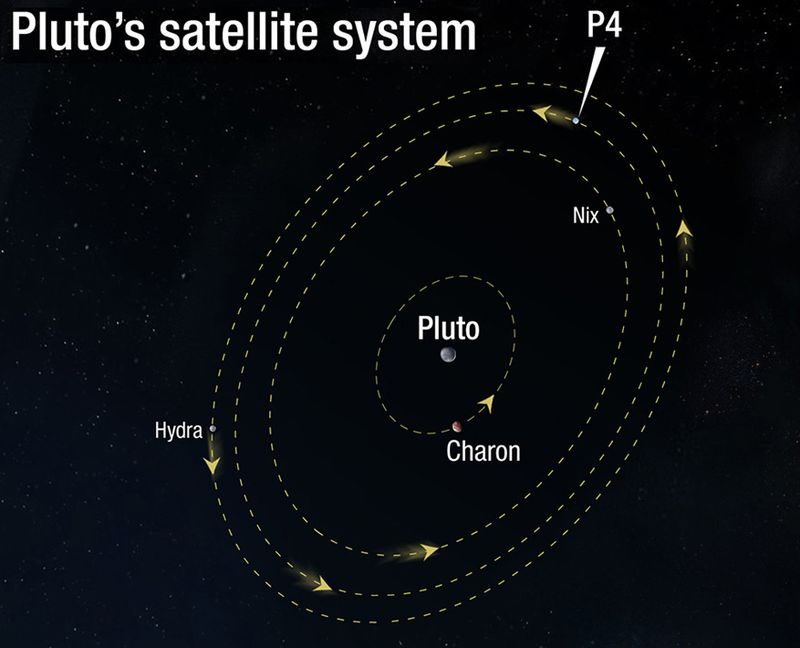 Pluto's Satellite system - Discovery News (interactive, click image for article) There may be a relatively easy test for Variable-G gravity 'constant' in our outer solar system. Though now believed Newton's G is a universal constant, there may be anecdotal evidence that it varies with distance from a hot star like our Sun. Though never tested for before, knowing that Pluto has many moons, and tracking their respective orbital paths around Pluto, we may over time discover that their paths are not uniform, but vary with Pluto's eccentric orbit around the Sun. By observing Pluto's moon orbits during the upcoming fly-by (NASA's New Horizons mission flies past Pluto in 2015) we can later observe these same moons with future fly-bys and compare their orbital characteristics. If gravity G is weaker closer to the Sun, but stronger further out, at about the calculated rate of 1 G per 1 AU (since Pluto's eccentric orbit takes it from 30 to 49 AU), then this variable should be measurable. Expectations would be that at Pluto's perihelion, the moons would be slightly farther from the planet and slower velocity (gravity G is weaker); whereas at aphelion (where G is higher), the same moons would be closer in and faster velocity. This observational data could also over time be collaborated with observations from Hubble, for example. And though the timeline of Pluto's revolution around the Sun from one eccentricity extreme to the other is over an Earth century, small variations should be evident over a period of a decade, if this 'Pluto Effect' is real. This could be a meaningful test for the hypothesis that Newton's G is not a 'universal constant', that does not require a dedicated test for it in our solar system. Of course, such test would still be required to confirm this conclusively. Just in, Pluto may have 10 more moons?! It makes no sense for a planetoid smaller than our Moon, unless the gravity G 'constant' is substantially greater than here. Ditto for its surprising atmosphere. Also see: NASA updates on New Horizons flyby Pluto, 14 July 2015 More on Pluto Density Anomaly | ||||||||||||||||||||||||||||||||||||||||||||||||||||
| Useable force, perhaps? |
I find it strange that my Gravity universe is so different from how physics is now understood. For example, in my above MOVED experiments, when measured on a sensitive hanging scale (to within 0.01 pounds/0.005 kilograms), I discovered that when the gyros are spinning they are ever so slightly 'heavier' than their dead weight. These differences are minuscule, for now, but the effect had been noted in other experiments when the spinning gyros were placed on a platform and the platform was either spun in direction of natural precession (heavier), or against natural precession (lighter), so this effect (though slight) seems to be consistent. The only way I can make logical sense of this is if my earlier (off-the-cuff) hypothesis is correct, that in each spin there is exhibited a 'virtual' microscopic black hole. If so, then gravity attracts that virtual black hole (ever so slightly) but counters it under precession. This is better illustrated by twirling a spinning gyroscope on a string, where this effect (though self contained) is immediately obvious: one way the gyro flops down, the other way it rises up. Strange as this sounds to me (and anyone reading it), it nevertheless seems to fill some sort of gap in our understanding of the 'pure' physics of gyroscopic action as a "conservation of angular momentum" effect. But is that all there is? If I allow for 'lateral' thinking on this, perhaps there is something else at work, something that we haven't figured out yet. Is 'virtual black hole' aligned with gravity 'heavier', but perpendicular to it 'lighter'? Strange idea… But if it really exists, can it be useful? Can it be harvested as a useable force?… Just asking…. One example that seems most strange his how a gyroscope will lose "weight" when it is free to precess, as per this experiment by Prof. Eric Laithwaite:  (interactive, demo video) (interactive, demo video) Demo showing gyro "losing weight" when in full precession. But take away its precession by blocking it, or stopping spin, and it sinks like a stone. But when with precession, here is what it looks like: Eric Laithwaite - gyroscopic gravity modification.mov - believe it or not... Strange? Here are some Russian kids trying it in their Test Flight (video)…. but with limited results. Null results shown per their set up. Experiments to date have shown this MOVED G-force to be so small as to be nearly negligible, but like a tiny flame fanned into a real fire, I predict that within a hundred years we will be using it to power all of our terrestrial and space craft on a grand scale. But between here and then, there is gargantuan engineering work to be done. We will do it. Not so strange, but it still needs much work... | ||||||||||||||||||||||||||||||||||||||||||||||||||||
| Next Phase G-force research |
Is Magnetically-self-confined Plasma-Torus next phase of research to reach fully operational MOVED G-force motor? Self gravitating toroidal plasmas generated electrically over a poloidal magnetic field may be the real breakthrough needed. 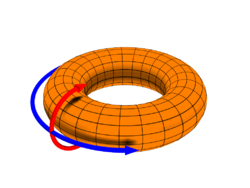 (interactive) (interactive) Toroidal-poloidal spin - Wikipedia Still to be discovered magnetofluid dynamics, whether from liquid or gas generated plasma, what materials and how to contain high rate of spin. The goal of this research is to substitute 'gyroscopic action' of spinning wheels with spinning toroidal self-gravitating plasma, in control-activated bands within the greater spin motors aboard. Differentially Rotating Plasma Rings with High Magnetic Energy Densities may be one way? Probably employing Euler-Lagrange equations, not as now used in Fusion physics experiments, but much simpler mechanics, as rotating plasma is naturally self-gravitating. The toroidal rotation of hot plasma is a natural Modified Vector Dynamics effect, except we do not know, besides vibrations noted, what effect it will have on inertial mass. Experimental evidence would clarify how much directional mass effect generated, if any. It's all engineering science from here, and we'll need lots of it. Unfortunately, if is also capital intensive to build these prototypes. One step at a time… and eventually we will tame re-directed G-force to full amplification efficacy. | ||||||||||||||||||||||||||||||||||||||||||||||||||||
| Why it works |
Why does this work? 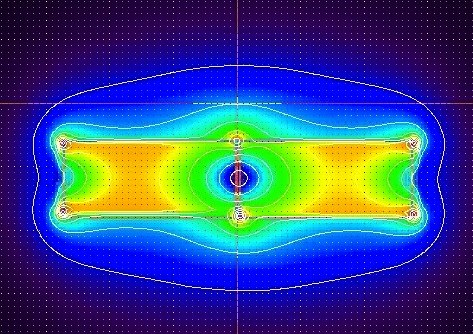 (interactive - a discussion on Energetic Forum) (interactive - a discussion on Energetic Forum) Example of (magnetic) zero-point energy torus - but MOVED G-force is not magnetic! Though this illustration is shown only because it may approximate what happens inside the MOVED G-force motor, if taken as an inertial mechanism (rather than magnetic) it may be showing what is happening at the 'zero point' of spin, per right hand rule. Why should gyroscopic spin result in precessional motion activated by gravity, so that to add weight to the counterbalance arm of a gyroscope accelerates its precession? This may not be fully understood with current physics, but there may be speculative physics that might explain it. Further, it might also explain why G-force can be re-directed in the MOVED G-force motor along the axis, as demonstrations have shown. Here is a progression of possible ideas: 1. Gyroscopic spin captures Earth's gravity potential and redirects it into torque precession. Now stand back from it a moment. What have we done? Is this not a re-direction of Earth's gravity field potential into a new directional force, so motion results? This motion can only be sustained if, and only if, the pulses of acceleration are continuous in order to effect sustainable motion. It is not the spin that controls this motor process, but the acceleration added to that spin. Therefore, for the MOVED G-force motor to work, it needs constant 'pulses' of acceleration to maintain directed motion. Obviously this is not practical with the apparatus set up consisting of gyroscopes (as above), but it is possible with electrically induced spin in either fluids or gas, enhanced into faster spin by microwave energy stimulating it into a very fast spinning plasma, pulses controlled down to attoseconds for precision of control. The science is simple, but the engineering henceforth is demanding, as we have not yet designed anything like it before. But that's how it works. I might add, it was a simple statement by a physicist friend of mine that gave me sudden insight into why this motor works. He said, in passing: "It's the transfer of your hand's energy added to spin that transfers acceleration to the gyroscopic spin's direction, which is what moves it." That immediately came clear to me, as I had been looking at 'spin' being the catalyst for redirected precession (which merely effects gyroscopic action). No, it's the 'acceleration', which is totally Newtonian, that does it. No new physics here, but a way to re-direct known physics of the conservation of angular momentum, now transferred along the axis of spin… Which means ‘momentum’ is modifiable, why it works. (thanks Anthony!) This is a totally 'inertial' force, as per the Equivalence Principle (thanks Albert), and not magnetic in nature. (Though, fast spinning plasma to power the spinning motor may have magnetic by-products, so may need a 'Faraday box' for passenger cabin?) In the end, why this works is because the Earth generated G-force potential is captured by gyroscopic action, and when spun in a whole apparatus it redirects that G-force potential from its lateral precession into a vertical equivalent along the axis; which with acceleration force added it becomes (as if) the acceleration registered by increased rate of precession, but now along the axis. This is a usable force, as presented to the US Patent Office (Patent US 20130186711). Thus it moves. [Addendum: Incidentally, what this transference of acceleration to counter spinning apparatus mimics is a nuanced physical motion, that if all the atomic vibrations in mass were on a vectored bias, that some vibrate a bit more in the aggregate in one direction than any other, the physical mass will be moved in the direction of vectored vibration. The Moved-G inertial motor, in effect, with its high frequency kicks along the axis, mimics this form of biased physical motion.] IDA Also see: Impossible space engine may actually work, suggests NASA - not same idea, but may be remotely related as both 'violate' conservation of momentum, which is new, and both promise 'infinite acceleration'. G-force Inertial Drive revisited Why UFOs glow with plasma UFO spotted by US fighter jet pilot (2004) footage released. This just in: US Navy pilots saw UFOs off coast of Virginia (May 2021) | ||||||||||||||||||||||||||||||||||||||||||||||||||||
| Dethroning Einstein? |
'Dethroning' Einstein has been coming more into vogue of late. Are his halcyon days over? Einstein's General Relativity (and Special) is coming increasingly into question... 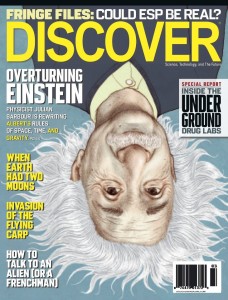 (interactive - click image for link) (interactive - click image for link) Discover Magazine cover: "Overturning Einstein", March 2012 In the Discover article "Gravity off the Grid", science writer Zeeya Merali makes a credible case for Machian gravity/space-time, such as proposed by English physicist and independent researcher Dr. Julian Barbour. But about half way through the article, it once again becomes a convoluted stretch to believe that Einstein can be dethroned by Barbour et al's theories of Quantum Gravity. For example: The idea of "emergent time" is indeed intriguing. But later Barbour's associates fall back into the 'dark matter' trap, that it must exist, though they (rightly) call 'dark energy' illusive, but for wrong reasons. In truth yet to be fully discovered, it will be much simpler if the universe is not spanned by a 'universal constant' gravity G, but rather is variable: viz. Newton's G is much greater in intergalactic space (where space 'appears' to be expanding); and G weaker in intragalactic/inter-stellar space (where 'expansion' slows). By way of explanation such as posited by the Axiomatic Equation, the universe is indeed simple… and so is the math... that space 'expansion' is a high-G gravitational redshift optical illusion. It may very well turn out, in the end, that all the known 'cosmological constants' are in fact interrelated, and some are same for parallel reasons. At the end of the day, Dark Matter, so called, will be nothing more than cold ordinary baryonic matter in a ultra high gravity G environment (perhaps X50,000+ G of ordinary matter here), made exotic because of its high G environment, and nothing more. Early in our discovery that Newton’s gravity G could be variable, we questioned if Einstein could have gotten some things wrong: Things Einstein was wrong about But keep plugging. Also see: Brilliant, Beautiful Mind of Einstein Einstein's Relativity carousel | ||||||||||||||||||||||||||||||||||||||||||||||||||||
| Dark Matter non-baryonic? |
Why Dark Matter 'appears' non-baryonic 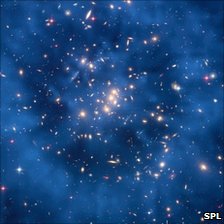 (interactive) (interactive) Lambda Cold Dark Matter Dark Matter appears largely non-baryonic as it cannot be detected by normal light or other electromagnetic radiation. This renders it 'invisible' to astronomical observation except for its gravitational interaction with ordinary matter. The evidence for Dark Matter is primarily from observed gravitational lensing and greater orbital velocities of stars in galaxies (per Zwicky). At present, Dark Matter is believed electric charge neutral, constitutes about 84% of matter in the universe, and hypothesized it does not form atoms. Rather, it is expected to be of exotic heavy mass particles called WIMPS, the search for which has thus far proved illusive. Some have challenged this theory (per MOND), see study at arXiv.org available online. However, if Variable-G is a factor, there may be an easy explanation why DM is 'invisible' to us. The hypothesis for a variable gravity G 'constant' is still speculative, as it had not been found by dedicated tests in the outer, or inner, solar system and is currently believed to be a "universal constant" by physics. Should it be found otherwise, that hypothesized Variable-G grows with distance from the Sun (at about 1 G per 1 AU), there would be cause to think this G 'constant' is orders of magnitudes higher in deep intergalactic space far from hot electromagnetic energy. Per hypothesis from three separate calculations done to date (see Countdown to Strangeness), including the Boltzmann Constant-CMB and deep space Hubble gravitational redshift*, there appears to be correlation that deep space gravity G is about 4-5 orders of magnitude greater (approx. 50-100,000 times) than the Newton constant G as measured here on Earth, as predicted by the Axiomatic Equation. But another calculation using the cut-off frequency for Photoelectric Effect (see June 3, 2004, AXIOMATIC CUT-OFF FREQUENCY FOR GRAVITY?), at about visible light lambda=397 nm (violet), there seems to be correlation again with deep space gravity G in the 10X-6 range (as opposed to 10X-11 range, Earth), so this may give a clue as to why 'dark matter' is invisible to us. If deep space gravity is high enough to effect the Photoelectric Effect, then it may be cutting off electromagnetic interaction, since radiating light may not interact with whatever baryonic matter is diffused in deep space. Below a certain "cut-off" threshold, matter ceases to be visible for very high G effect on baryonic mass, hence rendering it "non-baryonic" to observations. In effect, Dark Matter only 'appears' to be non-baryonic because it inhabits cold deep space where gravity G is high enough to trigger a Photoelectric Effect on whatever atomic, baryonic mass is diffused there, so it becomes invisible to our radiation powered observational instruments. All that is left is the gravitational observation, as already observed, that any gas or dust in deep intergalactic space has very high mass, what had become known as illusive Dark Matter. *(Hypothetically, if dark matter interacts with light gravitationally, and light redshifts through gravity (Pound-Rebka), then it could be inferred that distant cosmic light (line of sight) redshifts at the Hubble constant/Lambda cosmological constant naturally. The light we see from deep space is already redshifted by dark matter, if so, without the need for Doppler space expansion hypothesis, or Big Bang, or DM self-annihilation igniting star combustion, as they become irrelevant.) Also see: Is cold Dark Matter 'hot' electrically? Dark matter blowing bubbles?.. It get's crazier: Earth may be crashing through dark matter walls - NewScientist Meanwhile, they keep looking for the 'invisible'... 1st Results from Space Station Particle Detector Experiment Coming in March - Discovery News Just in: Will we ever… understand what dark matter is made from? -BBC Science News But we are edging closer... Dark matter rival boosted by dwarf galaxies (MOND) -NewScientist Also see: Mass of the Universe and Standard Model deviant? Planck's Constant (6.626e-34 J-s) may be changeable, and perhaps strangely dark. IDA This just in, Discovery News: Dark Matter Mystery Could Be Solved in 10 Years
Also see, just in: Dark Matter map yields first results - BBC
JWST Might Have Spotted the First Dark Matter Stars - Scientific American (July 2023)
This just in: Still in the dark about Dark Matter New dark matter map reveals cosmic mystery - BBC =============================== REPRINTS (edited) Photoelectric Effect (see June 3, 2004, AXIOMATIC CUT-OFF FREQUENCY FOR GRAVITY?):By Ivan A. on Thursday, June 3, 2004 - 12:54 am: | ||||||||||||||||||||||||||||||||||||||||||||||||||||
| Variable G, not there yet |
Variable G revisited, concept had been broached before, but without traction. DIRAC suggested in 1937 that the gravitational 'constant' G might vary with time. There had been some attempts to see Newton's G gravity 'constant' as possibly variable by astronomers, some of whom had been discredited, of the likes of Brans-Dicke, Van Flandern, Arp and others trying to understand the "missing mass" paradox. But this was dead ended... First to postulate "variable G" was perhaps Toivo Jaakkola, Finland,  (interactive -in memoriam) (interactive -in memoriam) in his Action-at-a-Distance and Local Action in Gravitation: Discussion and Possible Solution of the Dilemma (c.1978-1995).
Another was Variable G by W. H. McCrea (1978) ... I.e., where variable mass 'might be' variable G dependent, per Equivalence? Or again Jaakkola, by Jean-Claude Pecker, Paris (1996), quoting Toivo Jaakkola: - (Apeiron No. 4) However, these concepts never gained traction in a world of mainstream cosmology, frenetically proving "Einstein was right!" over and over again, which makes General Relativity dominant in all gravity theory. In fact, variable-G may be the missing link in cosmology to explain many puzzling phenomena, from large atmosphere gas giants in the outer solar system, to cosmic redshift Hubble constant, to the "missing mass" dark matter, to super fast spinning stars, to galactic 'black holes', to gassing out comets in the inner solar system, to the Pioneer Anomaly, to tiny Pluto's many moons. It all fits so well with a "variable gravity G" concept, ushering in a new era of fundamental physics and cosmology…. There was no way to prove a variable gravity G from our Earth's position, same as there is no way to find 'dark matter' here. At this time, the concept of gravity-G not being a universal constant would appear to be 'pie in the sky' were it not for coincidence that other methods had collaborated to calculate deep space gravity, which seem to confirm a variable G: Viz. Deep Space Gravity, which indicates how high G (gravitationally) redshifts distant cosmic light at the Hubble constant; and The Boltzmann Constant, when applied to CMB, seems to indicate the same high G in deep space. These support the calculations derived from the Axiomatic Equation, as applied to figuring variable G; at this time, this is all still anecdotal. For proof, we need to measure G away from Earth's orbital region... But not there yet. Also see: Mass of the Universe First math why Newton's gravity G 'constant' may be Variable, per Axiomatic equation. (See Sept. 16, 2003 - towards New Physics) Julian Barbour's curious astrophysics (sans 'dark matter'): Einstein was wrong - he didn't go far enough? Gravity, the perfect illusion MOND revisited, why it is valid Revising Relativity: How Modified Gravity Challenges Einstein and Dark Matter - SciTechDaily (21 June 2024)
Galactic Black Hole mystery Short cut to calculating Proton mass, per universal Gravity - coincidence? ============================= Here is a partial copy of very first speculative discussions leading to variable gravity G, while searching for a Theory of Everything, 2002: By Ivan A. on Friday, March 29, 2002 - 02:15 pm:...etc... | ||||||||||||||||||||||||||||||||||||||||||||||||||||
| Planet Energy short hand |
Total Planetary Energy calculations short hand. Sometimes the simplest things are the hardest to find. Back when we first theorized total planet energy, c. 2003 by combining products of solar radiance, planet's kinetic energy and solar distance, to give a template of combined radiant and gravitational energy, the calculations achieved were laborious and cumbersome, but reasonably useful to calculate energy E and local gravity G. From these results were then calculated relative proton mass and the proton-proton gravitational constant, from which was derived Newton's G for each orbital region around the Sun. But upon reviewing equations to balance both sides with function (f), it became obvious there is a simpler way to arrive at the planetary orbital total energy, where quite simply it became: (f) = 1/AU^2 (dimensionless)* so that, on both sides of the Axiomatic equation, taking Earth's (base) value E=9e16j and multiplying it by 1/AU^2, we get the same result calculated long hand. Therefore, dividing known (E=mc^2) as 90 petajoules for Earth's value (for 1 kg mass) by any planet's astronomical units squared gives us a handy short hand for the total energy levels of planets based on their relative solar distance, or at least pretty close approximations. For example, in original long hand calculations: MERCURY: 60.55E+16 J VENUS: 17.33E+16 J EARTH: 9.0E+16 J MARS: 3.66E+16 J JUPITER: 0.335E+16 J SATURN: 0.1004E+16J URANUS: 0.0247E+16J NEPTUNE: 0.01E+16 J PLUTO: 0.006E+16 J Instead, we just multiply 9.0E+16 J by 1/AU^2= E for each planet's AU, so now we get: Mercury: 59.21e+16J Venus: 17.37e+16J Earth: 9e+16J Mars: 3.89e+16J Jupiter: 0.333e+16J Saturn: 0.0997e+16J Uranus: 0.0244e+16J Neptune: 0.01e+16j Pluto: 0.0056e+16J The results are almost same, and our universe just got simpler. So same as found on planetary spin where (AU)^1/2, square root of astronomical units, plays a role in bringing planetary spin ratios to unity, and also hypothesized for Pioneer Anomaly, where (in centimeters) acceleration towards the Sun is about -a=-1/AU^1/2, so is it with total planetary energy calculated to find variable G; they all seem to fit nicely together. One has to wonder why?... Could it really be that gravity G is variable on a curve at about 1 G per 1 AU? It would all fit handily if so. *(same rule applies to both proton mass and proton-proton gravitational constant g, where both Earth values multiplied by AU^2 gives their respective values for any planetary orbital distance) Ivan Rome SPQR Also see: Variable-G paper | ||||||||||||||||||||||||||||||||||||||||||||||||||||
| MOVED G-force Patent US 20130186711 |
Modified Vector Dynamics 2 US 20130186711 A1 ABSTRACT Gyroscopic precession is the result of angular velocity of rotation and angular velocity produced by torque which acted upon by vector force of gravity will cause precession. The resulting precessional vector force at right angle to torque is currently well understood, though not understood how this precession vector can be modified by right angle to produce the same force as a directed vector force; how angular momentum could be made directional. Inventor shows in principle how this Earth gravity G-force is re-directed using gyroscopic action housed within a larger apparatus, when whole apparatus is spun in either direction, whereby the angular momentum is transferred along the axis of spin. The result is a directional force caused by acceleration of spin of whole apparatus, which may be a usable force in future propulsion systems. CLAIMS 1. This propulsion assist power objective is met with the Modified Vector Dynamics (MOVED) G-force, per invention FIG. 1, applied to a motor with sustained pulse acceleration directed along the axis of spin of the whole apparatus, so a resulting re-directed vector force moves the vehicle in a dedicated manner, along motor axis, to enhance propulsion in the direction desired. 2. When this motor is taken to full efficacy, per invention FIG. 2, the “assist-power” would become “full-power”, which would enable the motor to work at its best capacity as a stand alone power source of motion and lift in future vehicles. DESCRIPTION CROSS REFERENCED TO RELATED APPLICATION This current application replaces the prior filing of U.S. Provisional Patent application 13/216,082 filed on Aug. 23, 2011. FIELD OF INVENTION The present invention relates to the apparatus using counter-spinning mass housed within an external sphere to re-direct Earth's gravity from natural lateral precession into a vector along the axis vertical force. This new directional force can then move the whole apparatus along its axis by using the MOVED G-force to effect a utilitarian force. Based on this principle can be designed future motors for propulsion in any medium, including space. ABSTRACT Gyroscopic precession is the result of angular velocity of rotation and angular velocity produced by torque, which acted upon by the (downward) vector force of gravity will cause it to precess. The resulting precessional vector force at right angle to (moving in the direction of) torque is currently well understood and amply documented. What is not documented, nor perhaps understood, is how this precession vector can be modified by right angle to produce the same force as an either up or down vector force simulating either “lift” or “sink”, or how this angular momentum action could be made “directional”. Inventor will show how, in principle, this Earth gravity G-force can be re-directed using gyroscopic action housed within a larger apparatus, when the whole apparatus is spun in either direction, whereby the angular momentum is transferred along the axis of spin. The result is a directional force caused by acceleration of spin of whole apparatus, which may be a usable force in future propulsion systems. SUMMARY OF INVENTION Gyroscopic action principle has been used successfully for purposes of vehicle stabilization and alignment. This new motor is designed to use the same gyroscopic principle, commonly called “conservation of momentum”, to re-direct it into its vector equivalent along the axis of spin. This is same principle, in effect, as illustrated by tying a spinning gyroscope to a string and then twirling the string either clock-wise or counter-clock-wise to effect the gyroscope's “rise” or “fall” at the end of its tether, though results will be shown opposite. When two gyroscopes, spinning in same direction, are attached perpendicular to the axis of a larger sphere apparatus, pointing opposite so their precessional force cancels out, their precessional motion can be re-directed along the whole apparatus's axis, in either direction depending upon direction of spin, so a force results that moves the apparatus in such direction. This is the underlying principle of the Modified Vector Dynamics G-force motor, whereby Earth's gravity captured by gyroscopic action, what results in natural lateral precession, is now made perpendicular to the whole apparatus's natural precession. It has been found that a small force results, one that could be amplified by design, so that actual motion along the axis results. For right spinning gyroscopes, clockwise spin, the natural precession is counter-clockwise for the whole apparatus; when the apparatus has force applied to accelerate it to spin in direction of precession, counter-clockwise, the result will be an axial force in one direction, while spun counter to precession, clockwise, the resulting force will be in the opposite direction. For an upright axis of whole apparatus, added counter-clockwise will make it ‘heavier’ by fractional kilogram; whereas if spun clockwise, it will be ‘lighter’ by fractional kilogram. Tests have demonstrated that if above described (right spinning counter-balanced gyroscopes enclosed) apparatus axis is horizontal to Earth's gravity, counter-clockwise spin will move it to the right, whereas clockwise spin would move it to the left. Though effect is still small, it demonstrates the principle involved, which is totally Newtonian, where Earth's natural G-force enters the system and manifests as gyroscopic action, which in turn with accelerative-force added to effect spin of the whole apparatus, a momentary G-force induced reaction will be vectored along the axis of the whole apparatus. Upon this principle is what powers the Modified Vector Dynamics motor. To gain full effect of this motor, a constant pulse of accelerative force must be added continuously to gyroscopic action, if the re-directed vector motion is to be sustained. Further efficacy will be explored to amplify this MOVED G-force effect. It is the inventor's opinion that full efficacy will be achieved by substituting gyroscopes with multi-leveled bands of fluid, or dense gas, stimulated into fast spin with electro-magnetic pulses within the stacked bands, which are then rotated continuously, so a continuous re-directed vector force results to propel the motor in desired vector. This amplification may further be enhanced by microwave pulses (MASER) to turn fluid, or gas, into a fast rotating toroidal plasma within the rotating bands, which may greatly increase the gyroscopic effect. At this time, pending further research, it is not yet known what materials would work best for full and usable efficacy, but the basic principle of Modified Vector Dynamics is the same, to use Earth's G-force and redirect it along the motor's axis. IMAGES 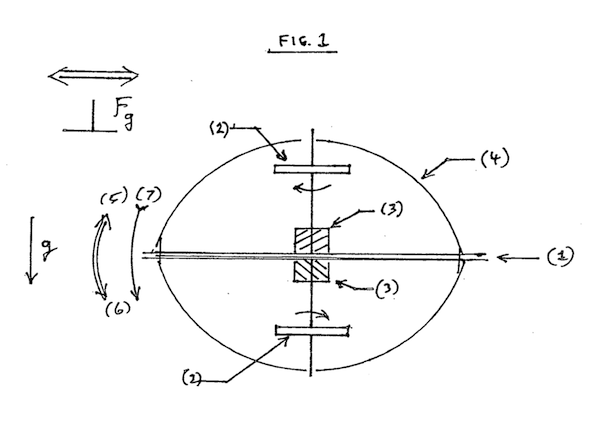 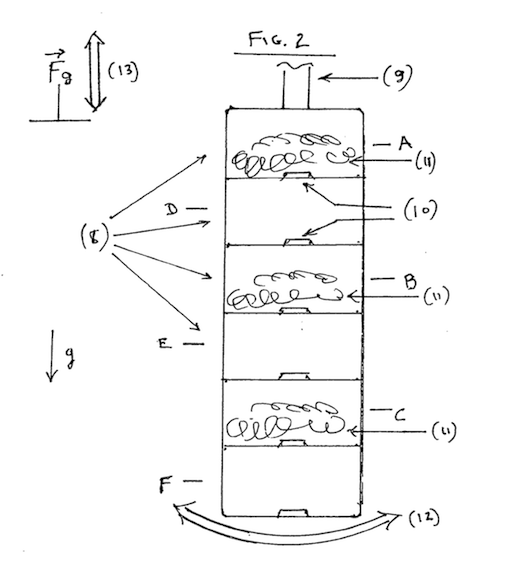 DESCRIPTION OF DRAWINGS FIG. 1, demonstrates the basic gyroscopic action housed within a spin induced motor. The motor axis (1) is shown horizontal to the Earth plane, with two right-spin gyroscopes (2) perpendicular to such axis powered by electric motors (3). The enveloping housing (4) has angular force added to spin it in either right spin (5) or counter spin (6), so motion results perpendicular to motor's natural precession (7), vector-F directed along the axis (1). FIG. 2, demonstrates envisioned MOVED G-force motor using stacked bands (8) attached to a supporting swivel rod (9), whereby inside each stacked bands is an electric magnet (10) over which is a fast rotating toroidal plasma (11). The electric pulses are made of three sets of alternating and continuous (A,B,C and D,E,F) activations. The motor is then rotated in toto (12) in chosen direction to re-direct the vector force (13) in direction desired. ADDITIONAL REMARKS There is no new physics here, this is totally Newtonian. The added spin acceleration, with either mechanical or electric force, to the whole apparatus translates into a redirected vector force. It is the inventor's vision that three such MOVED G-force motors fastened inside a craft will give it triangulating motive power in any direction desired, both vertical and lateral motion, and full range in between by swiveling it. When the motor's efficacy is substantially enhanced to effectively use both the Earth's and Sun's gravitational forces, there is unlimited possibility for space travel with a continuous accelerative force to take us to destinations desired in a much shorter period of time than now achieved with chemical reaction rocket engines. In effect, this is ‘gravity on board’ our space crafts to simulate what are now ‘gravity assist’ maneuvers, to take us to distant bodies in space, both in our solar system and out.* CLASSIFICATIONS U.S. Classification 185/27, 74/DIG.900 International Classification F03G3/00 Publication number US20130186711 A1 Publication type Application Application number US 13/216,082 Publication date Jul 25, 2013 Filing date Jan 25, 2012 Inventors Ivan D. Alexander Original Assignee Ivan D. Alexander Classifications (3) [Inventor's Note: The invention is not yet effective as a useful propulsion source, as the transfer of pulse acceleration to spin is still too weak, but it illustrates the principle involved, that MOVED G tests show that electrical induced pulses of acceleration can be transferred to directional axis of whole apparatus as shown; this transfer of acceleration pulses 'kicks' the whole apparatus in either axial direction dependent on direction of spin, which is the main claim of this patent. IDA]* _____________________________________________________________________________ See also: USPTO related patents: US5090260 -1992 US20010032522 -2001 US20020148308 -2002 US20050160845 -2005 *Addendum: Each band of electro-fluid of the spinning motor takes in 'gravity' in the form of 'inertial mass' (per Equivalence) to transfer the electric accelerative impulse into a directional 'kick', which then dissolves as a directional neutral force into the lateral spin of the fluid; this is what makes it work. Think of a swimmer with each stroke moving forward, or a bird's wings in flight, or a bee's; the principle of the inertial drive, MOVED-G motor is the same. What makes it different is the frequency required to generate sufficient directional trust; which in fluid may be in thousands of cycles per minute, or in plasma thousands per second, while a swimmer or bird may do only a few per minute, or insects a few beats per second. But in principle the directional motion is the same. | ||||||||||||||||||||||||||||||||||||||||||||||||||||
| Dark Matter near Earth? |
Is Earth surrounded by 'dark meatter'? - Discovery News
New Scientist - GPS satellites suggest Earth is heavy with dark matter
Dark Matter hypothesis - American Physics Society: Dark-Matter Wind Sways through the Seasons 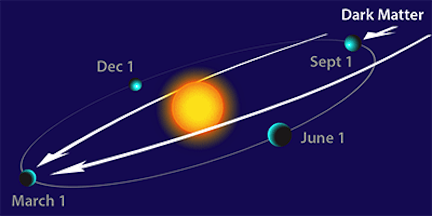
In our previous calculations, Newton's G per Axiomatic Equation showed in Earth orbital region as about 7.24E-11 m^3 kg^-1 s^-2, which is slightly greater than Earth's measured 6.67E-11 N (difference may be accounted for by Earth's interior heat). Could this be the illusive 'dark matter' in Earth's vicinity? At least they're looking for what may or may not be 'invisible' dark matter ... Counting down to Variable G. IDA Also see: A possible flyby anomaly for Juno at Jupiter (PDF 2017) | ||||||||||||||||||||||||||||||||||||||||||||||||||||
| Gravity waves found? |
Have cosmologists found gravity waves? Gravitational waves: have US scientists heard echoes of the big bang?  (interactive) (interactive) We know gravity waves exist but just haven’t detected any yet. Credit: www.shutterstock.com The Daily Mail writes:
But it is unlikely they found 'gravity waves' per se. Rather, the announcement will deal with 'echoes' of the Big Bang in its first nano-seconds, which may mimic what scientists had been searching for the past century, as predicted by Einstein's General Relativity, 'gravitational waves', which had eluded detection to date. More than likely, they will announce some shadow of microwave background energy, which could be interpreted (per General Relativity formalism) as background gravity waves. It remains to be seen what is actually announced tomorrow… But if Big Bang is an observational illusion artifact due to very high gravity-G intergalactic space gravitational redshift, then the exercise will once again prove futile. But it is exciting nevertheless, what new scientific discovery isn't?… Stay tuned, tomorrow. THE NEXT DAY: Major Discovery: 'Smoking Gun' for Universe's Incredible Big Bang Expansion Found - Space.com
So they found 'ripples in space-time' in the first instant of Big Bang? Mind, these are some of the brightest minds in astrophysics, perhaps headed for Nobel Prize. So they found 'polarized light' twisting in the CMB, which per their Einsteinian cosmology model means they found 'gravity waves'? It remains to be seen what this means really, or is, but interesting. And so... Big Bang Mythology continues, while learned scholars continue their disputations. And then it gets better: Our Universe May Exist in a Multiverse, Cosmic Inflation Discovery Suggests -Space.com Also on BBC Science News: Cosmic inflation: 'Spectacular' discovery hailed
Here is a little more detailed explanation of 'twisted light polarity' discovered: Gravitational Waves in the Cosmic Microwave Background -by Sean Carroll -Astrophysics and Theoretical Physics _______________________________________________________________________________ [Some afterthoughts: Curious minds will seek to inquire further, whether this discovery of polarized 'twisted light in CMB' observed by the BICEP2 team is in fact what it is theorized to be, the distant echoes of the first trillionths of a second of Big Bang inflation, or perhaps something else. For example, could it be some parody of the Olbers' paradox, if the light received from 13.8 billion years ago as Cosmic Microwave Background, the most distant signal possible within our observable universe, and which must pass through all of deep space from that distance, that it per force passes through all the galaxies in our line of sight; and that all such galaxies in the path have black hole centers; that the CMB light observed had undergone spin aberrations en route from spinning black holes to give it the observed twist reported? We can check that by overlay matching galaxies with the reported B-mode curls shown. Also, perhaps such polarization curl could be an artefact of maximum redshift, so what we see is a natural phenomenon and not necessarily caused by 'inflation' in the beginning of spacetime, nor 'gravity waves' per se. There may be other considerations, especially if all gas and dust in the (invisible) darkness of intergalactic space, what appears to be non-baryonic but filled with dark matter, is subject to substantially higher gravity-G, and it has this observable effect on light. Do we know this, or are we still guessing? Despite the fact that Einstein's General Relativity generated Big Bang cosmology 'expanding universe' received a Nobel Prize, it may yet prove an embarrassment if gravity is found to be a non-universal constant, but constant on a curve. There may be much we still do not know, except that we have 'curve fitted' observation within the parameters of accepted cosmology theory, so are interpreting it as such, but not necessarily true. Inquiring minds have room to doubt, and would want to know. - IDA] _______________________________________________________________________________ Also see: Are gravity waves falsifiable? BICEP2 Papers: http://bicepkeck.org/index.html#papers Some questions by Cosmologist/Theoretical Physicist Matt Strassler: If It Holds Up, What Might BICEP2's Discovery Mean? ...Stay tuned. Just in: Gravity waves legit?.. Or just dust and rumors? ...also: Cosmic inflation: Confidence lowered for Big Bang signal - BBC Science News LIGO finds ripples of 'gravity waves' This just in: GW170817 LIGO neuron stars collision verified in visible light Or perhaps not: Grave doubt over LIGO’s discovery of gravitational waves | ||||||||||||||||||||||||||||||||||||||||||||||||||||
| G-force inertial drive revisited |
G-force Inertial Drive revisited (interactive) When the MOVED-G force inertial drive was tested with spinning counter-balanced gyroscopes, it exerted a small vector force, as measured in fractional kilograms. The theory behind this force was written then: The idea behind this result is that it is not the acceleration pulse that moves the apparatus, but its tiny remainder force of gravitational inertia that leaks out in a directional force. This is a 'best guess', as no such mechanism is known at present. In effect, this tiny force, as represented by the mass of gyros and Earth's (weak) gravity, is what gives the apparatus its small kick. But each accelerative kick must be repeated continually, without sacrificing its gain (to other counter forces), in order to sustain accelerative motion. In the US Patent Application filed, it says: So per this reasoning, it is the "Earth's gravity captured" (as inertial mass cum force, per Equivalence) that results in motion observed, albeit weak for apparatus tested. To amplify this weak force, it may be needed to use electrically stimulated fluid spin, so each electric pulse causes accelerated fluid spin, which then returns to a neutral state without sacrificing the (gravity) impulse gained. The whole apparatus, with spinning fluids counterbalanced inside, is likewise in spin, what causes the gyros precession transfer to the apparatus axis, directional depending in direction of spin. (Viz., Spin one way gives directional force along the axis, spin other way reverses it, for consistent fluid spin.) To make this work means that such gained force is not lost inside the apparatus, or more succinctly, that the directional force gained is not reversed once accelerative impulse stops; it merely dissolves into the spin of the whole apparatus after each kick without creating a counter force. This is key to capturing the weak gravitational force that entered the system, what gave it a small directional vector force.** If this works as described, then it merely becomes an engineering feat of stacking spinning gyro fluids and increasing the rate of accelerative electric impulses. The greater the rate, the greater the force, so accelerative motion results, and the whole apparatus becomes an engine of directional motion. Should it prove correct that gravity-G is not a universal constant, but greater in the outer solar system and beyond, the inertial kicks should prove stronger with distance from our Sun; at Saturn, if gravity-G grows at the rate of 1 G per 1 AU, the inertial force would be almost ten times what it is on Earth, for example. And if so, then we would have a powerful engine for powering our spacecraft in outer planet exploration, and beyond. This MOVED-G motor could in fact overcome the limitations of rocket powered motors, a kind of 'gravity force onboard', which would be capable of taking us far deeper into space, even interstellar space, not achievable with rocketry. IDA Also see: Impossible space engine may actually work, suggests NASA - not same idea, but may be remotely related as both 'violate' conservation of momentum, which is new, and both promise 'infinite acceleration'. From the research paper EmDrive:
*[see Axiomatic Equation, mass derivation: m=h/c(lambda) ==> m=hc/lambda(proton m) etc., used for developing variable-G hypothesis.] Also see: Why UFOs glow with plasma **Addendum: Each band of electro-fluid of the spinning motor takes in 'gravity' in the form of 'inertial mass' (per Equivalence) to transfer the electric accelerative impulse into a directional 'kick', which then dissolves as a directional neutral force into the lateral spin of the fluid; this is what makes it work. Think of a swimmer with each stroke moving forward, or a bird's wings in flight, or a bee's; the principle of the inertial drive, MOVED-G motor is the same. What makes it different is the frequency required to generate sufficient directional trust; which in fluid may be in thousands of cycles per minute, or in plasma thousands per second, while a swimmer or bird may do only a few per minute, or insects a few beats per second. But in principle the directional motion is the same. We said above: “This is key to capturing the weak gravitational force that entered the system, what gave it a small directional vector force.” This captures best what MOVED-G motor does. In effect, if this motor were to be built commercially, it might be called “vectored-gravity-acceleration” drive, or VEGA Drive. Why does this work? We hope this technology is our own, see video: UFOs in Virginia Beach? - The Virginian-Pilot military news (May 2019) | ||||||||||||||||||||||||||||||||||||||||||||||||||||
| Relativistic Mass conundrum |
Relativistic Mass conundrum 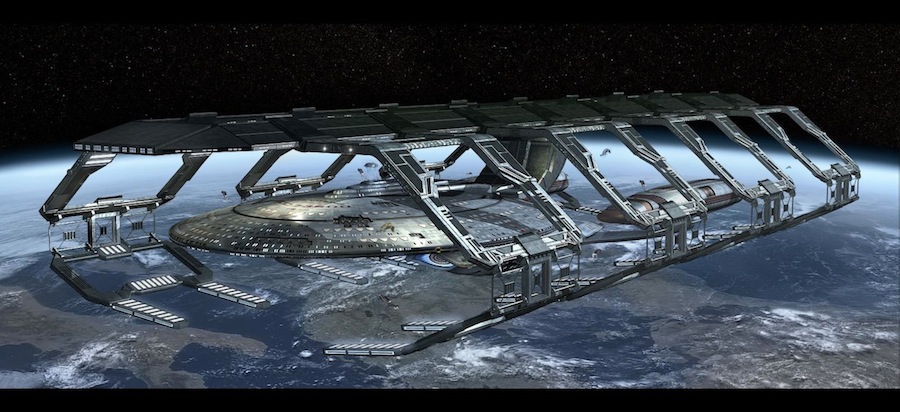 (interactive) (interactive) In the Wiki page on Relativistic Mass it says:
The classical equation for momentum is p=mv, where momentum is conserved. In relativistic mass, the energy of velocity is added to the system whereby at relativistic velocities approaching v=c speed of light, the energy and mass grow to infinity, so momentum is thus conserved at m=E/c^2. But what if velocity is not due to kinetic energy? What if velocity is approaching relativistic velocities from its internal closed system, where energy remains constant, since no new energy, whether kinetic or internal particle energy, is added to the system (internal reference frame only, Newton's apple in elevator), so momentum remains invariant, and thus conserved? Then if momentum is conserved, at increasingly high velocities, and for equal momentum, the mass would have to 'decrease' rather than increase. This, of course is in direct violation of Einstein's relativistic mass increase at relativistic speeds, but it satisfies the conditions of conserved momentum. How can such an acceleration of mass occur without increasing energy? The answer can only be if the velocity is increased within the closed system to leave energy side of E=mc^2 equation invariant. And the only way this could happen is if acceleration is from gravitational 'pull' rather than kinetic push. If kinetic push, then energy must increase and mass remains constant as rest mass except at relativistic speeds where it increases; but if pulled by gravity (not out of reference frame but inside, onboard), then energy remains constant, and to conserve momentum, mass must 'decrease'. At relativistic speeds, as velocity approaches the speed of light, mass decreases to the mass of a photon, which in essence means mass at near light speed approaches zero. This relativistic mass conundrum had never been considered because accelerative mass was never considered possible without increased kinetic energy to force it moving faster. But in the above mentioned scenario, where mass is accelerated internally through gravity, or extreme gravity forcing it faster, if momentum remains constant (conserved), then with higher velocities it must decline equivalently; at v=c, mass drops down towards zero, but not totally (See How fast we can travel in space below for why this is so). Why is this significant? This relativistic conundrum has to do with space travel at relativistic speeds if, and only if, the gravity-G of deep space is orders of magnitudes greater than measured here on Earth. Such gravity would be crushing for any spacecraft traveling there. But if mass is dropping commensurately with velocity, then at high velocities, it essentially is able to 'outrun' its relativistic mass, as at high speeds it balances out into lower mass, so the spacecraft (and its occupants) are spared the relativistic mass conundrum. Rather than being crushed by high gravity-G, the higher the velocity, the lower the internal mass; so occupants would feel no change. This of course is not from an observer's point of view (reference frame), where relativistic mass increases, but from the spacecraft's point of view, where mass feels constant. 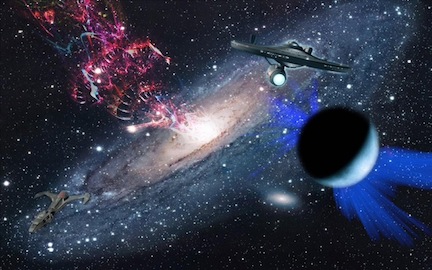 (interactive) (interactive) Of course, none of this scenario is relevant if gravity-G is constant, but it becomes paramount if gravity-G grows with distance from a hot star and is some five orders of magnitudes greater in interstellar space. Then to travel there would require very high velocities for the spacecraft to survive the journey. But such velocities cannot be achieved with kinetic energy accelerations; it can only happen if we learn to harness the great gravity-G force out there to propel our craft. At this time the promise of a Moved-G type engine is still a distant dream, but if it could be built to achieve wormhole-type velocities powered by very high G, gravitanionally at full power, this is the only way we could outrun its crushing force. It also defaults to practical constraints on this type of travel, which means we cannot stop and exit the spacecraft in deep space, any more than we can step outside a bathysphere in deep ocean. The effect would be crushing. Addendun: Note, this relativistic mass hypothesis may be falsifiable, to test for diminished 'inertial mass' in an accelerated gravity vehicle. Though not exactly as described above, where gravity acceleration is generated onboard, the same lower mass effect may be measured in any falling vehicle, such as in space reentry free fall. If aboard the reentry vehicle is a spinning disk, as Earth's gravity accelerates the vehicle (though our local G is very weak), there should be an observable effect: during reentry free fall, the disk's rate of spin should slow slightly (perhaps related to chronofield effect?). Of course, this would violate hard Equivalence Principle, as the inertial mass is lowered, while vehicle gravitationally accelerates. This could be an easy test to check if momentum stays internally constant while gravitational acceleration increases velocity, where mass is decreased, so spin is slowed; and none of it would be felt onboard. IDA See also: Rosetta's comet is spinning down approaching Sun Einstein's relativity carousel | ||||||||||||||||||||||||||||||||||||||||||||||||||||
| How fast in space? |
How fast can we travel in space? (Continuation of Relativistic Mass conundrum above.)  Starship in Close Encounters To travel in space, you must think Big. For example, per Engineering Tool Box-acceleration we can calculate: To reach v=c in deep space at v=300000000 m/s you need acceleration a=500000 m/s^2 for time t=600s (10 min) which is gravity G equivalent a=50968g (about average G in deep space) and if a same acceleration time is t=1200s (20 min) your velocity is v=600000000 m/s The operable equation here is Average Velocity using gravity g, no matter what the G:  This acceleration is continuous, so to reach Alpha Centauri, for example, at distance 4.366 light years, let's say in one year, you need to achieve average velocity for distance: va=d/t Distance d=(distance of c in 1 yr) 9.46e+15 m * 4.366 ly= 41.3e+15 m, distance to Alpha Centauri, for an average velocity for one year (1 yr =31.54e+6s) of v=41.3e+15m/ 31.54e+6s= average v, which is v=1.31e+9 m/s (of course, that's 4.366 times speed of light, you break 'light barrier' three times! - Warp 4 Mr. Spock) a velocity achievable at 50968g acceleration within about 43 mins. What happens at those velocities? Does the vehicle at v=c become ‘pure energy’ from our reference frame, but exists as itself within its own frame? Is the spacecraft 'pure energy', so like neutrinos can go through solid mass? Or in a Star Trek fashion jump into some hyperspace dimension where ordinary matter becomes invisible to us? … Probably not, but don't know, will have to get there first. This velocity would be reached through continuous deep space higher G acceleration (assuming G grows at about 1G per AU) until G peaks about half way (in coldest part of interstellar space), then starts to regress as approaching target, where G declines approaching hot star, and where the G powered spacecraft begins to slow until it reaches humanly tolerable G levels, of about ~<5 G, where it can cruise at leisure. (Note: If this space gravity-G acceleration is calibrated to be just a fraction below full power of background G, and the spaceship is traveling in perpendicular orientation to its direction, the occupants on deck would experience a gravity g same as if on Earth, so to ease the hardship of the long journey; that's how onboard gravity 'pull' power works, where remainder inertial mass gives negative acceleration on cabin floor, and how 'they' do it.) Of course, if this acceleration works exponentially, the distance to Alpha Centauri would probably take less than a year to get there. Now, that's space travel! Say goodbye to 19th century physics, hello to 21st century. Think Big, if we are to break through the Einstein ceiling. Also see: GRAVITY SUPERHIGHWAYS | ||||||||||||||||||||||||||||||||||||||||||||||||||||
| Simple space gravity equations |
Some simple (deep) space gravity equations: (this is a continuation of How fast can we travel in space post above) If the operative gravity g equation is: va=(sqr root 2gd)/2, as per above, then it stands to reason these follow naturally, simple algebra: 2va=(sqr root 2gd), which by squaring gives us: (2va)2=2gd, which is also: d=(2va)2/2g, or g=(2va)2/2d. Now, if we assume gravity acts equally on all mass, so it is the same on a pebble as it is on a starship (why astronauts can walk in space at the ISS), the let us assume that if d=gt2 and g(m)=ma, and if m=1, then g=a when gravity acceleration is internally driven, no matter how high the G. Therefore, ag=(2va)2/2d, and conversely d=(2va)2/2ag, if, and only if, m=1 (same as in Axiomatic Equation). Remains to be seen whether these will prove useful when we learn to travel space using gravity-G engines, which could propel our ships at multiple superluminal velocities. However, this then causes another challenge: can we find real time, entanglement-type, collapsed wavelength communications* to talk to our ships? For now, this is all a fine fiction, but maybe someday…. *(See also: X-Rays: Next-Gen Way to Travel and Talk in Space?) | ||||||||||||||||||||||||||||||||||||||||||||||||||||
| Gravitational Fly-by Anomalies |
Why are Gravitational Fly-by Anomalies anomalous? 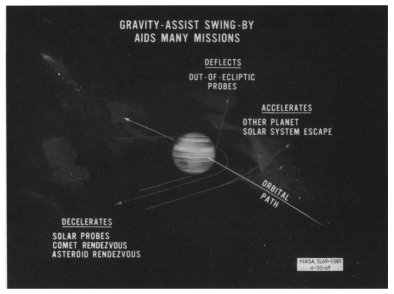 Gravity-assist swing-by (click image for more info) Thinking outside the box, there may be two things at work here that account for the fly-by anomalies: 1. Possibly inertial mass transfer from the planet's spin, its mass angular momentum transferred to the fly-by probe; or 2. the variable-G factor, where the inertial mass of the probe is slightly higher out in space (away from Earth's hot energy) than it is on Earth, so the G equivalent (distant from Earth, but still in its orbit) is G=~7.24e-11 N(m/kg)2 (in space) vs. 6.67e-11 N(m/kg)2 (measured on Earth's surface, value of G we use in all our computations), or what some have called a 'dark matter halo'; 3. or it could be a combination of both 1 & 2. Regrettably at this time, though the fly-by anomaly effect had been measured, there is still no known math to explain this phenomenon, except for a proposed equation by J.D. Anderson et al:  where we is the angular frequency. etc. (see original page - click on equation) This fly-by anomaly is something worthy of further study, especially as it may apply to larger gas planets of the outer solar system, where such effect should be more pronounced. Also see: Mercury's precession as a function of Sun's angular momentum transfer. | ||||||||||||||||||||||||||||||||||||||||||||||||||||
| Why UFO magnetic plasma glow |
Why Alien spacecraft radiate electromagnetic energy and have plasma glow. 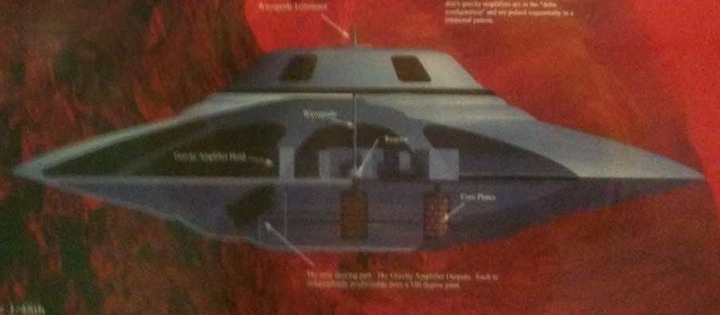 Alien spacecraft (all images are interactive) It had been reported on Alien craft sightings that they radiate a strong electromagnetic field, often disabling our electrical equipment or digital cameras, and they appear to glow with ionized energy. (See MUFON reports.) Upon reflection of their Alien propulsion system (as theorized on Humancafe), the physics driving their propulsion system may actually generate the reported electro-ion effects. If the inertial drive is due to transfer of acceleration (per US Patent 20130186711 A1) from spin to axis direction, then several factors are involved that generate conditions observed. First, the electrical impulses accelerating spin in an electric fluid, what is the MOVED-G inertial drive's basic system, then the spinning electric fluid will generate its own magnetic field, as its own dynamo effect; so the more pulses per second, the greater the effective magnetic field. This effect may be amplified further, so it can be a powerful byproduct of the craft's power system. (See Bob Lazar's UFO.) 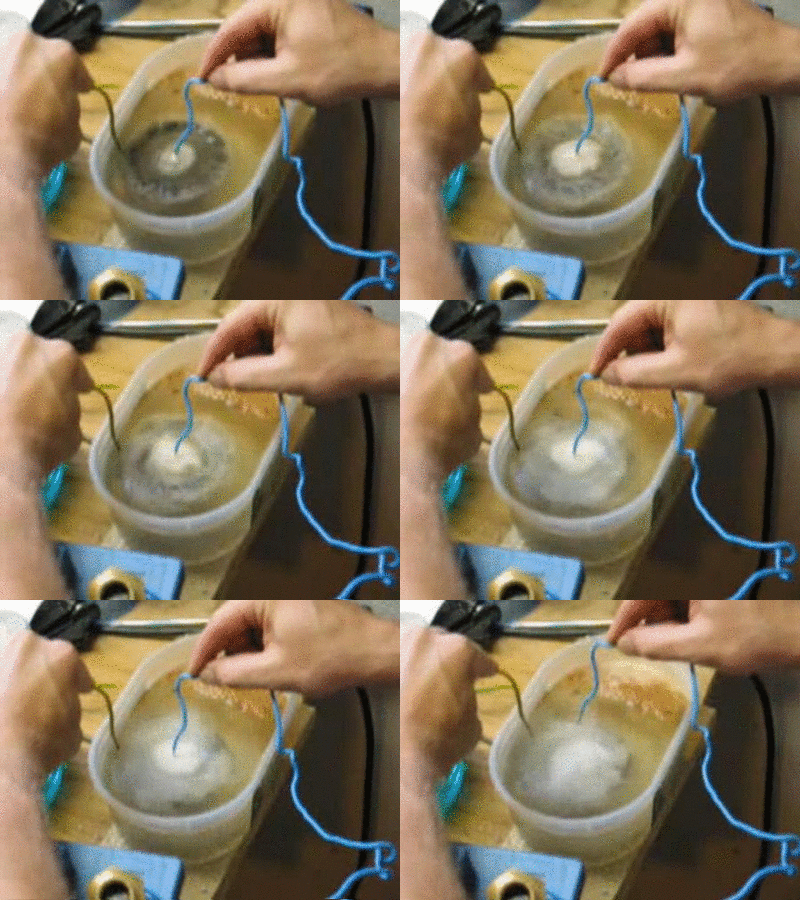 Electric fluid spin 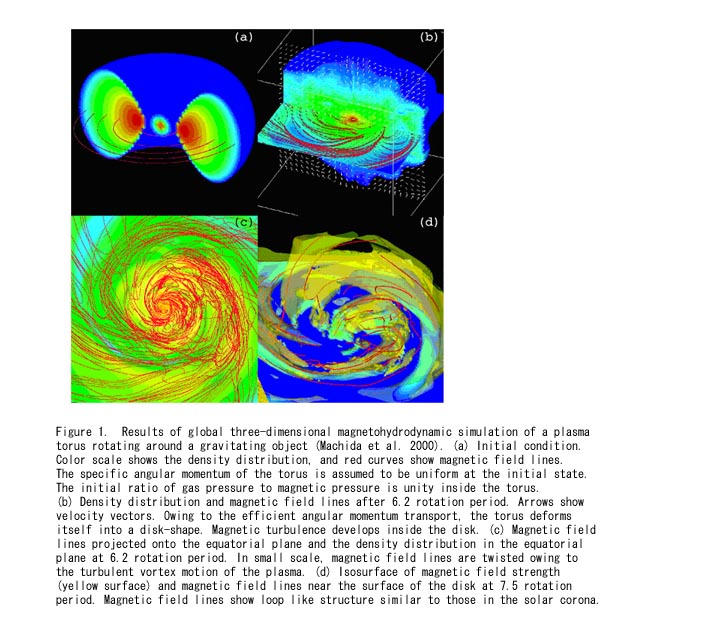 Self gravitating plasma spin Second, if taken to the next level, where the electric pulses driving accelerated spin are thousands of pulses per second, such as could be achieved in self-gravitating plasma spin, then the electromagnetic effect would be amplified into a force high enough to ionize the air molecules around the craft, so it would glow as reported. The more the power, the brighter the plasma glow, and the greater the electromagnetic effect. This might explain why at low power, when the Alien craft is hovering, for example, there is little glow; but when it accelerates, the glow is intensified.  Glowing plasma of Alien craft In the end, this form of Alien craft propulsion simulates what happens naturally in a galactic black hole, where the self gravitating energy surrounding its extreme gravity generates strong spin and electromagnetic energy emanating from the axial jets. Or to put it another way, the Aliens powering their spacecraft have found the secret to harnessing the self-gravitating power of the galactic black hole. This is a truly 'gravity on board' effect, if so. It also explains why their craft had been observed to radiate strong magnetic energy and light. IDA Also see: G-force Inertial Drive revisited Is Gravity at the femtometer wavelength? More UFO pictures - HumanCafe | ||||||||||||||||||||||||||||||||||||||||||||||||||||
| Welterweight Pluto takes on Heavyweight Einstein |
Welterweight Pluto takes on Heavyweight Einstein (short story) 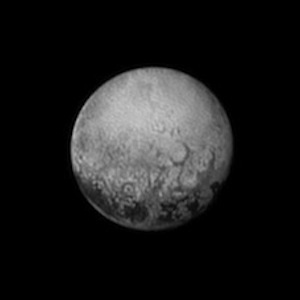  (interactive) (interactive) The fight of the century It was the Big Event, the fight of the century. The odds were heavily stacked against the welterweight, but the anticipating crowd was raucous, jubilant, anticipating a quick win. Millions were bet, back and forth as the fight dragged on past the sixth round. It was all muscle and sweat, the air thick. The heavyweight was too much of a gentleman to take down his lighter opponent in one blow, though few doubted he could. Rather he played with him, giving the jubilant crowd a go for their money. They were grappling. The bell rang, ready for the next round. Then Einstein went down with a heavy blow, unsuspecting that the welterweight had it in him. He hit the mat hard, but was relatively quickly back on his feet. No one expected the surprise that lightweight Pluto, with such low density, could deliver a heavy wallop. But there it was, and he did it again, the heavyweight once more lying on his back. He raised his head, a puzzled look on his face. All thought he had it, how could they all be wrong? How could this be? Now in the ninth round, his face was swollen, the heavyweight lay there listless. Pluto danced around, careful to avoid the heavyweight's legs to not get caught in his famous relativity grip. But he knew what he was made of, his veins running through with water ice, pumping hard in the surprisingly high gravity of his welterweight mass. His muscles bulged and rippled like mountains floating on ice. Nothing suggested such mass until it was measured in an impressive array of instruments during a New Horizons encounter, just a flyby! The heavyweight gets up, he's up on the ropes. His trainer, Prince Ton, is trying to help him up. But then he's down again... So there it was. In a flash genius moment, the Greatest was down for the count. The crowd grew quiet. Nine, eight, seven... And the winner held up both arms in dancing jubilation as the crowds roared! Cameras were rolling, typewriters clattering away. This was a game changing fight, some said a Paradigm shifting fight. Pluto took down the greatest. The heavyweight lay still, but the fight was not out of him yet. He'll be back, calling for a rematch, too many fortunes at his back. Tonight he wasn't showing his stuff. Some started mumbling that he took a fall for the mob. We'll see if this was a clear win. But if it was, history was made today. And all who bet on the heavyweight will have to go back to their bookies, and pay. Or as they say, "back to the drawing board". Relatively speaking, you don't give up a good fight. 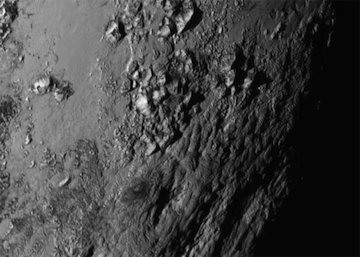 Ice mountains on Pluto IDA This just in: More Pluto pictures set for release -BBC Pluto's rings, higher gravity-G for this tiny planet suspected? 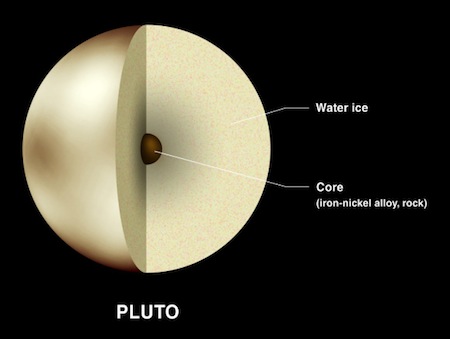 What is Pluto made of? There may be less rock and iron than they think, if Gravity constant is higher, at about 30G. They'll be calling for a rematch! Pluto flyby video - Space.com (14 July 2015) Watch this space... | ||||||||||||||||||||||||||||||||||||||||||||||||||||
| Pluto's Atmosphere Anomaly |
Pluto's Atmosphere Density Anomaly 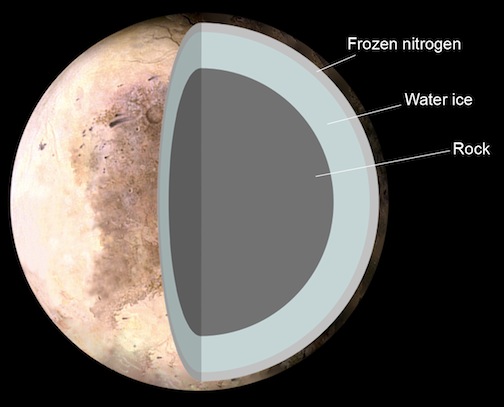 Pluto's composition The recent New Horizon flyby to Pluto has lifted the veil of mystery from this tiny dwarf planet of our outer solar system. What had to now been a blurry image of our 'ninth' planet as seen by the Hubble telescope was revealed to be a reddish complex world with mountains and plains, possible cryogenic volcanoes, and a surprisingly large atmosphere for a small planetary body of about 18% mass of our Moon. The atmosphere is composed largely of nitrogen with traces of methane and carbon monoxide, which appears to have its own weather patterns of precipitation, most likely methane-hydrocarbon snow flakes. By contrast our Moon, a rocky body, had virtually no atmosphere, whereas Pluto has one surprisingly tall. This atmospheric disparity could be attributed to Pluto being an ice body, which is more dynamic than the rocky composition of our Moon. As solar energy hits the nitrogen and water ice on Pluto, it may sublimate into its tenuous atmosphere, a large part of which is blown off into space by solar wind, so there should be continuous renewal during the Pluto year (~246 Earth years) as the mini planet swings from about 30 AU to 50 AU in its orbit around the Sun. It is currently believed Pluto's atmosphere sublimates while closest to the Sun at its perihelion, but condenses back down to ice further away, so at its aphelion it should be compressed back down to its frigid surface. At this time there may be some question as to how this happens, or if in fact it does happen; prior measurements showed about 1.5 micro bars atmospheric pressure close in, but about 3 micro bars further out. Perhaps this could be expected, as density would increase with lower temperature, or perhaps it may suggest an alternate explanation. 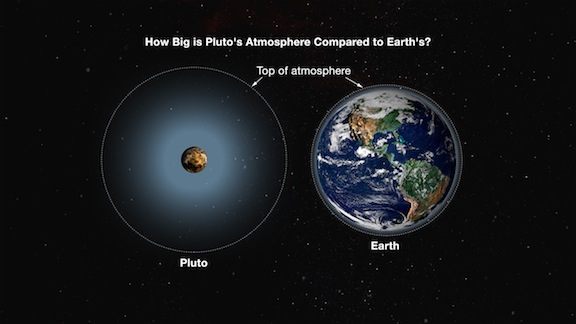 Pluto's atmosphere vs Earth's In fact, prior observations show an anomaly to Pluto's atmospheric dynamics in that rather than compressing further out when temperatures drop, its atmosphere actually increases. This was a surprising discovery, one which requires further study. But it may also be one that demands an alternative explanation to current theory, as current hypothesis that the atmospheric dynamics are linked to Pluto's polar regions warming and cooling seem ad hoc and may not hold up over longer observations. In fact, the reason for Pluto's atmosphere expanding further from the Sun may be surprisingly simple. It can be a given that Pluto's largely nitrogen is in thermodynamic equilibrium with its surface nitrogen ice, so there should be fluctuations due to temperature change. Nitrogen ice should sublimate closer in, but re-condense further out. However, if the opposite occurs, where the atmosphere grows rather than shrink further from the Sun (nitrogen ice sublimating near pherihion but recondensing aproaching aphelion, scouring new nitrogen from (50 G) space) another dynamic may be at play. If so, the expected atmospheric dynamics would be reversed. All this may still be speculative, but the nitrogen atmosphere sublimation may be from cause other than mere temperature change. It may be more a possibility if gravity dynamics for Pluto's highly eccentric orbit be considered, so ice sublimation may be more a function of gravity 'constant' G fluctuations than heat. (This would make it more akin to why comets gas out in their eccentric orbits, where they condense further out in their orbits, but decompress closer in.) At about 32 AU (~32G), where Pluto is now, if factoring a variable-G, the internal composition pressures would be released, or gassed out; while further out at 40-50 AU (40-50G) they would be compacted. In fact, both could be curve fitted to approximate each other, both temperature and variable-G scenarios, except where one would predict smaller atmospheric parameters further out, the other would predict larger atmosphere. This latter would be a function of higher gravity-G at higher AU for Pluto's orbit, so the atmospheric divergence should become apparent with distance from our Sun. This gravity phenomenon, as yet unknown, could be easily measured over time in how Pluto's moons respond to variable gravity in its eccentric orbit (gravitationally more dynamic further out), something that can be measured. Of course, there could be other factors, such as cryogenic volcanic activity variable. But if Pluto's atmosphere shows greater density and is taller farther out, rather than compacted down as now predicted, this could be a significant discovery. And if so, it may be one more indication that gravity-G 'constant' is not universal as now believed; rather it is variable as predicted by this forum's Axiomatic Equation, as we count down to universal gravity Strangeness. IDA Also see: Pluto Density Anomaly Lifting the Veil on Pluto's Atmosphere - Space.com Pluto by-pass video - YouTube This just in: Methane ice dunes found on Pluto Nasa's New Horizons: Excitement ahead of Ultima Thule flyby - BBC Science | ||||||||||||||||||||||||||||||||||||||||||||||||||||
| Why outer planets gaseous |
Why outer planets are gaseous, and inner planets rocky. 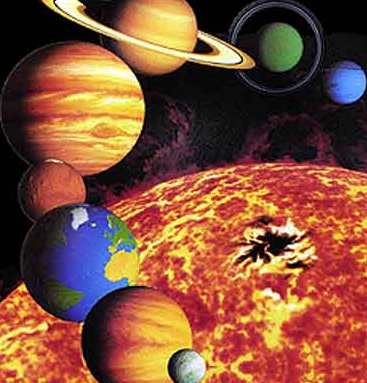 New images of Pluto show a hazy atmosphere with likely weather made of frozen nitrogen and other soft ices, probably frozen gasses. This is surprising, as our own Moon, larger than Pluto, exhibits virtually no atmosphere. The other outer planets, Neptune, Uranus, Saturn, Jupiter, at beyond 5 AU are all gas giants; while the inner planets, Mars, Earth (Hera), Venus, Mercury, all within a 3 AU radius from the Sun are rocky. The asteroid belt between Mars and Jupiter are also of rocky composition, mixed in with water ice. Why such gradated distribution? If we consider that heavier elements sink towards a gravity center, such as happens in Earth's interior where heavier metals sink towards the planet's center, it could be analogous to heavier elements, from the primordial cloud that eventually coalesced into planets, likewise gradated into layers of heavier near the Sun, while lighter farther out. If so, then it would be no mystery that Mercury's density is largely rock and metal, while Pluto's light density is largely frozen nitrogen and water ices. Now, if we factor in a variable-G scenario, then the composition gradation makes sense. The heavier elements near the Sun at less than 5 AU exist in a low gravity G region, so heavier elements bind more easily while lighter elements remain more volatile, so the planetary bodies are rocky; but beyond 5 AU, there lighter elements bind easily because of 5 G and greater gravity G, so the outer planets become gas giants, as lighter elements in higher G act more like heavier elements, per Equivalence; why lighter matter appears denser in higher G regions, that it has greater mass per weight and appears ‘heavier’. Subsequently, heavier elements are more scarce farther out is that they had already sunk towards the Sun in early planet formation, why they are rocky; while the lighter elements condensed into planets farther out, why they are gaseous. (Jupiter may have a larger rocky core, being on the rocky-gaseous cusp, and thus attract a larger gaseous atmosphere.) But this scenario can only play out over the billions of years of planets coalescing if, and only if, the gravity-G is gradated as predicted by the Axiomatic Equation. The enigma in this scenario is again Pluto. It has a surprisingly high atmosphere, but not enough to be a gas giant. There, whether from its small size or extremely cold temperatures, at about 30-49 AU, Pluto appears to be a frozen body. But it could have been a frozen ice body as a small gas giant, given its 30-49 G orbital region, but it coalesced into a soft ice planet instead. Still, the overall thesis fits, that inner planets are heavier, rocky worlds, while outer solar system is largely gaseous. The size and composition of the planets is then a function of the material available within the primordial solar disk, their densities per the variable-G scenario. If so, then it all fits. IDA See also: Protoplanetary disk regularity Titan’s atmosphere 10X taller than Earth’s 'Perfect solar system' found in search for alien life -BBC WASP-193b - super light exoplanet found around F9 type dwarf star.
| ||||||||||||||||||||||||||||||||||||||||||||||||||||
| First indications for variable-G |
First indications for a variable-G, in highly eccentric comets and orbits. The first clue gravity-G may not be a constant (as now believed in physics), but rather variable on a curve (lower G closer into the Sun, greater farther out) may be evident in how comets are gassing out approaching perihelion, and how they are layered like an onion. With each orbital cycle, on cometary bodies with highly eccentric paths, material accretes while far from our star (higher G), but releases it closer in, so they develop a layered composition. Heavier molecules of matter are retained on closer approach, while lighter molecules (water and gasses) are sublimated in lower G nearer the Sun, hence their cometary coma visible. This coma sublimation is already evident at Saturn's cold region. The result is a density 'heavier' comet surviving perihelion, to resume the accumulation cycle as it swings farther out. The second indicator may be the cryogenic volcanism on very distant bodies, like Pluto and Charon, where their very cold environment is active from below and thus changing the composition of the surface. Same as sink holes found on comets, both worlds should show the same phenomenon. The 'layering' effect on Pluto may be responsible for the alligator like surfaces found on its geological smooth plains. It is unlikely such surfacing and layering could be from temperature changes due to solar heating alone, given the extreme cold at Pluto; it better fits they are resultant from the accretion and sublimation cycle, due to gravity compression and decompression over millions of years, because of variable-G effect on their eccentric orbits. To better understand this variable-G strangeness phenomenon, one which also differentiates gaseous planets from rocky planets, it would be opportune to better understand internal density of planetary and comet bodies; why lighter matter appears denser in denser G regions, that it has more mass per ‘weight’, to see how they vary at different points of their eccentric orbits. This would be another clue to how variable gravity measures with distance from the Sun. Of course, the obvious test necessary is to test Newton's G at orbits both closer and farther from our hot star, or any star. For example, is the rocky-gaseous planets distribution same for exoplanets as here? Do 'cold' stars (with much greater G) have large 'Jupiters' closer in than our system? How do we test variable-G in space with calibrated inertial spin momentum? These are all questions that will lend clarity to how future space travel will be affected, if we humans hope to launch our probes, and ourselves, beyond the constraints of a (relatively) low gravity-G on the edge of our solar system. We must test it there first, and if found variable, the G encountered in deep space may be orders of magnitudes greater than experienced here, maybe thousands of times stronger. If so, we may have to rewrite gravity in ambient space, and all cosmology with it, from the ground up. IDA V Also see: Welterweight Pluto takes on heavyweight Einstein | ||||||||||||||||||||||||||||||||||||||||||||||||||||
| Gravity waves 'falsifiable'? |
Are General Relativity's gravity waves 'falsifiable'? 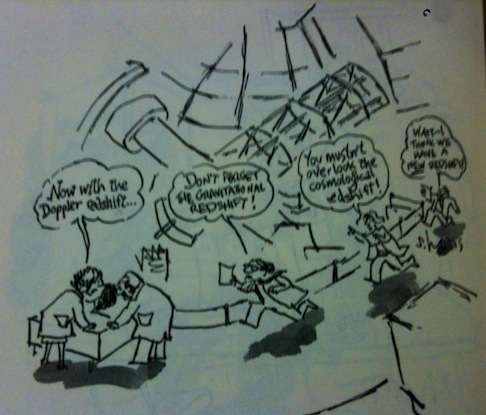 Competing theories of cosmology It can be argued that a hypothesis is not falsifiable, only data observed is falsifiable. Now that gravity waves had been observed by LIGO, the former null results have moved the hypothesis from improbable to probable. But it is not yet proof gravity waves, as hypothesized by Einstein, are in fact real. (For example, if gravity can bend light, why not powerful bursts of e.m. energy leave a gravitational wake in its path?) There is still room for alternative theories of what LIGO had actually found. For this discovery to be 'falsifiable', hence real, there must be a confirming validation from other observable data. Though they immediatey looked as soon as signal found by scanning the skies in approximate location of expected merging black holes (as calculated per General Relativity), to date they have found no such visible evidence. Either at the light spectrum, or other electromagnetic spectrums, from X-ray to infrared, nothing has shown up (though a false GRB was reported), which fails the 'falsifiability' test. For example, if gravity travels faster than light, or in Newtonian sense is an instantaneous force, then the light reaching us from the merger is yet to arrive; or it may arrive 1.3 billion years hence! We hope by then Gravity will be better understood. And though per Einstein's-science-theology (it all reverts back to his revered Relativity cosmology) gravitational waves have been found, in real terms the LIGO signal alluding such waves remains a cleverly designed mathematical inference; but to date, it remains a grand illusion, its purported gravity waves unfalsified, and thus 'inconclusive', fabulous media claims aside. IDA This just in: First ever Black Hole imaged Strange Noise in Gravitational-Wave Data Sparks Debate - Quantamagazine.org (June 2017) (It may be ‘noise’, not what it seems) Was It All Just Noise? Independent Analysis Casts Doubt On LIGO's Detections - Forbes (June 2017) GW170817 LIGO neuron stars collision verified in visible light Fourth gravitational wave is detected, with European help - Phys.org (September 2017) ('Gravity waves' confirmed, or inertia waves detected (momentum transfer)*, now confirmed with e.m. energy validation: Neutron star smashup seen for first time, 'transforms' understanding of Universe - Phys.org (October 2017) *(It may also be a case of observational simultaneity, where the two coincident events, gravity detection being one phenomenon, while e.m. energy detection the other event in same sector, but both are not necessarily the same event.) GW190814: Gravitational Waves from the Coalescence of a 23 Mo Black Hole with a 2.6 Mo Compact Object (June 2020) - No electromagnetic counterpart confirmed to date? IceCube Search for Neutrinos Coincident with Gravitational Wave Events from LIGO/Virgo Run O3 (February 2023) - No neutrinos energy coincident with gravity waves detected? Also see: Space Gravity at 3.97e-7 G LIGO/Virgo Binary-Black-Hole Orrery Van Flandern - speed of gravity The further we look, the more we see - red Some Big Bang, modern Cosmology peculiarities | ||||||||||||||||||||||||||||||||||||||||||||||||||||
| Planck's constant strangeness |
Planck's Constant (6.626e-34 J-s) may be changeable, and perhaps strangely dark. 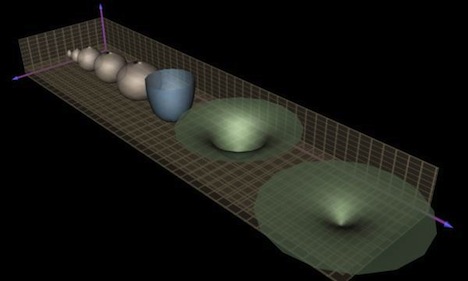 Planck's constant may be changeable? There seems to be some odd interrelationships for Planck's constant. At 397 nanometers, at about the ultraviolet lambda (0.7557e+15 Hz), a photon quanta of light can dislodge an electron from metallic potassium, what is called the photoelectric effect. At red lambda of light, this photoelectric effect stops. The Planck constant figures in this photoelectric effect as E=hv (Planck's constant times photon energy frequency), as per Planck-Einstein equation (a physical constant that is the quantum of action, central in quantum mechanics), same as formulated by Prince Louis de Broglie; the unit of energy in Planck constant is 'energy multiplied by time', also called a 'quantum of action', expressed as J-s. This equation can be expressed as E=hc/lambda (since frequency is also expressed as f=c/lambda where lambda is equal to, per de Broglie, lambda=h/p). Note how this is similar to the Axiomatic equation, a modified Planck-Einstein equation, where Energy is E=hc/(lambda*proton mass). Is this Planck constant strange, or significant? Its origin lies in Black-body radiation investigated by Max Planck in late nineteenth century, where in a black-body equilibrium temperature of light absorbed equals the spectrum of light emitted, e.g., Planck's law. But at 397 nanometers (3.97e-7 m) lambda and frequency, the 'quantum action' changes, as per photoelectric effect. This in itself is not strange, except this is also the 'gravity equivalence' value, where deep-space gravity 3.97e-7 G is isotropic. This is further supported by the strange coincidence where one can calculate a 'proton mass' value from Planck's constant, if divided by the deep space gravity value, Planck's h/deep space G=Proton m value: 6.626e-34 m^2 kg s^-1 / 3.97e-7 m^3 kg^-1 s^-2 = 1.67e-27 kg (kg per meter seconds) The SI units may be strange, though these can be broken out, for example, so Proton mass kg is expressed as a 'unity per meters in time'. But if Planck's constant is a proton mass function couched within a universal space G constant, then if the proton mass is different, so would the h become different, per this relationship, as the only constant then is the universal space G. For example, if we take the proton equivalence on Mars, which is at about 1.5 G, which is (Earth measure) proton m=3.86e-27 kg, then if we figure Planck's constant for Mars, we get: 3.86e-27 kg * 3.97e-7 G = 15.32e-34 G kg (as opposed to Earth's 6.626e-34 G kg; i.e, approximately Earth's Planck's constant times 1.5 squared), so it is slightly higher than on Earth.* Now if we look at deep space proton mass, which works out to be approximately 3.65e-18 kg, we can arrive at deep space Planck's constant: 3.65e-18 kg * 3.97e-7 m^3 kg^-1 s^-2= ~14.5e-25 m^2 kg s^-1 (per kg meter per second) which is orders of magnitudes higher than on Earth. What these exercises show, if they are reality, is that Planck's constant is contingent on what is the energy flux E from a nearby hot star generated in the region of space where it is being measured (per Axiomatic equation), in proportion to what both Energy and proton mass are locally. Of course, we know empirically what h is on Earth, but we had not measured or observed it elsewhere, at this time. However, the value for Planck's constant when figured outside Earth's value yields (per Axiomatic equation) a proton mass value in 'local' kilograms, so they would be different from same figured with Earth's Planck value. So if we take deep space value of Planck's, the local values for proton mass would be in local kilograms. For example, if Energy in deep space is (per Boltzmann CMB), approximately E=0.413e8 J, and Planck's deep space local is 14.5e-25 m^2 kg s^-1, we can calculate 'local' proton mass with: E=hc/(lambda*proton_m) Axiomatic equation ~0.413e8J=14.5e-25 m^2 kg s^-1 * 3e8 m s^-1/ (1.32e-15 m *local proton_m) ~0.413e8 kg m^2 s^-2* 1.32e-15 m/ 43.5e-17 m^3 kg s^-2= proton m local, which equals 0.545e-7/ 4.35e-16 = local proton mass =~0.125e9 kg/kg (approximately) Or 'local kg' deep space proton_m= ~1.25e8 kg/kg This deep space local proton mass is incredibly high, nearly value of unmodified proton micro-center gravity at Strong force, which is tremendously greater than Earth's 1.67e^-27 kg, and orders of magnitudes greater than proton_m figured with Earth based proton mass for deep space (which was =3.65e^-18 kg, as per Boltzmann's constant). At proton_m for deep space =1.25e8 kg/kg, we have a value that approaches local light speed c; think extreme gravitational redshift equivalence; so in effect, if we divide light by deep space kg, it is absorbed, or canceled out by local proton mass. There light does not shine, and does not interact photoelectrically with matter, though it is still acted upon by gravity at deep space G. Therefore, per this outside the box leap of logic, we can relate Planck's and deep space protons back to deep space gravity-G, if at ds_G=3.97e-7, we get light 'disappearing' into the darkness of space, though it is active gravitationally. In effect, at this orders of magnitudes higher G, protons, all atoms, drop out from view, they becomes 'invisible' to us, as was posited by Why Dark Matter appears non-baryonic. If so, this may be one more indicator that 'dark matter' is nothing other than ordinary matter at very high deep space G acting non-baryonic, while gravitationally redshifting cosmic light at the Hubble constant. Therefore, if so, matter in deep space, dust and gas, is of necessity 'dark' and it interacts gravitationally only. In the end, Planck's constant could be a variable, which translates into orders of magnitudes higher values for deep space where Energy is very low (at CMB), and gravity-G very high. And this is significant, as it may be one more step towards a Grand Unified Theory. *Please note: If testing such variable Mars Planck's constant by using the Axiomatic equation yields a Mars proton mass that is higher by about 1.5 squared, as shown below, it may be a validation empirically of a variable Planck's 'constant' yet to be discovered. IDA Also see: Shortcut to Proton mass Proton as a micro-Planck scale 'black hole'? | ||||||||||||||||||||||||||||||||||||||||||||||||||||
| ESA LISA Pathfinder |
LISA Pathfinder satellite to test gravity in orbit. 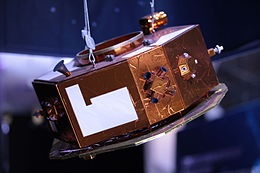
It will be interesting what their 6 month mission found. Can Lagrangian points be used to test for variable-G? | ||||||||||||||||||||||||||||||||||||||||||||||||||||
| Summing variable gravity-G |
Summing up variable-G gravity hypothesis. Here is what we can surmise to date, what could be paradigm shifting in how we understand gravity, that Newton's G may be a variable-gravity value. The ultimate test will be to measure Newton's G at different distances in our solar system: where it should read lower G closer into the sun, and higher G at Mars and beyond at the gas giants planets (to >30G at Pluto), with commensurate variable body densities. These are the theoretical findings to date: 1) The first hint gravity, Newton's G=6.67e-11 m^3 kg^-1 s^2, may not be a 'universal constant' was discovered when developing the Axiomatic Equation (2003), which postulated that for variable Energy flux levels, as measured with distance from a hot star, it yields inversely proportional gravity-G at orbital 'constant' levels. This is where we are now, that coincident corollary calculations seem to support a deep space 'universal' gravity-G at ~3.97e-7 m^3 kg^-1 s^-2 as the operative value, with implications for merging gravity into the other known forces. What remains is a dedicated test for gravity measurements beyond Earth's orbit to see how the hypothetical gravity-G curve fits with distance from the Sun. And if so, then cosmology as now understood (no Big Bang), including Einstein's General Relativity, the mass of the universe, etc... all will need revisions. This is the present 'state of gravity G message' per the variable-G hypothesis. RE (1/AU)^1/2 IDA Rome Also see: Gravity -the perfect illusion First indications for a variable-G, in highly eccentric comets Spherically symmetric ADM gravity with variable G and Λc By Giampiero Esposito et al. (2018)
More gravity anomalies: http://www.whillyard.com/science-pages/anomalies.html Deep space experiment could measure the gravitational constant with nearly 1,000 times improvement in accuracy (2016) -This test should be performed in the future at varying distances from our Sun to test for variable Big G. Elusive Planet Nine could be an alternative form of gravity masquerading as a planet, study claims - Live Science (16 October 2023)
| ||||||||||||||||||||||||||||||||||||||||||||||||||||
| TRAPPIST-1 System understood? |
Do we understand TRAPPIST-1 System? TRAPPIST-1 Ultra cool brown dwarf - Wiki 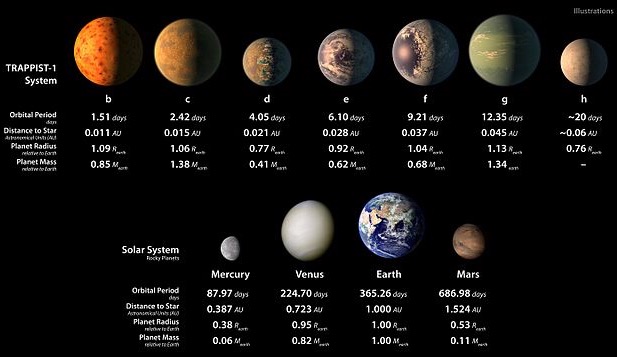 (Space.com article) (Space.com article) In the Notes of above Wiki link, it states the gravity estimates for this brown dwarf were figured per: This would be expected, that we apply Newton's universal gravity constant G to calculate mass and sizes of discovered planetary system based on their distances from their sun and orbital velocities. However, TRAPPIST-1 is no ordinary star. First it is an ultra-cool brown dwarf, so its energy output is very low. Second, its planets orbit exceptionally close to their sun, completing orbits in days rather than years; they are entirely within the orbital distance of Mercury in our solar system; so their orbital velocities are very great. Third, they may exhibit orbital resonance, and possibly tidal locks, the kind we have with our moon, or Charon has with Pluto. So where does that put this cool brown dwarf relative to our known solar system? Most likely, the Trappist system is a very high gravity-G, per the Axiomatic Equation, so its orbital characteristics are closer to what we see on Pluto (about 40G per equivalence), so we have planets very close in, orbiting at very high velocities, something like Pluto's Charon analogy. (Charon orbits in about 6.4 days, though their barycenter is 'off world' for both.) Therefore, all the calculations regarding this planetary system may need to be recomputed at higher Newton's G equivalence, including the total energy output of the brown dwarf (at about 2550 K, it is closer to Earth's interior heat than hot stars, which per Axiomatic would mean higher G equivalence for this cool system), which would in turn affect planetary densities: per higher G, they would appear more dense than actually are. Planetary mass, calculated with a consistent G, would probably come in close to estimated, since "mass is mass" no matter by what G calculated. But orbital velocities, assuming readings are correct, should mimic what we see at higher G region, per equivalence, such as Pluto Charon system, where orbits are only days. The rest, as to whether planets are rocky, can sustain water, and perhaps harbor life within the habitable zone, these are all conjectures at this point. At nearly 40 light years distance, and measuring mostly in infrared, it will be difficult to fix with any real certainty of what planet system characteristics are observed. However, this is potentially an exciting find for other reasons than prospective life. It may be a key to better understanding variable-G. IDA | ||||||||||||||||||||||||||||||||||||||||||||||||||||
| Jupiter Juno mission update |
Jupiter Juno mission 2017. 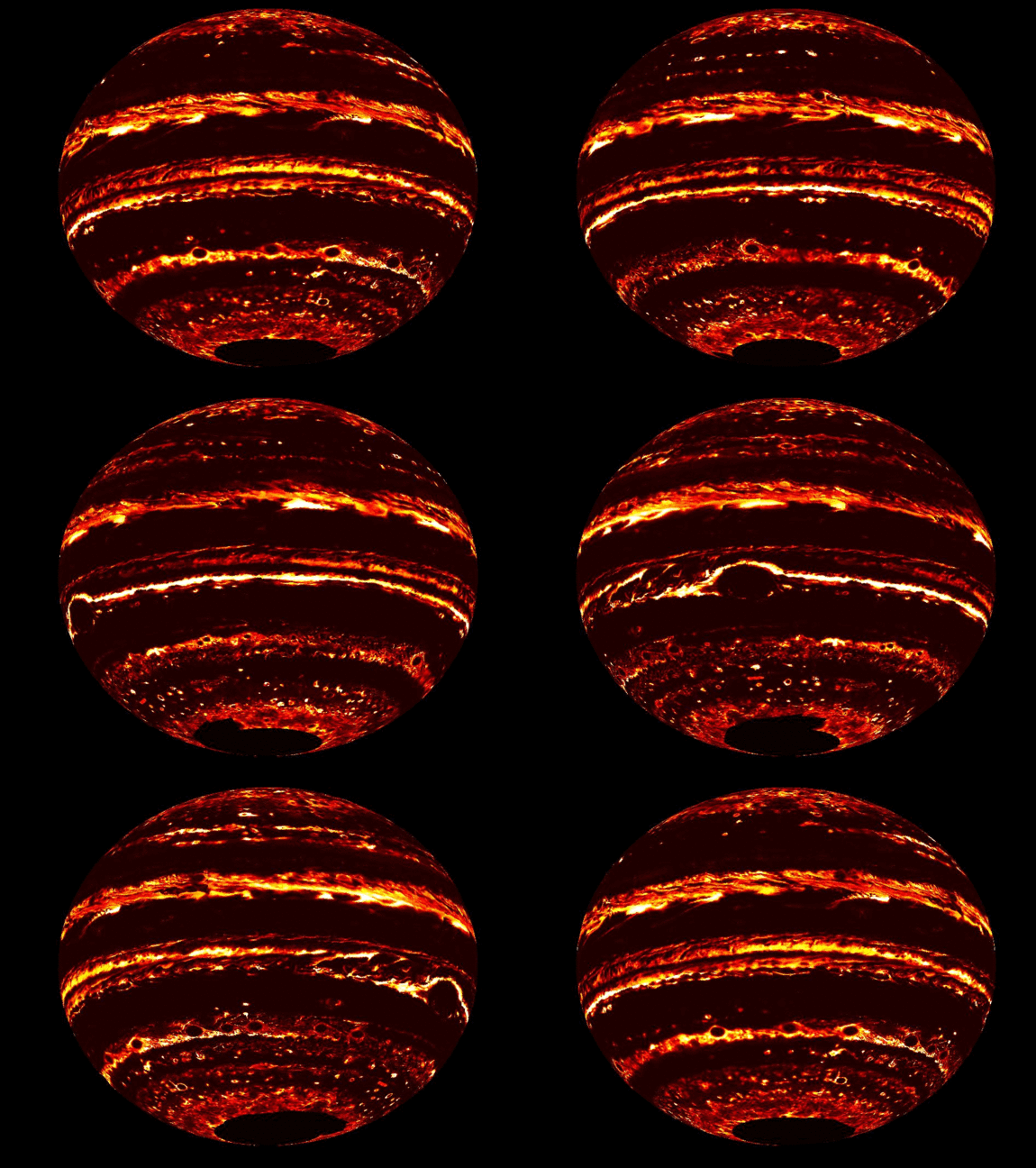 Juno Mission - Space.com (click image)
Juno peers below Jupiter's clouds - BBC Science
The mystery of Jupiter deepens. What of the core? What gravity anomalies? Still watching... Also see: THE JUNO MISSION GRAVITY SCIENCE EXPERIMENT: A SEMI-ANALYTIC THEORY | ||||||||||||||||||||||||||||||||||||||||||||||||||||
| Gravity anomalies at Jupiter |
Gravity anomalies at Jupiter, per Juno mission. 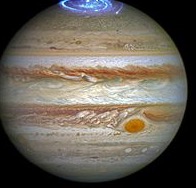 Juno at Jupiter In their paper "A possible flyby anomaly for Juno at Jupiter" by L. Acedo et al (November 27, 2017), the authors state their intentions:
In their calculations, they discovered this flyby anomaly:
Then finally the authors conclude:
So something is different on Jupiter's flyby anomaly than Earth's. It could be an early hint of gravity-G being greater at Jupiter than on Earth, meaning per Equivalence, greater inertia per greater gravity-G (about 5X Earth's) to account for the greater flyby anomaly at Jupiter. See: Is Earth surrounded by dark matter? It was 19 years ago this month we first opened the forums at Humancafe for discussions (now closed) and explorations of natural phenomena and ideas, and it was about 5 years later we first theorized a 'variable' gravity-G. Perhaps this Juno mission is giving us the first real hints that Newton's (and Einstein's) gravity-G is not a universal constant, but variable with distance from the Sun (as implied by Pioneers anomaly). But to date, no dedicated test had been performed to falsify this hypothesis. Though, there is growing anecdotal evidence it may be so. IDA Also see: The Problem with Gravity: New Mission Would Probe Strange Puzzle - Space.com | ||||||||||||||||||||||||||||||||||||||||||||||||||||
| Ivan Alexander Username: Humancafe Registered: 12-2017 |
Proto-planetary Solar disk Regularity: Proton mass and planetary Mass cum Variable gravity-G, resulting in flatter protoplanetary disk. 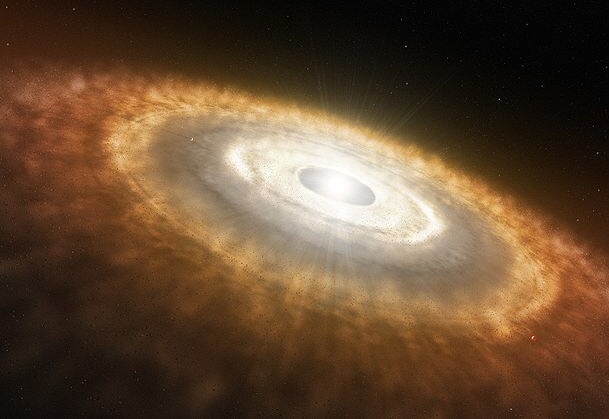 Protoplanetary disk Protoplanetary disk may have been flatter than we think. Some 4.6 billion years ago the Sun ignited its fusion reaction from gravitational collapse of compressed dust and gas pulled together under intense (very high G) gravity, leaving behind a detritus of matter which surrounded the newly formed star. By the variable gravity-G scenario, this disk distributed itself around the star, from which were formed the planets. Per this scenario, the planets closest to our hot star were either in the very low gravity-G of the inner rocky planets, or further away in a subsequently higher G of the gaseous giant planets. This innately affected their planetary composition, where the inner planets (lower G) compressed with heavier elements, while the outer planets (higher G) compressed from lighter elements, with resulting inevitable planetary density ratio differences: inner planets more dense while outer planets less dense. Yet within the variable-G scenario (where G grows about 1G per 1AU), their masses remained as now measured (per universal ‘constant’ Newton’s G), so only density was different via an adjusted kg’/kg as shown. Here is a table showing the adjusted Proton mass and densities for planets, derived from multiplying adjusted planet Densities by adjusted gravity-G (1G per 1AU) and known planetary Mass (Viz. MARS: 6.42e23 kg X 1.5G x adj density 0.407= 3.92e23 kg:
What is immediately apparent is that from adjusted Densities result in adjusted Proton masses for the planets that approximate Earth’s Proton mass, e.g. 1.67e-27 kg; while the resulting adjusted planetary Masses (bold) flatten out towards similar readings as that of ALL the planets, with exceptions for Jupiter and Saturn, which are higher (but Mercury, Mars, and Pluto are lower). What can this mean? The first curiosity, that adjusted Proton mass times planet (adjusted for variable G) density yields a value approximating Earth’s known proton value is unsurprising, since they are mathematically linked as a function of each other, merely a marker. But the second curiosity, that the adjusted planetary Mass should be flatter than now calculated (with constant G) is noteworthy, because it shows a relatively flat protoplanetary disk in the early solar system, indicating that planets accreting from swept up disk detritus arrive at about the same mass (as adjusted for variable G) within Earth’s parameters. So Mercury, which is directly blasted by solar wind, is somewhat smaller though much denser; Mars lost something to its heavyweight neighbor Jupiter (and asteroid belt); while Pluto, farthest from the Sun, is relatively smaller than the rest, and less dense, showing it at the sparser fringe of our solar system (less material for accretion). The bulge at 5-10 AU are Jupiter and Saturn, which might mean the protoplanetary disk was already thicker there than the rest of the material ringing the Sun, so accreted planets are bigger. 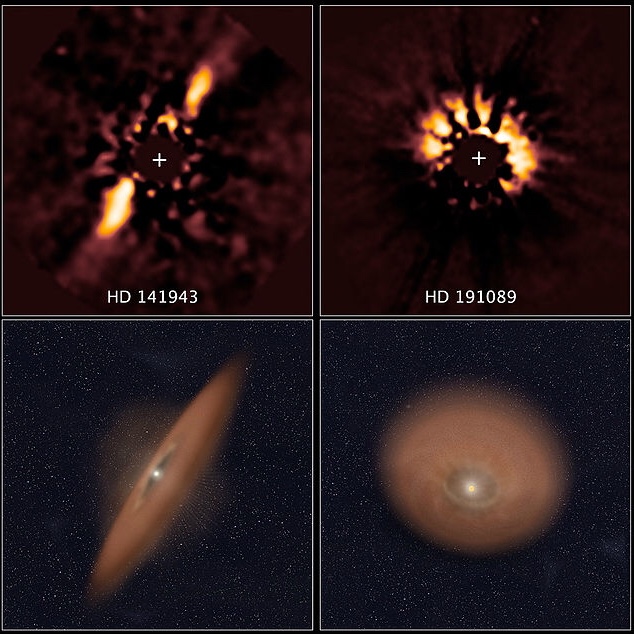 Protoplanetary debris disks If all this is true, that relative planetary Densities are G-sensitive, and that gravity-G grows with distance from the Sun as theorized, then the protoplanetary disk showing relatively equal distribution regularity, as shown, should come as no surprise. But the state of Gravity Physics is not yet able to confirm this, perhaps not yet ready for some decades, as a variable-G would invalidate much of current Cosmology, and Einstein’s GR gravity theory. IDA | ||||||||||||||||||||||||||||||||||||||||||||||||||||
| Ivan Alexander Username: Humancafe Registered: 12-2017 |
Still in the dark over Dark Matter. 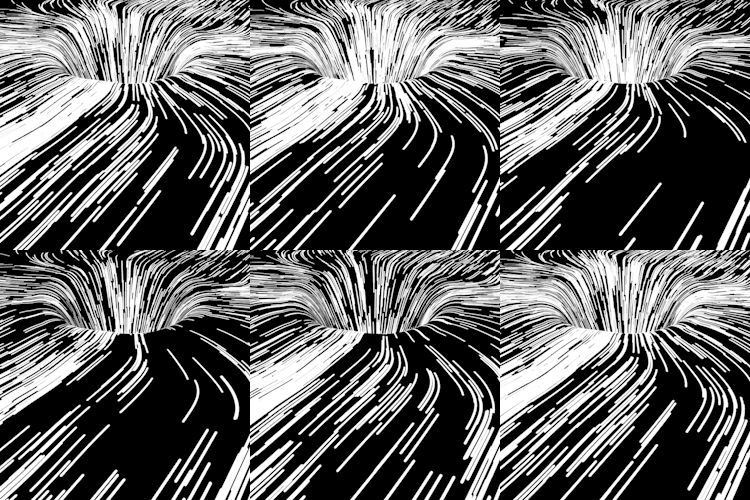 In the Dark about Dark Matter - Scientific American (interactive) We’ve been looking for WIMPS and Axions, but to date have found nothing. From article linked above (click image) we have instead:
So we are in the dark. Perhaps a new theory of gravity is in order? For example a Variable gravity-G? Also see: Why Dark Matter appears non-baryonic Discussion: What if gravitational constant G is not constant? - Physics forum ADDENDUM: If you think about it, doesn't it stand to reason that if the universe is 'isotropic and homogenous' (per Einstein et al) and hydrogen is ubiquitous throughout the whole universe, then it is 'hydrogen' in its various forms (baryonic and non-baryonic) that under stated high G conditions (high G in interstellar-intergalactic medium) which mimics the so called 'dark matter' (invisible to our instruments) but is everywhere out there; and that included large aggregations like the Dark Galaxy. Occam's razor et al. Elusive Planet Nine could be an alternative form of gravity masquerading as a planet, study claims - Live Science (16 October 2023) Revising Relativity: How Modified Gravity Challenges Einstein and Dark Matter - SciTechDaily (21 June 2024)
| ||||||||||||||||||||||||||||||||||||||||||||||||||||
| Ivan Alexander Username: Humancafe Registered: 12-2017 |
A SOLILOQUY  When we first launched the online discussion forum called Human Café, we had no clear agenda in mind. It was to be an open discussion ‘to make a better world’ in a free flow of ideas. Within a couple of years we found the discussion gravitating towards an inquiry into whether there can be a Theory of Everything (TOE), one that would be universally encompassing incorporating all the known ideas, both scientific and religious, to better philosophically understand how works the universe. In time we realized there were two conditions in universal existence that spanned an infinite totality. One was electro-magnetic energy, that light and radio waves were ubiquitous to all existence; and the other was gravity, which potential spanned infinity. This was a starting point in our search for TOE, so we placed these as a baseline for inquiry. Very soon we focussed on a known dictum, that energy equals energy in all its forms, from work energy to electromagnetic energy, to quantum energy including Einstein’s famous E=mc2 (first postulated by J.J. Thomson), that adjusted for International Units could be written as a continuous equation (Em•c = hc/lambda = h/lambda(eomo)^1/2 = mc^2= (Bm)c^2 = E energy in Joules) so all energy was shown as equal. We called it the Axiomatic Equation, as it was axiomatic that energy is universal in all its forms. This equation did not include gravity, only all spectrums of e.m. energy. Though gravitation potential could also fit into this equation, we treated it as something separate. But it was the equation of Einstein’s E=mc^2 made equal to Prince Louis De Broglie’s E=hf, (E equals Planck’s constant times frequency, where f=c/lambda; also called Planck-Einstein relation, which is same as E=mc^2=hc/lambda) quantum equation that became of special interest, which when rewritten became an equation for mass: m=h/c•lambda=1, where mass m was made equal to one. Now standing back from it, it appeared we might have a way to rewrite this as: (h/c•lambda)+ g = m = 1 (2002). This simple algorithm became more interesting, because as explained then, we were integrating infinities with infinitesimals (zero•infinity=1 template), so that the largest integers were times their inverse, so together when placed one against the other we got one, what we had set for mass. However, what was missing from this energy cum mass interrelationship was gravity, which is separate. Therefore, to include it back into the equation we added it in, taking the smallest infinitesimal we could find (as opposed to the largest being infinite gravity, to bring it to unity) which was a dimensionless number of proton-to-proton gravitational constant: g=~5.9e-39. Now we had something we could work with, and this was the true starting point of integrating universal gravity into the universality of electro-magnetic energy. I should mention that in the background of these discussions was a phenomenon I had called ‘interrelationship’, an idea developed a couple of decades earlier. This abstract idea actually started the whole line of inquiry into the Theory of Everything, since interrelationship is foundational to how the universe is an interrelated totality. This foundational idea states that all energy, all matter is interrelated to infinity, both geometrically in a matrix of interconnections, and through time preceding these connections. Nothing exists of its own without being interconnected to everything else. All things are subject to this matrix of interrelationship, because they cannot be any other way. If you think of any one thing as a product of the state of everything else, to infinity, then nothing can be other than as the ‘pressure’ of everything else had allowed it to be, in time. Therefore, from an infinity of interrelations forms as image at totality that then defines what each thing is. And what is that? It is itself! From infinity is definition of each thing in the universe, from quantum to galaxies, each having an infinitely interrelated identity to be itself, including us. From that seminal idea of interrelationship also came the idea of a totally interrelated universe, enabled with life and consciousness, that it all reverts back to energy. This was the foundational idea behind our TOE sought after, which then led to other discussions, which in the fractal nature of interrelationship led to permutations of what it all means, culminating with our place in the universe, our Who. So this was where we were (2003) in formulating a universal idea of Energy that would span all of the interrelated totality of existence, in effect, our TOE. In exploring further our Axiomatic Equation, we settled on the accepted value for E=mc^2, which is E=90 peta joules, as a baseline value for one kilogram of mass (m=1 kg on Earth). Now came a new idea that perhaps Energy is not the same for all planets, as they are at different distances from our Sun. So this led to my speculations, that if we integrated solar radiant energy (e.m. related) with its orbital energy (gravity related) for each planet, we should get different energy levels for each planet. This I did, using Earth’s equivalent 90 peta joules, and in so doing discovered the planet Energies (vs. Earth’s E=9e16J) were on a curve: Energy was related to 1/AU^2 distances from Sun. Closer into the Sun, planet energies were higher, while farther they were lower. Worked out further, using the basic equation h/c•lambda= 1m-(g), we were able to figure relative proton mass for each planet’s Energy computed, which led to E' = hc/(lambda)(proton m) = [1(kg'/kg)-(g')pi^2] c^2, as a basic expression incorporating both proton mass and the prorated g dimensionless constant (2005). Not surprisingly, the proton mass followed the AU^2 paradigm. But something else happened that led to an exciting discovery. If we multiplied the proton gravity constant by c^2 and pi^2 we got a value very close to the square of Newton’s gravity=G^2, which taking square root yields G=7.24e-11 m^3kg^-1s^-2 (vs Earth’s known 6.67e-11, Earth’s interior heat was a lowering factor), so something wonderful opened up: the gravity constant Newton’s G grew at a steady rate of about 1G per AU with distance from the Sun. (At Mars G was about 1.5, at Jupiter about 5, etc.) How surprisingly amazing was that? It suddenly opened up a whole new universe, from the one we had with an assumed universal constant of Newton’s and Einstein’s gravity G, where energy and gravity were inversely proportional. Then surprising things started falling into place like tumblers in a lock. Using Boltzmann’s constant, we were able to match the microwave background of the universe (CMB), using the gravity-G conversion to show the universal, intergalactic gravity is about 3.4e-6 G; while the Hubble constant comes in at about 0.35e-6 G, if assuming deep space cosmic light is gravitationally redshifted line of sight passing through cosmic hydrogen and dust. MOND became understandable, same as the Pioneers anomaly could in part be explained by variable-G. Were these collaborative confirmations? The gas giants in our solar system, their orbital regions being in higher G, per Equivalence, were better able to aggregate lighter molecules and thus grow larger than their inner rocky planet neighbors inhabiting lower G. Small planetoids like Pluto could sport large atmospheres in their high G orbits; while Saturn moon Titan, a tenth of Earth’s mass, could sustain a large atmosphere ten times taller than ours. Comets swinging out to the Kuiper belt (and Oort cloud) would accumulate more mass in higher G, then release this mass in sublimation as they approached the inner solar system. Planetary spin, per the Axiomatic equation, could be powered by a tiny black hole in the planet’s warm interior (vs background cold space) in a reasonable way. And galactic centers powered by a massive black hole made sense, as all the light energy of ambient stars canceled on a point, releasing massive gravity-G. There were other findings, such as Mercury’s precession was a transference of the Sun’s angular momentum at perihelion. Cold Dark matter is in very high G, making it invisible to the light spectrum, and cold plasma and dust clouds in high G collapsing into star combustion. All these started making sense in a variable-G universe, where deep space gravity clocks in at about 3.97e-7 G, where even GUT begins to make sense at that level. Were we edging closer to our TOE? These discoveries, still anecdotal at this point, left us stunned, I personally felt overwhelmed. What was happening to our Cosmology? I remember reading works by Paul Davies and thinking ‘could our cosmology be wrong’? Can Einstein’s relativistic universe, based on light c as a standard ruler, be but an observational protocol? Is his General Relativity incomplete? We had never thought of doubting Einstein’s brilliant mind. These were disturbing thoughts. If distant cosmic light is a gravitational redshift (line of sight) in a higher G interstellar space, then isn’t an expanding universe an optical illusion, that there is no space expansion? Does this invalidate the Big Bang? Was there now possibility of harnessing interactive G with onboard inertial drive? Our minds were reeling, that perhaps everything we believed in our Cosmology was wrong! All that remained was to measure Newton’s G away from Earth’s known value, like pulling on a string untying a Gordian cosmological knot, and everything would fall into place. That’s where we were then, this is where we are now. If we live in a totally interrelated universe, then the way we see this universe, and ourselves in it, must change. We no longer live in a detached Cartesian universe, but one that hugs us intimately, its interrelated reality defining every part of itself, including each one of us, and is able to create life. If this reality is a biofeedback loop, then we are living in a self defining Living Universe, where life is endemic to it. We should find life in all its forms throughout the Cosmos. We as intelligent human beings endowed with consciousness are equipped with our minds to interact with this universal reality to better have this interactive reality work with us, rather than we against it. That means we must individually be free to be ourselves in how we manifest this reality in our lives. And that means our definition as free and conscious human beings must be mindful of our natural human rights, if we are to ‘have the mind’ (Habeas Mentem), to be a Who within an interactive living reality. This is the threshold on which we now stand, where a question on the ‘theory of everything’ opened up whole new consciousness vistas of our human being. Interrelationship spanning an infinite universe in real time is the key to how works the universe, where our understanding of relativity is but a subjunct of its reality. And then, once we understand, the Universe will open its living eye upon us, to let us explore its infinity in places we had never been before, and wonder. I thank you for your attention. PS: I could not have come to these conclusions and findings without the help of many who had contributed their thoughts to the HumanCafe discussions, though any mistakes in my understanding I humbly submit were my own. To name a few, Col. Edward Chesky, Mohideen Ibramsha, Jim White, also Israel Sad, Nelson Zink, Isaac Cavaliero, Mikhail Shapkin, John Tsang, Sushil Yadav, Carl Schmidt, John Duffield, Michael Stransky, Vlad Parkhom, Wayne Hodges; some were only known by their handle, Aladim, Naive, Davet84, PeterK, Chris, WJ, Ron, G-man, Anon, Sextus, Brother Michael, Claude, Amar, Kevin, Scheptik, Le Chef, Bradley, Mark, eV, and many others who wrote but wished to remain anonymous. There were kind advisors from outside these boards who gave input, not always in agreement, Dr Anthony Smart, Bill Chapin, Dr Dimitri Kirillov, Ray Raines, Dr Vladimir S. Netchitailo, Hugh Lawrence, and others. We may have opened a chink into the fabric of the universe, and perhaps now explore it in ways we never thought before. To all thank you! Ivan Demian Alexander Rome, Italy | ||||||||||||||||||||||||||||||||||||||||||||||||||||
| Ivan Alexander Username: Humancafe Registered: 12-2017 |
Note most ‘extinct’ comets have their orbits inside 5AU.  Hypnos comet orbit With the exception of Hypnos, which has orbit out to 7AU, the other extinct comets stay within 5AU orbits around the sun. (Other ‘Near extinct’ comet 1996 PW goes out to 500AU.) Why is this significant? It is because if comets gassing out is due to solar warming, then these comets had gassed out long ago and are no longer able to do so. BUT if this gassing out is from sublimation of ‘accreted’ dust and ice in the Kuiper belt or Oort cloud much further away (beyond 40AU) then their gassing out should already be apparent when they are still way out at 5-10 AU approaching Saturn and Jupiter, where space temperatures are deeply subzero and sun’s heat is not yet able to excite molecules into cometary tails. Therefore, deep space comets can acquire dust and ice in very high G regions far from the sun, and release them in sublimation upon closer approach to inner solar system before heated by the sun; while comets traveling at less than 7AU aphelion would not do as much; those under 5AU would almost not sublimate at all (as they are unable to accrete dust and ice within their nearer the sun, lower G orbits). This is not how cometary tails are understood in astronomy at present, they being believed to be released from solar heating only. But other factors of mass and composition may be in play. Also see: Jupiter Trojans | ||||||||||||||||||||||||||||||||||||||||||||||||||||
| Ivan Alexander Username: Humancafe Registered: 12-2017 |
Mars-Earth mass and volume ratios: a hypothetical  Per NASA fact sheet on Mars, the Mars to Earth mass ratio (0.6417e24 kg to 5.9472e24 kg) is 0.107, while their volume ratio (16.418e10 km^3 to 108.32e10 km^3) is 0.151. This is surprisingly aligned with Mars being at 1.5 G vs. Earth at 1 G (as per distance from the sun 1.5 AU vs 1 AU), per the Axiomatic Equation hypothesis. So if we multiply their mass ratio by their G ratio we arrive at their volume ratio. Coincidence? Could it mean, thinking outside the box, that if G was constant (always 1 G), then Mars to Earth mass-volume ratio would have been 0.15? But if G is 1.5 at Mars, then dividing Mars’ mass-volume by 1.5 G yields mass in 1 G on Earth, which makes the mass-volume ratio 0.10? And if only taking the volume ratios, they could not be affected by higher G ratio (since volume is a function of size, which is known), except as the volume of Mars is a function of density, where density on the red planet is actually more equal to Earth’s but now adjusted for higher G makes Mars’ volume higher (per mass) by the 1.5 ratio? So the red planet is inflated by volume while deflated by (lower) density? Mass is mass no matter how figured, whether with constant G or variable. It’s always the same mass. Likewise volume, it is fixed by radius of a sphere. But what can fluctuate is density. So in the NASA table example above, where mass ratio for Mars/Earth is 0.10, the volume ratio is 0.15, meaning that though mass on Mars is as calculated, given known orbital mechanics, it is nevertheless a mass composed of lesser density (in fact Mars density is 0.38 Earth’s) than Earth’s equivalent density. And it is this lower density that increases volume of the red planet making it larger per mass than it would have been in a constant 1 G (density=mass/volume). So in conclusion, Mars is an ‘inflated ‘ planet, made of the same rocky materials as Earth, but in a higher G it acts as if its volume (function of radius and known) was ‘inflated’ by the lower density (density gets progressively lower as G climbs higher in outer solar system, where reside gas giants), to make the planet larger per its mass equivalent (P=m/v); this was how it formed in its orbit, by 1.5 G ratio. By this hypothesis, if Mars had formed in Earth’s 1 G orbit, its size would have been lower (about 0.67 of current size, with smaller diameter, maybe ~4500 km?), with higher density, lower volume, and a resulting planet a bit larger than our moon. Of course, all this is mere hypothetical speculation. IDA Also see: ’Sticky' soil on Mars? First audio recording of wind on Mars by Perseverance - 2021 | ||||||||||||||||||||||||||||||||||||||||||||||||||||
| Ivan Alexander Username: Humancafe Registered: 12-2017 |
Oumuamua flyby ‘asteroid’ had anomalous acceleration.  Asteroid-extra-solar Oumuamua (2017) had rounded the sun and exhibited non-gravitational acceleration as it began its journey out of the solar system. Per Nature: However, no spectrographic outgassing was found near perihelion, which put the theory in doubt. Other sources of possible anomalous acceleration, such as magnetism, solar radiation pressure, photon release, were discounted as insufficient to account for it. Further, since this asteroid-like body is also tumbling, end over end every ~8 hours, it would be too chaotic to effect a gassing out pressure consistent with observed acceleration. This leaves a valid conundrum: why did Oumuamua ‘accelerate’ past perihelion? Another question is: “what would the centrifugal force inside the asteroid be, given its tumbling spin?” Could it mimic an interior gravity effect? Using a centrifugal force calculator, ~400 m diameter (length), rotation ~0.0436 m/s, for 1kg mass, it works out as F=~ 9.25E-7 kgf, (vs Earth’s surface gravity 9.80665 kgf). So though Oumuamua has a very slight centrifugal ‘gravitational’ force on each end from spin (tumbling), it is much weaker than gravity on Earth. But this in itself would have no bearing on its ‘non-gravitational’ acceleration past perihelion. So if outgassing, solar sail effect, and other effects are eliminated, what does it leave us? There had been speculations that this unusually shapes oblong asteroid could be a spaceship cruising from the Vega system to our solar system. But when scanned at all radio frequencies by SETI they found only radio silence. It is possible some other form of ‘subspace entanglement’ communications is used, but we have no way to listen in. Further, by space travel standards, this is a very slow moving spacecraft, only 26.33 km/s (94,800 km/h; 58,900 mph), though much faster than other asteroids, yet hardly Starship Enterprise velocities. Why would any alien civilization send a spaceship that takes thousands, or millions, of years to reach its destination? At least it could stop at our solar system to reconnoiter, but it merely flew by (why it is unlikely to be manned). Unfortunately, our present technology does not allow us to send a probe to catch up with its hyperbolic velocity and study it up close. So we are left guessing. Reducing all the possibilities, there is only one that has a slight probability, though impossible to verify: that this extra-solar space rock is an ‘abandoned ship’. It may have been abandoned millions of years ago, either through accident or on purpose, drifting through all the debris of deep space. As the millennia passed it accumulated more and more debris to give its regolith appearance, why it appears as a long space rock. However, the mystery would remain: are all aboard dead, mummified, turned to stone, or dust? Or is it empty? The other mystery is the non-gravitational acceleration at perihelion around the sun. Without visiting up close, it is impossible to answer if it truly is a ‘ghost ship’; but the anomalous acceleration could be accounted for, though not with any known physics, if there were still functioning pro-gravity ‘capacitors’ aboard. This would mean that the capacitors would still have ability, even unmanned, to capture deep-space gravity (from a kind of inertial drive source) and release it upon close encounter with a stellar body, which would enhance its gravity assist ‘sling shot’ effect around a star. Think of it as a kind of ‘dark matter’ push still operable, even if long abandoned. Thus, if it were so, whenever the large ship (~1/4 mile long!) arrives at a solar system, it ricochets back into interstellar space with its ‘pro-gravity’ slingshot to continue its ghostly mission. Fact or fiction? Of course this is only a ‘what if’… But seriously, what if? Only the original travelers would know for sure whether it is not of natural origin, why this lost space rock is tumbling through interstellar space. Why so far from home, on what mission? Was there one, or just abandoned? But if it really is a millions-of-years old ship from another civilization, when we are technologically able to do so, we should catch up with it. It would be in pursuit of a fabulous mystery, if it really is an interstellar, asteroidal Ghost Ship. IDA Also see, hear: Sound of interstellar space (audio) The visitors from deep space baffling scientists - BBC (May 2021) Was the Interstellar Object ‘Oumuamua a Nitrogen Iceberg? - Scientific American (March 2021) | ||||||||||||||||||||||||||||||||||||||||||||||||||||
| Ivan Alexander Username: Humancafe Registered: 12-2017 |
Do ‘live’ hot stars like our Sun collide? 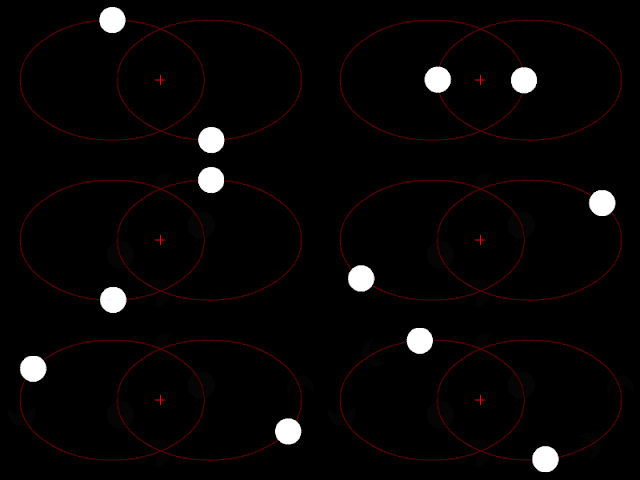 Can stars collide? Per the Wikipedia article, Stellar Collision, it says: Subsequent searches narrows this down to collisions only between binary stars, which orbit each other, or blue stars with red giants. But there appears to be no evidence of main sequence stars, also called ‘live’ stars, colliding. Mostly this is understood as a factor of distance, where the great distances between stars reduces their changes of collision dramatically, so they merely pass by each other, even when galaxies merge. Is this not curious? Should the variable-G gravity hypothesis prove to be correct (with testing for G outside our Earth’s orbit) where Newton’s G is expected to grow at about 1G per AU from distance of the Sun, then it is a puzzling fact that out of billions of live hot stars in our galaxy few, if any, actually collide. However, this hypothesis may actually give simple explanation why hot stars are so far apart. In our exploration of travel away from our Sun in interstellar travel it says: This was the idea behind interstellar acceleration for spacecraft using G inertial drive, powered by gravity in space, which increases velocity with increased G. Taking this concept, hypothetically, to interstellar distances, something interesting happens: At midpoint between stars G would be at its maximum (about 3.97e-7 G), whereas approaching either star the G would decline to its minimum. Now step back and think about it. If radiant energy generated by ‘live’ stars mitigates the G factor, where it is at its lowest at the star, then it should stand to reason the two stars stay far apart because of progressively lower G approaching the star. This means, in effect, that the higher e.m. radiant energy makes gravity less attractive the closer you get to a hot star (as opposed to white dwarfs or red giant which have degraded radiant energy). So in sum, by making G weaker near a hot star the gravitational attraction (in progressively weaker G) weaker and weaker until we arrive at the star itself, where it is weakest due to its strong radiance. So on balance, like a lighter than air balloon becoming buoyant in the denser atmosphere, the hot star ambient environment is ‘buoyant’ being lighter than the ‘heavier’ G thick interstellar space environment. Therefore, though gravitationally bound they maintain their vast distances and float away from each other. Hence, why they do not collide. Naturally, if so, when galaxies merge their stars don’t collide. This would apply as well to binary stars, that unless their radiant energy is so degraded that they closely revolve each other, this principle should keep them at a respectable distance to avoid collision. The exception, therefore, is cool stars that do not have enough radiance to mitigate the G factor, such as ‘dead’ stars, or dying stars, and they then run the risk of collision or merger, as we have seen in blue dwarfs and red giants. Another special case would be neutron stars, which have virtually no radiant hot energy, but very great G instead, so they can merge easily (as gravity waves detected by LIGO suggests). But there may be one more intriguing aspect to this ‘gravity buoyancy’ phenomenon. This ‘gravity buoyancy’ principle may also apply to the electron shells of the atom. At the time in the postscript it said:
So if the ‘positive-negative’ charge relationship is actually a modified G in electromagnetic radiance effect, where raising the energy level will raise electron shell energy, as per Quantum physics, so it has a repulsive effect on the electron. This e.m. energy modifying gravity G, at all levels from atomic to cosmic, may be endemic to how is built the universe. Gravity G dominates all space, it is space in a very high G state, while radiant energy modifies this space, from how live stars are kept at distance to how the internal structure of the atom exists; the two are related, in a gravity ambient state energy repels. (By extrapolation, it could also mean Quantum states in high G space would be tighter than here on Earth.) This is a tall order, if true, and it revolutionizes our understanding of how the Cosmos is put together. But this can be true if, and only if, Newton’s G is not a universal constant, but a variable constant instead, which has yet to be proved. IDA Also see: Summing up variable-G gravity hypothesis | ||||||||||||||||||||||||||||||||||||||||||||||||||||
| Ivan Alexander Username: Humancafe Registered: 12-2017 |
REPRINT: This electro-gravity equation was posted in the now archived (closed) portion of Humancafe, so reprinted here for reference: http://www.humancafe.com/discus/messages/70/108.html?SundayJuly1020050610pm Axiomatic Equations (new physics):*(note the kg drops out, unless it becomes kg/kg) Ergo, G as function of proton-proton gravity constant g, backing out c, (g) is Volts per kg. | ||||||||||||||||||||||||||||||||||||||||||||||||||||
| Ivan Alexander Username: Humancafe Registered: 12-2017 |
REPRINT: How Axiomatic Equation was derived (from archived vault of Humancafe, now closed). http://www.humancafe.com/discus/messages/70/166.html?SundaySeptember1120051203pm By Ivan A. on Tuesday, March 1, 2005 - 09:56 pm: HYPOTHETICAL ATOMIC MASS AS A GRAVITY AND ENERGY FUNCTION, PER THE AXIOMATIC EQUATION: With Implications for the Pioneers 10 & 11 Acceleration Anomalies. By Ivan D. Alexander Costa Mesa, CA USA (Dated November 27, 2004, revised September 6, 2005) Abstract: Mass is both a function of energy, as per Einstein's famous equation E = mc^2, and also a Quantum function of Planck's constant times c, divided by lambda l times the proton mass, also known as the Planck-DeBroglie equation. It will be shown that in addition to these, mass is also a gravity function, as defined by the Axiomatic Equation, derived here, as an extension of the DeBroglie-Planck-Einstein equation; where the proton mass is a variable, leading to a proton-to-proton gravitational coupling constant variable, which can then be computed into Newton's G gravity 'constant'. This Newton's G becomes a function of the Energy region where it is being measured, where for our solar system its delta G increases linearly at the rate of ~7.24E-11 Nm^2 kg^-2 per astronomical unit from the Sun, one AU = ~150E+9 meters. The hypothesis is that what happens to atomic mass at the quantum level is how it converts into Newton's G gravity at the macro level, per the Energy regions where G is measured. Introduction: It had always been assumed that gravity is a universal constant, with which using Kepler's Law and Newton?s orbital equation we were able to calculate distant orbital mass for planets and other cosmic bodies. Because these calculations yielded usable trajectories in space, there was no reason to doubt this universality until the Pioneers 10 and 11 traveling in opposite directions beyond the Kuiper Belt encountered a consistent acceleration towards the Sun, at the computed rate of ~8E-8 cm.s^-2, which remains unexplained to known physics [1]. Neither Newtonian gravity nor Modern Physics as postulated by Einstein's General Relativity, both based on assumed universal constant G=~6.67E-11 Nm^2kg^-2, can accommodate this acceleration anomaly for our distant space crafts, so other systemic causes were examined, as per Scheffer [4], to no verifiable satisfaction. Gravity remains an anomaly to our understanding, though we had been able to use its assumed constant successfully for the inner planets. It was at about Saturn, at 9.5 AU, that this anomaly became pronounced enough to become measurable, though we had not been looking for it. In fact, it should have become obvious by Jupiter, at 5.2 AU (adjusted for solar wind pressure), as will be seen below. The fact that this acceleration anomaly had remained constant right out to the Kuiper Belt, at beyond 50 AU, points to the need for a deeper understanding of what gravity is. Based on this observation, there is reason to believe that it may not be a universal constant, but interactive with the solar energy output of our local star, in a predictable way. There are now proposals to study this phenomenon directly, such as proposed by the European Space Agency [2] and by the proposed study by the LANL/JPL team, S.G. Turychev, J.D. Anderson and M.M. Nieto [3]. This may be achieved by finding the inertial mass equivalence to the gravity G at any given AU distance, per the 'principle of equivalence' hypothesis, as studied by Haisch-Rueda et al [5] [6]. The concept of a non-universal Newton's G was proposed by both MOND [7] as well as by the late Toivo Jaakkola [8], so this is not a totally new idea. To date, no solution has shown itself to satisfy a relativistic approach to gravity to explain this anomaly. It is here proposed a methodology for understanding this problem using a modified version of the E = hc/ l(proton mass) = (1)c^2 equation, where mass is redefined. The computed values from this modified DeBroglie-Einstein equation yields a significant result for the Pioneers Anomaly observed, where G is shown to not be a universal constant. 1.0 : How the Axiomatic Equation was derived: 1.1: Hypothesis for a new definition of Mass: Conceptually any value of one can be derived from an integer multiplied by its inverse, from zero to infinity, where the product is always = 1. This principle can be applied to mass as having a value that is the product of Energy and its inverse 1/c^2, to equal one. In our region of space, this will always work out to be E =~ 9E+16 Joules, or 90 petajoules, when m = 1. Because we measure gravitational mass on Earth in kilograms, this m = 1 kg is assumed. But it need not be limited to Earth's gravity, if gravity is not a universal constant, since this value of m = 1 kg may be different elsewhere. By this above reasoning, mass is retained as m = 1, but the kilograms is held aside for now and (m) will be treated as kg/kg instead, so that the value of one, as a product of inverse numbers, is preserved. This means that when there is a total interaction between E and 1/c^2, mass as m =1 is assured. But if this interaction is less perfect, meaning the numerator E is less than the denominator 1/c^2, mass becomes less than one. The evident assumption that follows is that if mass is less than exactly one, there is a remainder that must be accounted for. Given the Planck quantum equation E = hc/ l(proton m), we can see immediately that for E = 90 petajoules, given h = 6.626E-34 m^2 kg s^-1, c = 3E+8 m s^-1, and l = 1.322E-15 m, the resulting proton mass = 1.67E-27 kg [9], which thus matches Einstein's E = mc^2. However, now if the real mass is less than one, to satisfy DeBroglie's equation, leaving all things equal, we must find another value on the right side to satisfy the equation. One way to do this is to say that mass, always equal to one, is modified by a gravitic value related to the left side, its proton mass, to account for a real value less than one. This can be met with subtracting from m = 1 a proton-to-proton gravitational constant value, let's call it 'g', which on Earth is computed as g = 5.9E-39, dimensionless. The resulting value for mass becomes m = (1-g) approximately, as will be explained. Though this value is so small as to appear negligible, it will be shown to be very important when values for E are calculated for different planetary orbital Energies. 1.2 : Calculating Mass as a function of Energy: Thus far, what results from the above is an equation that looks like this: E = hc/ l(proton m) = ~(m)c^2 = ~(1-g)c^2 This is only an approximation, as will be shown later, but it serves to illustrate a principle. It also illustrates that (1-g)c^2 is a value of Energy that must translate into: (1-g)c^2 = c^2 - gc^2, whereby E' = E - gc^2, where E' is a true Energy value, and E is the inverse of 1/c^2. This ideal inverse relationship can only exist in its pure form if there is no gravity, otherwise, E' must be less than E, per this equation, which means E is an ideal number and mathematically correct, though E' represents a real value. If m =1, which means g becomes zero, it drops out, then the equation no longer works, except as a pure expression of E = mc^2. But no matter how small the g value, as long as g holds above zero, this equation may be usable as an expression of the interaction of Energy and its inverse, with a g remainder. The result is that E' is slightly less than E, of necessity, and that this Energy E' is the value sought after to calculate the proton gravitational constant g. Once found, then it can be converted into Newton's G, as will be shown. For now, the operable equation is an approximation for E': E' = hc/ lproton m) = ~(1-g)c^2, where g is the proton gravitational constant, as it is subtracted from a mathematical ideal m = 1. This leaves us with two mathematical ideals: E/c^2 = m, and m = 1, which may not represent what happens in the real world. If we take one hydrogen atom as m = < 1, what we have is a proton nucleus surrounded by electron energy shell. This total atom is a unity of one minus its gravitational constant, as measured here on Earth, per this equation, which is less than the mathematical ideal, but closer to what is observed. Proton mass is a gravity effect, where on the left side the quantum E = hf is an energy effect. On the right, we have an ideal mass unit minus its gravitational coupling constant, times energy c^2, which should result in the Energy that defines E = hf. Thus, greater or lesser values for Energy E' will result in lesser or greater values for proton mass on the left, since they are inversely proportional, while at the same time on the right we should get the same proportional values for g. What we had hitherto assumed to be ideally equal, E = hf = mc^2, is in fact not, since there is a small remainder force of g to be accounted for. Though extremely small, this g is a sought after value, because it will enable us to calculate the like Newton's G value from it. 1.3 : Computing Newton's G 'constant' from the Proton gravitational coupling 'constant': Multiplying out the above equation, we can see that mass is defined as (1-g) times the energy value of c^2, so that of necessity the proton gravitational constant, as a function of energy, becomes gc^2. However, this will be found as incomplete without pi^2. So the gravitational function G should now become: f(G)m = gc^2 (m) pi^2, to yield an approximation of G = 6.67E-11 m^3 kg^-1 s^-2, which is: f(G)m = (5.9E-39)(9E+16 m^2 s^-2) (pi)^2, which equals = 53.1E-23 (9.87) = 52.41E-22, in taking the square root is: function of G = ~7.239E-11 , which is in SI Base: G^2 (1) = g (1) m^2 s^-2 pi^2, where kg/kg is implied for m =1, and g is expressed in "Volts meters squared/second", viz. W/A m^2/s, where for A = Nm^-1, then (m^2 kg s^-3) (m^2 s^1)/ (m kg s^-2) (m^-1) = m^3 m kg/kg s^-2, making: V*m^2/s =V^2= (m^4 s^-2)(kg/kg) and therefore: G^2 = [(m^4 s^-2)(kg/kg)(m^2 s^-2) pi^2], (SI base units for f(g) may also be (kg s^-1), still unresolved)** so taking the square root: G = (52.41E-22 m^6 s^-4 kg/kg)^1/2 = ~7.239 E - 11 m^3 kg/kg s^-2 (which is ~0.57E-11 more than Newton's G = ~6.67E-11 Nm^2 kg^-2), as only an approximation of Earth's G. Although this is only an approximation of Earth's G, and g estimated in SI units of Volts remains unresolved, it is a workable equation for converting proton gravitational constant into Newton's G, with a relatively close result. Though it is not exact, there may be other reasons why Earth's gravity is slightly less. Earth may generate its own energy, which may effect planetary spin or interior heat, and its magnetic field, though for now these will not be pursued. There may also exist a relationship between Earth's energy received from the Sun and its total orbital Energy, modified by its internally generated energy, but not covered here. 1.4 : Comments on the preceding development: At this stage, the equations are still disconnected from their applications, which will follow, where the Newton's G 'constant' will be shown to grow linearly from the Sun at a constant rate of delta G = 7.239E-11 Nm^2 kg^-2/AU. The purpose of the development thus far is to show how the DeBroglie-Einstein equation can be modified to accommodate a gravitational value g, which can convert into Newton's G, and prove a useful variable. The goal will be ultimately to show how this new value of G applies to the Pioneers Anomaly. For now, we still need to finalize the above listed equations into what will be a workable model. Why was this not addressed a hundred years earlier by physics in Einstein's famous E = mc^2? My guess is that the value difference between ideal mass and real mass was so small, viz. 10x^-39, that it seemed irrelevant, so was basically ignored, or perhaps simply not yet understood. 1.5 : Writing the Axiomatic Equation: If we postulate that solar Energy may be different for planetary orbits, we must accommodate this with the two values of Energy, as E' computed for the planets, and E for Earth, (where here E equals 90 petajoule), we need a qualifier function of f(E'/E) to satisfy the computed values of E'. It is obvious that for Earth, where E' = E, this additional function f(E'/E) is irrelevant, since it equals one, but for other planets this will become instrumental in computing their relative proton mass and gravitational constants. So the equation, factoring in this postulate, should be: E' = hc/ l(proton m) = f(E'/E)~(1-g)c^2 = planetary total orbital Energy An additional qualifier, to make g exact , which will become more meaningful later is a function: Proton gravitational constant f(g' ) = (proton m)' * g / (proton m), where (proton m)' = proton mass for E', and (proton m) = proton mass for E. So the full Axiomatic Equation, factoring in pi in conversion to G, should read as: E' = hc/ l(proton m) = f(E'/E) [1 - f(g')pi^2] c^2 Where f(E'/E) [1 - f(g' )pi^2] is the modified version of Mass on the right side of the DeBroglie-Einstein equation, for m = 1, as a postulated Axiom [10]. (Please note the function f(g?) will not balance on the right side in Earth based units of the proton gravitational constant without an adjustment per (g/g?) coefficient.) 2.0 : Planetary Total Orbital Energy E' and the resulting g' : 2.1 : A Variant of Kepler's Law for the Planets: Energy is energy, so whether it is found as electromagnetic irradiance, or heat in Kelvin, or as accelerating orbital motion, it is still Energy, which can all be expressed in Joules, or Joules per second as Watts. One possible approach is to measure the total orbital Energy E' for the planets in our solar system, and then compare these Energy levels with the DeBroglie-Einstein equation to calculate a proton-mass equivalent for each planet. This calculation may be accomplished by multiplying the solar irradiance in Watts (per meter squared) by the distance from the Sun, and then multiplying the result by the planet's orbital kinetic energy, where KE = 1/2 mv^2, and m = 1 (kg/kg). Note this is a combined function of solar electromagnetic radiant energy and, as expressed by orbital KE, gravitic energy. When calculated for Earth's orbital Energy, taking data from "Nasa Planetary Fact Sheet" [11] per equation: E' = solar irradiance x 1/2 Rv^2 Solar irradiance: 1367.6 W/m^2 Mean distance from Sun: 149.6E+9 meters Mean orbital velocity: v = 29.78 km/s (1367.6) (149.6E+9) = 204592.96E+9 = 2.046E+14 W/m = solar radiance energy KE = (1/2) (1) (29.78)^2 = (1/2)(1)(886.85) = 443.4 m^2.kg.s^-2 (Joules) = gravitic energy KE * W/m = ( 443.4 J) (2.046E+14 W/m) = 9.07e16 Joules (times Newton force N) # = Earth's total orbital Energy. (Please note m = 1 is a net function of planet mass already in orbital motion, and the planet KE is ?template? function only.) Earth's E = ~9.07E+16 J, which is close to E = mc^2 = 90 petajoules. This Energy level (for Earth) then sets the basic template for like Energy E' levels for the other planets, using the same methodology: MERCURY: 60.55E+16 J VENUS: 17.33E+16 J EARTH: 9.0E+16 J MARS: 3.66E+16 J JUPITER: 0.335E+16 J SATURN: 0.1004E+16J URANUS: 0.0247E+16J NEPTUNE: 0.01E+16 J PLUTO: 0.006E+16 J The resulting Energy E' values if plotted on a chart show a parabolic upward steeply curved for the inner planets. and progressively lower and flatter for the outer planets, with an elbow for this curve about the level of Mars and the asteroid belt. It is immediately obvious that the inner planets receive a much greater level of solar irradiance than the distant planets, and that this total power-energy in Joules/second for each orbital has a parabolic relationship, where the energy levels for the outer planets declines on a curve[12]. 2.2 Solving for a variable Proton Mass: How does this apply to Newton's G constant? We can calculate an intermediary function resulting from this Energy variance through the DeBroglie-Planck-Einstein equation: E = hc/ l(proton mass) = 90 petajoules. In computing the proton mass for each Energy level, we get a variable that can be used to estimate Newton's G at each Energy E'. Assuming that Planck's constant h = 6.626E-34 m^2.kg.s^-2, and electromagnetic energy lambda, 1.322E-15 m (assumes no redshift within our solar system), with light constant c, 3E+8 m/s, we get: E = hc/ l(proton mass) E = 9.0E+16 J = (19.878E-26) / (1.322E-15)(proton mass), so that proton mass is: Proton m = 1.67E-27 kg Using the same methodology, we can compute proton mass equivalents for each of the planets Energy levels, where E' is on the left, and equivalent proton mass is on right: MERCURY: 60.55E+16 J, 2.48E-28 kg VENUS: 17.33E+16 J, 8.67E-28 kg EARTH: 9.0E+16 J, 1.67E-27 kg MARS: 3.66E+16 J, 3.86E-27 kg JUPITER: 0.335E+16 J, 4.49E-26 kg SATURN: 0.1004E+16J, 1.498E-25kg URANUS: 0.0247E+16J, 6.1E-25 kg NEPTUNE: 0.01E+16 J, 1.5E-24 kg PLUTO: 0.006eE+16 J, 2.58E-24 kg From this above, we can immediately see that proton mass varies inversely to Energy, so that the equivalent proton mass on Mercury is lower than Earth's, while on Saturn it is greater. In using our above Axiomatic Equation: E' = hc/ l(proton m) = f(E'/E) [1 - f(g')pi^2] c^2 , we can see the f(E'/E) relationship for Earth is =1, while for Mercury it is =6.728, and for Saturn it is =0.011. Please note, it should be understood here that these values for planetary Energy are as measured in Earth's values, and that if measured in terms of their respective planetary Energy levels, of necessity, this ratio is always one. The reason this function is a variable is that E is an Earth value, our basis, while each planet exists within its own orbital Energy E' as calculated in terms of Earth's Energy, so a numerical f(E'/E) ratio results. 2.3 : Calculating for the Proton Gravitational Variable g': The above values for proton mass will now lend themselves to finding the proton gravitational constants equivalents: Again, taking our Axiomatic Equation: E' = hc/ l(proton m) = f(E'/E) [1 - f(g')pi^2] c^2 We can now compute the f(g') proton-to-proton gravitational coupling constant for each E' of the planets. Using Earth's g = 5.9E-39 as a basis, we can find f(g'} by applying f(g' ) = (proton m)' * g / (proton m), as per above. Using this equation as a direct proportional value for g relative to proton mass, the ratio of the planet's proton mass (proton m)' = g' to Earth's (proton m) = 5.9E-39, we get =f(g'). For example: Mars proton mass = 3.86E-27 kg, which times Earth's g = 5.9E-39 equals 22.78E-66, divided by Earth's proton mass =1.67E-27 equals f(g')= 1.36E-38 (greater than Earth's g). This methodology yields the following proton gravity g' constants: PLANET: total orbital Energy, Proton mass, Proton gravity constant: MERCURY: 60.55E+16 J, 2.48E-28 kg, 8.76E-40 VENUS: 17.33E+16 J, 8.67E-28 kg, 3.06E-39 EARTH: 9.0E+16 J, 1.67E-27 kg, 5.9E-39 MARS: 3.66E+16 J, 3.86E-27 kg, 1.36E-38 JUPITER: 0.335E+16 J, 4.49E-26 kg, 1.586E-37 SATURN: 0.1004E+16J, 1.498E-25 kg, 5.29E-37 URANUS: 0.0247E+16J, 6.1E-25 kg, 2.153E-36 NEPTUNE: 0.01E+16 J, 1.5E-24 kg, 5.3E-36 PLUTO: 0.006E+16 J, 2.58E-24 kg, 9.11E-36 As can be seen from the above, the proton-to-proton gravitational coupling constant g' increases with distance from the Sun, and decrease towards the Sun, so the inverse relationship of Energy to proton gravitational constant is preserved. This can be further converted into Newton's G values via an equation, as per the conversion equation mentioned above: G^2 * m = g c^2 pi^2, where g is the proton gravitational constant, and m =1, G^2 * 1 = (5.9E-39)(9E+16)(9.87) = 524.1E-23 = 52.41E-22, of which square root is: G = ~7.239E-11 Nm^2kg^-2 for Earth. (Note this is 0.57E-11 more than Newton's G = 6.67E-11 N.) 2.4 : Converting Proton Gravitational g' into Newton's G' constant : Using this same methodology, we can now calculate the variable local Newton's G "constant" for each of the Energy levels for the planets, preserving the 10x^-11 relationship constant for plotting ease, we get for E' the value of Newton's G' : PLANET: total orbital Energy, Proton mass, Proton gravity g', local Newton's G': MERCURY (0.39 AU): 60.55E+16 J, 2.48E-28 kg, 8.76E-40, ~02.79E-11 N VENUS (0.72 AU): 17.33E+16 J, 8.67E-28 kg, 3.06E-39, ~ 5.20E-11 N EARTH (1 AU): 9.0E+16 J, 1.67E-27 kg, 5.9E-39, ~7.24E-11 N (vs. 6.67E-11 N) MARS (1.52 AU): 3.66E+16 J, 3.86E-27 kg, 1.36E-38, ~10.96E-11 N JUPITER (5.2 AU): 0.335E+16 J, 4.49E-26 kg, 1.586E-37, ~ 38.6E-11 N SATURN (9.5 AU): 0.1004E+16J, 1.498E-25 kg, 5.29E-37, ~68.5E-11 N URANUS (19.2 AU): 0.0247E+16J, 6.1E-25 kg, 2.153E-36, ~138E-11 N NEPTUNE (30 AU): 0.01E+16 J, 1.5E-24 kg, 5.3E-36, ~217E-11 N PLUTO (39.5 AU): 0.006E+16 J, 2.58E-24 kg, 9.11E-36, ~284E-11 N When these Newton's G values are plotted on a chart on the X axis, with planetary distance from the Sun in AUs on the Y axis, it shows a linear growth at the rate of approximately: delta G = ~7.24E-11 per AU. Such a hypothetical G variable is not beyond the scope of possibility, as mentioned above, i.e., MOND[7] and Toivo Jaakkola[8], and perhaps theorized in the Machian principle [13], though no conclusive theory of variable G has yet emerged. In the above, given the parabolic nature of the Energy curve, which was not expected to yield a linear Newton's delta G, offers an algorithmic solution to a variable G', as per the Axiomatic Equation. Consequently, what is sought from these calculations is the hypothetical rate of acceleration towards the Sun by the Pioneer distant probes. 3.0 : A Variable Newton's G 'constant' affecting Pioneers 10 and 11 Acceleration: 3.1 Calculating the Pioneers 10 and 11 anomalous acceleration: Given that the above calculations yield a linear growth of Newton's G by the rate of 7.239E-11 per AU, the resulting plotted line points inwards towards the Sun towards a hypothetical 'zero' value on the Sun's hottest surface corona region (where G' = ~4E-15 N per above equation), and outwards towards the gas giants, so that by Saturn the G variable is approximately 68.5E-11 Nm^kg^-2 which at 9.5 AUs from the Sun is about ten times Earth's G equivalent. Taking it beyond the solar system out to the Oort Cloud, for example, at about 50,000 AU, yields a G value of about 3.5E-6 Nm^2kg^-2, though this value may flatten with extreme distance, and reverse as we approach another hot star's Energy. (Though beyond the scope of this paper, there may be a possibility that this linear growth for G may plateau at some 'cut-off frequency' when stellar-galactic Energy is lower than the photo-electric effect's 700 nm lambda, at which point gravity reverts to some very high constant value in the deep of intergalactic space; per the Axiomatic Equation, this level, viz. G" =~1.6E+4 N, is reached where E = c. Implied in this is that a total absence of Energy, which does not happen naturally due to MWB, maximum G would be absolute, where G'" = c, though this may only happen in a galactic black-hole.) We had really no reason to consider a variable Newton's G before because our local trajectoral needs were satisfactorily met using a constant G and its resulting estimated mass for distant bodies. The obvious implication here is that our mass estimates may have been wrong, at least in terms of local G, but that we still managed to reach our trajectoral objectives with a universal Newton's G and in-flight adjustments. Given we computed local mass from this universal G, we got workable results. The fact that the Pioneers are now about 250,000 plus miles closer to the Sun than they should be raised a valid question on the resulting trajectory. Given a constant momentum, a greater inertial mass affects its deceleration, and thus its resulting velocity. (Please note: The probes's spin factors may also be affected, where given a greater inertial-G-mass, spin should accelerate; however, depending upon right-hand or left-hand spin, it could either accelerate faster or accelerate towards a reverse.) 3.2 : Acceleration of the Pioneers towards the Sun: The acceleration towards the Sun may therefore be calculated from the G variable, using the methodology described above. Taking the delta G divided by Earth's known G, and then divided by one AU in meters yields the expected acceleration pointed towards the Sun: Delta G = 7.239E-11 Nm^2kg^-2 (m^/s^2) Earth G = 6.67E-11 Nm^2kg^-2 One AU in meters = 150E+9 meters (7.239E-11 Nm^2kg^-2) / (6.67E-11) / (150E+9) = Pioneers acceleration anomaly hypothetical acceleration = 1.085 / 150E+9 = 7.235E-12 m/s^2, in centimeters is: ~-a = ~7.235E-14 cm/s^2, which satisfies the computed delta G of 7.239E-11 per AU, and workably close to Earth's G = 6.67E-11 Nm^2kg^-2 at one AU from the Sun. If we take inertial mass growing at the same proportion as G, per the Equivalence Principle, then the resulting acceleration towards the Sun for any probe on an 'exit' trajectory should experience the square root of this (delta G) acceleration: ~-a' = ~2.69E-7 cm/s^2. It is this value the Pioneers should experience due to the equivalence of delta G on their inertial mass as they travel out of the solar system. The fact that their trajectory acceleration towards the Sun had been calculated as ~8E-8 cm/s^2, leaves room for other systemic factors as to why the probes are slowing in deep space. These anomalies had been proposed by others, including heat venting, space dust, radio waves pressure, and other conventional reasons, such as proposed by Louis S Scheffer [4], solar wind, dark matter, as having no gravity or "new physics" basis. But as can be seen from the above, there may in fact be a gravitational basis for the distant spacecrafts acceleration anomaly. It is the author's opinion that the reason the rate of acceleration is lower than a pure delta G value is due to the internal "heat" carried by the Pioneers, such as vented, which yields a lower value for inertial mass for the spacecrafts. Otherwise, as the G' environment through which they travel increases linearly with distance from the Sun, so does its acceleration towards the Sun at a constant rate. This constant acceleration towards the Sun confirms the postulated Axiomatic Equation's variable Newton's gravity delta G, within reasonable parameters, for the outer solar system. 3.3 : Additional Confirmations sought for a Variable Newton's G: The prospects for a variable Newton's G had been foreseen more than a year before the author learned of the Pioneers Anomaly, so when found it came as a pleasant surprise, though not unexpected. Physics cannot explain the gravitational anomaly revealed by the Pioneers. What the author had hoped for instead was to find distant comet trajectories behaving as if G was greater in the outer solar system, though there was no effective way to measure this at their great distances from the Sun without attaching a probe to them. This should still be a viable project for future studies to better understand what comets do once they leave the near vicinity of Earth, where they can be readily observed. We know what they do here in our region of G, but do not know how they behave where G is substantially greater. It should be noted that though G' is multiples of Earth's G for the outer planets, it is still a very small value of 10x^-11, so that it remains a very weak force even out by the Kuiper Belt regions. It is not until we get to the Oort Cloud where G may be computed as a much higher value, viz. G' = 3.5E-6 N, that we would see a markedly different trajectoral behavior. The author thinks that the Oort Cloud is a 'graveyard' depository for all cosmic objects with insufficient momentum to leave the solar system, which may ultimately be the fate of our Pioneers as they settle into a very large orbit around the Sun. To achieve an escape velocity from the Sun requires more than a constant momentum, if delta G is a factor, so that it would need constant acceleration to go beyond the Oort Cloud. Studies proposed to measure greater inertial mass for the outer solar system [2] [3], such as by the European Space Agency, are a necessary first step to confirm a variable gravity, one that is inversely proportional to the Energy received in that region, as per the discussion above. The numbers worked out for this paper are only approximations to illustrate a principle, so they need to be verified empirically to give us a more correct understanding of how this principle of variable G operates in space. As Einstein was fond of saying: "Experimentum summus judex." 4.0 : Implications for the Axiomatic Equation in future studies: 4.1 : Do we know what Mass is for distant cosmic bodies? Per force our thinking on mass and cosmic density must change. The two are inversely proportional to the solar Energy received. This should be the first implication from a variable gravity, that the estimated mass for the planets are wrong. By measuring mass using Newton's orbital equation, GM = Rv^2, we of necessity get readings true in Earth's G only (believed a universal constant), though all mass numbers in local G are of necessity wrong. This means that a space probe leaving our G region and traveling into a greater or lesser G, its inertial mass remains the same in Earth kilograms, but changes in terms of local G. Thus our distant planets away from the Sun have effectively progressively lower mass per greater G in their orbital regions, while those closer into the Sun have higher mass per lower G. The further implication is that planetary density will become affected. For example, in a higher G region, gas molecules which cannot hold together easily in a lower G region will bind more easily, as we see in the gas giants. Conversely, planets closer to the Sun should have a more difficult time binding light molecules, so that heavier molecules should give them a greater interior density within a lighter G region. This could explain why Mercury would be an almost all metallic planet devoid of water, while Neptune is an almost all gas planet. Pluto is a variant, possibly a former Neptune moon or captured Kuiper Belt object, in that it may be an almost all water ice body with enough G density so that, though half the size of our Moon, it is able to retain an atmosphere. The rocky planets Earth and Mars, and perhaps Venus, live in a middling gravitational environment, so that molecules of both gas, water, and solid matter bind as they do. We are not accustomed to thinking this way, so it requires a new vocabulary to accommodate a variable gravity, where mass has a definition both in terms of Earth's kilograms, and effectively in local "kilogram", where "inertial-G-mass" is affected. The first clue to this is how the planets are composed, for which proton mass and the resulting variable G can be calculated, at least as an estimate, by using the Axiomatic Equation. 4.2 : Newton's G 'constant' and Einstein's General Relativity: We can still think of Newton's G as a constant, but only within the parameters of a body's orbital location. This means that where planets or moons have highly elliptical orbits, they stray from a constant G, and thus as expected given their constant momentum, they should accelerate within a lower G field, and slow in a higher G field, as observed. However, now in addition to Kepler's Law, which is purely geometric, we can add physical causality as to why this is so. Mercury's precession was adequately explained by Einstein using General Relativity, but again it was a mathematical explanation without causality. This new way of seeing mass and momentum as a function of energy and gravity may give us a more real explanation as to why Mercury behaves the way it does at its perihelion, since it resides in a highly sensitive G region, where it is extremely weak. The fact that the Pioneers are behaving the way they do, now in a predictable fashion, can give us valuable data on how other distant bodies will behave in space within the context of a variable G, whose delta is linear from the Sun. Obviously, for other stars, this variable G will be different, depending upon the Energy output there, where some stars may be so weak as to fail to produce enough Energy to break the postulated gravity 'cut-off' frequency, so they are forever trapped in a very high gravity environment. This may be an alternative explanation for what are neutron stars, for example, rather than collapsed stars; in fact, they may be failed stars instead, though a cold collapsed star would have the same results. This new approach may also offer some relief to understanding why galaxies behave on the margin the way they do, with a postulated so-called "dark matter", since this may only be a function of a much higher G region. We know cosmic light redshifts, as evidenced by spectrographic analysis of distant light and their molecular signatures. It had been postulated that this redshift is due to a Doppler effect of an expanding universe, from which sprang a Big Bang Theory. We may be forced to relegate the Big Bang to a mere hypothesis, since distant cosmic light may be redshifting due to a much greater gravity environment of deep space, so that traveling over great distances for long periods of time through heavy G fields will lengthen their electromagnetic wavelengths, hence redshift. Alas, Big Bang may not survive variable gravity, unlike Relativity which will. Assuming light is indeed a constant velocity, Relativity is a meaningful observational science, which will prove useful when we travel at or above lightspeed, but it may not necessarily be the most efficient way to understand the physics of our universe. In particular, if inertia is affected by its location in relation to a star's energy, and not universal, then we cannot assume that there are "no preferential inertial reference frames" in Relativity; which puts Einstein's first postulate of Special Relativity at risk; in fact, only the star's radiance output is preferential by this reasoning. So we may need to change some aspects of Einstein's highly successful theory of relativity by making adjustments to General Relativity, if gravity is not a constant. This may be more difficult to do politically than scientifically, unfortunately, since a whole body of Modern Physics had been built upon the foundations or Relativity, which represents a tremendous investment in brain power and money over the decades, not to be dismissed lightly. The Axiomatic Equation, built out of stock equations of the known physics, including Einstein's, shows a different relationship, but it does not obviate the exceptionally brilliant work done to date, only we may have to rethink much of our cosmology in terms of a variable gravity. 4.3 : Bridging Energy and Gravity into a Unified Theory: This has been the 'holy grail' of physics for decades, and it may continue to be still. The author does not know if the Axiomatic Equation can bridge the micro world of Quantum Mechanics with the macro world of astrophysics. It is the author's goal to show how such a bridge may be achieved, but its actuality is beyond this paper. If gravity and energy are inverse proportions, they may never be unified a priori . What happens inside the atom is contingent upon the gravity and energy environment within which this atom exists. It may be no coincidence that per our physics the so-called Strong Force holding like charged protons together is equal to one. This is an almost immediately self canceling force, and had been compared to a 'bungie cord' force, which gets stronger if stretched within the extremely short distance involved. If we look deeper into the atom, beyond the obvious electrical charge involved holding proton and electron together, we might begin to see it as a function of extreme gravity, where g = 1 at the proton nucleus, which is then modified into its extremely weak force of g' by the electromagnetic energy received. The obvious source of this energy is from the local star, which dominates all matter within its domain, but it should not be excluded from other factors, such as a planet's interior black-body heat. Any source of energy will affect how this g' becomes manifest, and thus affect how any matter within its vicinity will exhibit mass and density. For example, why is it that the inner rings of the gas giants show a dirty composition, while the most peripheral rings are almost all water ice? The Axiomatic Equation would point to a reason of lighter G for the inner rings of relatively 'hot' planets, which succeeds in holding together heavier molecules at the expense of lighter ones, and a heavier G for the outer rings, which can better hold lighter molecules, such as water. This does not invalidate the planet's gravity as an inverse square law force, so that there is obviously more gravity near the planet than further from it, but it does suggest that the G environment will cause some molecules to stick better than others. Of course, per our hypothesis, closer into the planet gathers more dust, and water, but the water molecules are rejected, so that dirty rings result. On the fringe, the opposite effect takes place, so water is retained in larger proportion. The same can be said for the planets, where those closer to the Sun will be of heavier density, while those farther away, especially past the asteroid belt (3 AU+), will bind lighter molecules in a heavier G region. However, this is a conjectural hypothesis for now, and in need of greater study. 4.4 : Atomic Mass as a function of Gravity and Energy: It will take a complete paradigm shift to think of the atom as more than a product of its electrical charge, including quarks, etc. The Bohr model has been operable successfully, as evidenced by our highly successful accomplishments in chemistry, but it falters when presented with Quantum Theory. Atom smashers have given us a large roster of 'elementary' particles, but they may not explain what is actually keeping the atom together as a unitary whole. Niether General Relativity, nor its predecessor Special Relativity, successfully merge with Quantum Theory to date. Seeing the atom's nucleus as a product of a very strong gravity force, where it is at its maximum value of g =1, found elsewhere only at the center of a galactic black-hole, becomes more meaningful as what holds protons together, along with their corollary neutrons, within their tight radius, as they are modified by ambient energy received. This resulting atomic mass, which remains m =1 in its ideal form, is the product of this energy interaction, as E/c^2 = m, so that the original strong gravitic force is retained, and now only modified by its energy relationship, as electromagnetic waves split off into their dual pole charge. This is much different way to understand the atom, and much simpler than a Bose medium modified by spin, color, up down, charge, quarks, gluons, leptons, muons, etc. We know light photons interact with electron orbital shells in a quantum manner, as observed. These interactions may be harmonic in relation to the energy received [15][16]. The interaction within the atom is no more than intense gravity (g=1) modified by energy (the inverse relationship of E/ c^2), so that a charge neutral (or ionized) totality forms, with a small remainder force of gravity to define the whole atom. If it were a complete 'combustion', in a sense, this atom would have no gravitic remainder and matter would all fly apart. It is an indication of how well balanced is our universe that all matter displays some gravity, and thus can form into larger bodies to populate space. By this same reasoning, any star which puts out too much energy cannot hold together, since its g falls off towards a level where it can no longer hold mass together, so one would have to postulate that there is an upper limit as to how much energy a star can produce. Above that range, the atomic mass fails, and the star explodes. The author speculates this upper limit of Energy is: E'" = mc^3, but beyond the scope of this paper. Out in deep space, where energy is low, the gravitic remainder of atomic mass should be greater than here, hence more gravity evident, as well as a greater inertial mass, so that molecules there can bind more easily, even for the very light hydrogen molecules. What the Axiomatic Equation projects is that space dust, activated by hot plasma gas energy, should find in cold-deep-space sufficient very-high-gravity to clump together this gas with enough pressure to combust into nuclear fission, thus producing stars. With very large number of stars around a center of ambient Energy focussed on one such point, symmetrically in-radiating light to its interior, should cancel all electromagnetic lambda on that point; this would initiate the formation of where E = 0, G = maximum, and thus cause a black-hole. Of course, a black-hole may be initially 'seeded' by a massive collapsed star, but that is not the main process of its creation. Once this process is activated, a whole new range of processes then takes place to start a galaxy formation, with surrounding stars activated into spin around this center, each with planetary formation around the star; and we return to where we began: a new solar system with a variable G in inverse proportion to the distance of the Energy produced [10], as per the Equation: E' = hc/ l(proton m) = f(E'/E) [1 - f(g')pi^2] c^2 Where m =1 is Axiomatic. This is what the atomic Mass as a function of Gravity and Energy looks like, as per the Axiomatic Equation. There is more, as to how this theory may power future motors and spacecrafts with a variable G, as electromagnetically modified, with an amplified version of the Casimir force [14], but I must leave it off here. Thank you. Ivan D. Alexander Humancafe@aol.com November 27, 2004 Costa Mesa, CA USA ------------------------------------------------------------------------ References: [1] "Study of the anomalous acceleration of Pioneer 10 and 11" by John D. Anderson, Philip A. Laing, Eunice L. Lau, Anthony S. Liu, Michael Martin Nieto, Slava G. Turyshev (2002). http://arxiv.org/abs/gr-qc/0104064 [2] "Pioneer anomaly put to the test", Sept. 2004, PhysicsWeb.com news, authors: Slava Turyshev, John Anderson, Michael Martin Nieto. http://physicsweb.org/articles/world/17/9/3 [3] "Lessons Learned from the Pioneer 10/11 for a Mission to Test the Pioneer Anomaly", by S.G. Turyshev, M.M. Nieto, and J.D. Anderson. http://arxiv.org/abs/gr-qc/0409117 [4] "Conventional Forces can Explain the Anomalous Acceleration of Pioneer 10" by Louis K. Scheffer: http://arxiv.org/abs/gr-qc/0107092 [5] "Gravity and the Quantum Vacuum Inertia Hypothesis" by Alfonso Rueda, Bernard Haisch, and Roh Tung: http://arxiv.org/abs/gr-qc/0108026 [6] "Beyond E=mc^2, a first glimpse of a postmodern physics, in which mass, inertia and gravity arise from underlying electromagnetic processes" by B. Haisch, A. Rueda & H.E. Puthoff. http://www.calphysics.org/haisch/sciences.html [7] "Modified Newtonian dynamics (MOND)", Wikipedia encyclopedia: http://en.wikipedia.org/wiki/Modified_Newtonian_dynamics [8] "Action-at-a-Distance and Local Action in Gravitation", by Toivo Jaakkola: http://redshift.vif.com/JournalFiles/Pre2001/V03NO3PDF/V03N3JAA.PDF [9] DeBroglie-Einstein wavelength equation, per Hyperphysics.com: http://hyperphysics.phy-astr.gsu.edu/hbase/debrog.html#c1 [10] Further reading: Please note, more can be found on how these ideas had evolved over the past three years in the forums at Humancafe.com/discus , where specifically the threads: "Axiomatic Equation" http://www.humancafe.com/cgi-bin/discus/show.cgi?70/108.html and "Does Gravity Zero-point Energy Explain Spin" http://www.humancafe.com/cgi-bin/discus/show.cgi?70/145.html by I.D. Alexander et al, may offer some insights. [11] "Nasa Planetary Fact Sheet": http://nssdc.gsfc.nasa.gov/planetary/planetfact.html [12] "A Gravity Variable Newton's G 'constant' Hypothesis for the Pioneer 10 and 11 Distant Probes Acceleration Anomalies" by I.D. Alexander (Nov. 13, 2004, not yet published). [13] "Mach's Principle" by H. Litchenegger. http://arxiv.org/pdf/physics/0407078 [14] PhysicsWeb.com: "The Casimir effect: a force from nothing" by Astrid Lambrecht. http://physicsweb.org/articles/world/15/9/6 [15] "Harmonics, Music, Pythagoras & the Universe" by Ray Tomes. http://homepages.ihug.co.nz/~ray.tomes/alex.htm [16] Atomus Summus, see: "Electron 'Harmonics' for Hydrogen" by I.D. Alexander, (Sept. 15, 2002) at: http://www.humancafe.com/discus/messages/1/65.html **( SI base units: http://physics.nist.gov/cuu/Units/units.html are still unresolved for g) #(Erratum: in the original I had it worked out as W/m, or Joules per second per meter.) Acknowledgement: Many thanks to all who had contributed with their ideas, or challenges, to help in formulating these works. My thanks to Jim W., Nelson Zink, Alan Levine Ph.D, Greg Hall, Michael Stransky, Chris Torri, Margaret Kelso, Ted Sarhanis, Adam Shiono , Bill C. Esq., Richard Hoagland, Jerry Jensen (all USA), Dave Tirrell (Australia), Laura and Arkadiusz J. (Poland), BingXin Gong (China), and others, for your contributions to developing these thoughts on mass, gravity and energy. Also thanks to the participants of the many on-line forums on physics and astronomy who challenged my ideas, for your rebuttals were important: They made me think. With a special thanks to the valuable inputs and editorial help from Dr. Anthony Smart, Ph.D. Physics (UK/USA), though I hold only myself responsible for any errors or omissions. My further thanks for the excellent reference pages at Hyperphysics.com. | ||||||||||||||||||||||||||||||||||||||||||||||||||||
| Ivan Alexander Username: Humancafe Registered: 12-2017 |
The more we look, the more we see. 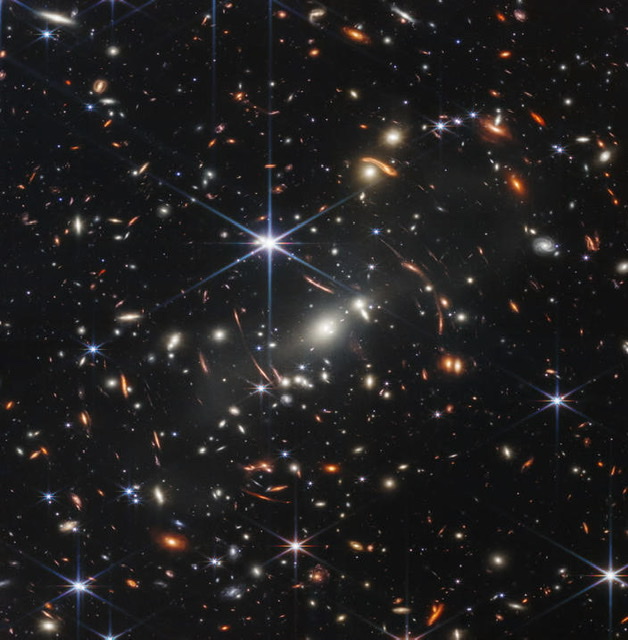 Nasa's James Webb telescope reveals millions of galaxies - Yahoo Science news. It will take some incredibly creative mental calisthenics to understand how a universe only ‘600 million years old’ can have fully formed galaxies present. How can this be? The more we look in infrared the more we will see this mind boggling phenomenon, fully formed galaxies…. Of course, if distant cosmic light is ‘gravitationally redshifted’, that’s another story. More to follow… Webb Space Telescope spots most distant black hole yet — and more may be lurking - Black hole 9 million solar masses a mere 570 million years since the alleged ‘Big Bang’? What’s wrong with this picture? This just in: Astronomers accidentally discover 'dark' primordial galaxy with no visible stars - Space.com (12 Jan 2024)
| ||||||||||||||||||||||||||||||||||||||||||||||||||||
| Ivan Alexander Username: Humancafe Registered: 12-2017 |
The Allais effect of Foucault’s pendulum, unexplained. 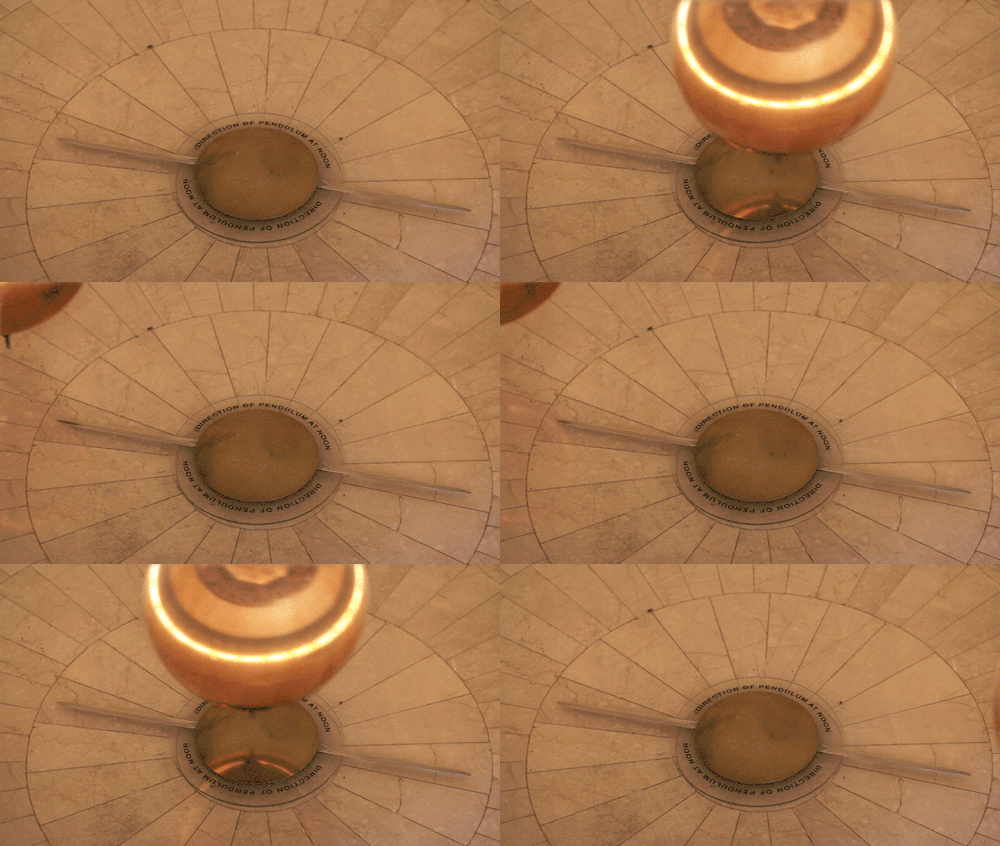 There is a mystery regarding anomalous behavior of Foucault’s pendulum during a total solar eclipse, first discovered in 1954 by Maurice Allais, where the pendulum had erratic swings of a slight deviation from its normal swings. This so called Allais effect had been subsequently tested with mixed results, but no real explanation thus far reveals why it happens. It may be an artefact of the moon’s shielding of the sun’s gravity, during total eclipse, or it may have another exotic explanation, such as gravity waves affecting the normal course of the pendulum’s swing. Or it might be an anomaly caused by ‘gravity lensing’ with alternative explanation of a dichotomy between light and gravity velocities. If this was the cause of anomalous pendulum swings during total solar eclipse, the Allais effect would have to show eight minutes (the time of sun’s light reaching earth) before the total eclipse is seen, which would indicate some sort of lunar shielding of the sun’s gravity. But this would be true if, and only if, the sun’s gravity shielded by the moon was felt ‘instantaneously’ while the sun’s light traveled at c, so the Allais effect would foreshadow the eclipse. For now it remains a mystery, if effect is true. | ||||||||||||||||||||||||||||||||||||||||||||||||||||
| Ivan Alexander Username: Humancafe Registered: 12-2017 |
What is “anti-gravity”? 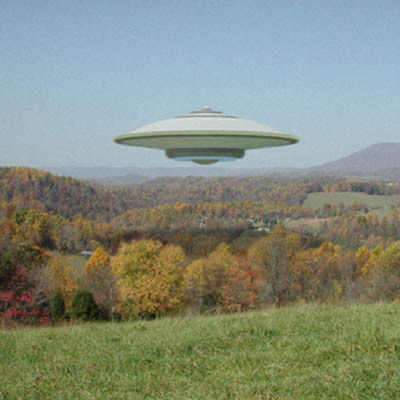 A good friend of mine asked me to explain in plain English “how anti-gravity works” per my understanding. A few minutes later I sent him this explanation, with links, to explain best I knew how: About Gravity/anti-gravity. * Now ‘anti-gravity’ is a bit more complicated, because it isn’t really ‘anti’ but ‘pro-gravity’ that makes it work. As I explained it here, why Moved-G motor works: Sometimes a friend’s simple question can lead to the synergy of a simple answer. Also see, just in: NASA engineer creates propulsion system that defies the laws of physics -
IDA | ||||||||||||||||||||||||||||||||||||||||||||||||||||
| Ivan Alexander Username: Humancafe Registered: 12-2017 |
Why does the lunar high tide happen on the opposite side of the Earth? Earth’s tides were a mystery even when Galileo tried to understand them, though he got it wrong, thinking that tides are due to oceans sloshing from the Earth’s rotation. Tidal bulge on the planet’s side facing the moon is easily understood, that it is attracted gravitationally. But the nearly equal bulge on the planet’s opposite side is not easily explained, as it is opposite the moon’s attraction. 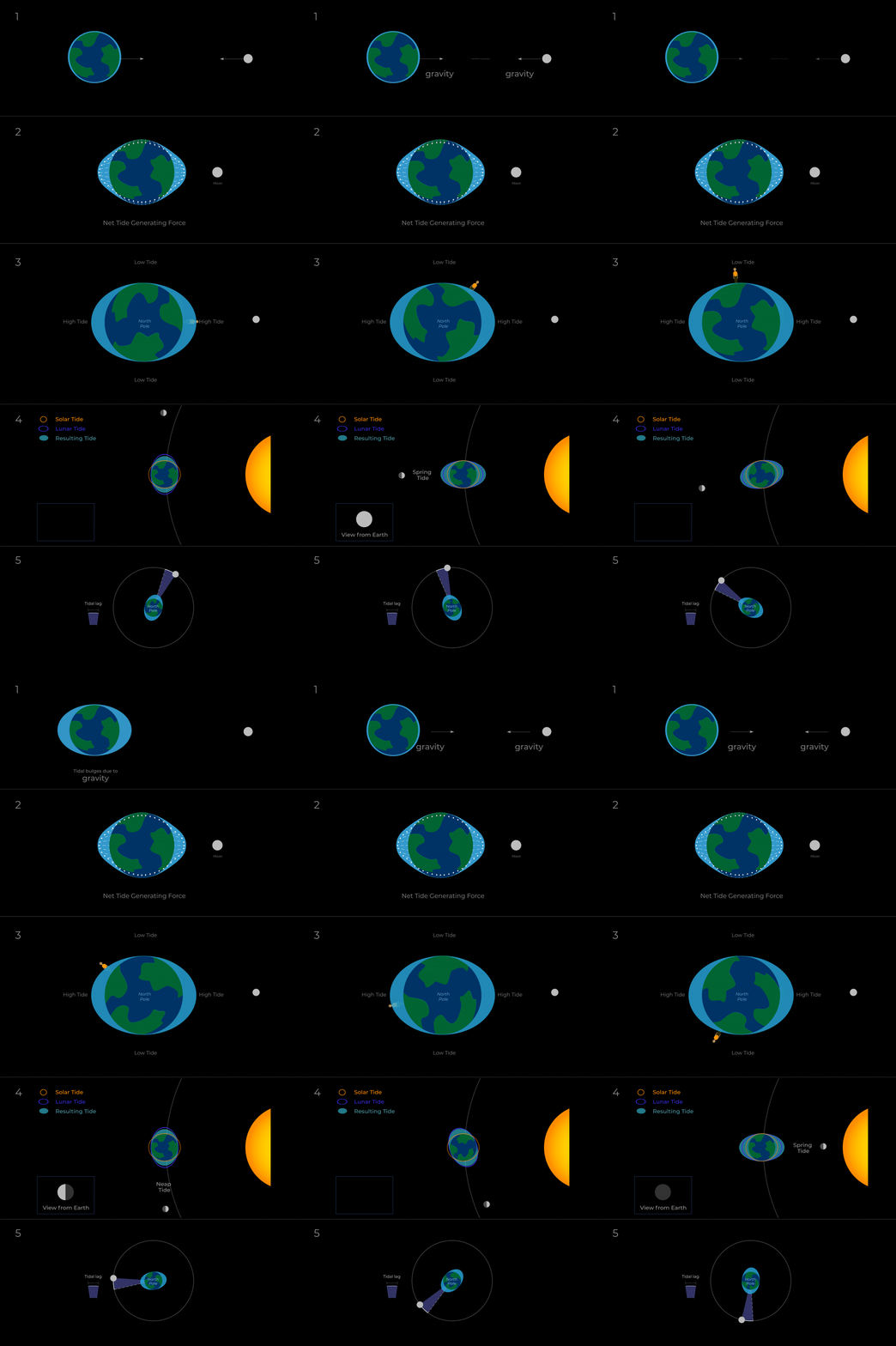 (interactive) (interactive) Tidal forces Earth-moon-Sun Or, as one usual explanation goes: Why do high tides occur simultaneously on opposite sides?: This is a line of reasoning most accepted, that the opposite bulge is due to ‘inertia’ of the water mass there. The other explanation sometimes offered is that the revolving Earth-moon gravitational barycenter is inside the Earth, so its centrifugal forces make it bulge on the far side since its center of attraction is not at the Earth’s center, so it is thrown off from gravitational equilibrium, not a convincing argument. Or as the same source explains: So if not centrifugal, and if not Earth-moon barycenter, what drives the inertial tidal pile up of water on the far side of the planet? 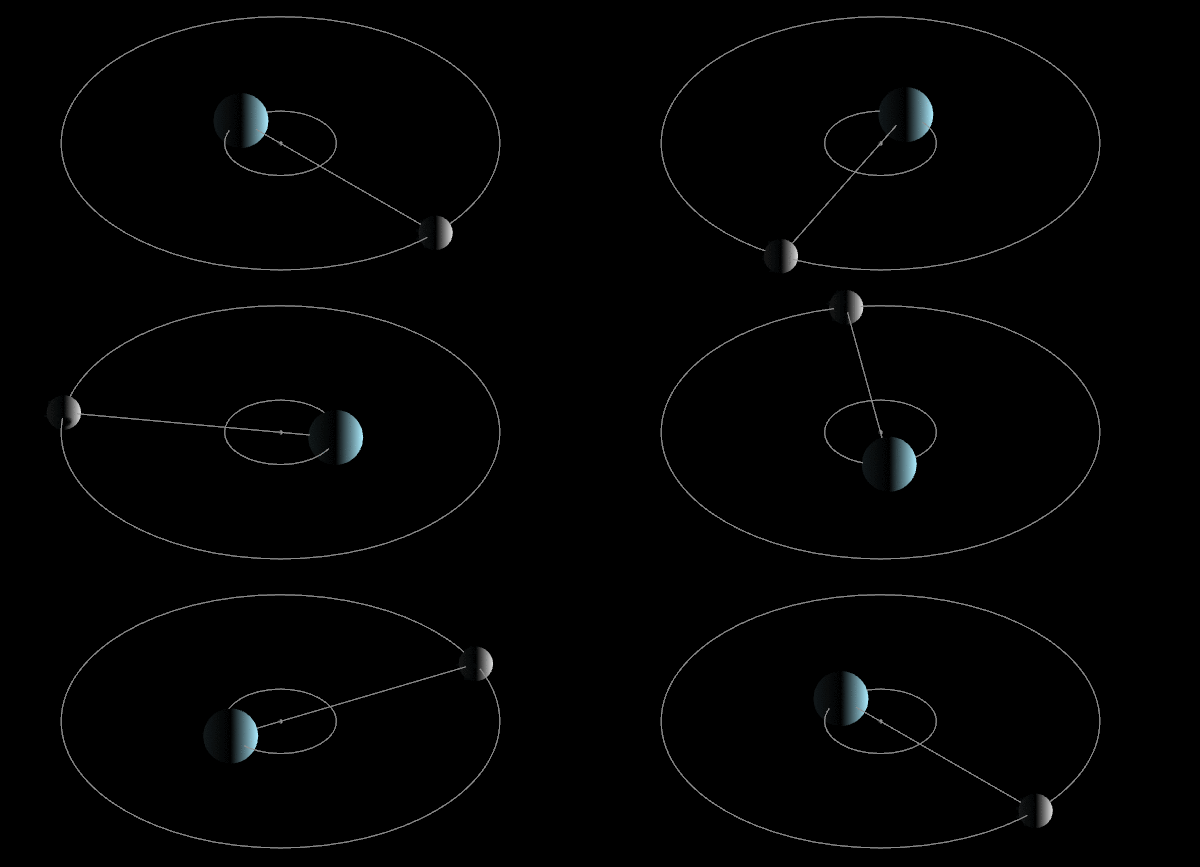 Earth-moon barycenter A corollary explanation is that because gravitational attraction decreases with distance by the inverse square law (actually 1/r^2 x 1/r, inverse cube law), the moon’s gravity is much weaker on the Earth’s far side, but this still does not explain why it bulges by nearly the same as on the near side; it might account for a partial difference, but not of nearly equal in magnitude without stretching the explanation . At this time, the inertia explanation makes more sense than the alternative explanations. The inertia explanation continues: So it is Earth-moon rotational, or ‘centrifugal’ about their barycenter, that drives the far side, regardless of the moon’s attraction? It seems tenable, along with the inertial explanation. 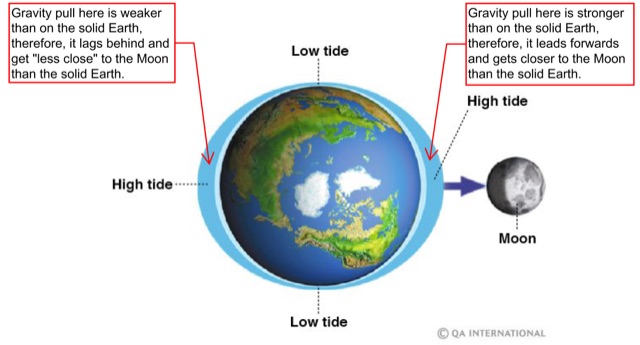 Inertial tidal forces from Earth-Moon barycenter effect “The key is to consider the differences in gravitational pull felt by the Solid Earth and both the water facing the Moon, and that oposite to it.- ibid There may be another cause for tides that is not directly related to inertial or centrifugal sources, but may be from vortex like forces of the planet’s oceans. Ibid: Not a very clear reason for why there is a tidal bulge on the far side of the planet, same as continental interference with tidal flows are tidal modifiers, but the idea of ‘vortex’ forces may have merit, which would invoke a Coriolis effect making Galileo’s explanation almost right. However, there may be an additional factor for the far side tidal bulge, that it may be from a kind of Allais effect, where the moon’s gravity is ‘blocked’ by the Earth’s gravity, so it acts as a shield on the moon’s force. This is not an accepted theory at present, but it mimics the accepted theory that the Earth-moon barycenter, being inside Earth, acts ‘as if’ it were to swing the far side of the planet on its barycenter, so there is an ‘extra pull’ on the planet’s surface. The resulting effect from this barycenter is that the Earth’s massive gravity acts so the moon’s forces are negated there, so resulting in a planetary bulge. But that barycenter idea may not be the real cause. Instead, while the Earth’s rotation distributes its water mass around the equator equally, it remains as a far side inertial mass bulge because of its lower lunar gravity from the ‘shielding effect’ of Earth’s mass itself, in a kind of Allais effect. So the far side bulge is not from a single factor, but resulting from a combination of three factors: the Earth’s rotation distributing inertial mass around the planet’s equator, the inverse square law diminishing effect on lunar gravity on Earth’s far side, and the Earth’s Allais effect (mimicking the barycenter effect) shielding the moon’s gravity. The result is an oceanic bulge that inherently (in addition to local factors, such as continental contours and amphidromic points) registers in toto what is evidenced as a tidal bulge on the opposite side of the planet. So which is it, the barycenter effect, or the Allais effect? Therein lies the puzzle. One more consideration, that of physicist Richard Feynman who also suggested the barycenter explanation for the antipodal lunar tide, from The trouble with Tides by Miles Mathis: Not a clue? Could Allais effect fill the gap? Four centuries after Galileo’s attempt to understand the cause of tides, what he understood wrongly, we are still struggling with the peculiarity of having a tidal bulge opposite the moon’s gravitational attraction. A three part solution as described may not be the best answer, perhaps no more than a Tyconic explanation, but it seems to fit what is observed, that Earth does not wobble from an unequal water mass distribution but is balanced on both sides. Or quite simply, the far side of the Earth weakens or blocks lunar gravity, so it is able to distribute ocean waters near and far equitably. IDA | ||||||||||||||||||||||||||||||||||||||||||||||||||||
| Ivan Alexander Username: Humancafe Registered: 12-2017 |
Measuring Einstein’s Relativity protocol.  It has been oft said that Einstein’s Theory of Relativity has been most thoroughly tested in the last hundred years, to multiple decimal points. But what is it that was actually measured? Was it the speed of light, a postulate of Special Relativity? Yes, that is well known. Was it General Relativity’s gravity space-time curvature? Yes, the curvature of light around large mass like stars or galaxies has been confirmed with astronomical observations, gravitational lensing, and light bending during solar eclipse; as has been verified General Relativity’s Mercury perihelion orbital precession; as well as space-time Frame Dragging of Gravity Probe-B, and gravitational redshift. But though these were found, they were not measured to multiple decimal points. So what had been measured of Einstein’s Relativity to such accuracy with tight constraints? Was it the time errors of Global Positioning System? Yes again, with GPS we are getting closer. The ultra-precise measurements that validate Einstein’s Relativity are in measuring ‘clock synchronization’, and these had been measured with accuracy to multiple decimal points. 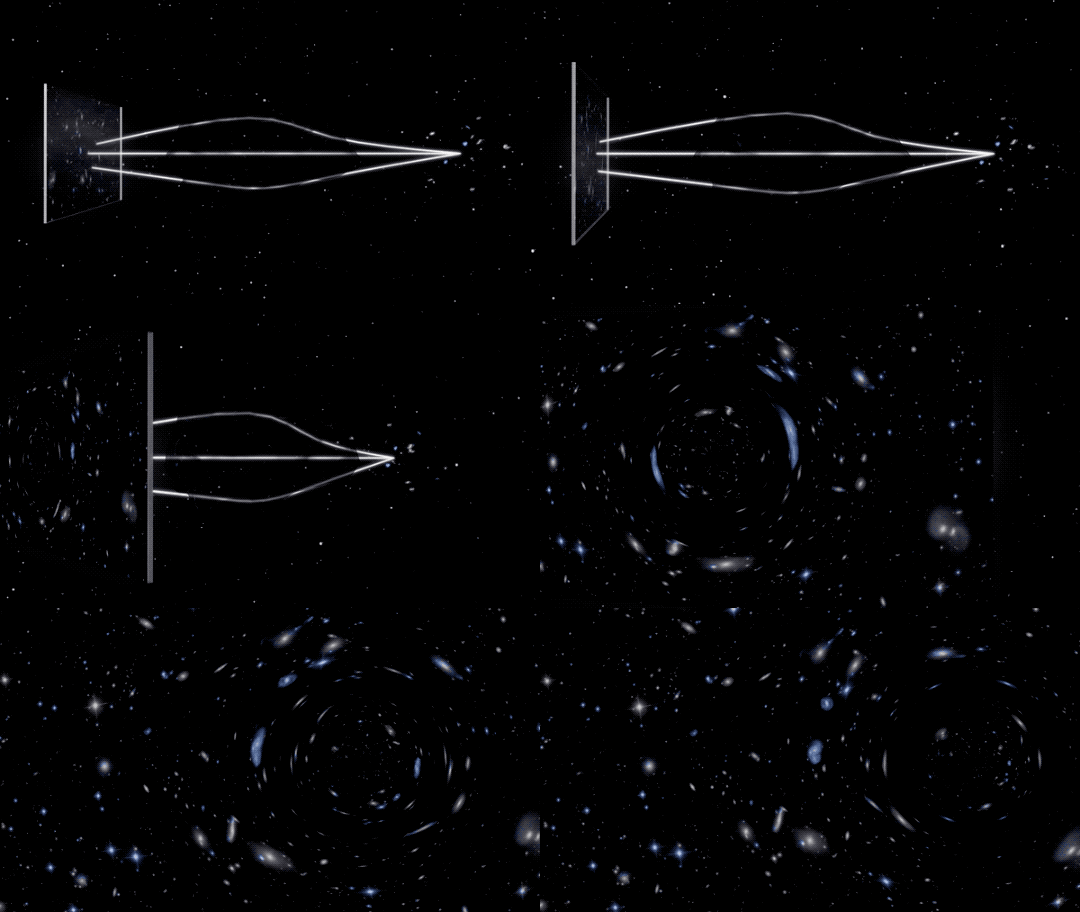 Gravitational lensing Here are some links, with quotes to illustrate: Relativity and the Cosmos by Alan Lightman - NOVAn
Theory of Relativity
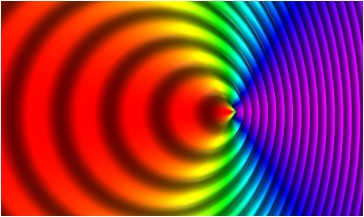 “A source of light waves moving to the right, relative to observers, with velocity 0.7c. The frequency is higher for observers on the right, and lower for observers on the left.” - Relativistic Doppler effect Testing Einstein's theory of general relativity
Einstein synchronisation
One-way speed of light
JILA Atomic Clocks Measure Einstein’s General Relativity at Millimeter Scale
The Most Precisely Tested Theory in the History of Science
Most precise atomic clock shows Einstein’s general relativity is right
 So in the end, what shows up repeatedly is “clocks”, which is what validates Einstein’s Relativity measurements protocol to ultra-accuracy (to within 0.00000000000000001% accuracy), in the measurements of synchronization of atomic clocks; this measurement then validates all other relativistic effects of time-dilation in both Special Relativity and General Relativity. The clocks must be measured as absolutely accurate as possible, as the whole relativistic effect pivots on this synchronization to validate the theory, and all its mathematics. Atomic clocks’ drift had been measured with precision to multiple decimal points, as Einstein’s Relativity protocol all hinges on knowing the precise time to validate the relativity calculations. IDA Also see: Time in a relativistic variable G universe - using lightspeed as a ‘yardstick’ for time. Mining ‘deep space’ Gravity - Humancafe - 2007 “LIGHT REDSHIFT DISTANCE TRAVELED AT 1 Z in intergalactic medium, with implications for deep space gravity G.” Not all reference frames are created equal | ||||||||||||||||||||||||||||||||||||||||||||||||||||
| Ivan Alexander Username: Humancafe Registered: 12-2017 |
Classical physics vs Quantum physics  Classical physics is defined by mathematics as its standard language. But what happens when the mathematics drives the physics, as it does in Quantum mechanics? Mathematical formalism may bridge the gap between the classical and quantum eras of physics if the results yield useable outcomes, as it appears to have. But the pitfalls are there, that the mathematics models our understanding to find what we are seeking, which may yield a 'mathematical fiction' with delusory, yet believable results. And if so, we may be understanding it wrong, though all the math works out. We study particulars in science, experimenting we see how these particulars interact with each other, think chemistry, and from them deduct theories reduced to laws of mathematics and physics of how the world is put together. The reality we are observing is interconnected in specific ways obeying these laws of how particulates interact. But the particulates, the atoms and molecules and their subsets, may not be the answers we are looking for. By themselves they are but islands in our understanding. What we are looking for is how they interact, each atom related to all other atoms, in an astronomically infinite complexity that defines each part of itself. Each particular thing in this interrelated totality, to infinity, is positioned within it exactly as the rest of it pressured it to be, itself there and then. That defines it. It cannot be any other way, and the laws and theories describing it are but reduced approximations, some approaching certainty while others remain probabilities, that give us some understanding of how they interact, but not how they formed through time to be what they are. From atoms to galaxies, the whole universe is interrelated to define every part of itself, and even us, our living, thinking and feeling, human being. How fabulous is that?! At this time we still do not know, do not really understand it, except that we have an infinite macro mechanism that we need to explore. How deep are the connections in their interconnected complexity? Where do they cancel out? Or do they? The particulates are easy, just study what they are; but the macro interactions are infinitely complex, and we can only deduce they exist, abstract for now, but not how they work. Yet, the answer is there, how the universe is infinitely interrelated to be what it is, all the way down to atoms, and us. In Richard P. Feynman's excellent little book, Six Easy Pieces, written from his lectures for undergraduates entering physics, he presents with his characteristic good humor the evolution from classical physics to the more recent explorations into quantum and relativistic physics. It was quite a journey, and he makes it fun to read, easy to understand. Starting with the atom and the atomic periodic table he works through electric fields and magnetism to wave theory, then to waves as particles, showing the progression that ultimately led us to quantum theory. But once we got there, the particle-wave duality of classical observations failed us; we could not see into the atom. So that was where the mathematics came in, to drive our 'observations' with mathematical models that would describe what we see, such as observed (statistically) in electron interference patterns, or atom smashing experiments. And to date they have been quite successful. We do not actually understand what electromagnetic energy is, nor what gravity is, though we have put to good usage what part we do understand, how they work. Perhaps a new approach to understanding these forces might yield a fuller understanding of what they are, but are not there yet. There had been an attempt to understand these forces here, in Humancafe's forums, awkwardly developed with stock off-the-shelf equations, some argumentation back and forth, which may yield some insights into what they are. Though crude and naive to be sure, but with interesting results, we found 'something'. For example, posted 2008, The Atom, what is it exactly it explored the concept that the atom is made up of a strong force modified by electromagnetic energy. These interactions then leave gravity as a remainder. As understood there, proton mass is variable depending on its distance from the sun, where further out it grows, but is 'constant' in any given orbit. This dovetails nicely into the Axiomatic Equation (E=hf=mc^2, quantum equation), where energy is E=E always, and gravity, Newton's G, grows with distance from the sun (at about 1G/AU). There were further collaborative discoveries supporting these conclusions listed at Count-down to Strangeness, which together supported this concept (inconclusively until G measured outside earth's orbit) though at this time unknown, unconfirmed. So there may be a new way to understand forces in physics, where only two forces interact, that of (cold) gravity and (hot) electromagnetic energy, both inversely proportional to each other. The strong force and weak nuclear force are a subset of the two. Of course, these concepts rest on the shoulders of the science and physics developed by others over the centuries to date; it can be falsifiable with distant solar system verifications of Newton's G. This validations would have consequences on our understanding of cosmology, the Hubble constant, the so called Big Bang, and how space gravity works. So much more to explore! But all this must still dovetail into a universe that is interactive and self defining, where each thing is as the pressure of everything else allowed it to be, what here had been called 'interrelationship', to infinity. How to reconcile that with the rest of physics, of what we understand it to be? This is still a very tall mountain to scale in our understanding the world. No doubt, we will be busy for a very long time exploring it. And when we think we do, another mountain will be seen beyond it, of which Quantum physics will be but a small subset. So we will climb that too. Or as Richard Feynman had said after explaining the fundamentals of Quantum mechanics illustrating Heisenberg's uncertainty principle: "We would like to emphasize a very important difference between classical and quantum mechanics. We have been talking about the probability that an electron will arrive in a given circumstance. We have implied that in our experimental arrangement (or even in the best possible one) it would be impossible to predict exactly what would happen. We can only predict the odds! This would mean, if it were true, that physics has given up on the problem of trying to predict exactly what will happen in a definite circumstance. Yes!. And therein lies the spirit of how works the universe in terms of itself, that in its interrelated, infinite totality, it knows exactly! What Feynman is pointing out is that we, with our limited understanding of the universe at the Quantum level, are left with uncertainty. Only the universe is certain. IDA |