Em • c = h/l(eomo)1/2 =(Bm)c2 = (1-g)c2 = Eenergy
If the above Axiomatic Equation is true, then the next challenge will be to convert it all into the same basic dimensional units, so that amperes, electron volts, Joules, Newtons, can be unified to be expressed universally into their energy equivalents either in kilograms (which is a function of gravity), meters per second (a function of photon light), or Hertz (a function of EM energy lambda), or into...(?)
The Fundamental Physical Constants to be worked with are:
c: Speed of light in vacuum: 2.99792458 x 10⁸ m/s
h: Planck constant: 6.6260755 x 10⁻³⁴ J.s
(also expressed as [m2.kg.s-2].s)
g: Gravitation constant: 5.9 x 10-39 m3.kg-1.s-2
(also as Newton's G = 6.67259 x 10⁻¹¹ m3.kg-1.s-2)
eo: Electric permittivity in vacuum: 8.854187817 x 10⁻¹² F/m
mo: Magnetic Permeability of vacuum: 4p x 10-7 N/A2
where g, h, Bm, and Em may be variable-constants depending upon the EM wave l and velocity of c.
Mass is always m = 1, which can be expressed in kilograms as kg/kg, a function of gravity (i.e., m3.kg-1.s-2) when the meters-cubed and per seconds-squared are dropped, or m = 0, when positive and negative charges cancel.
l: EM lambda: expressed in m (per second, but can also be in Hertz)
So this is the Challenge, to convert all of the above into universal units, such as the SI base units.
Good luck!
Ivan
By Ivan A. on Friday, July 4, 2003 - 04:50 pm:
ONE SMALL STEP ... work in progress...
...ONE GIANT UNIFIED STEP FOR _______ ?
CHECKING MATH TWICE, with a simplified explanation of Axiomatic Equation.
ADDENDUM, it's about Time:
RE the Axiomatic Equation:
RE above, RE Axiomatic Equation:
E = mc2 makes sense, even with atomic mass already at v = c.
PETAJOULES?
ELECTRON'S MOMENTUM If we substitute the value of E with the high energy of mass and momentum, we get: pc = [E2-m2c4]1/2, where 'p' is the electron's momentum. (See math at: Em * c = hc/l = h/l(eomo)1/2 = (Bm)c2 = (1-g)c2 = Eenergy ®*
MAXWELL'S & AXIOMATIC, continued:
AXIOMATIC EQUATION REVISITED: Breaking out the parts of the whole.
POSTSCRIPT, to Axiomatic Equation Revisited:
RANDOM THOUGHT ON CM = E^1/2, the square root of Energy.
this was very interesting....
Dear Anon,
ONE KILOGRAM VS. PROTON, as per Axiomatic Equation.
MOMENTUM, and gravitational mass.
ZERO POINT FIELD - ZPF
MASS FUNCTIONS, per the Axiomatic New Physics.
ZERO = 1/N, where N =>> INFINITY??
What is Zero?
DANGERS OF AN "AXIOMATIC DRIVE" ENGINE
THEORY VS. REALITY
THINKING ON GRAVITY G, a possible interpretation in Volts? G^2 (m)^2 = g (m) c^2 pi^2, which simplifies into:
THE AXIOMATIC EQUATION FOR GRAVITY IN G
AXIOMATIC CUT-OFF FREQUENCY FOR GRAVITY?
DOES LIGHT HAVE MASS?
The "Allais Effect" is mentioned in this Economist article on gravitational anomalies: http://www.economist.com/science/displayStory.cfm?story_id=3104321
ENERGY AND GRAVITY SLOPES, as computed using the Axiomatic Equation.
PLEASE NOTE: This above work is not yet the final product, though the charts appear to work okay. There will still be the necessary adjustments to both total orbital Energy for the planets, as well as their mass, and hence their gravity variable constants, in order to bring everything into line with GM = Rv^2 as a final test of consistency. The error that appears throughout this work is that planetary mass was taken from current astronomical calculations, but these mass calculations, derived from Newton's orbital equation, included a constant Newton's G, so that the planetary mass may be off, so will need recalibration. Only Earth's mass would remain the same. To correct for this is the future project still in progress. Once an all inclusive uniform consistency for both G and mass is achieved, the final stage may then go in. It will change the above charts slightly, including total orbital Energy and planetary G constants, but the overall direction appears to be correct. Similar proportions should result, though the slope of both the Energy and Gravity curves should change somewhat. If it all works, the planetary spin should also fall into place. Please consider the above still a 'work in progress'. Stay tuned.
This is fantastic!!! Brilliant brilliant brilliant. A unified theory of cheese. Mozarella and Swiss and Cheddar and American and all the cheeses coming from one magical equation! Godspeed you young king of math, godspeed indeed.
You are not taking into account that space plasma is like glass in respect to the traveling of light through the medium. Please look at at my "Tired Light" theory, I think you'll realize you need to change quite a few things with your "new" physics.
I already proposed this theory back in 1965. I was in a hot tub with Carl Sagan and presented to him on a bar of soap the Axiomatic theory of physics. If you doubt it just find the 1969 article of mine published in "Sky & Stars & Other Large Things" where I actually have tests *PROVING* axiomatically that the 19.5 parallel on every planet has an axiomatic hexagon that gave the people of Cydonia their power.
... I'm just slaving away in the attic into the wee hours of the night, trying to mend the errors of my ways.
Hi Richard,
My Hyperdimensional-Axiomatic Theory is the foundation for a "new" era of physics. Yes 19.5 IS important because that is where a rotating body will create with gravity a hyperdimensional conduit, which is why all this energy appears at 19.5 degrees at all these planets. Gravity allows this hyperdimensional-axiomatic energy to flow into our dimension, thus increasing the energy of the system. Axiomatically the dimension we are in is tied via a hyperdimensional hexagon to other dimensions. It requires angular momentum and electromagnetic energy to really see this phenomena. I have used Hypdimensional Geometry on Mars Cydonia plain to show that *someone* understood this and was trying to pass along this information a millenia ago. Look at my website and you will see the math I use on the various maps of Cydonia prove without a doubt that hyperdimensional energy exists and that it can be shown axiomatically.
Thanks for the explanation, Hoagland.
So basically what you're saying is that gravity gets stronger as electromagnetic gets weaker? This is intriguing. I must tell you, I've been doing experiments that may prove everything you have here! So I had a biiiig slice of cheese pizza, and I noticed that as I went from the hot, hot rays of the sun to the cool relaxation of my air-conditioned apartment, the pizza felt lighter. Could it be, I wondered, that cheese, much like Superman's nemesis in Superman IV The Quest For Peace, that cheese is affected by the sun? So I left one cheese pizza out in the sun for 2 hours, then ate it. Then I ate another cheese pizza indoors. I was definitely alot heavier after eating all that cheese, and let me tell you, things don't move too well after all that! So there you go, I don't know if you want me to write that up in a more scientific way, but I think that proves your unified theory of cheese. Come to think of it, Superman himself got his powers because the earth is under the yellow sun, not the red sun of Krypton. Maybe you should call your theory the Superman Theory! Ride that rocket, you Kal El of the Physics world!
Ah yes, thank you for posting my website. I was not going to do it myself, I'm not one for promoting myself in such ways, but I appreciate the gesture. I will talk to my webmaster about getting a link to your fine website as well. The piece you are missing in your equations is incorporating hyperdimensional energy. It is the hyperdimensional energy that enables the axiomatic relationship between electromagnetic energy, gravity, and mass. Your theory is result of hyperdimensional physics. I was at a Chinese restaurant with Arthur C. Clarke back in 1968 and I pointed out this very conclusion. He was stunned, needless to say, and incorporated it into several unpublished short stories.
Aaron, you're a riot! I love it! More cheese, please, especially the Gorgonzola. See if any of your Superman cheese theories might explain the Allais Effect better than we had to date. As you no doubt know, it's at the Bad Astronomy's Allais Effect casts doubt on GR?. Have fun!
Hoaggie, I would love a merge of hyperdimensional physics, incorporating mass, energy and gravity, since I think this would really clinch it. But I must proceed only one step at a time, so not there yet. These above postings are a kind of 'stream of consciousness' on the matter, showing how the math works and where it seems to be going. When I am closer to my goal, which is to show how internal black-body heat of planets relates to their spin. That's what I'm now working on the page titled Does Gravity zero-point Energy Explain Spin. I'll be in a better position to write a formal paper when I get there... but not yet... just not yet.
When Maurice Allais was growing up, his parents owned a small cheese shop. Cheese would figure greatly into Maurice's early life and would influence his entire professional and personal career. His first bed was made out of cheese, as were all the furnishings and indeed, even his clothing. Needless to say, in elementary school he was often harried by small-minded children and small-bodied rodents. His favorite shirt was made of Crottin de Champcol, a versatile goats milk cheese. Pascal Jacquin put a lot of effort into this cheese so that it can be enjoyed from young, for salads and crostini, to old, for grating. Crottin de Champcol is made in the Loire around Sancerre and Berry, and is named for the tiny village of Champcol. Crotin in French means horse or mule dung. Not a particularly appetizing description but nonetheless a rich a flavorful cheese. Crottin Jacquin are produced in Berry, near Cher. Driven to long days of lonely play by cheese-ostracizing peers, young Maurice turned to scientific experiments to fill his time. He built his first cheese pendulum at the age of 8. It was made with Argentinian Reggianito cheese. The vast grazing pastures of Argentina revealed themselves to be ideal for immigrant Italians wishing to produce Parmesian cheeses in the new world. Reggianito translates to little Reggiano, so called because instead of a massive 80 lb. drum, the Reggianito cheese is produced in 15 lb wheels. Reggianito is cured longer than any other South American hard cheese which enhances its flavor. This cheese tastes a little saltier than its namesake, but the white crystals in the Grana are not salt grains, they are due to the lactose in the milk which breaks down into free amino acids. Because the cheese was so hard, it was perfect pendulum building material. It was with this pendulum that Maurice discovered the “Allais Effect”.
Ahh... mais oui, si! Je le vois!
More on Pioneer Gravity Anomalies, per PhysicsWeb:
Ivan-
Thanks J___!
Ivan,
J___,
STRANGE GRAVITY?
It is quite impossible to determine the tastiness of cheese from a distance. Yes, the color, texture, and smell to some extent can be determined, but let's face it, smell has ever been a false indication of taste in the cheese world. Some of the best cheeses smell like my dead granny's socks. And 10 cheeses in the bush are worth one in the hand, so to speak. Sadly, the flavor only reveals itself when the tongue and cheese share adjacent space.
Some of the best cheeses smell like my dead granny's socks. And 10 cheeses in the bush are worth one in the hand, so to speak.
Gravity constant called into question, NewScientist.com article.
As posted on BadAstronomy's "Gravity behaving BADLY": http://www.badastronomy.com/phpBB/viewtopic.php?p=352579#352579
THE G 'CONSTANT' PER AU DISTANCES, and the Pioneers Anomaly.
I have calculated that by eating 100 packages of Fig Newtons and a cheese pie every day I can acheive a constant rate of growth of 4 lbs. a day. Hence "Newton's Constant" is indeed a constant when applied to a body at rest, and needless to say the body will remain at rest after that cheese pie! As for you, Sir Ivanhoe, I really think you're on to something. Gravity is definitely being mischievous with those space probes. It's also being mischievous with my sock drawer..where is that other sock??!?? I wonder if its disappearance is related to that dream I had last night about eating a long fat noodle....no, I blame Axiomatic Gravity for my woes!
ERRATUM: Correction for Pioneers' acceleration towards the Sun, per above post of Oct. 23, 2004, as derived from Axiomatic Equation.
EXACTLY WHAT IS "Em/Bm = c" , in terms of magnetic storms on the Sun? "Astronomers suspected that such titanic energies were
I haven't had a good Bm in days. I ate a whole block of Velveeta cheese the other night...
Aaron,
"Are our theories of gravity wrong?"
AXIOMATIC EQUATION, Revisited:
AXIOMATIC, Revisited-2, adjusted for gravitational constant "g":
I am an inventor/Engr and still waiting for the gods to smile on me as Ivan said. Did you know that Gravity Blocks Reaction if use an activated counterweight properly? A motor will thus come up to speed in 1/2 the time. Also a motor 1/4ths the size has the same power. Please tell the hybrid car people. Otherwise we waste 3/4ths the energy when accel or decel. See www.intersurf.com/~propul Thanks Richard Foster
The gods are smiling at you Richard, they're smiling at you alot.
ATOMIC MASS AS A GRAVITY AND ENERGY FUNCTION, PER AXIOMATIC EQUATION
A THUMB SKETCH OF AXIOMATIC EQUATION, and why it is important to look for more evidence.
Variable Newton's G simplified.
"Note, whether we measure mass as a function of gravity or as a function of force, it is always the same. Einstein, and Newton, and Galileo before them, got that right. What they had no means of knowing was that in a variable G scenario, a greater G' makes for a greater inertial mass. Why would they have ever suspected a variable G if GM=Rv^2 works and matches Kepler's orbital equation? They had no reason to suspect it, so they went with an assumption, that G is everywhere the same. Now, how can we test for a universal constant G not being true?
Michael, I think I see what you're getting at: JUST Hear me out What if it is a varible M and not a G?
"So the Sun's massive gravitational force puts near orbit bodies into immense spin, but that's only half the story? The other half is that so near very high solar energy flux the inertial mass is very low, so all things move faster? Intriguing idea."
Here is a good article which shows a simple, documented article of how gravity is effected
Lab fireball 'may be black hole' Ten times as many jets were being absorbed by the fireball as were predicted by calculations.
I don't want to lose my cheese to the evil black holes!!!
I don't want to lose my cheese to the evil black holes!!!
DEEP SPACE GRAVITY?
GRAVITY PARAMETERS ESTIMATES OF G, per the Axiomatic:
DUAL NATURE OF ELECTROMAGNETIC WAVES. Louis de Broglie came close to discovering the real nature of the wave functions with his dual wave model proposing that a particle is formed by a physical wave, which is accompanied by second 'probability wave' the Schrodinger wave function. Louis de Broglie then made a bold speculation: If light really is a stream of particles why shouldn't other particles also have their own waves? He used Einstein's relation for the relationship between the energy of a photon and its frequency, E=mc^2=h*f, suggesting that the corresponding relation also might apply to particles like the electron, proton and neutron.
Magnetic portion of Axiomatic Equation revisited. Per post above dated Nov. 6, 2004, I had written: E = Em * c = (Bm)c^2
The Rule of In-radiating vs. Ex-radiating Energy.
I figured out the unifying equation for cheese!
Fiver orders of magnitude higher G: A way to estimate it (intuitive, very rough guess) is to take the opposite tack, and to leave lambda same as we have it here, l = 1.32E-15 m, and then solve for proton mass:
Energy equation per the Axiomatic: If G^2*m = gc^2 pi^2, then it stands to reason that, being a function of c^2, the actual mass (1-f[g']) should be (1-f[g] pi^2) on the right side. So now, the full equation (leaving out the Maxwell equations) should be exact:
Gravity component in Axiomatic solved. What remains to be resolved at this point is balancing E' with (1-[f(g')pi^2]) c^2.
LIGHT REDSHIFT DISTANCE TRAVELED AT 1 Z (in intergalactic medium), with implications for deep space gravity.
I believe the above Challenge can be approached with the knowns, and then to solve for the universal dimensions unknown:
The known dimensional values:
h = m2.kg.s-1, also J.s, or (m2.kg.s-2.s)
c = m.s-1
l = m.s
mass = kg/kg = 1
From these we can construct:
hc/l = (m2.kg.s-1)(m.s-1)/m.s
...which is the same as h/l(eomo)1/2 in the Axiomatic Equation, so that by canceling and multiplying we get:
hc/l = m2.kg.s-3, which therefore gives us a value that is also J/s, Joules per second, and equal to W, or Watts' power radiant flux.
Therefore, this is our operative equation for all the others, so that we can now look for functions of those unknown to us: (Em.c), (Bm)c2, and (1-g)c2
These should now follow:
Em.c = (m.kg.s-2)(m.s-1), so that Em = m.kg.s-2, which is Joules per meter, which is also the Newton force.
(Bm)c2 = (kg.s-1)(m2.s-2), so that Bm = kg.s-1, which is Newton per meter per second, or Joules per meter squared per second.
(1-g)c2 = (kg.s-1)(m2.s-2), in which (kg/kg - g) is Newtons per meter per second.
So that for the Axiomatic Equation:
Em.c = h/l(eomo)1/2 = (Bm)c2 = (1-g)c2 = Eenergy = m2.kg.s-3,
...which means that Energy is an expression of the power radiant flux Watt, W, which is also J/s, Joules per second, all expressed in the universal dimensions of meters, kilograms, and time.
Ivan
... am I getting it right? If it is, we should be able to plug in numbers and make it work.
By Ivan A. on Monday, July 7, 2003 - 12:43 am:
While jogging the ridges of Williams Canyon under a hot California sun, my two wolf-dogs and I racing the horseflies (all agreed the flies won), it occurred to me that we already had everything we needed to complete the Axiomatic Equation, including the numeric values. With values for lightspeed, lambda, and Planck's constant, and knowing the universal dimensional units, the rest is easy.
Here is how it looks:
Since c = 1/(eomo)1/2 = 2.998e8 m.s-1, then:
Em x 2.998e8 m.s-1 = 6.626e-34 m2.kg.s-1 x 2.998e8 m.s-1 / 2.2087e-42 m.s = (Bm) 8.99e16 m2.s-2 = (1 - 5.9e-39 kg.s-1) x 8.99e16 m2.s-2 = ~8.99e16 m2.kg.s-3 = Energy, in Joules per second, or Watts.
(Please bear in mind that kilograms are a function of gravity force, an abreviation of "m3.kg-1.s-2" into "kg".)
So all that is missing:
Electric force = Em = ~2.998e8 m.kg.s-2, which is Joules per meter, or the Newton force, and:
Magnetic potential = Bm = ~1 x kg.s-1, which is Newtons per meter per second, or Joules per meter squared per second, to complete the dimensional values for the equation.
(Ps: Please note that the Magnetic potential constant of the Axiomatic Equation is not the same as Magnetic force. The relationship between the two is that Bmagnetic= A/m = m-1.kg.s-2 is an expression of (m.s) EM lambda, to become Bm = kg.s-1 value of the Magnetic constant.)
Therefore, for our solar region of space, these are the values that tie together the Axiomatic Equation into a relationship of Electric force, light lambda, Planck's constant, lightspeed, Magnetic potential, and Gravity.
Cold reason, a more masculine trait (or curse), may have created the equation, but there is something in the hot sun that brings about the blessing of feminine intuition, and that is how it all came together for me. There are only two forces, Gravity and Energy, and all else, including the self canceling strong and weak forces, is ancillary to these. In effect, we have here what is beginning to look an awful lot like a Unified Field theory. But its application is not yet, and if the gods saw fit to give Promethaeus fire, a light energy source we had been using since that ancient time of legend, then what future legend lay in our use of darkness, of the gravity we may now be able to tame? This is the great work that still needs to be done, to tame gravity through the canceling of fire, of light energy, in all its lambda. And if we can tame this universally present, and very intense force, Gravity, then a whole new world opens up for us, not only of space travel and exploration, but of a new energy source for us here on Earth.
Fantasy or fact? Is this right? We will not know until we discover whether or not gravity is a universal constant, as Newton and Einstein and their successors of modern physics theorized, or it is a variable-constant, as the Axiomatic Equation theorizes, inversely proportional to the abundance of energy in any given region of space. This, really this, is still the great unknown.
I suspect it will be the latter, and though the math may work, until this is known, it is mere speculation, which says Einstein's famous formula was right on (but only missing a constant). The truth is out there, and once we find it, the thinning branch of Modern Physics will have to give way to the more robust limb of a New Physics. If so, then funding will inexorably shift from current research to the new physics research. Then, and only then, can we move forward into our future destiny as humankind. We may be at the start of a great journey. But to get there, we must first obey the new Prime Directive, that we stop killing one another, that we learn to interact with one another through a process of agreements rather than coercions. Only then, when we become conscious of Who we are as free human beings, will our great Universe open up its secrets, and like a living eye over its children, will it cast its brilliant light with new knowledge upon us.
This may be all because of the new Axiomatic Equation:
Em. c = h/l(eomo)1/2 = (Bm)c2 = (1-g)c2 = Eenergy ©
I thank all of you for your kind attention,
Ivan
Habeas Mentem
By Ivan A. on Wednesday, July 23, 2003 - 09:55 pm:
Since I got such controversial responses from my earlier post of the Axiomatic Equation, everything from "this makes no sense" to "insane", I went over the math again. Not wishing to be the only one in the world who understands this equation, I thought to show it as simply as possible, this time leaving out the dimensional values. So this is the pure math. The lines below are numbered, so any criticism can be directed to the lines in question, and I also included links from where I lifted the functions used. Not in question here the physics, but the math. Granted a new idea cannot come about without challenging the old, so I list below where I introduce new concepts, and why. It is all made to equal E = Energy.
1. E = mc^2, a very famous equation.
2. E = hc / l,
where h=Planck's constant, l=photon lambda, c=photon velocity. This is an expression of the natural interaction of radiation and matter, derived from
Ephoton x lphoton = hc, as per: http://hyperphysics.phy-astr.gsu.edu/hbase/forces/couple.html
3. E = Em /(eomo)^1/2 ...really!
where in taking Em /Bm = c, from the Electromagnetic Wave equation at: http://hyperphysics.phy-astr.gsu.edu/hbase/waves/emwv.html , and taking c = 1/(eomo)^1/2, as per http://hyperphysics.phy-astr.gsu.edu/hbase/electric/elefie.html#c1 , we can rewrite it into Em/c = Bm , which further converts into Em (eomo)^1/2 = Bm. However, this is not yet complete, and here some will cry "foul!"
Using the original E = mc^2, and introducing a new value for mass = m, we have a new way to express Energy = E. The new concept is that the atom is a product of outside energy and a superstrong gravity in its nucleus which results in a balance of these two forces that are the basic atom. However, the balance is not total, and hence there is a remainder force. For the magnetic force, the positive and negative inside the atom cancel to zero, but there is a remainder which is the atom's magnetic potential. Therefore, by this reasoning (not in current usage in physics, where the atom is a product of a positive nucleus and negative electron shell) the mass of E = mc^2 can be defined as a magnetic component of m = (zero mass) + Bm. The result (whether or not anyone agrees with this, math only!) is that E/c^2 = m can be rewritten as E/c^2 = 0+ Bm , which is equal to E = (Bm)c^2 = (Bm) x 1/(eomo),
which by substituting Bm (as per above) leads to E= Em (eomo)^1/2 x 1/(eomo), which by canceling is equal to E = Em /(eomo)^1/2 (as listed in #3), which is also:
E = Em * c ...so Energy equals Electric force times photon velocity... this really is new!
So now we have three equations all set to equal Energy = E. To bring them together:
4. E = Em * c = hc/l (by substituting c = 1/(eomo)^1/2 ) = h/l(eomo)^1/2 = mc^2, all equal as Energy.
By the same reasoning as above, that the atom is a product of energy and a super force gravity nucleus, the other remainder force of this balance of forces is gravity. What this means is the interactions between these two forces do not exactly balance out, but there is a remainder from the nucleus which becomes the very weak gravity we experience.
Therefore, by substituting "m", it can be written as mass = m-g ( where "g" is a negative force) for each atom. In the aggregate, this small g is a component of the gravity field created by all mass. Again, it is the math I am after, not the physics concept, which I am sure will be controversial. So in setting mass as m = 1, which is kg/kg, or one hydrogen atom, and with the gravitational component as m = (1-g) and with the magnetic m = 0+Bm , we can write, math only:
5. Eenergy = Em * c = h/l(eomo)^1/2 = (1-g)c^2 = Bm * c^2 .
So in these five easy steps, the math is developed into an equation for Energy. The physics involved may be controversial, speculative, or plain wrong. But that is not the issue here. What is in question is: Does the math work?
And if it does not, then which of these five steps is wrong?
* * * * *
As a comment, I should note that the result of this equation is that the gravity and magnetic potential atoms feel in our solar region are the product of the output of energy generated by our sun, that they are somehow inversely proportional, and that if we were to take these measurements far away from our solar energy, they would be different. That is how this Axiomatic Equation plays out, that gravity is a variable constant, and it will be a different constant for either different stars and galaxies, or out in deep space. We will not know this, however, until we go out there and find out.
Ivan
By Ivan A. on Friday, August 1, 2003 - 03:59 pm:
I should note that all measure values in the above Axiomatic Equation are per second, so that even mass, here expressed in kilograms, is nevertheless per second. This could be interpreted as the Equation having a continuous time function expressing Energy as Joules, which in being also per second to become Watts, is always in the process of becoming, an event through time. So time is not an additional coordinate in space time, but rather is an algebraic component of the equation.
The Equation, thus understood, never stands still, but is always incorporating into itself the passage of Time.
Ivan
By Ivan A. on Monday, August 4, 2003 - 11:44 pm:
I think I can see where the problem rests with this equation, and why people have trouble with it. It's in the:
E * c = E portion of the equation.
We know Em/Bm = c, so that Em/c = Bm, and if both sides are multiplied by c^2, we get:
Em * c = (Bm)c^2, as the Axiomatic Equation says.
However, why should this be equal to E? How do we know that Electric force times speed of light equals Energy?
If we can show this, then I think we had better start to measure gravity on Pluto, because it will be "heavier" mass than here on Earth.
Ivan
By Ivan A. on Thursday, August 7, 2003 - 08:25 pm:
I think the problem with this equation is its conclusion, not its structure, so that all who oppose it do so on a principle that it does not coincide with the known physics, which it should not.
If Em/Bm = c is a good function, then it follows that Bm * c = Em, which has been at the root of the problem where:
Em * c = Eenergy
But there is no mystery here, since it only means that an electron accelerated to light speed becomes energy, very simple. And vice versa, energy is broken down into mass and gravity and magnetic force. Truly elegant and simple, so that (Bm)c^2 = E is no more a mystery than all the rest of the equation, since in the original, Bm * c = Em, is only a reflection of this accelerated to lightspeed c, to meet the conditions of what the equations says: It says, in simple terms, that in accelerating an electron to light speed, it turns into pure energy, which is then broken out according to the equation in how interrelate Planck's constant, photon lambda, light speed, which result in mass minus gravity and plus magnetic potential force. Simply that and no more. Of course, these further then break down into other useful component equations, per the known physics. The only difference is that the Axiomatic Equation now explains the gravity to electromagnetic relationship for a star system or deep space. Otherwise, it rolls back into the known physics from which it came.
So if there is opposition to how the equation was written, let it be expressed not in terms of what the equation says, or generalities, but where the structure is faulty. To date, other than criticize it in whole, no one has shown where the error is.
For reference, I list these Magnetic and Electric Power links:
http://hyperphysics.phy-astr.gsu.edu/hbase/magnetic/genwir3.html
http://hyperphysics.phy-astr.gsu.edu/hbase/electric/ev.html
-compliments of Hyperphysics.
In final analysis, the only difference between the Axiomatic Equation and the known physics is that Gravity is NOT a universal constant, but inversely proportional to the level of Energy in the environment where it is measured. Period.
Ivan
By Ivan A. on Wednesday, August 27, 2003 - 08:31 pm:
The Axiomatic Equations says:
Em * c = hc/l = h/l(eomo)1/2 = (bm)c2 = (1-g)c2 = Eenergy º E = mc2
This means, therefore, that electric force, which like light is always at v = c, if taken to the next level of c brings it up to the level of E, and with it atomic mass traveling at c. Mass, either zero magnetic mass or one value of atomic mass, needs to be brought up to c again to become c squared, which is E. This may further be interpreted as: atomic mass traveling at c does not gain infinite mass, as currently believed, but maintains its atomic integrity, and becomes an electric force, whereby mc = Em. By the same reason, atomic mass would dissolve into pure energy at c2, such as happens in a galactic black hole, where G2 = c2 = E.
Another consideration is the electron jets shooting out the axis of galactic black holes. If per Feynman, photon light absorbed there does so at c2 velocity where equal to E, then the separation of positive and negative values of light get both absorbed by black hole gravity, the negative value, and spit out the axis, the positive value. It could be, a guess, that black holes create atomic mass in the form of ionized hydrogen atoms, positive value, which shoot out at near light speed, v=mc, which is electric force, and which may account for the magnetic energy surrounding those black hole jets. This may be how the universe seeds itself with atomic mass, which then combines with energy to form hydrogen atoms with an electron shell. This may be the first step in how stars in their life cycle form matter, which becomes dispersed as the known elements when they die.
Can't explain more than this for now, but that's how it "feels" right. Once we find gravity is not a universal constant, we can engage engineering work to solve how we can cancel all e.m. lambda to recreate the great gravity force of deep space inside a vessel, and travel at speeds now unimagined. Will have to walk the dogs at Williams Canyon some more to get clearer picture. K
Ivan
By Ivan A. on Wednesday, September 17, 2003 - 11:18 pm:
I get a kick out of physics, because it had been made more complicated than it needs to be. Why 'petajoules', when simple Joules will do? The rest energy of E=mc2 is approximately 90 petajoules, which works out to be very close to the Axiomatic Equation's value for Energy, which is approx. 8.99x19^16 Joules/second, or Watts. Incase anyone missed it, 90 petajoules is 9x10^16 Joules.
See Wikipedia Energy for more.
By Ivan A. on Saturday, October 25, 2003 - 12:53 pm:
From Axiomatic Equation, Methodology:
Quote:
Hyperphysics Quantum). This breaks down into pc ~ E, which at a velocity as a fraction of c becomes: v/c = pc/E, which as v=> c, pc => E. However, momentum 'p' can also be expressed as: p = E/c = h/ l, (see referenced URL above), where 'l' is wavelength, and 'h' is Planck's constant, which further becomes: E =(c)(h/l) , or finally: E = ch/ l.
This had always been a question on my mind, as to why an electron's momentum should at light speed become energy. However, it can also be understood in another way, where momentum "p" is expressed as follows:
p = E/c
p = melectron * c
therefore E/c = mc, which is again E = mc2, which everyone knows.
The new equation for Energy is now:
Quote:
*(Please note this register mark is ownership claim of the Axiomatic Equation only, not to restrict anyone from using this equation under "fair use" provisions of copyright law)
The way this equation worked out, incorporating electromagnetic energy and gravity into Energy, always left me wondering: why electric force, Em, times light speed c should be E? Now, looking at it from a momentum p point of view, it begins to make sense, that an electron at light speed is Energy. And because of how this was derived from Maxwell's equation Em/Bm = c, then it all multiplies out beautifully to Em * c = Bm * c2, as per the Axiomatic above. There is no real mystery here, it's all to do with momentum. In effect, Em = p = mc.
The other side of the equation has to do with gravity and mass, where mass is always figured as m = 1, and all the other functions, including the proton-to-proton gravitational constant 'g', are then translatable into values interrelated to this mass, which then can be translated to whatever units of measure we will.
Really, this is quite easy!
Ivan
By Ivan A. on Tuesday, November 25, 2003 - 10:15 pm:
We know pc = E
and we know Em/Bm = c
so that we may surmize, per the above Axiomatic Equation that Em * c = E, that we can also rewrite this as:
Em * Em/Bm = E
which means, of necessity, that electric force squared divided by magnetic flux equals Energy, or:
Em^2/ Bm = E.
Now, if Bm = ~1, or approaching one, as it does in the Axiomatic, then pc = ~c^2 = ~Em^2 = E, which means the universe's energy is essentially electric force times itself, moderated by its magnetic force. And also which is light times itself, which is Energy. In all, it is all light versus darkness (of space), or gravity.
This universe is beginning to make sense to me!
Ivan
By Ivan A. on Tuesday, December 9, 2003 - 05:54 pm:
Em* c = hc/l = h/l(eomo)1/2 = (Bm)c2 = f(E'/E)(1-g)c2 = Eenergy = ~8.99e16 Watts (which is approx. ~90 petawtts, or ~90 petajoules per second)
Definition of terms:
Em * c = electron's electric force, expressed in Newtons, at light speed = approx. 2.998e8 m.kg.s^-2 times light speed 2.998 m.s^-1 = ~8.99e16 Watts = E
hc/l = Planck's constant times light speed divided by DeBroglie wavelength, also E = hf = (6.626e-34 m^2.kg.s^-1)(2.998e8 m.s^-1) / ~(2.2087 e-42 m.s) = ~8.99e16 Watts = E
(Bm)c2 = magnetic flux, of mass zero, expressed in kilograms per second, at light speed squared = (~1 kg.s^-1) (8.99e16 m^2.s^-2) = ~8.99e16 Watts = E
(1-g)c2 = mass equal to one, minus its gravitational constant, times light speed squared = (1- 5.9e-39 kg.s^-1) (8.99e16 m^2.s^-2) = ~8.99e16 Watts = E
f(E) = f(E'/E), a function of Energy, where E' = total planetary orbital Energy, and E = Earth's total orbital Energy of 90 petajoules/second, to modify mass=1 minus its proton g, times c^2. [Edited 11/16/04]
Clarification:
The whole equation is worked out in energy Watts, rather than the customary Joules. The reasoning is that Watts better describes the potential power Energy, which is a counterpoised force to Gravity. Gravity in Earth's region is extremely weak, but when all energy is absent it once again becomes total, where total Energy becomes total Gravity, as the equation describes. Gravity, as a potential work force, is better described as Energy per second, by this reasoning.
This is not the known physics as currently understood, where the atom is a product of Bohr's positive nucleus and a negatively charged electron shell. Here the atom is a product of its strong nucleus force with a value of one, which is in fact a gravitational like force, as it is modified by electromagnetic energy to become one unit of mass, where mass is always m = 1. The remainder force of gravity, here expressed as g, not Newton's G, is then a variable inversely proportional to the energy received by this unit of mass. The variables are electric force, inputted, Planck's constant, DeBroglie wavelength, magnetic flux, resulting, gravity remainder, and total Energy, all which go into making an atom. The constants are therefore lightspeed c, 2.998e8 m/s, and mass, m =1. This does not disprove the Bohr model, merely redefines it as a product of very strong gravity and its opposed electromagnetic energy, which results in the atom with positive and negative charges, as currently theorized, to equal Energy. The equation predicts that in low energy environments, such as on the edge of our solar system, or in deep space, the gravity per mass, and hence inertia, will be greater than here on Earth. The g value holds a star system together, but if it is too low, or zero, it breaks apart.
This equation is not yet complete, however, for there may be an energy density factor to be considered, which if so should make for another value of E to be identified. For now, it would appear that 'energy density' is a variable controled by 'electric force' (Em) generated by the local star, or galaxy. Where there is no electromagnetic energy, where it is canceled, the atom dissolves back into its nucleus force, to become once again pure strong force, which is maximum gravity. If this force can be contained, it may become a usable form of energy. This theory is derived from a rewriting of the basic Energy to Energy relationships:
hc/l = mc2 where g is subtracted from mass, and Maxwell's:
Em / Bm = c, where c = 1/(eomo)1/2, times light speed c.
Ivan
By Ivan A. on Sunday, December 14, 2003 - 11:38 am:
If G^2 = gc^2pi^2, then it can be rewritten as:
g = G^2 / c^2 pi^2, which substituting into Axiomatic's* (1-g)c^2 = E, we get:
E = (1-g)c^2 = (1 - [G^2/c^2 pi^2])c^2, multiplied out:
E = (m) c^2 - G^2/pi^2
so that with Newton's G, we have one more component to the Axiomatic Equation, which works out to be E = [(1)(~9x10^16)] - (4.5x10^-22), with m=1, or kg.s^-1 as per original, we again come close to 8.99x10^16 m^2.kg.s^-3, or approx. 90 petawatts, or Joules per second. (To make the SI units work out for this equation, one needs to impute mass as kg.s^-1 times the pi.)
*[Please note that this E = (1-g)c^2 was derived from E=(m-g)c^2, which perhaps should have been better expressed as E=(m-g(m))c^2, where m=1. This would signify Energy is lightspeed squared times mass, minus its very small remainder mass, which is the proton gravitational constant. In the final, E=(1-g)c^2, the m dropped out.]
Ivan
By Ivan A. on Saturday, December 27, 2003 - 02:11 pm:
If Em electric force is equal to one, what happens?
If Em = 1, then Em*c = c, or Energy is approx. = E^1/2
and h/l = c, and (Bm)c = 1
then also [(1-g)c^2]/c = 1, which multiplied out becomes
1/c - gc = 1
Therefore, Em = 1 = [-gc = (1- 1/c)] = [-g = 1/c - 1/c^2]
What does this mean? Only a possibility, when Em = 1, is that resulting -g = ~1/c, total Energy is only the square root of itself, i.e., E^1/2 = ~3x10^8 Joules. This E^1/2 may be a threshold level of energy before it crashes into a blackhole level of g =1, and E = zero.
For mental experimental purposes, let's say that g at a very low energy level of Em = 1 is some minimum value of g = ~1/c, or ~3x10^-8. This would be much greater than ~5x10^-39 in our solar region, for example, where Em = ~c, but the absolute level g can reach in natural space before rising towards g = 1 (in a blackhole). Then multiplied out:
[1-(1/c)] * c = (c - 1) = nearly ~3x10^8 Joules, or approximately the square root of E. Using G^2 = gc^2p^2 conversion formula, this also works out to be approx. G = ~1.64x10^4 N.m^2 force, which is very great indeed, to a factor of 15 over that of Earth's G value. This could be the resulting gravity value of deep space very far from any energy source (only a guess), but still weaker than gravity within a black hole, which is G^2, or approx. G =3x10^8 N.m^2.
One more perspective from this zero-one gravitational constant scenario is that Newton's Gravity goes from maximum blackhole gravity to deep space gravity for electric force Em ranging from zero to one, where g ranges from one to 1/c; and also Newton's G ranges from extremely weak, such as on Earth, to very great, such as neutron stars, in Em ranges from lighspeed maximum to near one minimum. So there is some sort of inversality of electric force and gravity, as measured in space in relation to the electric energy present. How is this potentially useful? It may show us how much gravity we will have to contend with when we go into deep space far from any galaxy, or perhpas the gravity values within the atomic shell between the nucleus and electron. Only a random thought...
Ivan
By Anonymous on Sunday, January 4, 2004 - 03:44 am:
Why isn't this stuff explained in school or at least on discovery channel. Much more interesting than looking at triangels and guessing how big they are
By Ivan on Sunday, January 4, 2004 - 12:29 pm:
We will have to await proof first from deep space, to see how gravity is different there from here on Earth, and in our inner solar system. Should the above Axiomatic Equation's theory prove right, that gravity far our in space is greater than Newton's G in our vicinity of the Sun, then we can begin rewriting the known physics. Stay tuned... but for now, we're only looking for clues. If you have any that shows how gravity is non-constant in different energy environments, please let us know.
Thanks for posting, and keep studying all you can.
Ivan
By Ivan A. on Sunday, January 18, 2004 - 01:19 pm:
The unified equation for gravity and energy says, in part:
hc/l = mc^2 = E = 90 petajoules
However, for this result to be correct, hc/l would have to be raised by one kilogram (proton mass 1.67e-27 times its inverse of 5.99e28 to equal m = 1 kg.), since m=1 in mc^2 is equal to 1 kg., so that we would have hc/l (m) = mc^2. Therefore, this relationship can work either way, where mass = 1 hydrogen atom, but the result is a small fraction of 90 petajoules, or m = 1 kg., where the result is as above.
These are reflections on how this Axiomatic Equation may be used both ways, either for mass as one kilogram, which was how I believe it was used in Einstein's original, so the total Energy = 90 petajoules; or it can be used as mass is one hydrogen atom, in which case the total Energy is very small, but this does not change the formula.
The same would apply to the latter part of the formula where the gravitational constant, ~5e-39, is subtracted from mass, viz. (1-g)c^2 = E, either as a gravitational "multiplier" of the gravitational constant of one kilogram, or as a function of what is substracted from one hydrogen atom's mass. The only difference is in how Energy is then measured, either totalling 90 petajoules, or a fraction of that. What this equation does is unify the various relationships between mass, electromagnetic energy, and gravity into an equation of Energy, showing how these components interact to become the matter of the observable universe. The values we then ascribe to this equation become a function of how we wish to measure it, provided it is adjusted for mass and remains consistent with the rest of the equation.
If, for example, the mass of the proton is chosen, m = 1.67e-27, then the resulting Energy would be:
Eproton = (m - g)c^2 = (1.67e-27 - 5e-39)9e16 = ~1.5e-10
which solving for lambda: hc/l = ~1.5e-10, so that lproton = ~1.3e-15 meters, which would be the electromagnetic wavelength for the proton mass of a hydrogen atom, if this is true.
(It appears that the original E = mc^2 was calculated at 90 petajoules as being Total Energy for mass = 1 kg.)
Just reflections here, thinking out loud with a rough sketch, not a definitive proof. What I wish to illustrate is that the Axiomatic Equation is adjustable for the mass being considered, so that if mass is one kilogram, then the original is as stated, with the gravitational constant being g = 5e-39 times one kilogram. If for a smaller unit of mass, then all units must be adjusted for the mass used. It would seem that for the mass of one hydrogen atom, the g would be significantly smaller than for one kilogram.
Ivan
By Ivan A. on Saturday, January 31, 2004 - 12:37 pm:
We know from common experience momentum as that which keeps going until stopped. It is what Newton formulated in his theory of inertia, where a mass at rest will stay so until force is applied to it, thus giving it velocity, and keep that velocity until another force is applied to modify its motion. The mass times velocity is what is now called 'momentum' = p, expressed mathematically as: p = mv.
DeBroglie also defined momentum in his wavelength relationship for the photon, which is expressed mathematically as lambda: l = h/p, where h is Planck's constant. He then translated this function into a relationship for electron particles, which are known to have mass. The mass of a photon is still debated, however the same function applies to both, meaning the photon acts as a 'particle' as if it had mass. The David-Germer experiment showed that the electron exhibits the same as DeBroglie's, so that l = h/(mv), if expressed in non-relativistic terms. (Please note 'relativity', as defined by Einstein-Lorenz, is treated here as a purely 'observational' technique, non-transferable into the actuality of the workings of physics in the real world.) This same function is also expressed as l = hc/pc, where pc = E for the photon, where E = 1 eV by convention. The linkage between the momentum of kinetic energy of matter and the electromagnetic wavelength of the energy of particles is shown using a 'relativistic' equation: E = mc^2 = KE + moc^2, so that the relativistic kinetic energy is expressed as: pc = (KE^2 + 2KEmoc^2)1/2, which at extreme relativistic velocities, E >> moc^2, so that pc ~ E. Thus, at a relativistic speed a fraction of the speed of light, momentum is calculated simply as v/c = pc/E, where as v = c, => pc = E.
This form of definition for momentum leads one to think of it as a relative constant, meaning that for whatever energy is applied to create this momentum, it will thus remain as a constant velocity, until this energy changes. Under normal circumstances in our immediate vicinity of space, this energy is always constant for any given momentum, so that momentum for mass always yields the same relative velocity. However, if we go away from our immediate Earth environment, say far out into space beyond the solar system, the energy levels there may not be the same as here, but much diffused and weaker, so that the momentum to velocity relationships, and inertia, may be different. This way of thinking is currently not accepted, nor even theorized (to my knowledge), except in how reads the interpretation of the Axiomatic Equation. It would appear, from this 'new physics' equation, that if momentum is a constant, once established, an increase in inertia, or lengthening of wavelength energy (which also increases gravitational force per mass), then the velocity should slow, and vice versa. I believe this linkage between momentum and wavelength effect can be demonstrated with the function of the Axiomatic Equation which deals with it.
If we take this equation function from the Axiomatic: hc/l(m) = (1-g)c^2, where mass = 1, and g = ~5e-39, a proton gravitational constant, (m) is proton mass, we can see how this works.
If p = mv, and p = h/l(m), where (m) is any given mass, then it follows that, given h/cl(m) = (1-g), per Axiomatic, that:
h/cl(m) = m-g, where m = 1= one atom.
Now, it works out that h = pl, so the above can be rewritten as:
pl/cl(m) = m-g, or p = (m-g)c, which is also: pc = (m-g)c^2 = E, for any particle of mass (m).
If we plug in the values: h = 6.6e-34, Planck's constant
(m)prot = 1.67e-27, proton mass
l = 1.32e-15, wavelength (proton) to satisfy the Axiomatic Equation
c = 3e8
matom = 1, then we get:
p = mv = 5e-19, which is (m) 1.67e-27 times 3e8 (v=c), and
pl = 6.6e-34, which is Planck's.
We know from the Axiomatic Equation that h/cl(m) = 1-g, so that the result of the equation, if l is of a longer wavelength will result in a greater value for the denominator of the equation on the left. This means that as the wavelength stretches, or redshifts, then the right side of the equation grows in the value of g. And if g is increased, then the momentum being equal would of necessity slow velocity, since the g per mass is now greater, so that p = mv now has a larger value for m, and lower value for v. This theory can be verified by substituting longer wavelengths for l, which results on the left a value of lower numbers below one, in effect, greater values for g, as it is subtracted from one on the right. (Please note that wavelength here, as l, is an expression of what is the solar energy output affecting any region of space, whereby the E = mc^2 equation defines mass, as it is adjusted into E = hc/l(m) = (m-g)c^2.)
So by this reasoning, momentum p is a constant, both in the velocity of mass equation and in the deBroglie equation for wavelength. However, if the wavelength changes, then per the Axiomatic Equation, the momentum will still be constant, but the mass value, as measured in terms of the gravitational constant, will also change. This leads to the conclusion that the shorter the wavelength, the less the inertial mass, and vice versa, the longer the wavelength, the greater the inertial mass, as a function of g.
This would translate into observations of mass at distances either near or far from the Sun, or any star and galaxy. Nearer means higher wavelengths, and farther as longer wavelengths, albeit by very small proportions. If we take light to be a quantum factor, there may be some distance where this effect becomes observable in quantum states. One way to understand this is that for some distance, say from the Sun to the asteroid belt, there is one quantum wavelength operable, which is a higher wavelength, so that all the rocky planets within that realm have a given inertia value. Taken from Jupiter to Neptune, or the gas giants, there is another longer level of quantum light wavelength which yields a higher level of inertia. And from Pluto and the Kuiper belt of comets, and beyond, there is another lower quantum level of wavelengths, which means there the inertia for mass, higher g, is greater still. These levels, at such short cosmic distances, may vary by very little, but should be observable in how velocity slows as mass reaches those distances, but become still greater as we exit the solar system, say past the Oort cloud, and out into deep space, where inertia should be very great. By this reasoning, when we are very far from any star, or in the vicinity of low energy cold stars, such as brown dwarfs or neutron stars, we should experience very great gravitational constants, shifted higher by lower quantum levels of light wavelength, and thus, given that momentum is always equal for mass, the velocity out there should slow considerably, since out there g and inertial mass are very great.
If so, then the question would remain: Does pl = h also respond to this quantum shift of light over great distances, as it redshifts away from its solar source? (We know that light passing through gravitational field will redshift.) My guess is that yes, Planck's constant may in fact prove to ve a variable constant too. Given this, it would mean that momentum, a constant, given longer l, would result in a higher value for Planck's h. In effect, for higher wavelengths of light, if h is constant, momentum p would have to decrease, which it cannot do by this reasoning. This is of necessity, since per the Axiomatic Equation, the function on the left can never equal more than one, or g becomes zero, which means that inertia would cease to exist; it would also mean that with gravitational value of zero, mass would fly apart, which does not happen. In fact, the opposite should happen, where inertia for longer wavelengths of light should become greater. However, we will not know this until we can observe mass slowing in its velocity as it travels away from the solar system. If we can find that comets slow, or de-precess, as they return to the distant reaches of the solar system, say out to the Oort cloud, then we would have our needed proof. This proof would then show that the velocity, in p = mv, would slow as m increased in inertial mass, as a function of its gravitational mass.
Ivan
By Ivan A. on Sunday, February 8, 2004 - 11:21 am:
"...what we regard as the (inertial) mass of the particle is, according to deBroglie's proposal, simply the vibrational energy (divided by c^2), of a localized oscilating field (most likely electromagnetic field)..." - Hunter.
This very telling sentence on inertial mass as a function of vibrational energy relative to the deBroglie-Einstein equations: hf = mc^2, which yields the Compton wavelength, is from a paper by Bernard Haisch and Alfonso Rueda titled: "On the Relation between a zero-point-field-induced inertial effect and the Einstein-de Broglie formula", Physics letters, 2000. http://xxx.lanl.gov/abs/gr-qc/9906084
In its simplest (non-relativistic) form, the left equation is the reality of:
hc/l , and the right side is Einstein's: moc2 as 'bookeeping', so that if divided by c^2, we get:
h/cl = m , in which the rest mass is merely mass in its own frame.
This dovetails nicely into the Axiomatic Equation as derived on these boards, though ZPF per se was never discussed at length. It seems that there may be a relationship between 'rest mass' and 'inertial mass' per the equations above. The particle I had chosen to work with is the proton, though it may also be true for the neutron.
I should note that if there is a gravitational to electromagentic inverse relationship operable, as per the Axiomatic, then inertial mass m as a function of the gravitational variable-constant g, as predicted by ZPF and deBroglie-Eisintein's, is a given.
If this is true, the Compton wavelength relationship to momentum may also indicate that the natural frequency of a particle at 'rest mass' is already operating as if it were traveling in space at light c.
Therefore, if p = mv, and v = c, then p = mc, whereby pc = E, so that Energy is E = mc^2. If so, then ZPF is the energy that makes mv = mc ...???
Ivan
By Ivan A. on Sunday, March 21, 2004 - 12:45 pm:
There is a fine point that needs to be understood in the New Physics, that Mass is not merely one value, but that it has multiple definitions dependent upon how mass is applied:
Mass is always equal to one as an a priori value: m = 1
This fundamental value is then broken down into sub definitions dependent upon how it is being measured:
Energy mass: E = (1-g)c^2, where m = (1-g)
Inertial mass: mi = 1 * g
Photoelectric cutoff mass: mp = 1 * 1/c, where lambda, L = ~5.2e-7 meters.
This last cutoff mass is where the star's electromagnetic energy ceases to modify mass so that inertial mass is at its maximum. Below this range of e.m. stellar output, gravity becomes total as in a black hole, where light lambda cancels.
The inertial mass in our solar region is very low, since g = ~5e-39.
This g is a function of the proton to proton gravitational force, which can be converted to Newton's gravitational constant G via the following equation:
(G^2*m^2)/pi^2 = g*m * c^2, where g = G^2*m/pi^2*c^2
Therefore, inertial mass and energy mass are not the same, for they answer to two different definitions. At the galactic center black hole, inertial mass is total, where g = 1, and energy mass is zero, where E = 0. This total inertial mass is the absolute value of the space-vacuum energy, not as a function of electromagnetic energy, but as a lack of it, where gravity is at its maximum. It is possible that this maximum space-vacuum energy, ZPF, will someday be duplicated and used to drive kinetic motors or motion.
The converse of inertial mass is magnetic mass, expressed as a function of the magnetic dipole moment:
(Bm) c^2 = (1-g) c^2 = E, whereby the magnetic mass will increase as inertial mass decreases, and vice versa, by the values produced by this equation, as they are inversely proportional.
On the Gravity needs rethinking post, Mar. 16-17, 2004, there is a question whether the far side bulge of lunar tides may have a magnetic-electrostatic component to it. Based upon these valuations of inertial mass and magnetic mass, this is still a possibility, though not yet worked out.
Ivan
By Ivan A. on Sunday, March 28, 2004 - 12:01 pm:
This is a new possible definition for Zero, not as a symbol of nothingness, since such a thing may never exist, but as a symbol of a decreasing fraction tending towards nothingness. Such a fraction, of near absolute Zero, is usable. Since 1/n * n = 1, then if 1/n , with n => infinity, equals zero, can we safely say: "zero * infinity = 1"?
We may yet need to use this kind of multiplication or division by zero in the future.
(see Space-Talk Astrophysics forum for more of this discussion: http: http://www.space-talk.com/ForumE/showthread.php3?threadid=2396 )
By Ivan A. on Monday, March 29, 2004 - 06:48 pm:
(Inquiry in progress, not a proof, nor a definition.)
I think the definition for Zero is a kind of yes or no question:
Can we say that one divided by an increasing number which as it approaches infinity is simultaneously the same number that approaches zero?
And the answer is...?
If yes, then when this number gets to infinity, is its inverse also at zero?
If no, then what is zero? Is it really a number? Or is it a convenience that is undefined?
Of course, if this definition for zero is yes, then we now have a way to add and subtract from infinity, by factoring in (+ or -) n, and (+ or -) 1/n, ( if n =>> infinity, and 1/n =>> zero) we get:
(zero - 1/n) * (infinity + n) = (1*1) - (1 * n/n) -(1* 1/n) = -1/n
(zero -n) * (infinity + 1/n) = (1*1) - (1 * n/n) - (1 * n) = - n
or (zero + 1/n) * (infinity - n) = 1 + (-1 * n/n) + (1* 1/n) = + 1/n
(zero + n) * (infinity - 1/n) = 1 - n/n + n = + n
... but this is a math we haven't invented yet.... not even sure I understand it either!
(...work in progress...) -- Ivan
By Ivan A. on Thursday, April 1, 2004 - 06:16 pm:
If there was to be an engine designed on the principles of the Axiomatic Equation, that the canceling of all lambda in a vacuum would lead to the re-energizing the zero point energy in that vacuum, which is pure gravity, there may be a danger in this new source of power, because of the tremendous magnetic energy released.
Should this prove true, the energy contained within the vacuum vessel, if this pure gravity point is at its center, would likely recreate a powerful magnetic field running through the axis of the vacuum. If this engine vacuum container were place at the top of the ship, and another like it at the bottom, there could be a reusable current of electricity generated around the axis between these two engine containers, which could be stored into some form of capacitor. The basic energy that powers the Axiomatic Equation is electricity, with the resulting effect of recreating mass and gravity, which these can be converted into kinetic energy. So this upper and lower engine placement can be positioned such as to give the current generated a pathway between the two engines, completing the energy loop, so that very little energy would need to be used to keep itself going. This could lead to a danger, however.
If the containment of this electric energy loop should be disturbed by some outside force throwing it off balance, an off balance that cannot be countered through kinetic motion, it might create a kind of lightning bolt within the vessel. The disturbed electric current would come loose and strike all within the vessel, in effect frying all the electronic equipment and occupants within. This would be most distressful, since the vessel would then likely cease to operate as designed, and fail.
Therefore, if inadequately shielded from such an occurrence, the vessel would lose its ability to maneuver, and in the process burn or otherwise injure the occupants, and possibly kill them. The gravitational point energy generated by this Axiomatic Drive technique would be extremely powerful, even if only a small amount of energy is used to create this zero point gravity. Once this zero point gravity is recreated, it takes on a sustainable force of its own. This gravity could then be manipulated to create motion by shifting the mass within the vessel, either through a heavy liquid or in how the ship's mass is distributed, to control direction and velocity. The more mass offset from the center, the greater the counter opposite movement of kinetic motion would result.
Nevertheless, there is a real danger: if there is some external effect that causes the zero point Axiomatic energy to be thrown off center, because it is so strong magnetically, it could have a dangerous lightening side effect within the vessel and its occupants. This is just a precaution should anyone attempt to recreate this energy system, for it can be dangerous.
Ivan
By Ivan A. on Sunday, April 11, 2004 - 10:03 am:
It had been approximately two years since the first questions were asked in these forums under a Theory of Everything that led to the Axiomatic Equations above, first formulated about a year ago. For now, it is theory only, which cannot be confirmed until such time that gravity indeed proves to be greater in the energy poor regions of deep space than in Earth's environment. The other proof would be to build an experimental model of what the theory suggests, that by canceling all electromagnetic lambda, such as happens at the center of equally converging light, that the gravity of that zero point is once again reasserted. Should this prove feasible experimentally, theory would have stepped over into reality. That is the next step.
Ivan
By Ivan A. on Wednesday, May 26, 2004 - 08:04 pm:
In my original above, I wrote:
Quote:
G^2 * m = g c^2 pi^2
where G=6.67x10^-11 m^3.kg^-1.s^-2 (Newton's G)
g=~5x10^-39 (proton to proton gravitational constant)
c=3x10^8 m.s^-1
m = 1 dimensionless, kg implied
pi=3.14...
When you multiply it out and take the square root of G^2, you come up with approx. G = 6.67x10^-11 (m^3.kg^-1.s^-2).
However, these two sides of the equation fail to balance in terms of SI base units. I had used the smallest value for g, where g = ~5e-39 (vs. 5.9e-39), dimensionless gravitational constant for proton to proton, where this constant g is derived after applying 1/137 ratio to the Fgravity/Felectric ratio = 8.1e-37 ( possible that the observationally derived Fg/Fe are inexact?). For g = ~5e-39, the conversion from g to G seems to then require pi^2 as a multiplier to make the numbers work, better with g = 5e-19, though SI units are off.
There was something that came up when I rewrote the above gravity conversion, by taking the square root of the equation (m = 1, stays same) as:
G*m = (g)^1/2 *c*pi
Now, the SI units became
(m^3.kg^-1.s^-2) kg = (g?) m.s^-1
which cancels the kg, so it leaves g as 'm^2.s^-1', not something immediately recognized, except that it might be a Volt expression... here's how:
If amperes are expressed in Newton's per meter (i.e., electron current is force 2e-7 newton's per meter, as per SI base units), then we can say:
A = N.m^-1
N = m.kg.s^-2, so that m cancels and
A = kg.s^-2
Volts are W/A so that W = J.s^-1 = m^2.kg.s^-3 which give us
V = W/A = m^2.kg.s^-3 / kg.s^-2, which simplifies into
V = m^2.s^-1
Now we can recognize m^2.s^-1 as an expression of Volts!
If the whole Axiomatic Equation were now rewritten as eV, it begins to make sense... I think. This then gives us an expression whereby the square root of gravity constant g can now be a function of electric force.
Hmmmph... what does this mean?
Ivan
By Ivan A. on Tuesday, June 1, 2004 - 10:21 pm:
The Unified Theory of Gravity and Energy, the Axiomatic Equation, says:
Em * c = hc/l(mproton) = (m - g)c^2 = (Bm)c^2 = mc^2 - (G^2*m/pi^2) = E
where E = ~90 petajoules.
By taking E = Energy, and
mproton = proton mass =~1.67e-27 kg
h = Planck's constant = 6.626e-34 m^2.kg.s^-1
Em = electric force
Bm = magnetic moment
l = e.m. lambda = ~1.32e-15 meters (for our Solar region)
m = kg/kg = 1 mass
c = lightspeed = ~3e8 m/s
g = proton to proton gravitational constant
G^2 = Newton's G squared
and if the conversion from the gravitational proton constant g into Newton's G is:
G^2 * m^2 = (g*m)(c^2)(pi^2), so that
G^2*m = gc^2 pi^2, then if m = kg/kg = 1, then
g = G^2*m/c^2 pi^2 , where
G = ~6.67e-11 Nm^2
g = ~5e-39, dimensionless, with kg implied,
which by substituting g, converts the Axiomatic above into G as follows:
(m - g)c^2 = (m - G^2*m /c^2 pi^2)c^2 = E, which is
mc^2 - G^2*m/pi^2 = E
E + G^2*m/pi^2 = mc^2
G^2*m/pi^2 = mc^2 - E
G^2*m = (mc^2)pi^2 - E*pi^2, and using the above Axiomatic we get:
G^2*m = (mc^2)pi^2 -[hc/l(mproton)]pi^2 = (mc^2)pi^2 - [Em*c]pi^2 = (mc^2)pi^2 -(Bm)c^2 * pi^2 = (mc^2)pi^2 - E*pi^2
taking the square root for G, where m = kg/kg = 1:
G * m = (G^2 * m)^1/2 = (mc^2)^1/2*pi - [hc/l(mproton)]^1/2*pi = (mc^2)^1/2*pi - (Em*c)^1/2*pi = (mc^2)^1/2*pi - E^1/2*pi = ...
which is the G in the F = Gm/r^2 equivalent of E.
* * *
This above greatly simplifies configuring G in any region of Em or l, since these then become inversely proportional to the electromagnetic energy intensity in any given region of space, so that G is a variable-constant, very weak near a hot star, and very great if far from stellar energy in the deep cold of intergalactic space. It also implies that in a black hole, where all lambda is canceled, G^2 = c^2, so that all light c is canceled by G.
If this is so, there is no need to think of black holes to be collapsed heavy stars, since they may be no more than where all ambient light from around the galaxy cancel on the axis, with resulting maximum gravity where all light is absorbed and broken down into its positive and negative charge. The negative is absorbed or canceled by the black hole, while the positive is pushed out the axis as very high speed positive ions. The great gravity G of the black hole is thus counterbalanced by the mass and angular momentum of the surrounding galaxy, while the positive ions re-seed space with proto-hydrogen atoms, what may become future matter of stars as it re-condenses in the very great gravity of deep space. The so-called 'dark matter' may in effect be no more than this very great gravity of deep space, and so-called 'dark energy' may be the positive charged repulsive effect of galaxies. However, this last may be in doubt, since space may not be expanding if the cosmic light redshift is due to the intense gravity of deep space regions, in which case the universe becomes infinite and in equilibrium.
Ivan D. Alexander
By Ivan A. on Thursday, June 3, 2004 - 12:51 am:
Can there be a 'cut-off' frequency of light for gravity? This question occurred to me when I was considering using Em =1 as a way to figure momentum p:
If we take m = 1, so that (m-g) = (1-g), and Em = 1, then per the Axiomatic:
Em * c = (1-g)c^2 = E, we get:
1 * c = (1-g)c^2 = E, which dividing it all by c:
1 = mc = E/c. = p
Now, if we take mass (m-g), where m = 1, in some approximation of 1/c, it becomes:
(1-g) = ~1/c, per the Axiomatic:
E = hc/l(mp) = (1-g)c^2, substituting (1-g) = 1/c, we get:
E = (1/c)c^2 = hc/l(mp) = 3e8 Joules , so that now we can solve for l:
3e8 m^2.kg.s^-2 = [(6.626e-34 m^2.kg.s^-1)(3e8 m.s-1)] / (l)(1.67e-27 kg/kg)
where l = 3.97e-7 meters, when mass is (m-g) = 1/c.
This value for lambda = 3.97e-7 meters, is also 397 nm, or 0.397 microns, or taken as hf =~3 eV as Quantum energy. In Hertz, it equals nearly 10^15 Hz, or visible light near violet. If our star could no longer put out light in this range or above (which for our star computes out per the Axiomatic as l = 1.3e-15 meters, or 10^23 Hz, above Gamma rays), our gravity would be very great, and our Sun would likely become a so-called neutron star.
This may be the 'cut-off' lambda where light energy no longer modifies the space-vacuum energy, so that greater gravity results, the kind expected in deep intergalactic space. However, we cannot know this at present. Though this may be one possible explanation for the existence of so-called 'dark matter', which is how all atoms and molecules in that deep space are affected by the very great gravity there, we will not know until we can get there.
How would this fit into the Photoelectric Effect, for example? If the cut-off gravity energy is at l = 397 nm, which is on the border of the visible light spectrum, violet near ultraviolet light, why does light of lower frequency than visible light in red, of longer than 700 nm, cease to eject electrons in a metal? Or is this only peculiar to our low inertia region, and it would take a much higher freqency to eject electrons in the high inertial regions of deep space? Perhaps there it will require 400 nm to have the same photoelectric cut-off effect? ... Don't know... something to ponder... If so, then deep space may be a very strange place indeed.
* * *
Further search revealed that the cut-off lambda for light in the photoelectric effect is approximately l = 0.6e-6 meters, which works out to be frequency of 0.5e15 cycles/second, Hertz, which is the range of orange light (see entry: 2-22-02). If so, then the universe is 'orange', since that is where it begins to affect both electrons and gravity. In fact, the two may be related, since below that frequency, gravity is dominant even at the electron level. That level is where Em = 1 in the Axiomatic Equation. (edited 6-21-04)
Ivan
By Ivan A. on Sunday, September 19, 2004 - 01:05 pm:
(This was in answer to emails sent to me, as to whether or not light photons have mass, so that if three pounds of fissionable material were exploded in a nuclear annihilation, would the released light measured weigh three pounds, per E = mc^2, which is a valid point.)
Dear S___,
I think you bring up an interesting point, that three pounds of fissionable material exploded in a nuclear explosion converted to light would still weigh three pounds, as per E = mc^2. This would lead one to think that the resulting light is now three pounds. However, this brings up the question of what is 'mass'. In current theory, because Einstein's famous equation has no gravity component, unlike what the Axiomatic Equation, there is no room for mass to remain, and all the mass is converted into light, which then equals total Energy.
In my equation (see top), where I took the deBroglie quantum equation, E = hf, converted to E = hc/l, and matching it against Einstein's relativistic E = mc^2 (adjusted for proton mass so both sides kg. balance), I further adjusted mass to be always =1, and what remains as gravity is a very small component remainder, so that m = (1-g). This means that in a total atom, if it were totally complete, mass would always be one, and gravity zero, but since this process of atom formation is incomplete, a small remainder gives us what is left over from this atom formation, hence we experience gravity. Of course, I still do not know if this is correct, since it implies that gravity can be different in different energy environments, and we measure everything from Earth where Newton's G gravity is surely a constant. But if this new thinking should prove to be correct, once we find that Newton's G is a variable as theorized, then mass takes on a different meaning, since it is what is measured as the 'remainder' function of the atom, even if totally smashed.
Now, back to light. Does light have mass? We know electrons have mass, since that had been measured. We also know neutrinos have a very small mass. So light photons might also have some mass. However, it does not have to. The reason being is that the three pounds measured after an atomic annihilation is still the small remainder g of mass that is left over, though it had been destroyed. This remainder mass now reverts back to the atom's spacevacuum energy, where it came from in the first place, while the electromagnetic energy is once again liberated from the atom as light. What this does, almost by definition, is define the atom as a light and gravity unit, so that with sufficient light energy present, as produced by our local star, the center point of every atom is reduced from its strong force (which may be gravity in the extreme) to a very weak left over g component (multiplied by c^2 becomes Newton's G^2, as per the Equation) so that it gives us the 'mass' of the atom (as measured in Earth's gravity field in kilograms). So in this way, mass is conserved, but it is not converted to light, which still leaves open the question of whether or not light has mass, because the mass after an atomic annihilation is still the 'remainder gravity' from inside the atom. Well, that's how the new thinking goes, why I call it the 'new physics'.
That said, I don't know if this is true or not. If this same atom was measured far out in deep space where the sun's light is very weak, it might exhibit a comparatively greater G constant than here, but this is still an unknown. Meaning, if fissionable material is three pounds here, the same material volume might be four pounds farther out, let's say past Pluto. So, stay tuned... awaiting data from deep space, though our outer planet probes should already be showing this, if true. Pioneers slowing may be due to increasing inertial mass (more atomic gravity) as they leave the solar system (where there is less light energy), so with constant momentum (p=mv) they must slow... but don't know yet. But if it should prove true, then cosmic light redshift and so-called 'dark matter' start to fall into place.
Ivan
By Ivan A. on Friday, September 24, 2004 - 03:03 pm:
This unexplained speeding up of the pendulum during a solar eclipse is a mystery for current physics, including Einstein's General Relativity, because it does not fit any known theory. Though, this had been confirmed experimentally, so it is a real effect.
Theoretically, this phenomenon yields to explanation with the 'new physics' of the Axiomatic Equation, which predicts that the gravitational constant increases when energy is reduced. Therefore, when the moon blocks the sun's energy there should be an instantaneous increase in G, albeit only slightly, to cause the pendulum to swing faster. This is what is reported observationally. It does not happen under non eclipse conditions on the dark side of the planet because the Earth's gravitational constant is the same throughout the globe. But it does happen when the sun's energy is reduced because it is blocked by a massive body at a distance, such as the moon, so that temporarily the G is increased.
We still do not know if the Axiomatic Equation (see first post above) is exactly correct, and there may yet be adjustments made to it in the future to better reflect observations, but in theory at least it is right on for this Allais effect, with regret and sincere apologies to Einstein.
Ivan
By Ivan A. on Monday, October 4, 2004 - 10:44 pm:
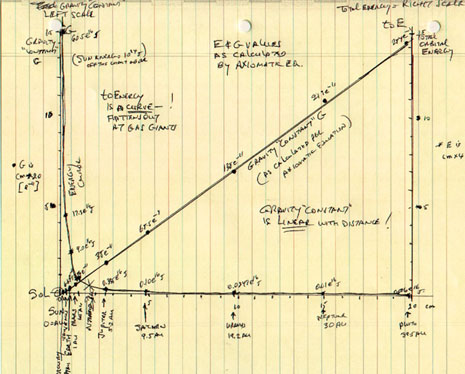
Note how total orbital Energy, as computed in Jaszz 4 (7/31/04), is very steeply curved. The gravity 'constant' G is linear, with an upward slope, which was a real surprise to me. Note also how the gas giants total Energy flattens out, while for the inner planets it is steeply sloped upwards, with an elbow about Mars and the asteroid belt. All planet distances are in AUs. What does it mean?
I must admit I had not seen this in my mind's eye. Sorry the quality is so poor, with my chicken scratching, but it gives you an idea.
Ivan
By Ivan A. on Wednesday, October 6, 2004 - 01:05 am:
Ivan
By James Roberts on Thursday, October 7, 2004 - 06:26 pm:
By Lyndon Ashmore on Thursday, October 7, 2004 - 06:53 pm:
Cheers,
Lyndon
By Richard Hoagland on Thursday, October 7, 2004 - 07:02 pm:
Peace,
Hoaggie
By Ivan A. on Thursday, October 7, 2004 - 08:58 pm:
J
I loved the bar of soap theory! I remember reading of the Cydonian Plain long ago, the 'simian' cities intrigued me.
The vitreous theory of space would have plasma moderate the 'constant' G below its maximum potential, not to be ignored indeed.
I like the 'four cheese' pizza theory of everything, at least it wasn't Gorgonzola!
Cheers, Ivan
By Ivan A. on Friday, October 8, 2004 - 02:18 pm:
Here is something I found re the 19.5' latitude on the Cydonian Plain of Mars. Erol Torun took it seriously enough to write a paper on it, re e and pi which he forwarded to you, as per http://www.mufor.org/hyperd.htm.
These 19.5 latitude anomalies, on Earth's Mauna Kea, Mars's Olympus Mons volcano, or Jupiter's red spot, are quite interesting, though I do not have an explanation either. Regrettable that the great physics giants of the past century, Helmholtz, Lord Kelvin, Faraday, Maxwell, were drowned out by the relativistic physics so arduously studied today. I have my issue with Einstein's Relativity because I think the first postulate, that there are no preferred reference frames, is flawed logic; in fact, the observer's reference frame is always preferred, otherwise we are forced to transfer the observer's observations onto the observed, which is an error. Perhaps now we can once again get back on the path of studying real physics rather than the fiction spawned by relativity, though it would continue to serve as an 'observational' science, and finally connect to an energy source which had been ignored for the past 100 years.
My work seems to indicate that electromagnetic energy is inversely proportional to gravity, though we on Earth cannot know this because our gravity is rendered so weak by our very powerful local star; so the G constant was imagined universally very weak, basically ignored. I suspect that is not so, and that once we can understand how strong it actually is, we will use it in ways still unimagined. Perhaps the 19.5' phenomenon is a strong hint to us, that it is there for the taking with a 'new physics', for those who can think outside the small box modern physics put us in. One such thinker, Thomas Van Flandern, mostly maligned by the mainstream physics community, offered that there was a 10th planet between Mars and Jupiter, but exploded to leave its remnants as an asteroid belt. If you look at my (rather bad) graph above plotting solar energy for the planets vs. their gravitational G constants, you will see that this 10th was counterpoised with Earth's position on the energy curve, though its G was greater than Earth's 6.67e-11 Nm^2, further up the linear slope; Mars is in the middle, and the gas giants are in a category totally different from the inner rocky planets.
Anyway, this is all I have to offer for now, still working on it, and the next step is to recalibrate all the energy E and gravity G numbers to adjust for the planetary mass calculated from Newton's orbital equation. I suspect our distant bodies mass readings are wrong, since we used a constant Newton's G to calculate them. Once these fall into place, I think I may have a clearer relationship between planetary inner black-body heat and their orbital spins. I know it's slow boring work, but somebody's gotta do it. I wish I could have seen the markings on that bar of soap... was that at Ten Thousand Waves?
Cheers, Ivan
By Richard Hoagland on Friday, October 8, 2004 - 05:35 pm:
Peace,
Hoaggie
By Ivan A. on Friday, October 8, 2004 - 05:50 pm:
Since not everyone is familiar with hyperdimensional-axiomatic energy, if I may, here's the link to your Enterprise Mission page, so others can come to know it. More to explore, to find the common thread of where energy's and gravity's dimensions meet our reality. Great fun!
Ivan
By James Roberts on Friday, October 8, 2004 - 06:05 pm:
By Richard Hoagland on Friday, October 8, 2004 - 06:53 pm:
Peace,
Hoaggie
By Ivan A. on Friday, October 8, 2004 - 11:42 pm:
:-)) Ivan
By Ivan A. on Friday, October 8, 2004 - 11:54 pm:
In thinking of 19.5', it somehow reminds me of inverted triangles within a circle, but just a random thought for now, and would love to see more.
I appreciate the link idea in support of where we're trying to go, where *someone* had already gone before! We'll get there too.
Thanks, Ivan
By James Roberts on Monday, October 11, 2004 - 05:55 pm:
By Ivan A. on Monday, October 11, 2004 - 10:07 pm:
Aaron, very good explanation of the M.Allaise of the cheese effect on pendulums. In fact, I had always been partial to hard cheese, though in my boyhood in Auvergne I also loved the local soft blue cheeses, which were deliciously pungent, but useless in pendulums. (Those clever Italians 'down under' in Argentina made a better product for this purpose.) However, the soft cheese did prove useful in shielding the electromagnetic energy, mostly light, from coming through, so that a 'gravity density' shielded effect was noticed by Allais, when he tried it in his basement larder. That's when he switched to blue cheese from Reggianito in his physics experiments, but unfortunately the physics community collectively held its nose, and wouldn't publish his results. Undaunted, he recommended sending a large Auvergna wheel of cheese into orbit around the Earth, where the total energy from the sun could be interrupted enough to make his little Reggianito swing faster back home. However, since space exploration in those days was still in its infancy (Sputnik not yet launched), his ideas were dismissed as 'ciel bleu' so it never got off the ground. Still, the spirit of his blue cheese, and smell, lives on, for those of us brave enough to go where none had gone before. On the margin of his notes he wrote this deceptively simple equation: E=mc^2 and said something to the effect that if E was less than 90 petajoules (shielding), the m would be less than one, which adjusted for Newton's orbital: GM=Vr^2, would yield a higher G. Et voila! But the rest of the notations were lost, so the Allais gravity shielding effect remains contested and misunderstood. Furthermore, les souris ate the cheese, so all evidence is lost.
End of proof that the moon is made of cheese.
Avec souris souriant, Ivan 
By Ivan A. on Thursday, October 14, 2004 - 04:34 pm:
Spacecraft anomalies put gravity to the test
Pioneer anomaly put to the test
I'd like to know what is their relative velocities now versus what it should be without this anomaly, but can't find it anywhere. If the Axiomatic is right, then this anomaly is no more than the effect of greater G out there (which is a linear relationship with distance, as per post above, Oct. 4, 2004, graphed), and therefore greater inertial mass. The more inertial mass, given a constant momentum, the slower the speed.
Ivan
By J____ on Saturday, October 16, 2004 - 01:25 am:
Finally figured the anomalies out ... God is toggling the Gravity switch back and forth from low to very low.......
J____
By Ivan A. on Saturday, October 16, 2004 - 12:49 pm:
I suspected as much... God! Do you have an illustration you can share with us?
I was pleased to see the gravitational constant G, as I figured it on Does Gravity zero-point Energy Explain Spin?, has a linear relationship with distance, viz. d/d^2, or 1/d (like in how visual perspective works), so something is making sense here, though the curve for E is parabollic. Let's keep digging, but the real answers will lie in actual measurements of Newton's 'variable' G at a distance. To date, I have no idea on how to measure this.
Ivan
By J____ on Sunday, October 17, 2004 - 02:08 am:
Nobody else knows how to measure G at a distance ... all anyone can do is ... guess, but the variations due to composite density is the killer of all calculations ... A composite whole consists of a plentitude of different matter materials located in various strata layers with distribution so variable ... it would be impossible to include such effects to make such calculations ... honestly meaningful.
This brings up the question - Once we learn how the universe works ... will the benefits from such knowledge offset the costs of procuring it?
Methinks … a maybe … at best..!
J____
By Ivan A. on Sunday, October 17, 2004 - 11:19 pm:
I've been thinking, and I think there is a way to test for distant G. It requires having a spacecraft far out in the solar system, and it needs to be equipped with thrusters. All we can really test for is inertial G, since planetary G remains a guess, as you say, based only on our observations of its orbit. Per Newton's orbital equation, we then 'guess' the rest, as to its mass, assuming a constant G. But if we can observe how much thrust it takes to get a spacecraft moving at a desired velocity, that would give us a clue as to whether or not G is greater out in the solar system then here. Once we can figure the inertial G, then the rest is easy. Of course, it would also prove that inertial mass is G related.
I suspect that most things in our solar system do not have enough velocity to leave it, if G is greater far out. This would mean that all asteroids, comets, space flotsam and jetsam would eventually come to rest in some very distant orbit far from the Sun. I would put that place at the Oort Cloud, which is a great gathering of stuff far beyond Pluto. This may be the ultimate resting place for the Pioneer spacecrafts as well, so someday when space travel is more a reality for us, when traveling great distances at near light speed due to constant acceleration becomes something we can do, we'll likely meet up with our ancestral distant spacecrafts that had come to rest there. Some of them through chance of encounter may be pulled out of orbit and sent back towards the Sun again, so they once again pass through our solar system, but otherwise they will find their distant orbit and stay there. Anyway, that's how it will play out if we discover that inertial G, and planetary G, is greater farther from the Sun.
But think what it means if G is indeed a variable! It would mean it's a usable force, and that would be worth any cost achieving, since we could finally tap into constant acceleration of zero-point G in space.
Ivan
By Ivan A. on Monday, October 18, 2004 - 01:22 pm:
j___, no sooner said than here it is! Rob Roy Britt picked up on this problem in his latest piece in Space.com: The Problem with Gravity: New Mission Would Probe Strange Puzzle
Of course I disagree with his: "No fancy theory (of gravity) in existence, however, properly explains the Pioneer data."
I suppose my odd musings, as per this whole thread, don't qualify as a "theory" until a formal paper is published and peer reviewed? But the Europeans, who are not Einstein crazies, seem to be taking it seriously enough to put a space probe measuring inertial mass acceleration on their drawing boards.
Ivan
By James Roberts on Monday, October 18, 2004 - 05:43 pm:
By Ivan A. on Monday, October 18, 2004 - 11:00 pm:
Quote:
On a stinko meter, this one takes the cake!
J
By Ivan A. on Tuesday, October 19, 2004 - 01:22 pm:
This is not exactly how the 'variable' G works, as per above Axiomatic, but it is a start for them to start looking into it deper. Of course, in my opinion, they're barking up the wrong Big Bang tree. BBT is a stretch of the imagination, a nice story, but very likely not really what happened, Genesis and Einstein's General Relativity aside.
Ivan
By Ivan A. on Saturday, October 23, 2004 - 01:26 pm:
Just for fun, for the record, but we're still a long ways from proof. - Lunatik
Ivan
By Ivan A. on Saturday, October 23, 2004 - 05:47 pm:
I calculated that Newton's G 'constant', so called, grows linearly with distance, as per the posts on "Does Gravity Zero-point Energy Explain Spin?", Oct. 4, 2004. In fact, it seems to grow linearly at the rate of about 7.3e-11 Nm^2kg^-2 for each AU (astronomical unit = ~150e9 meters), so that by the time it is at Saturn, for example, a distance of 9.5 AUs, it is already up to 68.5e-11 Nm^2kg^-2, slightly more than 10 times Earth's 6.67e-11.
Now watch what happens when you figure this out in meters rather than AUs. If one AU is approximately 150e6 km, or 150e9 meters, then dividing the growth rate of 7.3e-11/AU equals:
7.3e-11/ 150e9 m = 0.048667e-20, or = 4.8667e-22 G/m.
Here is where it gets interesting, though I cannot swear this is right. Take that growth value of ¶G per meter and divide it by the G 'constant', which is:
4.8667e-22/ 6.67e-11 = 0.7297e-11 m.s^-2, which is also = ~7.3e-12 m/s^2, or in centimeters it becomes: ¶G/G = ~7.3e-8 cm.s^-2. (It should be ¶G/G = ~7.3e-14 cm/s^2. See ERRATUM below, Oct. 31, 2004)
In taking this acceleration (towards the Sun) and doing the square root (inertial mass is increasing by same rate as G) then we get:
-a = ~2.7E-7 cm/s^2,
which is the rate at which the linear increase in G should slow the Pioneer distant probe.
Why is this last interesting? Because it comes in approximately within range of what was discovered by the people measuring the Pioneers's rate of acceleration (Anderson, Nieto, et al, at LANL) towards the Sun = ~8e-8 cm.s^-2.
I don't know why these numbers work out the way they do, but that's the way it looks. Remember that we had always expected Newton's G constant to be a universal constant, so takin the inverse of the growth rate per the 'universal' constant yields the approximate rate of our distant space crafts's acceleration towards the Sun. They're slowing down by the rate of ~8e-8 cm/s^2, it seems, because of increasing G. So we do not need to find an explanation as per the crafts's radiated heat, or lower solar wind, or some other reason intrinsic to the craft, etc. It's slowing down because it's taking on more G, more inertial mass, as it progresses deeper into the outer solar system. I would venture to guess that its large elliptic trajectory will eventually settle into a distant orbit around the Sun, if this is so, perhaps out in the Oort Cloud region.
But if so, what's G at the Oort Cloud, or beyond? If it's linear, shouldn't we be able to calculate it, at least an approximation?
Question: Why is Earth's G 6.67e-11 if G grows at the rate of ~7.3e-11 per AU? It obviously is either wrong, or something else is at work here, since Earth by definition is one AU from the Sun. I suspect Spin. If the planet did not spin, it would have G = 7.3e-11 Nm^2gk^-2, but because it does spin, what we measure is slighly less.
Ivan D. Alexander
[edited - 10/27/2004 & 6/1/2005, for powers correction in centimeters per second squared... As my math teacher used to say: "How'd you get the right answer by the wrong method?" I think it's right now. -IDA]
I think I'll quit it here until we know more... If this is right, then the Pioneers anomaly is proving the Axiomatic Equation at the beginning of this thread is right. But I've got a headache.
By James Roberts on Tuesday, October 26, 2004 - 07:26 pm:
By Ivan A. on Sunday, October 31, 2004 - 07:45 pm:
I ran a test of my calculated for Pioneers slowing, and the correct result is a = 7.3e-10 cm/s^2 (vs. my original a = 7.3e-8 cm/s^2, versus LANL's 8e-8 cm/s^2), by calculating backwards from acceleration to Newton's G 'constant'. (I got caught on the inverse powers on the last, where "0.7297e-11 m.s^-2, which is also = ~7.3e-10 m/s^2", which should be: 0.7287e-11 m.s^-2 converts to 7.297e-12 m.s^-2, same as ~7.3e-10 cm.s^-2). Not fatal, but it does change it by 100 fold less than what is being measured.
How can this be? I suspect there are other factors, since mine is closer to a real value than LANL's. For example, running their numbers backwards, I come up with gravity growing at the rate of ~8.9e-9 per AU (*), which we know is automatically wrong, since Earth is at one AU, and its gravity 'constant' G = 6.67e-11 Nm^2.kg^-2. So by definition, since we are located at one AU, LANL's acceleration is too high. However, there may be many factors why this is so, why the probes are slowing faster than they should. To list a few possibles:
1. Space dirt, dust collisions in 'empty' space.
2. Heat released from the front of the craft may create 'push', ala Crook's black faceted radiometer, for example, where the molecules of 'empty' space collide with the craft in the same way the blades spin in a toy radiometer. In the deep cold of the outer solar system, heat may be a bigger effect than in the warmer regions closer in to the Sun.
3. Redshift related: Possible that Planck's constant h may increase with light redshift at greater distances (may be too small to matter at Pluto's distance), so that as light wavelength increases due to redshift, so does h as computed there. This would influence the rate of growth of G by increasing it (per Axiomatic). However, since G growth plots on a straight line (which I value) when computed from (parabolic) orbital Energy, I shy away from this explanation, unless we have other reasons to think so.
4. Gas released from the probes onboard equipment, as theorized by Louis K. Scheffer (25 Feb. 2003), and others, to explain Pioneers anomalous behavior. These had been discounted by the LANL group.
5. Calculations either based on the Axiomatic, or by the LANL group, are intrinsically wrong.
So my above error, once corrected, shows a one hundred fold lower for the Axiomatic versus a greater acceleration computed by LANL, which in itself may not be correct: if you run the numbers backwards to calculated Earth's G, LANL's G = 8e-9 Nm^2.kg^-2 (*), is a hundred times greater than it should be. I suspect the other factors, especially space dust and heat related slowing, may be more at fault for the divergent readings, if Earth's G is growing at the rate of ~7.3e-11 Nm^2.kg^-2 per AU, hence why the probes are slowing faster than accounted for gravity's growing G alone.
Ivan
*(a = 8e-8 cm/s^2 = 8e-10 m/s^2. If multiplied by constant G x 6.67e-11 Nm^2/kg^2 = 53.36e-21 = 5.336e-20 per meter, which multiplied by meters in AU, 5.336e-20 x 150e9 meters = 800e-11 per AU = 8.0e-9 Nm^2/kg^2 per AU. Too high!)
By Ivan A. on Saturday, November 6, 2004 - 12:36 pm:
I'm still stuck on this one, since it happens to also be a part of the Axiomatic Equation in how reads: E = Em * c = (Bm)c^2
What puzzles me is that Bm works out to be approximately =~1 for E = 90 petajoules. But what happens to Bm when E is less, or more, than that? What happens at E = mc^3, for example, which is the maximum Energy level generated by the hottest part of a star?
Is the magnetic moment Bm a net amount? If it is, can it be broken down further, for example? In other words, is there a ratio, or equation, that defines Bm under different energy conditions? Here's an example: Magnetic 'bubble' in distant galaxy. Also, as for so-called Neutron stars, they generate immense magnetic energy: Scientists have found a type of star, around which is the strongest magnetic field ever observed in the universe. This says:
Quote:
associated with the intense gravity of a neutron star. "
I am asking this because it is measured that magnetic radiation for white dwarfs is about 100,000 times greater than for the Sun, and for Neutron stars, it is orders above that. Is the magnetic radiation measured the same as Bm? Or is it still something different? Is what is measured actually Em, or electric force and the magnetic is then mathematically surmised from it? And when total Energy is lower than, let's say, the 'cut-off' wavelength of gravity, below l=700 nm, does Bm become something much greater? (But this would indicate that in (Bm)c^2 it is the c that is declining. And conversely, when E = mc^3, is Bm increasing by c?) The Axiomatic implies that when gravity is very great, meaning Energy is very low, that the magnetic moment should not be affected, but not sure about that. Can it be that the greater magnetic readings of these distant galaxies or Neutron stars are actually something else, unrelated to their intrinsic Energy levels, but rather readings generated by fast moving particles around their great gravitational fields, for example? I suspect so.
Exactly what happens to Bm if Energy is at its maximum: E = mc^3, such as encountered on the hottest surface of any star, where the gravitational G for each molecule drops off to virtually zero? This is when they are most restless and go off into the solar system as solar wind. As they travel the distance away from the Sun, they then gain in G again, so that their inertial mass eventually slows them down. But what happens to E = Em *c = (Bm)c^2 in that case? When G is near zero, and E = mc^3, does Bm remain the same, or is it greater by c? I suspect the latter, which is probably why the Sun has such magnetic storms on its surface, but don't really know.
So these are the questions on magnetism the Axiomatic does not make clear, for now.
I can think of c = 1/(eomo)^1/2, where the square root of space permeability and permittivity of light is a function of the speed of light. If we substitute this function for c, then we can rewrite Maxwell's equation:
Bm*c = Em
Bm * 1/(eomo)^1/2 = Em, or:
Em * (eomo)^1/2 = Bm
But this leaves me no wiser. A better understanding of Bm can lead to a better understanding of Gaussian forces for the planets, or solar wind, I would think.
Ivan
By James Roberts on Thursday, November 11, 2004 - 06:43 pm:
By Ivan A. on Thursday, November 11, 2004 - 10:21 pm:
Yes, unlocking the secrets of the universe has its bad days, where nothing comes out. Our distant ancestors read entrails to devine nature, no doubt employing a variety of laxatives to reach their intellectual ends. My advice? Stay off the cheese to ripen your thoughts. Good old fashioned thinking produces more solid results.
:-))
By Ivan A. on Monday, November 15, 2004 - 02:07 pm:
This is a series of articles exploring whether the Pioneer 10 and 11 and Ulysses spacecrafts acceleration anomalies may have a gravity basis, which implies that our understanding of gravity is incomplete. The above work in progress, per the "Axiomatic Equation", offers an explanation using total orbital Energy for the planets and their respective proton mass equivalents, for each orbit, (see Oct. 4, 2004 above: "ENERGY AND GRAVITY SLOPES", also Oct. 23, 2004, "THE G 'CONSTANT' PER AU DISTANCES"), to show how gravity as expressed by Newton's G 'constant' may account for this 'variable' Newton's G. The Aerospace Corporation analysis may in time come to a similar conclusion, if this is right, that our current theories of gravity are wrong.
Ivan
By Ivan A. on Tuesday, November 16, 2004 - 07:21 pm:
There had always been a mathematical problem with the Axiomatic Equation which I could not factor in, so it is time to revisit it.
The problem is on the far right of the Equation:
E = Em * c = hc/ l(Protonm) = (Bm)c2 = (1-g)c2 = 90 petajoules/second
This works fine for values of 90 petajoules or lower, though the actual value of g (proton to proton gravitational coupling constant) is not exact. So estimates had been used by figuring the proton mass and then taking a direct ratio for the proton gravitational constant. However, this is not exact, and it runs into trouble when E > 90 petajoules, as computes for Venus and Mercury. In that case, an additional value has to be added to multiply (1-g) by some factor. Consequently, this equation was only about 80% correct and needed an additional function to make it work fully.
For now, not having the function needed on the right side to bring it exactly in line with the left E, I will add a function to it, implying that this is an additional value needed to bring it into equality. So the new equation should be:
E = Em * c = hc/ l(Protonm) = (Bm)c2 = [f(E)](1-g)c2
This [f(E)] function is "a function of Energy" that must be multiplied by (1-g) times c2 to equalize both sides of the equation to equal E. The best approximation at this time is a function of E', which is planetary total orbital Energy, which divided by Earth's E, 90 petajoules/second, yields the function needed to balance both sides of the equation. If so, then:
f(E) = f(E'/E)
The original equation above will now be revised as:
E' = Em * c = hc/ l(Protonm) = f(E'/E)(Bm)c2 = f(E'/E)(1-g)c2
For Mercury, for example, this works out to be:
E' = 60.55e16 W/m = 20.18e8 * 3e8 = (19.78e-26)/ (1.32e-15)(2.48e-28) = 6.73 (~1)(9e16) = ~6.73 (1- 8.76e-40)(9e16).
so that Mercury's f(E'/E) = ~6.73
(Please note, the "g" function is still only an estimate, and needs further definition.)
Ivan
By Ivan A. on Friday, November 19, 2004 - 09:31 pm:
In the above Axiomatic Equation revisited, I adjusted the original equation to:
E' = Em * c = hc/ l(Protonm) = f(E'/E)(Bm)c2 = f(E'/E)(1-g)c2
with a note that the "g" function may still be incomplete. In fact, I believe this to be the case, since (1-g) does not exactly define what is happening to this proton gravitational constant equally on both sides of the equation. So it should read as:
f(E'/E) = hc/ l(Protonm) =f(E'/E){1-[f(g)]}c2 , where the "f(g)" must be defined.
In words, because this mass function (1-g) is derived from the computed "proton mass" on the left side, where taking a ratio of Earth's (E) proton mass divided by a computed planetary (E') proton mass, which yields a proton-to-proton gravitational constant on the right side, we can show this symbolically as:
(Protonm) / (Protonm)' = g/g', where g = 5.9e-39, or if cross multiplied:
(Protonm) * g' = (Protonm)' * g, where g' is the proton gravitational constant for E'.
Therefore, [(Protonm)' * g] / (Protonm) = g'
From this last, we can now construct what is "f(g')" needed to complete the Axiomatic Equation:
f(E'/E) = hc/ l(Protonm) = f(E'/E){1-[f(g')]}c2
substituting g' = [(Protonm)' * g] / (Protonm), we get:
f(E'/E) = hc/ l(Protonm) = f(E'/E){1-[f([(Protonm)' * g] / (Protonm)]}c2
And it is this last that should be exact... almost. It still needs to factor in the proton gravitational constant conversion into Newton's G:
If G2*m = gc2pi2, then it stands to reason that, being a function of c2, the actual mass (1-f[g']) should be (1-f[g]pi2) on the right side. So now, the full equation (leaving out the Maxwell equations) should be exact:
f(E'/E) = hc/ l(Protonm) = f(E'/E)(1-[f([(Protonm)' * g] / (Protonm)')pi2])c2
However, for brevity's sake, I think this version should prevail:
f(E'/E) = Em*c = hc/ l(Protonm) = f(E'/E)(1-[f(g')pi2])c2 = f(E'/E)(Bm)c2 = Energy in Watts, or Joules per second.
where it is understood f(g') = [(Protonm)' * g] / (Protonm)
Now, this is how will be adjusted the Axiomatic Equation at top of this thread, which of necessity changes the G equation that follows.
Ivan
By Richard E. Foster on Sunday, January 30, 2005 - 06:24 pm:
By James Roberts on Monday, February 14, 2005 - 01:46 pm:
By Ivan A. on Thursday, February 17, 2005 - 01:40 pm:
These first 4 pages (of 16 page paper) were posted for public viewing at BAD Astronomy BB under "Against the Mainstream/Allais Effect Casts Doubt on GR" at: http://www.badastronomy.com/phpBB/viewtopic.php?t=16815, see post Jan. 19, 2005.
The full paper is meant for 'peer review', so introduction to how math derived posted only, with solititation for endorsement to make whole work public. Any interest in seeing the full paper, please contact author:
Ivan D. Alexander at: humancafe@aol.com
By Ivan A. on Monday, February 28, 2005 - 11:01 pm:
http://www.badastronomy.com/phpBB/viewtopic.php?p=425768#425768
How Variable G was derived, as posted on BAD Astronomy forum. This is the short form for all of the above on the Axiomatic Equation, and why gravity may not be what we thought it was, a universal constant.
Sorry Newton, Einstein, we're right behind you!
J
Ivan
By Ivan A. on Monday, March 14, 2005 - 11:27 pm:
As posted on BAD Astronomy bulletin.
I realize how against the grain this new thinking on G must be, kind of like aqueeky chalk on the black board to all who had been trained in physics, since they're hardwired to only see it one way. I hope this helps explain it better, but don't know if I succeeded, for the record.
By Michael on Tuesday, March 15, 2005 - 12:18 am:
"
Hey Ivan- It just dawned on me, What happens if you look at "Why would they have ever suspected a variable G if GM=Rv^2" -
JUST Hear me out What if it is a varible M and not a G?
say you have a M of 2000 ok
well that is at say 9.8 at 23.95 hr rotation
BUT WHAT IF say it was 22.11 hr rotation?
What I think or did in some numbers is that
M would not have as much centrificul F on it
which then say would be M of 2009.
You see in deep space nothing moves with great velocities it is all slow, therefore a higher G
But closer to the sun velocities and rotations and oribits are faster,
Hold that image, that now the Mass bodies are spinning you with only see slightly less Mass values that is actually larger then what we say it is. That is why missing mass never works out becuase they never figured in the spin off mass F.
You you see my view for a moment in my shoes?
I think I will run numbers this way and see if it opens the door to something.
By Ivan A. on Tuesday, March 15, 2005 - 03:43 pm:
Quote:
say you have a M of 2000 ok
well that is at say 9.8 at 23.95 hr rotation
BUT WHAT IF say it was 22.11 hr rotation?
What I think or did in some numbers is that
M would not have as much centrificul F on it
which then say would be M of 2009.
You see in deep space nothing moves with great velocities it is all slow, therefore a higher G
But closer to the sun velocities and rotations and oribits are faster
So the Sun's massive gravitational force puts near orbit bodies into immense spin, but that's only half the story? The other half is that so near very high solar energy flux the inertial mass is very low, so all things move faster? Intriguing idea. While you're working on your numbers, I'll see if I can work out this principle for Mercury's eccentric orbit, or better yet for Pluto's. Let's see what comes up.
Thanks! Ivan
By Michael on Tuesday, March 15, 2005 - 09:31 pm:
Ok somewhat, back up one step. take the Sun's Mass as say a ficticuos value of 200 because of its ~30 spin. we then regulate all of the secondary m2's (planet's) by that 200 value.
BUT if there was no 30 day spin, and if it was not rotating there would be no centrifical rotatial force displacing some of the absolute vaule of Mass that we would like to think it is in a whole. Just say if the Sun did not rotate, then what if the true value would be 207.
That is where I come back to the Rotating motor on a stick. The F vaule is say a vaule of (4) with the motor spinning 6" from the floor. But when the motor stops, the value than becomes 4.8 becoming heavier cause a stronger gravity/or F attraction between the motor 6" from the earth's floor.
What I have just explianed is when any mass spins, it displaces some of its total value of Mass. therefore if we try to find the Mass of an object against any on the M1 or m2's F it may not be a complete true full potential F.
Maybe it would be best if a said when we use F=MmG/r^2 and V^2*r/G=M these may only be measuring the partial whole Mass that is not displaced by rotation.
BIG PICTURE, close inside our solar system things rotate and spin, and have excited oribts. Well that means there will be a lot of displaced Masses, dont get me wrong, the mass did not disappear, but just as (Mass&Gravity pull inward) the rotation kind of sheds off a certin amount do to spin so the total Mass pull is not there.
But deep in void/empty/space you will not find excited oribits and mass. But if there is any mass or rouge mass or even clusters of mass, that mass would tend not to be displaceing and F, so therefore much of that mass deeper in space would tend to be a truer total mass read in F then what you would find in the center of a system which negates some of its mass from rotational displacement.
I think if you think about that you might see where your ZERO G, and E would tend to agree with this, or have a close veiwpoint to the truth, but each view point has its own defined approch to the nagging question of gravity, absolute F, Absolute mass, and etc..
I will see what I can do with some numbers.
By Michael on Tuesday, March 15, 2005 - 11:08 pm:
http://depalma.pair.com/gyrodrop.html
By Ivan A. on Thursday, March 17, 2005 - 12:20 pm:
This BBC Science News article makes an interesting observation:
Quote:
The Brown researcher thinks the particles are disappearing into the fireball's core and reappearing as thermal radiation, just as matter is thought to fall into a black hole and come out as "Hawking" radiation.
This dove tails nicely into how the Axiomatic predicts where all ambient radiant energy converges on a point it cancels, so lambda is canceled, and gravity (which is inversely proportional to this energy) is once again recreated. The above atom smashing experiment with gold nuclei did just that, which is not unexpected. The same process occurs at the center of any galaxy where all ambient light cancels on a point, so a giant black hole results. The release of "Hawking" radiation is one byproduct, while immense gravity is the other. Also, note the ten to one ratio, which approximates the 'Dark mater' ratio to baryonic matter in the universe. I think we're on the right track.
Ivan
By James Roberts on Monday, March 28, 2005 - 06:04 pm:
By Ivan A. on Monday, March 28, 2005 - 11:06 pm:
Quote:
I suspect your cheese will not fall in directly into a black hole but be put into enormous spin around it, at great energy, so that a cosmic souffle will likely result.
Here's a thought: If the baryonic center of two bodies moves in relation to each other, when Galileo did his famous canon ball experiment at the tower of Pisa, shouldn't the larger ball hit first? After all, if the Earth is attracted to it at greater rate than to the small canon ball, it moved up slightly to meet it faster than to meet the smaller ball, so a minute difference should result where the large ball hits first. Our learned Aristotle's feta cheese pizza would flip if it were so!
By Ivan A. on Wednesday, March 30, 2005 - 11:57 pm:
Taking an earlier post where I worked out the axiomatic 'cut off' wavelength at E = 3E+8 J, (per post above June 3, 2004), which approximates the orange range of light:
3E+8 m^2.kg.s^-2 = [(6.626e-34 m^2.kg.s^-1)(3e8 m.s-1)] / l(1.67e-27 kg/kg)
where l = 3.97e-7 meters, when mass is (m-g) = 1/c.
Now, if E = 3E+8 J, what is the proton mass m_p = ?
Assuming l is unknown, and m_p is unknown, then we get:
3E+8 J = 19.878E-26 / l(m), so that
l(m) = 6.626E-34, which means there must be some value of equivalence for where l and proton mass stabilize. This may be achieved if we retain the proton mass in Earth's region, (for computational purposes only), and then get the l for the 'cut off' E, which means l = 3.97e-7 meters, which itself approximates the 'cut off' wavelength in the photoelectric effect.
If this should prove to be so, then it probably is the effective wavelength of deep space, meaning that because there are so many forms of energy in deep space, from dark galaxies made of hot gasses to ambient radiant energy from all the galaxies, deep space may have a more constant G than the deltaG experienced close to any star.
A way to estimate it (intuitive, very rough guess) is to take the opposite tack, and to leave lambda same as we have it here, l = 1.32E-15 m, and then solve for proton mass:
E = 3E+8 J = hc/ (1.32E-15)(mp), so that proton mass = 5.02E-19 kg, which means the proton mass gravitational 'constant' becomes g = 1.777E-30,
and using the conversion equation for Newton's G:
G^2 = gc^2 pi^2
G^2 = (1.78E-30)(9E+16 J)(9.89) = 158.44E-14, which taking sqrt give us G = ~12.6E-7 N... (approx. ~1.3E-6 N..)
So G_s = ~ 1.3E-6 Nm^2 kg^2, as the approximate 'cut off' equivalent of deep space gravity, where it begins to 'flatten out' as a constant. I would guess it more a constant there because of all the ambient radiant energy of galaxies combined with the ambient plasma energy in deep space, such as found in 'dark matter' galaxies.
Ivan
By Ivan A. on Friday, April 1, 2005 - 12:04 pm:
Thus, the highest G = 3E+8 Nm^2 kg^-2, gravity maximum such as encountered in a 'black hole' center of the galaxy, and lowest G = ~4.2e-15 N.., a minimum at the Sun's hottest corona, which is essentially where it fails to hold mass together, represent hypothetical parameters of extreme gravity, (versus Earth's G = ~6.67E-11 N..). The intermediate G = ~1.3E-6 N.. is probably where most of deep space resides (at a 'cut off' wavelength of l = ~ 3.97E-7 meters, the photoelectric range), such as perhaps experienced by so-called neutron stars. Interestingly, the gravity growth calculated as deltaG = ~7.2E-11N.. per AU, if projected to the Oort Cloud at about 50,000 AUs yields an in situ value of G = ~3.6E-6 N.., which is within the range of deep space gravity, and hence may represent the 'transition' zone for Newton's G where it 'flattens' into a relative constant.
This idea of a variable G is not recognized in current physics, even energetically opposed by some, but it may yet prove to be how the universe is constructed. If so, then Earth's G is a very light value, being so close to our hot star the Sun, if gravity's G 'proportional' is an inverse function to electromagnetic energy flux. Conversely, the very high maximum of gravity at G = c may exist only where all ambient radiant e.m.-energy-lambda cancel on a point, such as at the center of all galaxies. In between light ranges in very weak energy levels, as deep space plasma, or highly redshifted light far from solar-galactic sources, so gravity remains in that median region of G = ~10X^-6 Nm^2 kg^-2 range, representing most of intergalactic deep space. However, all this is speculation until we are able to measure for Newton's G at a distance from Earth's. If this proves true, then Einstein's General Relativity will need rewriting.
Ivan
By Ivan A. on Monday, April 4, 2005 - 07:21 pm:
In reading C. Johan Maserliez's paper on Quantum Mechanics (EST/Expanding Spacetime Theory) I came across something that I felt was of value. This dual nature of em energy, both as particle and wave function, has been an issue of debate between the great physicists of the early 20th century, Einstein, Bohr, deBroglie, Born, Schrodinger, Dirac, et al. It was Louis de Broglie who postulated his, cum Einstein and Planck, equation: E = hf = mc^2, which was later adapted as a foundation for the Axiomatic Equation (see above, at top). Though I disagree with the author's premise of an expanding universe, where T (as a = c/T to explain Pioneers Anomaly) of the Big Bang is approximately 12.5 billion years (alternately 14 billion in another paper), or that Einstein's space-time universe is a reality, since in my cosmology redshifted cosmic light is due to very great gravity in the cold of intergalactic space, I did find something of note in this very interesting and thought provoking paper (fair use):
Quote:
This immediately struck a chord with my thinking, that an electromagnetic wave in fact 'collapses', or turns, into a standing wave when it encounters a point in space where the gravity is extreme, so that this is where forms an atom. The standing wave then breaks into a positive and negative charge, where the proton is positive and relatively at 'rest' while the electron is negative and highly energetic around the proton, with the neutron as a half life proto-proton-like particle to balance out the charge. So in effect, by this reasoning, the wave is also a particle, but only when it encounters this extreme gravity point in space. I suspect these proto-atoms are actually created of positive ions spun out of the axii of black-hole galactic centers, but this is merely a supposition. So the deBgrolie idea that particles have their wavelength equivalent, which is the basis for the Axiomatic Equation, as a modified Comptons wavelength, made sense to me. Or as the author says (fair use):
Quote:
What this translates into, in my per force non-relativistic non space-time thinking, is that electromagnetic waves remain as waves until they are locked into a point in space to form the atom, at which time they behave like a particle, same as they form a particle. Taking this to the next level, when these same waves encounter any atomic mass, they automatically react as particles; to the next level where any mass if put in accelerated motion results in a wave, as per de Broglie. So both are right, they are both wave functions and particles, but under different conditions, and when they encounter matter, they become a particle function. Bohr and the Copenhagen school perhaps were wrong.
I enjoyed reading this paper very much, and will refer to it again because of its succinct way of reasoning on the quantum world. However, I am also left with the impression that the author found a very complicated way, the mathematics of space-time and general relativity, to express something that in the end may prove to be rather simple: a wave force 'collapses' into a particle when it encounters any mass. If so, then Louis de Broglie was right. What a prince!
Ivan
By Ivan A. on Monday, April 11, 2005 - 09:38 pm:
Quote:
What puzzles me is that Bm works out to be approximately =~1 for E = 90 petajoules. But what happens to Bm when E is less, or more, then that? What happens at E = mc^3, for example, which is the maximum Energy level generated by the hottest part of a star?
Is the magnetic moment Bm a net amount? If it is, can it be broken down further, for example? In other words, is there a ratio, or equation, that defines Bm under different energy conditions? Here's an example: Magnetic 'bubble' in distant galaxy. Also, as for so-called Neutron stars, they generate immense magnetic energy: Scientists have found a type of star, around which is the strongest magnetic field ever observed in the universe. This says:
"Astronomers suspected that such titanic energies were
associated with the intense gravity of a neutron star. "
I am asking this because it is measured that magnetic radiation for white dwarfs is about 100,000 times greater than for the Sun, and for Neutron stars, it is orders above that. Is the magnetic radiation measured the same as Bm? Or is it still something different? Is what is measured actually Em, or electric force and the magnetic is then mathematically surmised from it? And when total Energy is lower than, let's say, the 'cut-off' wavelength of gravity, below l=700 nm, does Bm become something much greater? (But this would indicate that in (Bm)c^2 it is the c that is declining. And conversely, when E = mc^3, is Bm increasing by c?) The Axiomatic implies that when gravity is very great, meaning Energy is very low, that the magnetic moment should not be affected, but not sure about that. Can it be that the greater magnetic readings of these distant galaxies or Neutron stars are actually something else, unrelated to their intrinsic Energy levels, but rather readings generated by fast moving particles around their great gravitational fields, for example? I suspect so.
Exactly what happens to Bm if Energy is at its maximum: E = mc^3, such as encountered on the hottest surface of any star, where the gravitational G for each molecule drops off to virtually zero? This is when they are most restless and go off into the solar system as solar wind. As they travel the distance away from the Sun, they then gain in G again, so that their inertial mass eventually slows them down. But what happens to E = Em *c = (Bm)c^2 in that case? When G is near zero, and E = mc^3, does Bm remain the same, or is it greater by c? I suspect the latter, which is probably why the Sun has such magnetic storms on its surface, but don't really know.
Revisiting this post, I had an idea. It came to me while reading Chris Hillman's paper titled: "Observational and Experimental Evidence Bearing on General Relativity." In his reference to "Neutron Stars" he says: "The typical pulsar is now thought to be a rotating neutron star with a magnetic field at least one trillion times stronger than that of the Earth."
This made me pause, because per the Axiomatic, Bm in the above E = Em*c = (Bm)c^2, the value of Bm=~1, when E = 90 petajoules. However, if E is substantially less than that, the value of Bm, the magnetic moment, should be dropping. In a neutron star, the radiant energy is negligible, though its magnetic output is immense. How can that be if the very low E generates a very high gravity component? The answer that seems to be insinuating itself, if the Axiomatic is correct, is that the variable in the case of a neutron star, and perhaps that of a white or brown dwarf, is that c, the speed of light, is in fact the variable. This would show up as:
Em * c = (Bm)f(c)^2 = E, where f(c) is a variable, and
where E is very low, Em, electric force, is high, and Bm, magnetic moment is exceptionally high.
This can only happen, per this equation, if the lightspeed function f(c) is exceptionally low! And this could be happening in a very high G region, where light is so redshifted by the intense gravity that it acts 'as if' it had slowed. Then the (Bm)c^2 side of the equation would have a very low c^2, by extension, but a very high magnetic Bm. And if this is so, then it makes for a very interesting cosmology indeed, since it then has implications for distant redshifted cosmic light passing through eons of deep space high gravity to get to us. We may not be so far away from those distant bodies as we think! The redshift is not necessarily with great distance, but may be happening as soon as light leaves its source and enters into the high gravity region beyond the star's high E. Or, put another way, the universe is far more infinite than we imagine, and we are able to see only a very tiny portion of it. Think what this means for advanced space travel, when we can get great gravity as the energy to propel our spaceships at tremendous velocities with continuous acceleration! The stars may yet be within our reach.
If redshift is a deep gravity function, it also implies that so-called neutron stars are perhaps no more than 'failed' stars, ones where the energy never got high enough to combust into a normal star, though it might also be the remnants of a burned out star. Either way, the gravity is intense, enough to slow down light, and the magnetic component of the star is likewise very great. Which also means that it did not take very great mass suns to continue collapsing through the neutron star stage into a black hole. Black holes are where light self cancels and total gravity takes over again, in proportion to the light, proportional to galactic mass, generated by the surrounding galaxy. There is no Doppler shift associated with it, except that the 'slowed' light shows up at a red shifted wavelength. And if this is so, the Big Bang is a big myth, since it becomes unnecessary... if the Axiomatic is right. Of course, if it is, then Hillman's paper is a fine historical analysis, but not how GR is truly representative of what the universe is all about.
Ivan
By Ivan A. on Friday, April 22, 2005 - 09:25 pm:
c=>c^2 vs G<=G^2
This seems to be how the universe works.
The conversion equation for energy to gravity is:
G^2 = g * c^2 * pi^2, where g is the proton gravitational constant.
Radiant energy in the form of electromagnetic waves is 'ex-radiating', so it is represented by the 'square of'. Energy is thus a function of E = mc^2, which is c=>c^2.
Gravity energy in the form of spacevacuum attractive force is 'in-radiating', so it is represented by the 'square-root of'. Gravity is thus a function of G<=G^2, inversely to radiant E, where G = (gc^2)^1/2.
You'll notice that hot energy is explosive, like the energy released from the atom; the other cold energy, like spacevacuum gravity, is implosive, like what happens when mass is present, or a galactic black hole. In between the two exist matter, balanced between these two interrelated (per Axioamtic Equation) and opposed forced, so a unity results, the atom. Out in space, where hot energy is low, spacevacuum energy is great, so gravity is great; conversely, near a hot star, where hot energy is great, gravity is low, so the spacevacuum energy is very low.
For all spacevacuum related energy, a gravity energy, the function that rules is the square root, while for all electromagnetic energy, radiant energy, the function that rules is the square of. What this means is that when matter is taken from a hot energy region to a cold energy region, it will respond gravitationally in a square root fashion; conversely, when matter is taken back into a hot energy region, it will respond gravitationally in a square of fashion. The line between these two is a gravity function that grows linearly away from hot energy, or falls linearly towards hot energy, such as a hot star. This is represented by GMm/ r. Hot energy, as a function of distance times energy flux, is also linear as it falls off from its source. This is represented by W/m. However, both in-radiating and ex-radiating energy respond to the inverse square law, as a geometric function of squares, as Fr^2 = GMm for gravity, and as W/m^2 for solar irradiance, though both are opposites.
What makes this interesting is that per the energy to gravity conversion equation above, the g, proton to proton gravitational 'constant' (which is believed dimensionless), is neither square of, nor square root, and is balanced in between the two.
Ivan
By James Roberts on Friday, April 29, 2005 - 03:27 pm:
PV=nRT
Piora*Vignotte = Neufchatel*Roquefort*Testouri
By Ivan A. on Sunday, June 19, 2005 - 01:04 pm:
Per my post above, Mar. 30, 2005, it appears by rough calculation that deep space gravity may be five orders of magnitude higher than Earth's G, i.e., 100,000 times greater than here. This may be the maximum 'cut-off' gravity for stars generating less energy than needed, where E' = < 3e+8 J, then G' = ~1.3E-6 N.., which may be the region of so-called 'neutron stars', which exhibit great gravity and immense spin due to very high centrepetal gravitational force. I then wrote:
Quote:
E = 3E+8 J = hc/ (1.32E-15)(mp), so that proton mass = 5.02E-19 kg, which means the proton mass gravitational 'constant' becomes g = 1.777E-30,
and using the conversion equation for Newton's G:
G^2 = gc^2 pi^2
G^2 = (1.78E-30)(9E+16 J)(9.89) = 158.44E-14, which taking sqrt give us G = ~12.6E-7 N... (approx. ~1.3E-6 N..)
So G_s = ~ 1.3E-6 Nm^2 kg^2, as the approximate 'cut off' equivalent of deep space gravity, where it begins to 'flatten out' as a constant. I would guess it more a constant there because of all the ambient radiant energy of galaxies combined with the ambient plasma energy in deep space, such as found in 'dark matter' galaxies.
This may also be the gravity for most of deep intergalactic space, so any 'gravity assist' maneuvers out there would respond to this terrific force, if we were able to get out there with our spacecraft. The only way I can see achieving such great velocities to reach deep space would be to have onboard gravity assist engines, something we still cannot do. The Axiomatic Equation says we can, if we can cancel all lambda on a point within a vessel, giving us the ability to create negative mass pulling on offcenter bias mass of the craft. Then velocities would be continuously accelerative, where great velocities are achieved. The bonus dividend to this would be that as we get farther from a hot star's radiant energy, acceleration would increase proportionally at about 1 G per AU, so by the time we leave the solar system past the Oort cloud, the acceleration becomes tremendous. Because it is continuous, the velocities then achieved may be unimaginable to us, though these can be calculated. That is where space travel will undergo a quantum leap, and we will travel to the stars.
Ivan
By Ivan A. on Sunday, June 19, 2005 - 01:32 pm:
In my post above, Nov. 19, 2004, I wrote:
Quote:
f(E'/E) = hc/ l(Protonm) = f(E'/E)(1-[f([(Protonm)' * g] / (Protonm)')pi^2]) c^2
However, for brevity's sake, I think this version should prevail:
f(E'/E) = Em*c = hc/ l(Protonm) = f(E'/E)(1-[f(g')pi^2]) c^2 = Energy
The value of Em for electric force is thus a variable, same as f(g), in proportion to E'/E, where the total Energy flux E' for any distance from a hot radiant star, in Joules, determines the resulting gravitational proportional for mass in situ.
This means that the full Axiomatic Equation, leaving out magnetic and space permitivity and permeability components, factoring in orbital Energy, should look like this:
f(E'/E) = E' = solar irradiance( -3) * 1/2 Rv^2 = Em*c = hc/ l(Protonm) = f(E'/E)(1-[f(g')pi^2]) c^2 = Energy in Joules
What remains to be resolved at this point is balancing E' with (1-[f(g')pi^2]) c^2.
Specifically, what is the relationship between E and (1-g) if g = f(g')?
Ivan A.
By Ivan A. on Sunday, June 19, 2005 - 05:20 pm:
Sometimes the answer to a question is as plain as the nose on my face, I just can't see it right away. Ask the universe, and cosmic answers do appear, so here is how I saw it, after 'asking':
RE
Quote:
Specifically, what is the relationship between E and (1-g) if g = f(g')?
What had been overlooked in that question is the fact that Energy, as expressed in the original E=mc^2 version, failed to take into consideration the gravitational component, and simply ignored it. On the other hand, the Planck-deBroglie version also ignored it as G a possible variable, so it simply assumed that what is measured on Earth is universal. (Bad assumption, as shown in all the posts above and on gravity elsewhere on these forums.) So the Energy equations, except as modified by the Axiomatic Equation, ignore gravity. When the Axiomatic factored in the proton to proton gravitational 'constant' it introduced a new variable that was never designed into the original equations for Energy. Hence, a disconnect happened, and both side of the Axiomatic would not balance: specifically (1-g)c^2 became a problem, since the "-g" was not accounted for on the left side of E.
Solution? So simple: modify the right side to balance against the left side by introducing the ratio that rebalances the equation: f(g') = (g/g')g'
What this means is that equation E' = (1-[f(g')pi^2]) c^2 becomes, of necessity:
E' = (1-[(g/g')(g')pi^2]) c^2
The function of f(g') broken out into what will in effect rebalance the equation to Earth's measurement of g = ~5.9e^-39, will be retained in the final solution for E', regardless of how g' reads, by rebalancing with (g/g'). The Energy equation is then left intact, mainly as a function of electromagnetic energy, but the gravitational component is now accounted for.
I dare say that this is a major step towards finding the Energy solution using gravity, which is inversely proportional to Energy, and we may now take one more small step towards building the machine that can generate 'gravity' assist power. The only 'answer' I got so far in my questioning how to do this is to contain high spin hot plasma in a vacuum vessel, and watch what happens: as all the e.m. energy cancels on the center of the vessel, there should be evidence of great gravitational 'energy' there. And that, future think, is where we will tap the other side of energy, its gravity component ignored by Einstein et al. Let's do it!
Man, I'm on a roll today. J
Ivan
By Ivan A. on Sunday, July 10, 2005 - 06:10 pm:
Question: What is the mass of the deep space "vacuum" at the distance light traveled to redshift 1z; and what is its effective deep space G?
From Answers.com it says one light-year is approximately D_ly = ~9.46E+15 meters. Though the spacevacuum is not entirely empty, let's assume light travels at c = 3E+8 m/s. How far would this light have to have traveled before it redshifted to 1 z? We know 1 + z = ~1 + (v/c) in non-relativistic terms (for v << c).
(1) Question of distance: If 1 z (where light is at 1% of lightspeed) is approximately 129.2 million light-years(*), then what is the distance traveled to reach delta 1 z? Can we multiply 129.2E+6 light years by the distance of one light-year? If so, then the distance is:
129.2E+6 l.y. * 9.46E+15 meters = 1222.2E+21 meters, or D_1z = 1.222E+24 meters.
This is quite a range of distance for light to travel in space to redshift 1 z. I do not know for sure if this is right or not (not sure how correct EvC Forum number is, and hard to find elsewhere), but it may be a useful number to figure something out, where light traveled 1.222E+24 meters at delta 1 z, where light has redshifted to only one percent of lightspeed c. If this is to be measured in AUs, where 1 AU = 1.5E+11 m, dividing gives us a distance for 1z of ~8.15E+12 AU, which is a lot! To put it into billions, it's roughtly 8,000 billion AUs, or 8,000 giga AUs, get redshift z = 1.
(2) Next question, number of atoms: How much space dust and gas, let's say primarily hydrogen, is there per one cubic meter stretched over that distance of D_1z = 1.222E+24 meters? Let's say that it is the conventional one atom per cubic centimeter, of which 99% is gas (of which 92% is hydrogen gas), and convert this to 100 atoms per meter. Now that meter distance for 1 z is 1.222E+24 m long, so the total volume of that long meter is 1.222E+26 atoms of (mostly) hydrogen per the distance of light traveling delta 1 z. Okay, so what does it mean?
(3) Question, mass of deep space atoms: If we have a reading on Earth (in Earth's 1 G gravity) of light "gravitational redshift" as D l/l = gh/c^2 = 1.136E-16 per kg (2.5E-15 divided by 22 meters)**, what would this same "gravitational redshift" be for space, where the volume density of the distance of 1 z is approximately 1.222E+26 hydrogen atoms?
We know hydrogen mass is m_h = 1.67E-27 kg, so multiply this by the interstellar volume of hydrogen, and you get the total mass per 1 z:
1.67E-27 kg * 1.222E+26 * = 2.04E-1 kg, which multiplied by gravitational-lightshift z, 1.136E-16 kg^-1 is:
2.04E-1 kg * 1.136E-16 kg^-1 = 2.318E-17
and we know gravity's G is 6.67E-11 m^3 kg^-1 s^-2. Now dividing, the interstellar volume of hydrogen mass times z, by the known G, and what do you get?
2.318E-17 / (6.67E-11 m^3 kg^-1 s^-2) = 0.347E-6 m^3 kg^-1 s^2. (This is the G for the gross mass of that one cubic centimeter of interstellar medium, over distance of 1 z)
G-deep space, is the "gravitational G" for hydrogen gas over the distance of 1z. In effect, this is the amount of gravitational G needed to make light redshift delta 1 z.
The answer is: G-deep space = 0.347E-6 m^3 kg^-1 s^-2
Note: I had previously separately figured out a "cut-off" gravity in deep space as about 1.3E-6 N.., but this above is the new instellar G to accommodate this cosmic redshift 1 z. (The prior was figured out, where G is about 1.3E-6 N.., which coincided with with "cut-off" wavelength of light, l = ~3.97E-7 m (orange light) as the photo-electric effect for sodium metal. These calculations above, if they are right, seem to fall pretty close in line, where the original, with less than one order of magnitude difference: 0.347E-6 N... vs. 1.3E-6 N., where the difference may be accounted for other factors in space. (See: Axiomatic Equation (above on this thread), posts June 19, 2005; Mar. 30, 2005; and June 3, 2004, for how derived originally.) There may be additional e.m. radiant energy in space to account for the difference, but don't know this.
(5) Taking this one step further, the "interstellar hydrogen" mass (per equivalence), is 1z_M = (1.67E-27 kg) * (0.347E-6 m^3 kg^-1 s^-2) = ~0.58E-33 m^3 s^-2, and divided by Earth's G (to convert back to Earth based units): (0.58E-33 m^3 s^-2) / (6.67E-11 m^3 kg^-1 s^-2) = 0.087E-22 kg, or interstellar m_h = 0.87E-21 kg, which is the interstellar mass equivalent, approximately, for hydrogen in interstellar space (over five orders of magnitude greater than here on Earth). No wonder hydrogen gas clouds, when there is enough volume, fuse together under great pressure to ignite stars!
These are merely rough estimates, but it gives us the idea of how much gravity G is needed in deep space to redshift light to z = 1, and what the hydrogen mass is, per equivalence, for all that interstellar medium, which makes up 99.99% of our universal space "vacuum". If it is found to be so with future observations, or close to it, then Doppler "expansion of space" in our universe becomes irrelevant, if light redshifts naturally due to a very high level of gravity per mass of the intergalactic gases of space. Is this "dark matter"?
__________
(*) [Note: this distance in light-years was derived from EvC Forum, where it says "a delta z (red shift) of about 0.024% (72 km/s or 3.1 million light years) that has been confirmed time and time again..", which if multiplied by the inverse of 0.024 (41.666) we get 129.2 million light years. I thus presume that if I multiply this distance of 129.2 million years by 100 x100 (reciprocal of 1% for z?), I should get the limits of the universe where light "greys out", which should be at about 12.9 billions years, hence the "estimated" beginning, or Big Bang's birthdate? If so, then the number given by VeC is more or less correct. See Wiki's Age of the Universe.]
(**) As derived from Gravitational Redshift, from Wiki.
_________
THE EQUATIONS FOR DEEP SPACE GRAVITY AND MASS:
1) Equation for G value in deep intergalactic space:
[(delta z)* (1z_D * Nh* Mp)] / G-earth = G-space
[(1.136E-16 kg^-1) * (2.04E-1 kg) * (1.67E-27 kg)/ (6.67E-11 m^3 kg^-1 s^-2) = 0.347E-6 m^3 kg^-1 s^-2
In words: "Distance light travels in 1z, times number of atoms (per cubic centimeter) in one linear meter of space, times proton mass on Earth, times redshift on Earth for one meter, all divided by Earth's G, equals gravity G for deep space."
[Note (this is new): I say atoms per meter and "per kilogram" because we are converting distance meters into kilograms equivalent of space-mass per meter, as it applies to gravitational lightshift per meter. So per a linear meter of mass, the gravitational lightshift z is also per the kilograms in that linear meter. If we multiply this linear meter cum kilograms by the basic gravitational lightshift measured (in Earth's 1 G), per meter, we get: delta G-z = 1.136E-16 kg^-1.]
2) Equation for deep intergalactic space Mass of hydrogen molecules:
(h mass * G-space)/ G-earth = proton Mass-space
[(1.67E-27 kg) * (0.347E-6 m^3 kg^-1 s^-2)] / (6.67E-11 m^3 kg^-1 s^-2) = 0.087E-22 kg , or h_M = 0.87E-21 kg in deep space.
In words: "Earth's proton mass times (deep space) gravity G-space, divided by Earth's G, equals deep space Mass for proton, or hydrogen atoms."
________
Ivan