GRAVITY RINGS AND ZERO POINT ENERGY.
Getting your email for some input has geared my passion again.
OK about the Bands a month ago I was kicking this around, what I did was take 1/G as a so called velocity.
Saturn's Rings
yes, I agree What I have contested was that they assume that with any M1 like Saturn, Jupiter or Sol, with all of their m2's V^2*r are equal among any of the bodies around the same M1. So it that it may, WELL I have seen an anomoly with that math. Considering that the "Math" should place the bodies at a certin posistion, and yet they find it +/- a % of error. That is the point I am trying to unravel.
SEARCHING FOR REAL DATA AMIDST (MATHDERIVED) ILLUSION. Then I would be certin that we have ground to stand on how the perception of any given MASS value alone, can not give percise calculations to other true profiles, of any M1 or m2. I believe the Math we have is true, but the way we exstraplate the values to make them fit the needs of todays research. Where as they say our data is .4% error from the data we gathered, based on Orbit, Time and Distance. But I am taking that .4% and finding that from that .2-.3% of the error is following the Spin amount, Mass, and profile of the m2.
MStransky, Ivan,
J_____ Thank you for that input,
MStransky, Ivan,
Ivan, Let us talk hypothetically, If the Bands of ZPG and ZPH, As you were explaining, let me see if I can put it into lay terms or please correct me on the idea, if I am incorrect.
O Ivan I just completed my other number
Surface Gravity(m/s2) = Mean Density(kg/m3) Radius(meters)*2.79251e-10 As a stellar heat source, body like the sun, will emitted or give of an opposing force (like stellar wind), which would offset the attraction of force between the two bodies as in attraction?
Ivan, Thank you, yes I understand exactly what you mean know about a common balance point between ZPG and ZPH. In relation to a density having been expanded by heat, thus reducing its atomic G strength.
Ivan, I gave it some thought on the ZPG and ZPH, what I need is a VALUE to reflect a common point,
Michael, What would be a good unit to use as a common mean density in the stellar aspect? what would be a given value at its least and greatest values, then I could come up with a relation to ZPH or ZPG, in a way to show its inverse property. if so this would also work with my spin formula idea, relating to Gravity density and spin guass.
Ivan,
J___,
Ivan,
Ivan, Mstransky,
J___, You hit the nail on the head. That is what few people are, them that are perfectionist have found. Those people who have a desire to know WHY! and how things work, and not just taught.
MStranski, Ivan,
you got me looking for better data (more resolution. So far I have only found this site
Thanks Michael, I looked up the fact sheets on the planets and found the inradiating solar energy numbers have some value, as a possible gage of ZPH, while the black body temperatures of the planets have some value as indicative of the planet's interior heat. The spin numbers line up more or less as I expect them, given the temps and solar inradiating, but have not yet worked out the actual relationships that are meaningful. In part, the problem is using non related measures, such as Kelvins and Watts, to make comparrisons, so direct relationships don't make sense. However, I did note that Venus was cooler than Earth, and that it rides in a band of zero point heat much hotter than Earth's. We know Venus has a very slow retrospin, while Earth has a fairly high positive spin. This is as I would expect, that Venus's spin should be slower than Earth's, but can't justify why retro. Also Mercury has a very slow spin, hotter black body than Earth's, but riding in a sea of very hot ZPH close to the Sun, so it still spins slowly, like once very 58 days. So not yet worked it out.
Ivan try,
JPL's Planets: Physical Data
PLEASE FORGIVE ME OF MY OUT BRUST AND BEHAVIOR on this one, I HAVE REASON to IF IVAN can recall a thread way back when. when I was trodden under foot for even suggesting a correction to some educated people, which Ivan told them as well not to slam others, so for myself and Iv__. Not sure if you remember that heated topic about black holes I had with that other N.A.S.# employee on that other thread site?
Michael,
MStransky: I HAVE REASON to IF IVAN can recall a thread way back when. when I was trodden under foot for even suggesting a correction to some educated people, which Ivan told them as well not to slam others, so for myself and Iv__. Not sure if you remember that heated topic about black holes I had with that other N.A.S.# employee on that other thread site?
J___,: Hawking is no better than Einstein, and so far as both of them ... they would together fit on the little toe of Johann Wilhelm Möbius.
I am not against them as persons either, just some of the thoery (dreaming) of the far fetched ideas that they create so far away from us. Those ideas people dream up into theories, which are so Great in size, or so small we can not read them, or ever be able to build the instruments to prove them correct or wrong. Which then makes those ideas a safe haven from attack, then those who will oppose the teaching they recieved (AND paid alot of money for it) those do not wish to feel as a fool, or to find out these ideas also lead to the foundations of quantum thinking and other ideas, which is just making random numbers fit, and to except a radom number, as if thats what it was going to happen anyway. What is next?, stringtuam mechanics? and yet our physics that we can touch or see has not been accounted for in whole as of yet.
Ivan I might be taking a leap on this one but, here is a thought. Take a baseball, through it away from you with a back spin, and it falls to the ground faster due to aero dynamics. Through the ball again with a forward spin and it tends to go farther.
Sorry I fought got to add in that ZPH and ZPG with my Magnetic Gauss, spin, into that collective thought. Hey tell me if I am wrong or something points to or away from this idea.
Becuase here is something that science can not blow off. If a force has an effect (like bending magnetic fields due to solar wind) it must have an equal oppisit effect. I think that will be in the solar wind, inverse to Gravity and orbit velocity^2*distance, and that the push of solar wind must be measurable on and mass, or its total F value in F=GMm/r^2. there has to be some kind of equation in it that this Heat/wind out put is in the equation. Becuase if we see it happen with the comet tails blow back and it has to make one think, in Heat/wind out put has to have some sort of relation to a MASS Gravity pull effect! HOW MUCH ENERGY @ what distance can push back how much MASS?
mstransky,
J___, thank you I enjoyed it and mainly the closing argument.
I am still looking for answers to my last questions but i found some old ones.
DISREGUARD the last link-
mstransky, Ivan, Everyone,
Hi J___, Michael,
J____
Michael,
Ivan, Michael,
Ivan, J___,
the BNL LINK IS
Thanks Michael for access to these links:
WHERE ARE WE IN ALL THIS? --a Speculation Only for now.
Ivan,
Hi Michael, J___,
JASZZ SPIN -- phase 1: Orbital Energy-Luminosity in Joules per second.
JASZZ SPIN -- phase 2: The Planets Orbital Energy-Luminosity in Joules per second, and how E = mc^3 on the surface area of the Sun.
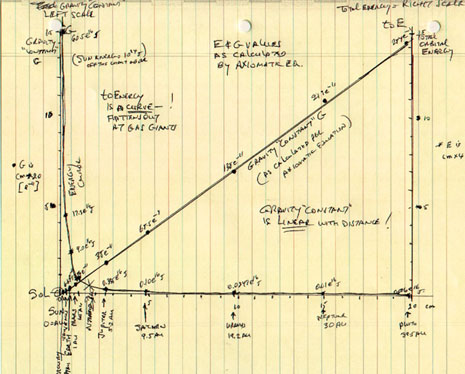
JASZZ SPIN phase 3: The outer planets's total orbital energy and gravity constants.
Abstract: If gravity is in inverse proportion to the energy present where it is being measured, as predicted by the Axiomatic Equation, then it should stand to reason that the closer we are to an energy generating star, such as our Sun, the less gravity per mass density should be present; conversely, the further we are from a star, the greater should be the gravity density for bodies located there. There should be a way to understand this at some 'zero point' in space at distances from this radiant source, in that the gravity to energy relationship should be different for each. However, this difference is distance related, and not different within each band of space surrounding the radiant body, so that the zero point values of gravity, or energy, should be consistent within each band equidistant from such an energy source. This would mean that Zero Point Gravity is equal within the rings around a star, but increasing with distance from the star. Now, this is a conceptual model only, and at present, I do not have the mathematical model to describe it. Below, this model is described in greater detail, including how this Zero Point gravity is related to its energy relationship, or ZPH, and may account for planetary spin. The mathematical expressions, based on the Axiomatic Equation, can be developed later.
Zero Point Gravity: The idea of a zero point energy of the vacuum of space is still new, and little understood. One example of this force is the Casimir force, where space vacuum has some intrinsic energy locked in it. The concept presented here is based on that this space vacuum energy is in fact the measured level of gravity at that zero point, or Zero Point Gravity, ZPG. The reason this force is so weak on Earth, and in the band of space where Earth travels around the Sun, is that we are located fairly close to our radiant star, and thus experience relatively little gravity here. We measure its intensity in Newton's G, which is approximately G = 6.67e-11 Nm^2. If this ZPG were measured around the orbit of Saturn, for example, it should register a higher reading, let's guestimate G(Saturn) = G e-9 Nm^2, for example, though I do not know this number is correct. Conversely, G(Venus) = G e-14, and Mercury's would be lower still, while Pluto's would be extremely high, i.e., G(Pluto) = G e-5 Nm^2, and out in the cold of space, higher still. These are arbitrarily picked numbers to illustrate how the ZPG would change depending upon where, or in what orbital band, it was measured. The mathematics would have to be worked out later, once we have a better understanding of these planetary compositions and mass.
This model of variable zero point gravity readings leads to an interesting possibility: that gravity radiates from a hot star not linearly, or in some steady progression, but may actually radiate in rings. This image of rings is in part inspired by the rings of the gas giants, such as Saturn and Jupiter, but also it makes sense in the way energy seems to be distributed in space. It is never totally evenly distributed, but seems to follow some sort of chaotic pattern, possibly even based on harmonic principles. From the harmonic ratios of electron shells, to the harmonics of spirals, to even a possible harmonic ratios distribution of the planets of our solar system, there seems to be a pattern of how energy obeys some sort of distribution pattern which at first glance appears chaotic, but upon further examination may be actually harmonic. (I reference the fine work of Ray Tomes, "Harmonics, Music, Pythagoras and the Universe", where this concept is explored further.) Even the so-called cosmic-microwave-background is not evenly distributed, so chaotic distribution is more the norm. The point is that ZPG may be distributed in rings around the Sun, much as the rings of Saturn or Jupiter are distributed, within bands radiating from the gravity source. (Note also that as ZPG gets greater from the Sun, planets gather more gaseous atmosphere, since the gravity density is greater there.) What both the planetary distributions and gas giant ring distributions may have in common, is that they are bands of rings rather than uniformly smooth. As we study the data returned from the Cassini-Huygens around Saturn, we should get a better clue of how this distribution works. That same distribution pattern should also work out for ZPG patterns around any large body, especially hot bodies, and in particular for radiant stars.
(Please note this has nothing to do with how gravity is effective at a distance, in the inverse square law manner, but how zero-point-gravity affects the mass in the zone where it orbits the Sun, though there may be the same relationship on how ZPG and ZPH are distributed at a distance from a radiant hot star.)
Zero Point Heat: The same principle should apply to the distributions of energy around a radiant stellar body, or any hot body, including the gas giants. The proportions of 'heat' found in the space vacuum should likewise show distribution patterns, so that the greater heat closer to the Sun is not distributed uniformly smoothly in the rings of ZPG around it. Rather, ZPH should exhibit chaotic anomalies, so that if it were measured the distance in a straight line from the Sun, there should be inconsistencies. This same ZPH should also register around any hot body, where the interior temperature of the planet or moon is greater than the space vacuum temperature there. I am using heat and temperature euphemistically, because this is an energy with which we are still little familiar. It may be relative to lambda of the electromagnetic energy radiated, for the full spectrum from radio waves to gamma rays. However, it may also be relative to the power of this energy, its Wattage, or its Joules per second. The concept presented here is that this energy manifests as temperature, such as could be measured from the molecular excitation it generates. Therefore, ZPH would be a measure of both the interior temperature of a hot body, as well as the declining bands, or rings, of temperature radiating at distances from the body.
Zero Point Spin: This same reasoning may apply to why the planetary bodies, and their moons, exhibit the spin they do. If we postulate that spin is a function of gravity, meaning that gravity exerts a centripetal force on the body, then all bodies should exhibit spin based on their mass. However, this is not the case, so no meaningful pattern emerges. Earth's moon spins once per revolution, whereas Venus spins very slowly backwards, and the gas giants have immense spin. How can this be explained? What we may be witnessing is an interaction between ZPG and ZPH, where the two live side by side in the space vacuum and affect all matter present there. The result of this interaction shows up as spin. This is a strange and novel idea as a byproduct of the Axiomatic Equation's new physics.
This strange new idea is based on how ZPG determines of any physical body in space in relation to its gravity potential within that band; the same ZPH relationship exists between that body's interior heat and the energy of the space vacuum where it is in orbit. For example, Mercury's orbit is very close to the Sun, so its ZPH band is very hot. Thus, if its interior heat is different from its orbit's ZPH, it will exhibit spin in relation to that heat differential. Therefore, if the heat inside Mercury is the same as its ZPH value, then it would in effect show no spin, showing the same face to the Sun (which it does not). If this interior heat is greater, then it will have spin; conversely if it were lower, which it most likely is not, then it would spin in reverse. Venus, which a hot interior but not hot enough to compete with its orbital ZPH, spins very slowly, but backwards. In fact, though Venus has a hot surface, it may have a relatively 'cool' interior, if so. The Moon has essentially no spin (except once around its orbital) and is locked in on Earth's gravity, so the interior energy and its ZPH are equal. This means the moon has no distinct interior heat in relation to the space vacuum heat energy where it orbits; the two are equal. Earth's interior heat is greater than its ZPH, so that it exhibits the spin we know, one revolution in about twenty four hours. Mars has a slightly lower interior energy (than Earth's) in relation to its local ZPH, so it spins slightly slower. Jupiter and the other gas giants seem to exhibit very high spin, comparatively, in fractions of an Earth day, which would indicate a very high interior heat in relation to the orbital band ZPH where they are located. One must remember that the gas giants inhabit very cold ZPH bands of space, so any interior heat will generate spin. Pluto, inhabiting a very cold ZPH zone, nevertheless has some spin to it, indicating it has some interior heat in excess of the ZPH there. This is a pattern of spin that should become more understandable as we are able to measure the zero-point-heat of the space vacuum, and the anomalies of the patterns of distribution of ZPH, whether chaotic or harmonic, should exhibit these anomalies in how the planetary bodies spin.
Conversely, ZPG should be inverse to ZPH per the Axiomatic Equation, so that as we exit the solar system, ZPH drops off dramatically, and ZPG rises commensurately. ZPH may be a function of the Axiomatic E = hc/l = (m-g)c^2, where for a lower E, there is a greater g. (Note 'g' is a proton-to-proton gravitational constant, measured here on Earth as g = ~5.9e-39, for m = 1 kg/kg, which converts into Newton's G by multiplying it by c^2, as G^2/pi^2 = gc^2, approximately.) So in the rings of gravity that radiate (not gravity waves) linearly from our radiant star, or any hot body, there will be some inverse proportion of gravity and energy, so that ZPH and ZPG will be linked. How these two then interact with any physical body's interior heat will then determine its spin. This planetary spin should not be affected by the size of its mass, since it is a constant relationship between ZPH and interior heat, no matter what the planetary mass is. In fact, we may not know the planetary mass at a distance, since it is also affected by the ZPG band where it is in orbit.
Conclusion: Why did we not know this already? Why has this interaction between ZPG and ZPH and interior planetary heat and spin not been discovered from all our astronomical observations, or our space probes? In part, it was because we were looking in the wrong places for what is gravity. The relativistic mathematical model became our sought after answer, but it only told part of the story, and was wrong because it assumed Newton's G to be universally constant. More importantly, we failed to notice different G in our observations because it is all relative. What happens to the distant planets also happens to their neighborhing moons, so we could not tell their gravity density was different from ours. The Pioneer 10 and 11 distant space crafts gave us the first clue. As they left the solar system, they entered greater ZPG bands, and thus took on more inertial mass and began accelerating (gravitating) towards the Sun, slowing them down. Saturn's moon Phoebe gave us the second clue, since its mass as determined by its size and composition and orbital velocity do not compute; it appears to be heavier than it should be, so astronomers are forced to add rock to this all ice body, to increase its mass. The fact that Phoebe has high spin only illustrates how cold the ZPH is in that region, where the interior temperature of ice is 'hot' enough to give it spin. It will be interesting to get close to Pluto and Charon to see what their composition is made of, very likely ice also, though likely colder than Phoebe, and in a very cold ZPH band. The larger moons of Jupiter and Saturn will also be affected by the ZPH generated by those large hot bodies, so their spin readings will be contingent not only on the ZPH of the Sun, but also of their parent planets. (Note, if Phoebe were in orbit closer to Saturn, it would have a lower spin, since Saturn's ZPH would more closely balance with its interior heat.) The further from the planet, depending upon the interior 'heat', the greater the spin; the closer in, the slower. Another clue is being offered by the patterns of rings around Saturn, now being studied by Cassini: the rings are stratified, possibly exhibiting the ZPG to ZPH bands relationships of Saturn's environment. The distant bodies, such as asteroids and iceballs in orbit around the Sun, may or may not exhibit spin, depending upon their interior heat to ZPH relationships where they are located. It should be remembered that some of these have extremely elliptical orbits, which means they transit from low ZPH, and high ZPG, into high ZPH and low ZPG as they approach the Sun. Hence, as they approach the inner planets, their spin should reverse from what they experienced far out in space. If they are balanced in their orbits, their spin should be captured by the nearest large body, in effect have no internally generated spin, much like our Moon. Very close to the Sun, Mercury's ZPG is very low, with a very high ZPH, and with a slightly elliptical orbit, these values interact so that the planet has spin, but its orbital velocity is also affected, where it 'accelerates' at the perihelion; this is because its gravity density lightens, lower ZPG, as it approaches the Sun. One should suspect that the inverse square law applies to both ZPG and ZPH, so that as one approaches the hot star, the E value of ZPH increases exponentially, while ZPG decreases in inverse proportion. If so, then Mercury's spin should slow slightly as it enters its perihelion, and accelerate spin slightly at its aphelion. Thus, conservation of energy is preserved.
This leaves the Sun itself. What happens there? How is the star of a planetary system different from the rest of the system?
Any hot body will have a convergence of energy at its center. It is at that center that the ZPH to interior heat interact, so that what happens in the center is counterbalanced by the zero-point-energy of the space it inhabits. In the case of the Sun, or any radiant star able to produce light of at least the orange visible range, also the frequency of its photoelectric effect (approximately 10e15 Hz), gravity, or its ZPG factor, is moderated by this energy produced. (Below that range of energy, the star remains an extinguished or failed star, a so-called neutron star.) This interaction between ZPH and ZPG is therefore balanced on the external skin of the star, so that its surface represents the first ring of its energy-gravity band; this surface area is where the high interior heat of the star and its low gravity band equalize. ZPG = ZPH on the star surface in such a way that they stabilize there. Not considering other forces, such as the star's powerful magnetic fields, this is where the star's spin is determined, which is fluid in that the equator rotates faster than near the poles. If there were no other factors, this balance of ZPG and ZPH would cause the star to have no spin. However, the interior is rich in spin, which is what powers the outermost layer of the star, so it appears to have spin.
The other result of the convergence of all its energy on its center is that all lambda there cancel, which is true for any hot body, including planets. What this means is there, the gravity, or ZPG is at its maximum, per the Axiomatic. This in effect creates a mini or micro black hole, where maximum gravity exists. Because this it is of such a small radius, and because it immediately interacts with the fluid mass of the interior body, generating heat and spin, this mini black hole is invisible to us. We cannot measure it, since it is covered by all the mass of the body surrounding it, where it equalizes as the hot body's angular momentum of spin, so the force is used up. This mini-micro black hole may also be the source of the hot body's electric and magnetic fields, now attributed to spin. In fact the two are inexhorably linked, but for a different reason than now supposed. The root cause of the magnetic field is its interior mini black hole, and not its spin, though spin results. Beyond the surface, we then enter the dominant ZPG and ZPH surrounding it in the rings of gravity and heat. On the more massive gas giants, this has a real effect on the surrounding moons and belt rings, whereas on the smaller inner planets, it is virtually totally dominated by the Sun. In the Sun itself, this interaction is totally self contained at the surface.
In conclusion, I believe that the Zero Point forces of heat and gravity in the space vacuum are extremely important, and warrant detailed study. For the present, we are mostly ignorant of their existence, since we judge the universe by what we know of Earth. As we get more space exploration data, we should see these patterns of forces and their interaction more clearly, as described above, and the mathematical expression should follow easily. However, without true data on interior planetary temperatures, their mass, or how the bands of ZPG and ZPH are distributed in the solar system, it remains for now only a conceptual best guess, but worthy of future study.
One more note: Why does a neutron star have such a high spin, to the order of hundreds of revolutions per second? One answer may be that it inhabits a very cold ZPH in space, since its energy potential is below the threshold, or cut-off frequency, of how energy interacts with the strong gravity of the space-vacuum. It cannot modify this intense primordial gravity. Therefore, because there is still energy locked inside this failed star, it converges on the center, creates a very powerful interior mini black hole, and thus has tremendous spin.
Ivan D. Alexander
Costa Mesa, California, USA
CAVEAT!! None of this is in any physics books or currently accepted theory. DO NOT USE these ideas in your school work.
By MStransky on Thursday, July 8, 2004 - 10:50 am:
"Does any of this jive with my new idea of ZPH and ZPG? I can imagine how
frustrating it must be to find correlation between metric volume and spin, but I
think it can be done! Spin is what is left over from the ZPG and ZPH
interactions, to conserve energy and momentum.
"
Yes I think there is something. The Idea of looking for multi orbits and Zero G has made me go mad at times, But as jam hads asked about G and his thoughts how F=F and was not listen to very clearly by many. I thought about it as well.
Take orbits and Mass spin, if V^2*r=R^2*a when you take G and M and F out of the Equation.
Ok Humour me on this,
May it be that we can then find Zero G is about how far from a Star(Sol) for V to equal 0 meters(or less than 1m/s) per sec. and also how come closer orbits are unstable, like Mercuary.
I am computing some numbers to see if our understanding of spin is overlooked by the means of how Mass is effected by it spin. say mathmatically your distance is 10 units away from the sun. But it is really is 10.02 units from the sun, but the planet has a high spin rate. Does the spin rate effect it like a Gyrosphere causing it to have less mass due to its spin. Or as in Jupiters case or Saturns, the Bodies that orbit the M1 seem to show that... Well lets say, We know the distance of Jup. or Saturn from the sun. and bing that the high spin of Jupiter (Lessens the Satitc wieght, or F).
Cut to the chase.
is it possiable that. a Static body no spin to hold a certin distnce from a sun in an orbit. BUT if that body was to have spin, causes a gryosphere effect which would not have a Static body, but a active body spin, Due to the spin the mass would by less with that new lesser mass the new orbit would have to be closer or faster than its static value.
On the Other hand if you had a mass Unit of 4, and a fast spin rate but, stopped the spin, would that same body have more mass measured in F if so than the V of the orbit must increase or the distance must increase.
The same would hold true with the density of a planet due to what its total flexing of Volmeteric radius is really streched due to spin throwing off our idea of how truely dense some planetary makeup is.
I am very Happy with the ZPG and ZGH thoughts you posted and copied me in and email. I will have to send you an update on my spread sheet, about the Orbits spin and stuff again, Its been months since we talked, but you just jogged my passion again.
The other thought you had I would agree that something is there when closer to a sun and temperature. Given the Fact no one has come straight out to say G is this... the only thing we have done is understanding how it is measured. I still believe we need to look at it not so directly, like in the finding years ago on the opposit hole flow of electrons in a wire, but they found it was easier to measure the electron flow with a meter. So it than gave them an equal value of hole flow in the opposit dirctions of the current flow.
So when talking about Gravity in order the gain and energy something must be given up. So I ask, " if Gravity flows in one Direction, whats going in the opposit direction!?" Some times the answers may be the sum of all the other actions around it.
Thank you Ivan you stirred me up again!!!
I will post so again with a clearer picture and some values to play with on my above thought, either it be for me or against me, but at lest by then we wont have to go down the same road twice.
CAVEAT!! None of this is in any physics books or currently accepted theory. DO NOT USE these ideas in your school work.
By MStransky on Thursday, July 8, 2004 - 01:00 pm:
Take the Suns R^2*a and the same with Jupiters
in excel format
The Suns R^2*a under columb A and paste it about 100 rows down. Then on columb B Take the 1/G number and each row below it divide the ^2 value by 2 like such [=SQRT((B1^2)/2)]. Then take columb C and have it as =A/b^2 to give you a distances. You will note that that b columb is a distance from the Main Mass, while the C columb is the velocity aruond the main mass. as you get about 100 rows of plotted graph values what you will notice is that all the major planets around the sun and the Moons around Jupiter fall about 52% to 63% of the most gravity at the source mass to the farthest distance when elocity becomes less then 1 meter per sec.
It intrigues me that the orbits & Velocities of all the major m2's fall about 50%-70% of the M1's k Factor. almost minimum to maximum of the Masses k factor in relation to its m2's.
I would like to compare the Rings around the Planets as much as where the ort cloud falls on such a measurement. Would this be as Bands you see? or are you thinking of more indiviual Bands of orbit measurment, where they fall into?
I did a crude one of the earth and Moon and the moon was at 68% of the earths total span.
This so far holds true with all the planets I did. would that % of 50 - 70% ring any bells with your ideas as Stabel threasholds, where when a planet is found at the inner or outer limits of the Span? This window I would call a stable window of a Stable orbit which would hold for millions of years, if there was an orbit closer and/or father away from the Mass span G window, well maybe a million years ago but thats why its not there now, (A little humour):)
I may sound Vauge but these Spans of Bands which I am looking at from just the V^2*r equal 1 back to R^2*a , the same odds values I am trying to put a finger on the Spin of a body and how much it might effect its Mean density to show truthfully about its mass. If there is an anomoloy with corolating data given to us for what we only have gathered, I hope the new data may lead to some percived mis-comprehension of what we thought about the makeups of saturn or its moons and their orbits, If I am right I believe Saturn to be a bit more dense then they have thought, and we will know as more data comes in from the Orbits of there moons.
By Ivan A. on Thursday, July 8, 2004 - 06:41 pm:
This article at Space.com offers additional clues for gravity variations. In particular:
"Saturn's moons might also play a role. They perturb particles in the rings by creating 'density waves' of gravity spotted by Voyager 2 in 1981 and in other new observations by Cassini. A moon inside a ring pulls outward as it orbits, for example, causing particles to clump together. The density waves could be locations where more water resides... but it's not clear yet if that's the case." (italics mine)
I suspect this above is still a little confused, but it shows there are anomalies to consider, especially since the inner rings are more rocky than the outer rings, which are more ice. The density distribution goes outwards, from low ZPG to higher ZPG.
If we postulate a "level playing field" for Saturn's rings, then this density distribution may offer us one more clue. For some reason, heavier materials congregate closer in to the planet, while lighter materials further away.
* * *
Michael, glad to hear you're working on these problems again. Let's see what we can find out!
Ivan
By MStransky on Friday, July 9, 2004 - 01:29 pm:
I have seen if you take all the "KNOWN" math point where bodies should be by the math, and the differance with where they really are +/- by an anomoly amount, that amount gets greater with the Spin, AND known density, And other character make ups of the m2's profile.
If I am able to take any m2 and countculate a +/- of deviation of is mass because of it Character proflie, and if it matches in accordance with the +/- error of is orbit placement of the known Math we use. Then I would be certin that we have ground to stand on how the perception of any given MASS value alone, can not give percise calculations to other true profiles, of any M1 or m2. I believe the Math we have is true, but the way we exstraplate the values to make them fit the needs of todays research. Where as they say our data is .4% error from the data we gathered, based on Orbit, Time and Distance. But I am taking that .4% and finding that from that .2-.3% of the error is following the Spin amount, Mass, and profile of the m2.
"Humor-" If you pick a basket of apples and weight them, and subtract the basket. They say we have 5.1 lbs. of apples, and a +/- of .2 Lbs of error from dirt, stems, leaves.
Most people would say who cares its apples, what point are you trying to make? I would agree if it was just apples, but by the time the company buys each basket and washes them, then sells 10,000 basket of apples. They wonder what ever happend to the 230 basket of apples.
I hope that my point is taken, if we do the math to get any given value, and we can not back trace it, then it is not good enough. (not saying our equations are wrong, but we are missing many anomolies that are occuring)
Ivan, I must say I am happy to see we are getting new data on saturn and its moons, which I am wondering how far the pevious data ERROR Check and updated, then the pressumed first thought ideas of them. I believe they with find Saturn to be a bit more dense then they think, but not by much.
And you added about the moons and the rings being perturbed by the moons. That being based on the ZPG and ZPH. I will run with you on this one, since the slow deteriation of the mathmatical slope of (k) V^2*r is not linear at all but a curve which is somewhat a straight line in math, but when you place the bodies where they belong they curve off of that line. And that is why the math does not work backwards, So something is being over looked, and only a few people are asking what happend to the missing baskets of apples!
(you seen the exaggrated execl plot of the curves I sent you? That was just an excelerrated graph of the given data. They should all be striaght lines but you see they deveate from being a stright line. Give me a few days So I can clean up my sheet and send you a copy of it, and that it is not to large.
By Ivan A. on Saturday, July 10, 2004 - 12:29 pm:
Michael, this MASS value is what has to be reconsidered all over again for all distant astronomical objects. Saturn, and all the gas giants, should act as if they are more gravity density rich. The math is true, I'm sure, but the distant readings are made to fit the math, as you also pointed out. So when we get more correct readings, the math will start to look funny, by the 'bushel' full. I think we should continue looking for clues of gravi-density of moons, rings, comets, brown stars, etc., and other anomalies of how mass, spin, elliptical orbits, behave in different ZPG and ZPH environments. As you say, where 'the math doesn't work backwards', we should look for more data to get correct readings. Thanks for sending the tables you put together thus far, and look forward to seeing more.
Quote:
Remembering that it may be theory that drives a search for data, but that data in the end drives the theory; we should look for more reports coming from distant space observational data, Voyagers, Pioneers, Cassini, and nearer to home, Gravity Probe-B, Mercury launch 2005, etc., as well as what keeps coming from Hubble, Chandra, SETI, all linked Earthbased telescopes, and put it all together. Out of all that data 'noise' should start to show a pattern that makes sense, regarding zero point energy and gravity.
Ivan
By J____ on Saturday, July 10, 2004 - 08:13 pm:
MStransky wrote: "I hope that my point is taken, if we do the math to get any given value, and we can not back trace it, then it is not good enough. (not saying our equations are wrong, but we are missing many anomolies that are occuring)."
The anomolies are occurring because of one factor ... that factor being ... what once was called aether, but denied by Einstein as existing or factual; however, in direct reference many times, Einstein declared ... for light to propagate, it must have something against which to propagate within.
When working gravity, by omitting what was proven to be aether drift, every formulation based on Einsteinian theory will be incorrect ... which leads us to the present bad science being taught to students at every level of academia.
J____
By mstransky on Saturday, July 10, 2004 - 11:42 pm:
One thought of mine, though I am not sure if the argument of aether drift can be used with my example, or if it can then good! or maybe a new name to label it?! or to discribe it better in terms.
Just as we can bend light, or fight the good fight on speeding or slowing down time. which all come down to says like. "Super nove we see happand many million years ago!" or " the Gravitation lens effect of seeing a star located behind a galaxey, but do to the light being bent, lest us see how gravity bends light from a distant star"
Ok take all that,
point 1)-- now if one was to take Half a circle, Draw object one at one end and object two at the other end, and say that the circles circumfrance was the path of light which it took to get to use around a Gravitational (center, anomoly, or which ever label Strong or weak).
point 2)-- Even if it is not that stong of a bend, but a Slight curve/arc from the straight path to get to us. from distant objects. the ACTUAL distance would be shorter than the path of the arc, in terms of a striaght line.
So my opion would be that the data we get from distance stars could be a stretch of the truth, by Straight distance, Light wave readings at diffrent levels, and so on with more OUT OF THIS WORLD this we are seeing.
But understand me, The data is great, better than nothing, but the data we get from more and more distant objects, I tend to take them with some great care. And that drift in space due to the bending of the data as it gets to us, may also be what the great scientist before us precieved as a/the "drift Idea" they first brouhgt into the discussions in the beginning.
Michael
By J____ on Sunday, July 11, 2004 - 03:25 am:
Please see new thread ...
Making Sense Using Honest Physics
J____
By MStransky on Thursday, July 15, 2004 - 10:25 pm:
As a stellar heat source, body like the sun, will emitted or give of an opposing force (like stellar wind), which would offset the attraction of force between the two bodies as in attraction?
Second question was the Idea that the bands of "Density" get less or greater the closer you are to a source?
Reason I asked for further explanations- I was pondering the Idea that space it self is NOT VIOD and FORMLESS. If the solar wind can push comet tails and Radiation belts, then in like manner I would agree that the Source Heat given off by a source is indeed overcoming the gravitational attraction of the two bodies.
SECOND- I tried something not ethical in mathematics, and tried to find the Density of space between two bodies, When I was finished running them a crossed the data, It looks as if space gets THICKER/DENSER the closer to a body. The farther away you get shows it to be less dense.
Given this thought of a fan, as you are closer to the HEAT SOURCE/FAN the Volume or pressure of the Force would be stronger. If one was to have a brick, tissue, and feather. Once the force is on the brick would stay where it is, and the tissue and feather would be at a greater distance and stop, once the force of the source cannot push the objects any further away. Like how the rings around the gas giants, and If the same with the sun. (IF ANYONE would like Gravity in the example, tilt the floor going towards the fan, the fan would be the Energy source)
Third- If this is true, and the Force is stronger closer to a source, and it being more dense in space (NOT BY MUCH, BUT a Difference) Then that Opposing force would be stronger to Give off a stronger (Energy Force) and as you gets farther away, and density of space gets thinner, the (energy Force) would show a significant drop in (energy Push?) But in the same respect that the same distance there is also less Gravity attraction to the source as such a great distance.
Am I agreeing with you? Am I over lapping the Idea with you?
Michael
(Ivan I have updated that sheet further if you would like a copy of it, with this in it?)
By Mstransky on Thursday, July 15, 2004 - 10:59 pm:
.000000000279250666666667
or better written as 2.79251e-10
I know in passed forums I never put (Units) in which became a big issue, but I have Learned to add them.
so
Surface Gravity(m/s2) = Mean Density(kg/m3)*Radius(meters)*2.79251e-10
Earth example I like to take KNOWN facts say like [Surface Grav @ 9.798(m/s2)] / [mean Radius 6371000(meters)]*[2.79251e-10] = [5507.2604(kg/m3)]
Note: if you have any of the two values Mass, surface g, Radius, density, you can pretty much get to the other and more values.
But check this out that number divided by G = 4.186666667 then Divided by 2 equals 2.0933333333
Now take the
(4.18666666667 + 2.09333333333)/2 = "Pi"
-------------------
CAVEAT!! None of this is in any physics books or currently accepted theory. DO NOT USE these ideas in your school work.
By Ivan A. on Saturday, July 17, 2004 - 01:57 pm:
Quote:
Earth example I like to take KNOWN facts say like [Surface Grav @ 9.798(m/s2)] / [mean Radius 6371000(meters)]*[2.79251e-10] = [5507.2604(kg m3)]
That's pretty good Michael! So you have a 'multiplier' number for converting gravity into density? If I recognize the above, Earth's mean density is something like 5.5 grams per cubic centimeter?
About your earlier post,
... that has to do with the inverse proportions of proximity to a star heat generating system.
Quote:
Second question was the Idea that the bands of "Density" get less or greater the closer you are to a source?
What the Axiomatic Equation theorizes is that the closer we are to a hot source, like a hot star, the less 'gravity density' exists per volume of mass, right down to the atomic level. The farther from a hot star, the lower the heat and greater the gravity density per volume of mass.
Think of an atom formed with C^2 energy compacted on a very deep gravity point in space + (positive charged), so that the resulting shell - (negative charged) gives us the parameters of this atom's size, weight, etc. Now, near a star, there is more pressure of c^2, and far from a star, there is less. The result is that atoms near a star have strong -electron shells, weak +centers; whereas far from a star, weak -electron shells, stronger +centers. So here's the trick: high stellar heat, strong -electron shell, weak +positive center, equals weak gravity density per atom; low star heat, strong +positive center, weak -electron shell, equals strong gravity density per atom. This means the 'atomic weight' would then be greater or lesser than what we measure it on Earth. More ZPG, gravity per mass density, the greater the weight, etc. However, we have not yet confirmed, except anecdotally, so pure conjecture for now.
So what the Axiomatic says is that under these circumstances, the gravity force for each such atom is either greater or lesser, depending upon the inverse of the amount of energy received from the hot star, or ZPH (zero point heat) per atom. If the ZPH is low, then inversely, the ZPG (zero point gravity) per atom is greater. By the time we get to the gas giants, like Jupiter and Saturn, we are already in a fairly low ZPH, higher ZPG environment, hence the giants have 'heavy' gas atmospheres around them. Closer to the Sun, the planets are smaller, with less atomospheres, since their gravity density per mass is lower than farther out, and are bobbing around in their orbits close to their hot star. Very far away, past Pluto, or even better past the galaxy rim, ZPH is extremely low, so that ZPG should exhibit very high gravity per volume of mass: i.e., Dark matter!
:-)) chuckles
Well, that's the theory in a nutshell 'atomshell', so hope it makes a little bit more sense. But it is only theory for now.
I still have to study the spreads you sent, so will do so.
Ivan
By mstransky on Saturday, July 17, 2004 - 09:11 pm:
This was my point on "other previous website forums which I tried to explain a common balance of density and radius. of those two which are inversely proportional to each other, under the value of the bodies surface gravity, or of its mass.
Back to the ZPG and ZPH, I would like to run the numbers on that on a spreadsheet and see if we can come up with anything. Like the same way I did any stellar bodies that we know.
I am curious that with any star, could the mean density reflect a proportion to its Radius and Temp. or mean temp. Something like that.
ON THE SPIN ISSUE I have come up with four different formulas that reflect Gauss to the spin, density, radius, and surface g or GM, and other constants here is the values given and found.
Gauss R#^3 m2 Name My Values found
4.28--------Jupiter--------5.388377095
2-----------SOL------------1.104860637
0.3076------Earth----------3.938362935
0.228-------Uranus--------1.116717646
0.21--------Saturn---------1.007691692
0.142-------Neptune--------1.951049038
0.0033------Mercury--------0.024885102
*Its been a while, but I do remeber you emailing me one time on your ratio to spin values a while back, and in the like manner explianing the same close proportional values*
Note that the profiles of each planet follow the same like trend to the given data, and another pit fall is due to the gauss reading and data for each planet was taken at different location distances from each expedition, which then does not give the public a good proportion data to work with. That some are from out in space, and some from flybys near its poles?
So when better data is given to work with, then the formula can be worked out. And also if they find out that Neptune gives off a stronger field then Saturn or Uranus, Then I will know I have something.
I am still re-computing different ways to the above Given data to see if it works out closer, as I get bored, or dumbfounded I will set up a ZPG and ZPN sheet and play with it as well.
By mstransky on Saturday, July 17, 2004 - 09:39 pm:
For example in the state of a liquid, say for argument it has a mass of 4, when colder as a soild it becomes more dense, but smaller, but still has the same mass. And when it becomes a gas it is less dense, still having its mass, but volumne has become greater.
What would be a good unit to use as a common mean density in the stellar aspect? what would be a given value at its least and greatest values, then I could come up with a relation to ZPH or ZPG, in a way to show its inverse property. if so this would also work with my spin formula idea, relating to Gravity density and spin guass.
I was thinking maybe Hydrogen?^3 meters
but then again you know how todays physics relates everything to the density of H2O, or Earth ratios, I kind of dislike that method of the univers being sized up to the Earth?!?
By Ivan A. on Sunday, July 18, 2004 - 12:26 pm:
Quote:
I was thinking maybe Hydrogen?^3 meters
but then again you know how todays physics relates everything to the density of H2O, or Earth ratios, I kind of dislike that method of the univers being sized up to the Earth?!?
Me too, too much Earthcentrism. The mass will not change where measured within its band of ZPG and ZPH, though the volume will, so mean density is an unknown except theoretically as taken from a planet or star in toto. That same mass density taken for another planet within another band of gravity and heat will then have a different mean density again. But at present, do not know how to define what a mean density would be... except to give it the cubic meters value.
We'll have to work with whatever measures exist for now, though the mass of distant bodies may be off, I suspect.
By J____ on Sunday, July 18, 2004 - 05:42 pm:
I venture to say the existing density data used for earth is not only misleading ... my bet is it is highly inaccurate...!
J____
By Ivan A. on Monday, July 19, 2004 - 01:17 am:
I would agree with you, though I have no way to back up the claim that our current estimates for planetary mass and density are wrong.
There are several factors to consider, such as planetary temperature, magnetic structure, interior spin vs. exterior spin (ie. plate tectonics), orbital chaos anomalies, elliptic, and planetary density. To inpute a metallic core to me is a copout, which tells me we don't understand Earth's interior. Seismic waves deflect off the interior, at some distance from the center, in an unexplained manner, as if the Earth were hollow. Uranium decay is not enough to account for the great interior heat of the planet. Spin for billions of years is too much to ask of momentum conservation without it slowing down to a standstill. Iron core? Why? Because of magnetic field, or because the planet's density needs to balance with its orbital velocity? And why should heavy metals sink to the core? Would it not be better if they sank to some equilibrium gravity point part way to the center of the planet? Perhaps the planet really is hollow, since spin gives it centrifugal force outwards, along with the gravity attraction of the rest of the mass of the planet from its center. And how hot is it down there? Any way to know?
So too many questions to come up with reasonable answers, never mind a theory. I think if we work with what we know and go backwards, starting with surface spin, we might be able to arrive at some meaningful numbers of mass and density. That's what Michael Stransky is looking at presently.
Ivan
By MStransky on Monday, July 19, 2004 - 02:43 am:
I would like to add in this as well to you above questions, Why does the Earth flip its poles every 10,000-20,000 years. (So why are we not having a rover look at any of the other planetary factures of their plate movement, to see if other planets have the same cycle! No we dream ideas up to have FACE when asked, and teach those ideas, then to say I will look into it when the availability comes to do so.
There may be bigger things at play here like gravity/magnetic Harmonics at play. Only time will tell.
It is a sad thing for us to be in a boat going 10 knots by the gauge and say "MY SCIENIFIC SPEED READER IS ACURATE!!! and be blue in the face saying it is correct. Then take the few people who ask" how come you got here so much sooner or later?" - [Drift of the water]
My Point is we only have the grasp of looking at our instrument gauges to read the measurements that they show at the time given.
For example One technician reads he has 24 DC volts on these to wires from a transformer, he thought he would just grab the wire, but to his SHOCK it was floating on 208 volts ac.
WARNING-DONT TAKE READINGS FOR FACE VALUE
I care less for the one time reading data, For example, We have plotted the orbits for years now, I would be more happy to except the days of orbits, (then the actual km/s) or how about the rounded off distances? 4,700,000,000,000 because after the 7 thats 49,999,999,999 That is still Big value of Gained/missing distance or mass, for which ever unit you work with.
So like in many ways when computed equations are done backwards, the values can be off quite a lot, some have lost mass, some people have gained mass, and now their are more teaching schools on missing matter, dark matter, Time dilations, missing time, and so on with "out of this world stuff" as the consturtion of a time machine.
Ivan, J___ just a little joke here..
Too many teachers and scholars, and not enough scientists and instruments to go around.
By J____ on Monday, July 19, 2004 - 02:53 am:
I have tried to go backwards, and it doesn’t seem any better than pure guessing. The problem is multifarious to the extent numbers used reach beyond oblivion and escape into infinity where they disappear into the sludge.
Maybe the following link is worth reading since I have not made up my mind if I can swallow the info……
http://www.space.com/scienceastronomy/planetearth/core_cyclones_991110.html
J____
By mstransky on Monday, July 19, 2004 - 10:42 am:
It is like this you have 3 children which look at a clock, one takes it for granted that it keeps time ~24hrs a day. Then there are those who will think a running hempster on a wheel keeps the time. At last the few people which want to take the clock apart and measure all the gears if it can be done.
Back to the Numbers,
1.) what would be nice is if JPL would post the absolute DATA numbers it has on the web site for people like you and me.
2.) with those numbers, they must show a (geneology tree of answers) as to WHAT VALUES derived which new canculated answers.
3.) because as you said
"numbers used reach beyond oblivion and escape into infinity where they disappear into the sludge."-J___
that is the problem we agree with each other, Yes if the earth is 6371000 Re/km fine when I do canculations backwards I get bogas numbers like 6371972km * 2 = a diameters larger then what is hear on Earth. So if our Scientist are taking what they are taught and use rounded of numbers, then find missing or lost mass, and teach an intire school course on it. THAT is BAD, and I dont mean the teaching, but the standinging on grounds of rounded of numbers.
4.) if an when JPL ever post The numbers the got from the data before rounding it off. THAT WOULD lead to people be able to see the true numbers. If I sell you a basket of 120 apples, looks like 120 apples, but when you count them you are short.
If you are short 10 apples, you would be mad and feel like a fool that you believed 110 apples could equal 120 apples. and all the todays teaching is "well the numbers are close enough!" then when you point out a problem, they tell you go back to school or get an education."
J___, Ivan I think JPL should post data fact sheets for all, and also post the data for the researcher, because if not, then we have all be short changed on our ideas of the univers, which will lead to a crooked measuring stick, distoring our concept of the truth!
By J____ on Monday, July 19, 2004 - 12:55 pm:
I honestly do not believe there is a data set that has been validated by multiple sources...! If so, it is deeply hidden in archives somewhere, someplace, where it is not accessible to idiots like apparently at least we three appear to be to the Einsteinian/Minkowski camp. What methinks has happened the several leading institutions that essentially control research funding have become another religion ... do it our way or perish...! The worse place to try and find something is the National Laboratory at Las Alamos.....
http://lib-www.lanl.gov/
When there click on Astronomy to get
http://lib-www.lanl.gov/edb/AST.htm
and then click on
ADS: The NASA Astrophysics Data System
Where you learn the database is housed on Harvard servers…!
You would at least think the database would be housed on NASA or JPL servers…!
Now you are there … try to find something in that 4 million document sucker!
I believe there is a consortium of institutions and agencies that are in fact no better than religions that tells us … do it our way or perish……….
J____
By mstransky on Monday, July 19, 2004 - 03:31 pm:
http://ssd.jpl.nasa.gov/
over the fact sheets from
http://nssdc.gsfc.nasa.gov/planetary/planetfact.html
the first link seems to have more data go down to meters of the planetary radius and +/- error% then just rounded off the the Km. like the second link.
I will wind up re doing my spread sheet to the more (Resolution) data.
Michael
By Ivan A. on Tuesday, July 20, 2004 - 10:32 am:
I used your table of computations to access spin velocity, mass density, but have not yet worked it out. Also, how would this then compute for Mercury and Mars, Jupiter and all the gas giants, and finally for the very cold bodies in the very cold space far from the Sun? I noticed the inradiating for Saturn, for example, is very small, while the planet's blackbody heat is quite large, if these readings are correct, so not surprised by Saturn's very high spin, though its planetary density is very low... so still thinking.
J___, I looked in on the LANL pages for data, and indeed, there's a lot to choose from. Remember that modern physics is a cabalistic private club, so it is not designed to be easy to access, nor to understand, since the mystery of the voices (of priests) from behind the stone gods must not be revealed.
Ivan
By mstransky on Wednesday, July 21, 2004 - 07:16 am:
pasting this in your browser bar it will open hyper terminal
ssd.jpl.nasa.gov
once you are in type the name of the planet then the number ID that shows like "Earth" or "Sol" then you will see the number id for them like 399 is earth type "399" then it will give the latest info of jpl data, with out most of it rounded off. I think it is the latest data I am not sure but the dates of update are in the upper part of the window. NOTE: it uses hyper terminal to get in, and is not the easyest to navigate, but the data is fairly good to use.
I hope this helps J___ as well.
By Ivan A. on Wednesday, July 21, 2004 - 05:49 pm:
Thanks for this reference Michael, it has some good data to work with. For example, look at the Equatorial gravity readings, see how some of the gas giants, Saturn and Uranus, are very close to Earth's and Venus. How can this be? Mars is similar to Mercury, while Jupiter is very high, followed by Neptune. Pluto is extremely small, if this is correct. However, since I think we are wrong on our calculations of planetary mass, something else is at work here. Also planetary density is very similar for the inner planets but drops off considerably for the gas giants, while Pluto's is merely a guess, not to mention the planet's radius is in doubt also.
My take on all this is that we simply don't understand what it going on here. If gravity density per atomic weight is a variable, weaker near the Sun and stronger far away, then by using a constant Newton's G we are getting bad readings for mass and gravity out there. We can't tell we're wrong because we are using assumptions that make it look right, that G is everywhere equal. If electromagnetic energy, and heat, cancel at a planet's core, then gravity in the core is very great, near maximum, and what happens is all surrounding matter is heated by immense interior spin to a greater or lesser degree. In the gas giants, it is immense, causing the outer layers to spin along with it; in the small rocky planets, this spin is confined to the planets's hot centers, but this translates into planetary spin of the cool outer crusts. If so, then planet radius or mass are less important in determining interior heat and spin than the relative position of the planet in its solar orbit, where the relationship between inrdadiating heat from the Sun drops off with distance and interior black-body heat becomes more dominant. This contrast of outer and inner heat then is responsible for spin. Ditto for gravity measures, where the planet's gravity density is greater farther from the Sun. The reason the gas giants can form is because the molecules there are condensed through greater gravity, a larger G, than here on Earth. By measuring atomic weight only in Earth's gravity we are getting bad readings for the distant planets. It will be very important in the future to get a better fix of planetary composition to arrive at more meaningful mass, rather than using orbital velocity as now done. Outside the solar system gravity should be very great in the cold of space.
Is space-vacuum an aether? Yes, in a manner of speaking, in that the zero-point-gravity of space acts as a medium for all the other energies passing through it. Far out in space gravity is strong enough to bind molecules so that interstellar gases can condense into massive proto-stars, where some will ignite into actual stars. This is the universe I envision, which makes a great deal more sense then what is believed now in astrophysics, and which explains many more interstellar anomalies, i.e., dark matter.
J___, Michael,
Let's keep chipping away at this, but the Axiomatic Equation predicts a universe where gravity density for matter is a variable in inverse proportion to the stellar energy output where it is measured. Keep spinning this stuff until it makes sense, because in the end it will.
Ivan
By MStransky on Wednesday, July 21, 2004 - 09:48 pm:
ITS ABOUT TIME THAT THEY TRIPPED UP!!!!
http://news.independent.co.uk/world/science_technology/story.jsp?story=543336
Independent - 2 hours ago
The most famous living scientist yesterday admitted he would have to pay the price for recanting one of his theories about black holes.
hawkings-http://www.guardian.co.uk/uk_news/story/0,3604,1266356,00.html
"There is no baby universe branching off as I once thought," Prof Hawking admitted yesterday. "I'm sorry to disappoint science fiction fans but if information is preserved there is no possibility of using black holes to travel to other univers(s). If you jump into a black hole, your mass energy will be returned to our universe, but in a mangled form which contains the information about what you were like."
Here the Mighty men take something simple as a dark star mass, and for over thirty 30years stuff like this gets taught. parrelel univers, and and other out of this world ideas, but as I said on "THAT Other post how much of the stuff is feed back into space from it. But since I had no degree, I was told to go get an education?
Well I am happy, the mud in my face disappeared, got sucked off my face into their WormHOLE and appeared on their face(s). Joke-LoL
Well I am glad, that I have been standing on his shoulders, all this time! This will be the only time that I will, and have the time to gloat!! End of Pointing fingers back at them to RETHINK-THIER OWN PERSONAL-EDUCATION! and mannar of Slugging out those who wish to see things in a different view.
Michael
Ivan if you must delete this post I made, I understand
By J____ on Wednesday, July 21, 2004 - 10:12 pm:
Good for you...! I once asked the great Hawking if he could prove his theories - he refused to answer the question.
Hawking is no better than Einstein, and so far as both of them ... they would together fit on the little toe of Johann Wilhelm Möbius.
J____
By Ivan A. on Wednesday, July 21, 2004 - 10:59 pm:
Quote:
Yes, I remember the times we wrote on the Space-Talk forums and got heat for not towing the common rope of nonsense everyone else towed. Well, the time of reckoning is coming, when even "Black holes turned 'inside out'" will be shown to fall short of the truth. Black holes do not destroy anything, though they may be very successful as cosmic 'recyclers' producing the proto-matter to seed future stars and planets.
I am not against Hawking, nor Einstein, for their very fine thinking, though in the end it may yet prove wrong. What I am against is their theorizations being raised to the level of incomprehensible pseudo-science religions.
No deletions or additions necessary, for in the end the truth will out.
Ivan
By Ivan A. on Wednesday, July 21, 2004 - 11:05 pm:
Quote:
They'll have to rewrite the encyclopedia Hawking didn't get anyway, at least the astrophysics part of it, so no great loss to him.
Can the future now be known with certainty, since knowledge is not lost down the black hole? No, of course not, though some living things who think about it will continue to insist the 'deterministic' philosophies anyway. In fact, we as living things are the deterministic future of the universe, since it is our sometimes creatively unpredictable actions that redefine the future as other than it would have been on its own without us. So... let's redefine how we see the future of the cosmos with some real science. This is the chance of a lifetime!
Ivan
By mstransky on Thursday, July 22, 2004 - 12:19 pm:
BACK to SPIN, I thought about and experiment to build a THING on a benchtop which might hold some truth to Planetary gyro magenatism, and the effects of heat or cold. I will think a bit more what materials will be need and stuff to do the experiment. I talk with a few very educated people at my site and thought it is possiable to to it on a bench top, Well I will have to see what I have and make room for it at home in my shop.
-Michael
By mstransky on Saturday, July 24, 2004 - 10:28 pm:
Now with looking at the data with saturn slowing down by 6 minutes to its day spin, made me think about something far fetched. and I have to touch a point with planetary magnetic feilds. The solar wind causes a force enough to bend the feilds faceing the sun POWER OUT PUT. could it be possiable that the velocity of a planet in its orbit path have a slight drag into its direction while the tail end of a planets magnetic flield get an equal thrust to its tail end giving its loss back to it. It is like the planets Velocity is equal to its Distance, and the spin is equal to its magnetic paddle wheel effect @ its distance of Heat give of by the sun.
I do not want to go nuts with this thought, but if it might be a possiablity that when saturn is getting closer to its approarch to the Sun. would show a decrease in spin (due to forward drag of angle approch), AND higher orbit velocity, AND closer distance to the sun. IF saturn then starts to get farther away from the sun in its distance of orbit, AND velocity orbit spd decreases, AND IF that "magentic paddle wheel effect" of the solar wind induces a force to give back some momentive spin back to its tailing edge as a boost back, from its forward drag into the wind?
I dont know!
BUT YOU WOULD have to consider-
That would raise some thought about mercury's spin rotation? Do you know if merc. spin slows down on its approch towards its closet point to the sun, at it highest orbital velocity. then if merc. then speeds up in it thrust outward away from the distance to the sun.
even though merc. mag feild is small, but the enrgy output closer to the sun is very much greater then out by us or even lees at the outer planets? would that energy output be so great to effect the small faild that merc has?
BUT YOU WOULD have to consider-
It would also raise question on like Venus, it has a opposite rotation then the other planets and barely no magnetic field. Have they found out if venus orbit is decaying? becuase its rotation is like a back spin on the ball?
Idea for thought? I just brain stromed this Idea thinking about ZPH and ZPG magnetic freilds and the new data about earth and saturns rotational days slowing down?
There is no data to even look at this that i know of, or even any resolution to its spin rates through out the oribt path of any planet!
I will have to think about this some more.
The small amount would be to hard to look for like Saturns spin decreasing by 6 min in I think 24 years? and earths decreasing by 30 secs a year, I think that is correct as well? or is it 30 secs a leap year?
Mike
By mstransky on Saturday, July 24, 2004 - 10:34 pm:
By mstransky on Saturday, July 24, 2004 - 10:54 pm:
By J____ on Sunday, July 25, 2004 - 03:43 am:
Without adding a factor that most modern physicists reject ... a real space medium ... methinks physical science will continue to wallow in the abyss first dug by Einstein with Relativity and Special Relativity, and then further deepened by Fr. George Lemaitre in 1927.
"The effect [of ether-drift] has persisted throughout. After considering all the possible sources of error, there always remained a positive effect." — Dayton Miller (1928, p.399)
"My opinion about Miller's experiments is the following. ... Should the positive result be confirmed, then the special theory of relativity and with it the general theory of relativity, in its current form, would be invalid. Experimentum summus judex. Only the equivalence of inertia and gravitation would remain, however, they would have to lead to a significantly different theory."
— Albert Einstein, in a letter to Edwin E. Slosson, July 1925
"I believe that I have really found the relationship between gravitation and electricity, assuming that the Miller experiments are based on a fundamental error. Otherwise, the whole relativity theory collapses like a house of cards."
— Albert Einstein, in a letter to Robert Millikan, June 1921 (in Clark 1971, p.328)
Please study the information Dayton Miller
Undoubtedly the leaders of change to existing theory will be amateurs like us, Ivan, you, me, and the true renegades of modern physics and astrophysics … Halton Arp comes to mind, who has long fought the establishment based on his observations of redshift, plus his sound knowledge of the work of Edward Hubble (the Hubble Constant has become a joke…!).
J____
By mstransky on Sunday, July 25, 2004 - 11:42 am:
"The fact that the present-day situation is totally opposite of my example is a testament to the intensely political nature of modern science, and how major theories often develop into belief-systems, which demand the automatic suppression of any new finding which might undermine the faith and "popular wisdom" of politically-dominant groups of academics. And that "wisdom" today is: Space is empty and immobile, and the universe is dead. I submit, these are unproven, and even disproven assertions, challenged in large measure by Dayton Miller's exceptional work on the ether drift. "
I truely believe, that Miller was looking at something, his data does so something, Second he exposed his data to the So thought outside interferance of direct sunlight, temperature and the data followed modern sciences automatic suppression of his experiment. Then he also removed those same effects and still had the same general results, but in a small amount.
Well of course if his readings where a by product of the direct exposure.
I will read and make a further comment to this as well.
Ivan, J___
On my above statments
1. do they have merc. spin speeding up and slowing down in it orbit?
2. was saturns orbit closet or further away during this reading than voyegers?
3. is venus orbit degrading?
4. How about a formula for densityHEAToutput from the source has how much oppossing force to a mass at what distance?
I mean hey, they can canculate the smallest orbit or reading of an electron, or force of it. But they cannot measure the opposing force of heatWINDdensity blowoff? Strange that they dont even want to touch this subject, but they claim to what to make solar wind sails to travel near the speed of light. So their has to be some kind of drift (maybe not eather drift) But somekind of HeatDensityDrift associated with that design of solar sails, but if they did it would give LIFE back to millers findings.
Thank you Mike
By mstransky on Sunday, July 25, 2004 - 09:23 pm:
Does other planets change their polarities?
yes!!
http://www.exo.net/~pauld/activities/magnetism/magnetismofplanets.html
"Red and Blue stripes on Mars record an ancient Martian magnetic field which changed its polarity."
http://mgs-mager.gsfc.nasa.gov/publications/grl_28_connerney/images/grl_28_connerney_cover_black.jpg
And
"The sun has a strong magnetic field that reverses polarity every 11 years creating the sunspot cycle."
So the question I will still look for is thier a Harmonic?
on Magnetics I liked this link http://nedwww.ipac.caltech.edu/level5/March03/Vallee2/Vallee2_2.html
But here is the kicker with all those sites, They all give the same data that venus does have a magnetic weak feild ~.00004 times less than earths
BUT JPL or NASA does not Display ANY INFORMATION on there fact sheets, or even the Horizons Hyperterminal link!
Still looking into SPIN...
Ivan here is a link...
http://www.users.zetnet.co.uk/trisen/sol/2300ad/wg/i-three3.html
It used the same round about thoughts as with my Idea of a gauss formula. But this has age of the bodies in the formula? Who is to say how old it is? or the way the formula is written, their is to many man assumtions to effect the outcome of the answer to minipulate the outcome.
Still looking into SPIN...
Mike
By mstransky on Sunday, July 25, 2004 - 09:55 pm:
Ivan here is a link...
http://www.users.zetnet.co.uk/trisen/sol/2300ad/wg/i-three3.html
It used the same round about thoughts as with my Idea of a gauss formula. But this has age of the bodies in the formula? Who is to say how old it is? or the way the formula is written, their is to many man assumtions to effect the outcome of the answer to minipulate the outcome.
This is not a physics link at all, my mistake!!!
Michael
By J____ on Monday, July 26, 2004 - 02:15 am:
Ponder this....
Michael, methinks where you want to go must begin with a more basic approach that encompasses a space-medium to work with. Where I am going with this is not my work, but work that I have verified solid as compiled by a very close and dear friend, who like us is presently engaged in a concentrated effort to force modern science to quit teaching theory as fact.
Forget all the 100 + basic particles - Since science has been chasing The Standard Model ... Einstein/Minkowski ... Fr. George Lemaitre’ and his Big Bang Theory, physics started moving into the world of virtual nonsense in order to force fit The Standard Model into a status of fact, which has become revered dogma much like that practiced by religions.
I am very well versed in the works of Nikola Tesla, who in all likelihood understood the phenomena of Force Field Theory better than any living human being living or dead, and it has everything to do with Zero-Point-Energy, and Zero-Point-Gravity. But we have a serious problem if we use the Standard Model as presently defined, and ensconced by the before named underpinnings of it. As early as 1891 Tesla had posited the universe as a kinetic system filled with energy, which could be harnessed at any location within it, and used the concept of a luminiferous ether to describe and define the source, existence and construction of matter.
I am not so much concerned with anything but the basics, yet from the basics come three very necessary ingredients … ZPE … ZPG … ZPH, of which are a significant part of the mechanism that continuously rebuilds the universe precisely as we observe it without the usual resorting to changing constants, virtual nonsense, and physical facts’ manipulations in order to force fit what is observable reality into the existing Standard Model Theory.
Until Einstein discarded the physical medium that comprises what the Standard Model today espouses as Space-Time, a physical medium was deemed necessary within what was then physical world academia, and accepted as realistic. Today that is not the case, and it is not likely to change until enough evidence is gathered to successfully attack the Einstein/Minkowski/ Lemaitre Standard Model. The only way to successfully attack it will be by using Einstein/Minkowski/Lemaitre source material, which is not so readily available; moreover, much of it is hidden in archives that are very difficult to locate.
To accomplish this attack a point of common contact must be established. Ivan has this forum available, and if he is willing to allow it, I will make available a source computer online to act as the repository for documents that use formal calculus formulations, and can be used as an informational source for an ongoing concerted effort to undermine the Existing Standard Model, and replace it with a complete Unified Physical Theory, which overcomes existing shortfalls of modern physics, cosmology, and astronomy.
Methinks we can expect the help of Halton Arp, James DeMeo, Maurice Allais, Michael Lewis, Tsolkas Christos, Ronald R. Hatch, John Kierein, Ardeshir Mehta, Paul Marmet, and hopefully others will join us as the movement begins to make inroads.
J____
By Ivan A. on Monday, July 26, 2004 - 01:14 pm:
Sorry for late reply, but been engaged this past weekend so just catching up. Great thoughts guys!
Keep in mind that my idea is a derivative of how worked out the Axiomatic Equation, crude that it is, so I am only following a string of ideas, which seem to point to an interaction between a passive universal force of gravity and an active universal force of electromagnetic energy. These two primary forces then are modified depending upon the energy production in any star system, so that the more energy produced, the more it overcomes gravity, so that in Earth's region it is the very weakly interacting leftover force as described by Newton's G constant, i.e., G = 6.67e-11 Nm^2kg^-2, which is then applied in G = GMm/r^2 for our understanding of gravity. But this gravity is a misnomer, since in its true raw form, it is very great, more like what we get from 'Dark Matter'. So this is the basis for my thinking on spin, gravity, and electromagnetic activity in the universe. Does the space-vacuum have an 'aether'? I suspect it does, though I am not clear on how this works yet. As J___, pointed out, there may be excellent theories on the aether which had been purposely ignored by modern physics. One possibility, a mental model I have, is that the aether is actually how raw force gravity attracts the flow of electromagnetic energy from a source. What this means is that once a photon is released, it is 'drawn' away from the energy source into the space-vacuum's raw gravity indefinitely, so that it theoretically can travel to infinity in a straight line, unless it is intercepted. Traveling through this 'medium' of gravity will eventually redshift it over great distances, though at close range its effect is what we see, electromagnetic waves radiating away from an energy source at lightspeed velocity, v = c. By thinking of it this way, the ZPG, ZPH, ZPE, are all functions of this interaction between a passive gravity force and its active countervailing modifying force of electromagnetic energy. This in a nutshell is the universe. How different this is from the Standard Model, General Relativity, the Big Bang model, etc. They are universes apart!
J___, I haven't read the Dayton Miller report, but will as soon as I can. As Einstein had said, if Miller's findings are correct, then scratch the theory of relativity, for all that remains is 'inertia and gravity' as modified by electromagnetic energy. That is precisely what Zero-point-energy is all about. I lean towards Einstein having to scratch his, especially when "experimentum summus judex" will prove him wrong.
Micheal, I see where you're going with the baseball spin analogy, though this is more of a mental model than actually planetary spin, since aerodynamics spin is a physical medium affecting the ball's trajectory, to either send it up or down in relation to Earth's gravity. Not sure how the solar wind or electromagnetic fields affect planetary spin, at this time, so need to think of it some more. I suspect the planetary spins may have more to do with how the two forces, passive gravity as expressed in ZPG, and active energy as expressed in ZPH, interact on any orbital plane. Due to conservation of momentum, there may be a slight speeding up of the planet's orbital velocity as its ZPG related 'inertia' drops off closer to the Sun, its perihelion, and thus its spin should slow slightly. Vice versa at its aphelion, farthest from the Sun, where its inertia is higher in the slightly greater ZPG, so its spin should actually speed up slightly. We're talking about minute differences, perhaps seconds per year type, so not easy to measure. I think Venus is an anomaly all around, where its spin is very slow retrograde, and may be slowing down, with almost no magnetic field. By my model, this would be accounted for by the near equivalence balance between ZPG and ZPH in Venushian orbital plane. Mercury's spin should slow slightly at its perihelion and accelerate slightly at its aphelion, though I had not seen measured evidence of this. This is just how my model would work out. Earth should experience the same thing. Remember we are dealing with very massive bodies, whole planets, so these differences may be very small, but should be evident if the theory is right.
So what happens to modern physics if these new ideas, as first derived from the Axiomatic, are correct? Per Einstein's words: "they would lead to a significantly different theory." Maybe Nicholas Tesla was already onto this different theory, but he got drowned out by the very vocal chorus of Einstein supporters, so it stopped when he died. So "carpe diem", let's take back the day, and pick up where he left off and put physics back on track. I suspect when we better understand this, it will all make so much more sense. Then, and only then, would I go for my Ph.D.. in Physics. Otherwise, it would be a waste, like mastering Ptolemeic cycles just as Copernicus and Kepler were developing their new ideas, and Galileo was being threatened with excommunication, or Bruno burned at the stake. Yet, how many young minds are being forced into the nonsense modern physics has become to get their Ph.D.? Carpe diem!
Keep up the good thoughts, Ivan
By mstransky on Monday, July 26, 2004 - 01:15 pm:
I have the understanding of what is looked for in ZPH and ZPG by Ivan's definition. Could you describe the ZPE, I would think you are saying it is a zero point energy? where ZPH is in balance with ZPG, like a proportion?
If not can you please correct me!
I wanted to email you but your name is not hi-lighted.
Thanks
By Ivan A. on Monday, July 26, 2004 - 04:54 pm:
RE Zero-point-energy, see Quantum Vacuum Fluctuations: A New Rosetta Stone of Physics?
also An Introduction to Zero-Point Energy
These might help you understand it better. Though I still find Zero-point-energy murky, what it says is the universe is full of energy at every 'zero point' of the space-vacuum.
By J____ on Monday, July 26, 2004 - 10:01 pm:
Me thinks Einstein/Minkowski/Lemaitre model is scratched...!
Dayton Miller, James DeMeo
Ivan .... Can we work out a forum on your site, and house documentation on my site whereas the forumulations required can be iterated using proper fonts...? If agreeable with you ... email me....!
Michael ... email coming at you....!
J____
By MStransky on Tuesday, July 27, 2004 - 07:17 pm:
This was the place I once worked at, until the RHIC project was complete. I left to secure a job on the outside 3 months before the completion, becuase 3000 people to build it, only 300 to operate it. So I left before the 2700 people took all the jobs on the outside.
But all in all, Book mark it, they have some very good research and data posted from time to time.
By mstransky on Tuesday, July 27, 2004 - 07:18 pm:
http://www.bnl.gov
By Ivan A. on Tuesday, July 27, 2004 - 08:08 pm:
Dipolar-shaped Magnetic Field
Magnetic Moment and Angular Monentum
Observations of Magnetic Fields/Inside and outside Solar System
J___, Michael, and all,
Just some very fun pages to look at, by Jacques P. Vallee (Canadian), in relation to what we're talking about here.
By Ivan A. on Tuesday, July 27, 2004 - 10:29 pm:
The fundamental idea is that Gravity is a passive universal force, much greater than what is registered on Earth, where G = ~6.67e-11 Nm^2kg^-2; and the other modifying force is Electromagnetic Energy, represented by E = ~mc^2. These two interact in the space-vacuum so that maximum Gravity = maximum Energy: G^2 = c^2, where G = (gc^2)^1/2 * pi, or at g = 1 (maximum), max G = ~3e8 Nm^2kg^-2. It is this maximum Gravity (black hole gravity) that is then modified by E to become the very weak gravity experienced on Earth, perhaps greater for the outlying planets, and lesser for Venus and Mercury.
By using the Axiomatic Equation we are able to arrive at what the G is for any given level of E. The basis for this relationship is the DeBroglie-Einstein equation:
E = hf = ~mc^2, which per the Axiomatic becomes:
E = hc/l(mproton) = (1-g)c^2,
where mass is m = 1 (kg/kg), and proton mass is (mproton) = 1.67e-27 kg., which balances both sides of the equation. The gravitational coupling constant for proton is g = ~5.9e-39 (dimensionless, but may also be expressed in volts when used with the gravitational conversion equation: G^2 = gc^2pi^2).
Invoking the inverse square law for photon energy generated by our local star, the Sun, we can then apply the above against the irradiating energy at given distances from the Sun to get a reading as to the energy density at any orbital distance. If this works out, then it would mean that the Gravity density varies with distance, not necessarily in the inverse square law for gravity, but in relation to the distance from the hot star generating the energy. If this works out, still to be computed, then we should see orbital bands of gravity density increasing in intensity the further we are from the Sun, ie, very weak for Mercury and very strong for Pluto, which might account for why the gas giants are structured the way they are, and why the small rocky planets close to the Sun are the way they are. This theory should also yield some explanation for why planetary spin is the way it is, perhaps a function of interior black-body heat and the energy density of their respective orbits. However, this too is only a guess and not yet worked out mathematically.
So this all means the following, where we are at present: Mass has a variable gravity density in inverse proportion to the Sun's electromagnetic energy density for the orbit where it is measured. If so, then any mass traveling from the inner solar system out to the outer solar system should take on gravity density, or inertia, and given a constant momentum, they should slow in velocity. This is believed to have been observed for the Pioneer space crafts traveling in opposite directions out of the solar system, though no explanation in current physics can account for it. It is presently believed Gravity is a universal constant, but this may be false, for it may be a variable-constant depending upon where the mass is in relation to any hot star. It would also imply that any star unable to generate sufficient energy will remain a so-called neutron star with very great gravity.
So this is the theory as it stands currently, given the Axiomatic Equation. The next quest is to find a meaningful way to incorporate distance and solar irradiation with planetary behavior and spin. Mercury may in fact not be any denser than the other rocky planets, but its location is in a very low gravity density region close to the Sun, and hence its internal density may behave as if it were "heavier" by contrast, appearing more metallic than rocky; conversely, Pluto may be no more than an all ice body located in a very dense gravity region, so that it acts as if it were heavier, or rocky. These are for now speculations at best, but they are the direction of my next search.
QUEST:
So this is the next quest, to find the ratios of in-irradiating energy from the Sun to the planets, taking Earth as a base of 1. I use this base unit of 1 because this is the ratio of lumincity to gravity ratio we are familiar with, which yields Newton's G. This ratio should increase closer to the Sun, more for Venus and still more for Mercury and into the Sun, and decrease to less than 1 for planets further away from the Sun than Earth. I will further assume, as one of my basic premises, that this ratio value will be "zero" at the Sun's surface, where its photosphere/chromosphere is exactly where the zeropoint gravity and zeropoint energy equal, so that they balance out within the star's gravity and its energy output on the surface. Note the Sun's luminocity is ~10e24 J/s (vs. E = ~9e16 J/s, or Watts, for the Axiomatic). I would also assume Newton's gravitational formula F = GMm/r^2 works inversely for any star, so that gravity is greater going into the Sun (but decreasing away from the Sun in the usual inverse square law). The fact the Sun has "spin" would then be of necessity for other internal factors, such as the churning of its interior; this interior churning may be due to a theorized (per Stephen Hawking-?) mini-black hole at its core, which also account for why the exterior spin is faster at the equator vs. the poles. The Sun's center would support a mini-black-hole if the Axiomatic Equation is correct, since all ambient energy from its circumference would cancel all lambda wavelengths there. If so, then any hot star is at its maximum gravity in the center and at zeropoint balance on the surface... only a guess for now.
It may then be theoretically possible to apply this ratio against the planet's interior black-body radiation of heat (Kelvin temps.) to establish spin. Because Venus has the slowest relative spin (approx. -1.08 times its orbit period of 224.7 days), I would use Venus as a base for spin-ratios, though only a supposition at present. Mercury's spin is slow (~58 Earth days), so its internal heat should be considered "cool" in relation to its very great in-radiating solar heat. The Earth's 24 hour spin would then be indicative of a relatively "hot" black-body internal heat to its orbital in-irradiating energy. Earth is a volcanically hot planet, with a hot inner core, and spins one day in ~24 hours. Mars is a volcanically "cool" planet, so though further from the Sun, its spin is akin to that of Earth's. What should show is that the further a planet is from the Sun, in the colder regions of space, the faster they should spin in relation to their internal black-body heat, however this too is only a supposition. The magnetic moment for each planet should then register as a function of that spin, though it may or may not be responsible for that spin, as presently theorized, but this too is still unknown. Therefore, this is the next stage of my quest, to find how the planetary spin reads in relation to the gravitic and energy density readings in their respective orbits. Give me some time to work this out... but this is how the theory looks.
Please note, should this yield in principle the results I am looking for, there will be a name for it: "JASZZ" spin ---with the named parties permission, of course. Though, at present, I do not know how to do this.
(JASZZ spin = J__, Alexander, Stransky, zeropoint zone spin.)
Let's get to work, see if we can figure it out, and all that Jaszz!
Ivan
By mstransky on Wednesday, July 28, 2004 - 12:36 pm:
Hold that thought I am brain storming.
Think of these laws on the side in your head
Tesla, inverse- Square law, Heat, and electron flow.
Ok solar wind has been measured at 6 gm/cm^3 and if this is a way to look at it. If any object gives up a certain amount of electrons its charge will attract other charges at different levels. Not necessarily at a charge of 0 and 10 or 100 and 0, but more like the sum of a masses charge.
If the sun gives of an electron sum charge by losses it in the form of radiation and heat or light, which ever the case. That same charge could be reaching out in the form of static lines of force creating a pull.
inverse square law- if the charge leaving a heat source has a density of 6 gm/cm^3 at a given distance like the earth, would that density charge also fall under the inverse square law as being like 2gm/cm^3 as less and less the further it expanded.
Know if the sun is like a tetriod magnetic field, and the magnetic lines of force are in a circular path like the orbits, then would the given energy of heat given off at the equator, left hand thumb rule. Which as the sun spin rotates leads the charge of given off heat mass. And at its poles would be more excited when they have an energy mass leave off into the path of a magnetic pole. The orbit magnetic path would be greater, and thus what has been seen like x-rays leaving the poles of some stars and bodies.
Another thought if an orbiting body comes closer in its orbit to the sun the greater density charge of the area it has to pass through.
So from this...
All planets have black body radiation, or signals from it own make up. Will the signal reflect how much charge is given of in the form of energy or heat? I do know planets can be measured at 3-10 meter signals, and some take it as a light wave.
I will draw this out in a pictorial, and some of the other things I emailed you on with Magnetism that their maybe two signals I was looking at that may explain way magnetic lines do not collapse, and some other things as well. I will have a few days to do this when I am on the road.
But I would tend to believe that a stronger radiation sum of energy near the source could be inversely measured, by a proportional distance. Because if there is a force that the sun gives off to effect the smaller bodies that same force has to be explained with Jupiter’s and its moons. And right down to the attraction of the earth and moon.
I am tending to think on how Tesla has explained how everything is a charge, it may not be as an out right electric voltage, but a charge of the sum of electrons, protons, in the masses entirety.
I hope I was able to put those thoughts into good enough words, but the drawings I will do I will scan them and email you both. I will have a few days to do many of them while I am on the road.
By Ivan A. on Wednesday, July 28, 2004 - 09:52 pm:
At the moment I am struggling with making sense of numbers, taking: irradiating W/m^2 times distance in meters times kinetic Energy for a gram of mass in Earth's orbit, and I come up with a fairly close approximation of 90 petajoules, which is the value for E = mc^2. But not totally satisfied with this yet, so still working on it.
Now, does black body radiation act like other energy, or gravity , with the inverse square law? I am told by my reputable friends that it does. The only exception I would make is that from the perspective of Perspective itself, we see things linearly, as if the image was at d/d^2, so that railroad tracks don't curve off into the distance but appear as narrowing straight lines. I suspect that the values I am looking for in Jaszz is like that, more linear, but don't know yet. So still working on it...
The Sun's radiation is still something of an enigma to astrophysics, as in Sun Spikes: Solar Quakes Fuel Hot Tendrils in the Space.com article. So much electro power in nuclear fusion that it's enough to make your hair stand up!
Still thinking, and frustrated with calculations, but we'll get that Jaszz yet.
Ivan
By Ivan A. on Wednesday, July 28, 2004 - 11:04 pm:
The goal here is to establish a relationship of orbital energy, as luminosity of solar irradiating energy times its distance from the Sun, as a function of kinetic energy to compute the total Orbital Energy for any given planetary orbit. To illustrate this I will use Earth's orbit for starters. Using the numbers found at Nasa Planetary Fact Sheet to calculate the orbital energy values I need. Here is the first sample:
EARTH: (solar irradiance W/m^2) (distance in meters) (orbital kinetic energy) = Orbital Energy
Orbital kinetic energy is expressed as: E(k) = 1/2 m v^2, where m=1 gram.
(Note: orbital kinetic energy is expressed in kilometers rather than meters, so the distance was adjusted down by a factor of 1000, from meters to kilometers.)
Values taken from Nasa, Earth:
Solar irradiance: 1367.6 W/m^2
mean distance from Sun: 149.6e9 meters (149.6e6 km)
mean orbital velocity: 29.78 km/s
(1367.6) (149.6e9) = 204592.96e9 = 2.046e14 W/m
E(k) = (1/2) (1g) (29.78)^2 = (1/2)(1)(886.85) = 443.4 m^2.kg.s^-2 (Joules)
(note that W/m is the same as J/s/m)
Multiplying: 2.04e14 W/m * 443.4 J = 907.2e14 J/s/m = 9.07e16 J/s/m, or Watts/meter.
Now, why is this interesting? I find this interesting because the result is fairly close to the Energy represented in Einstein's E=mc^2, which is 90 petajoules (9e16 J). The difference here is that this energy is also Joules per meter, as well as per second, so that something is different. Whether by coincidence of because it means something, the relative total energy of Earth's orbital location, taking both its orbital kinetic energy per gram and its solar irradiating energy per meter squared, yields a value which approximates the value we give to the Einstein Energy function. Is this any good? Eh... beh... don't really know. But it looks to me like E = 9e16 Joules is the ZPH (zeropoint heat) reading for Earth, ie., this is the energy level found in all our atomic structures here.
I suspect this is a good number, and that what it represents is the total orbital energy for our planet vs. the solar energy output where the planet orbits. Think of it as an 'energy soup' of ZPH where we travel, and now this begins to look like something. What I should find, when I do the calculations for the other planets, is that the inner planets towards the Sun should tend towards a higher orbital energy reading, towards the Sun's total luminosity (10e24 Joules = maximum ZPH), and those planets further away from us, the other way towards the gas giants, should yield orbital energy values that are lower than here, tending towards less than 9e16 Joules... but that is still a guess. What it also may mean, if it proves correct, is that the Energy levels of planets within this 'gravity-energy soup' declines with distance from the Sun. Now this, I must admit, was a surprise to me, since I assumed the energy levels would remain constant. On thinking about it, it seems to make sense that they are not, since the difference for lower ZPH is greater ZPG, or greater gravity readings as energy readings decline, per the Axiomatic Equation.
What I will be looking for next is, if Planck's constant is constant (6.626e-34) and c is constant, and l is constant (1.32e-15), then when E rises, proton mass (mp) should decline, and with it in like manner should decline the proton gravitational coupling constant g. Once we figure g, then we can convert it into Newton's G (via G^2 = gc^2pi^2) for each planetary orbit. (On Earth, this G works out out to approx. G = ~7e-11 Nm^2, per this conversion.) If E decreases, for the planets more distant from the Sun, then G should rise.
The BIG questions is: why didn't we see this before? But it's all relative, isn't it? So planetary or lunar bodies in different Gs acted as if they were all in the same G in relation to each other. Of course, if so, then we had planetary mass figured all wrong.
So this is the first step towards Jaszz spin, though we're still a good distance away.
Ivan
By Ivan A. on Friday, July 30, 2004 - 01:30 am:
The next phase for establishing a relationship of orbital energy, as luminosity of solar irradiation times distance from the Sun, and modified by the kinetic energy of gravitationally induced orbital velocity will take us to the Energy values for the inner planets, Venus and Mercury. We will also look at how the Sun measures up. (In "phase 3" we will swing out to the outer planets, all the way to Pluto.)
Please bear in mind that these are rough algorithmic sketches, so they may not be totally accurate and would need to be further refined with actual observations and measurements of their consequent gravity values, or their respective ZPG, zero-point-gravity, as it relates to ZPH, their equivalent zero-point-heat expressed here in Joules per second. At this point we still do not have the instruments necessary to measure gravity at a distance, so must send probes there to find out. Because these measurements for planets nearest us will exhibit very small variations in gravity from Earth's G, it will be difficult but it should be doable.
Repeating the same as done for Earth, using the planetary data found at Nasa Planetary Fact Sheet of solar irradiance in W/m^2, distance from the Sun in meters, and mean orbital velocity to find the kinetic energy per gram:
VENUS: (solar irradiance W/m^2) (solar distance in meters) (orbital kinetic energy) = Orbital Energy
Orbital kinetic energy is expressed as: E(k) = 1/2 m v^2, where m=1 gram.
Venus irradiance = 2613.9 W/m^2
mean distance = 108.2e9 meters
mean orbital velocity = 35 km/s
(2613.9) (108.2e9) = 282824e9 = 2.83e14 W/m
E(k) = (1/2)(1 gram)(35)^2 = 612.5 Joules, which multiplied out is:
2.83e14 * 612.5 = 1733.4e14 = 17.33e16 J/s/m or W/m.
Please note this is nearly double (1.93) the E value for Earth's E = 9e16 W/m, so that Venus rides an orbital energy field that is twice as hot as Earth's. It can also be epxressed as E(Venus) = 1.733e17 W/m.
MERCURY:
Mercury irradiance = 9126.6 W/m^2
mean orbital distance = 57.9e9 meters
mean orbital velocity = 48.9 km/s
(9126.6)(57.91e9) = 528430e9 = 5.285e14 W/m
E(k) = (1/2)(1 g)(47.87)^2 = 1145.8 J multiplied out,
5.284e14 * 1145.8 = 6055e14 = 60.5e16 W/m
Note this is seven times E for Earth (x6.72), can be also expressed as E(Merc) = 6.05e17 W/m.
The only other heavenly body closer to the Sun than Mercury is our star itself:
(10e24) (1) = 10e24 Joules
E(k) = (1/2)(1 gram)(0) = 0, so that other than the Sun's orbit around the galaxy, and its spin, it has no orbital velocity for itself. This leaves the Sun's total Energy as only what it radiates at the photosphere, where E = 10e24, which I believe is approximately 6000 Kelvin, though the corona has millions of degrees Kelvin, so not certain about this.
* * * * *
How does this affect E = hc/l(mp) = (1-g)c^2 of the Axiomatic Equation?
Obviously this violates the E = mc^2 rule, where E = 9e16 Joules. However, that is how we measure in on Earth, where we take mass = 1 (kg) to be how this E value is computed. Now we are looking at something different for the inner planets and the Sun:
Earth: E = (1)c^2 * 1
Venus: E = (1) c^2 * 1.93
Mercury: E = (1)c^2 * 6.72
Sun: E = 10e24 = (1)c^2 * c
And this last, E = mc^3 is the ultimate value of Energy for our local star? Possibly, but because there is still much confusion over temperatures of star surfaces, we may not know it.
Because we measure everything in terms of Earth's Energy, we had assumed that c^2 was the ultimate energy reading for mass. Now we can see that this was only a Terracentric reading, where planet Earth is valued as "1", and that the inner planets have values greater than "1" but less than "c". If we take c^3 as being an expression of three dimensional energy, then our Sun is a complete energy machine within its own confines of its photosphere. That is the universal maximum reading for Energy, where it is three dimensionally defined as mass. We will later see that at E = mc^3, gravity is zero, which is the zero-point-gravity on the Sun's surface where its inner energy balances with its overall mass, so that for each molecule on the photosphere, gravity does not exist. I suspect that past the chromosphere, gravity once again exists, but in a very weak form that gets progressively stronger as we gain distance from the star. By the time we are at Earth's orbital, gravity takes on the Newton's G we are all familiar with, G =6.67e-11 Nm^2.
What does this mean for other stars in the universe? is E = mc^3 the ultimate possible reading for Energy? My suspicion is that yes, that is as high as it can get, for to go beyond that, where gravity becomes less than zero, the star explodes. The same can be said for the red giants, where there luminosity is below c^3, so that they begin to behave more like very hot planets with some reading multiple of E = mc^2. For so-called neutron stars, the energy level cannot even reach c^2, and very likely remains at E = c or below, in which case it has only gravity and very little energy, except for very high spin kinetic energy. By this reasoning, very hot stars, like our Sun, are always at the E = mc^3 maximum power generating capacity. We who live on Earth are within its c^2 region, having some distance from the star, so that we occupy that sweet spot where gravity is relatively weak and the planet rides in an energy sea that does not boil away our water or freeze it solid. I would call the E = mc^2 * 1 the Life Zone. I suspect every star in the universe has this Life Zone, whether or not a planet formed there to manifest it. The more I understand of this universe, the more convinced I am that it is very intelligently put together. If so, then virtually every star will have a Life Zone planet where life can exist. I do not know yet why this is so, but suspect we will eventually understand why there is a very good reason for it. Earth happens to be one of those planets, where c^2 * 1 is the Life Zone.
* * * * * *
GRAVITY: Proton mass and the gravitional coupling constant for inner planets.
What happens to gravity in the inner planets which have energy at levels greater than Earth's "1" reading? Using the Axiomatic Equation, we get the following:
E = hc/l(mp) = (1-g)c^2 * (?)
If we assume for Planck's constant to be the same everywhere, and for l to be the same, and lightspeed to be the same, then the variables will be proton mass (mp), and the gravitational constant g. Mass is always m = 1.
Planck's constant = 6.626e-34 m^2.kg.s^-1
mass = 1 (always) the mass fraction kg/kg
l = 1.322e-15 meters
c = 3e8 m.s^-1
then the equations with constants reads as:
E = (6.626e-34)(3e8)/ (1.322e-15) ((mp) = (1-g) (9e16) * 1.93
VENUS: where E = 17.33e16 W/m, the resulting values are:
17.33e16 = (19.878e-26)/ (1.322e-15)(mp) = (1-g) 17.33e16
which works out to be: proton mass (mp) = 8.676e-28 kg.
(Please note this mass is less than the proton mass on Earth, which is 1.67e-27 kg.)
With knowing the ratio of Venus mass to Earth's mass, we can estimate the proton gravitational coupling counstant g:
(Earth's) g = 5.9e-39 * (Venus/Earth proton mass ratio) 0.5195 = 3.06e-39 = Venus gravity constant.
Converting this into Newton's G means: G^2 = gc^pi^2 = G^2 = (3.06e-39)(9e16)(9.87) = 271.82e-23 = 27.1e-24 = ~G^2 (approximation only)
taking the square root: Venus G = ~5.206e-12 Nm^2 (vs. Earth's G = 6.67e-11 Nm^2), which is gravity weaker than on Earth.
MERCURY, to repeat the above:
E (Mercury) = 60.55e16
Mercury's proton mass (mp) = 2.48e-28 kg (which is lower mass than Venus's)
Mercury's gravitational constant = 0.1485 * 5.9e-39 = 8.76e-40
Newton's G for Mercury = ~2.79e-13 Nm^2, which is weaker than Venus's gravity.
Let's do Mars, our closest neighbor since we're here, and worry about the gas giants next time:
MARS:
Mars solar irradiation = 589.2 W/m^2
mean orbital distance = 227.9e9 meters
mean orbital velocity = 24.13 km/s
E (Mars) = 3.9e16 J/s/m
Mars proton mass (mp) = 3.86e-27 kg
Mars's gravitational constant = 2.31* 5.9e-39 = 1.36e-38 (larger than Earth's g)
Newton's G for Mars = ~1.096e-10 Nm^2, which is greater than Earth's G.
Of course, you may have already guessed, but it should take less fuel to get off Mercury than presently estimated, and conversely more fuel to get off Mars. This is all because the probes would take on the planet's molecular G when they get there, hence mass inertia gets affected.
* * * *
Like I said above, these are rough sketches, but they are meant to illustrate how this ZPG/ZPH interaction affects planetary gravity. What puzzles me is that if these small gravity variations exist, then why have we not detected them before, since we have had spacecraft flying there? Or were these adjustments so small that the onboard jets were able to correct whatever trajectoral error occurred? I'd love to find out if NASA had to fudge a little to get to where they had never been before.
Of course, we are still a long way off from figuring planetary spin, and all that Jaszz.
Ivan
By Ivan A. on Saturday, July 31, 2004 - 04:44 am:
It may becoming more apparent that the lower gravity constants for the inner planets may also have some affect on how they are put together as physical bodies. For example, if the gravitational proton coupling constant is lower, it might also mean that more volatile molecules will have greater difficulty holding together, so that gases will escape more readily and what remains are denser materials. Conversely, for the outer planets, where this gravitational constant should be greater, gases should more easily be trapped. Hence, it should not be surprising to find the gas giants there. This same reason may also be why Saturn's rings will show greater density closer to the planet, muddy with heavier elements, and lighter towards the edges of the ring, where they are lighter with more water. This, of course, would then mean that Saturn will have a mini-energy generating capability radiating this energy on the space surrounding it. However, I am jumping ahead, so let's first work out the numbers for the gas giants, and Pluto, in the same way they were worked out for the inner planets to see if this theory of a variable zero-point energy and gravity remains consistent as we move away further from the Sun.
ORBITAL ENERGY FOR THE GAS GIANTS: Using the same equations as before, multiplying solar irradiation times distance from the Sun, and then times the orbital kinetic energy for one gram of mass, we arrive at the total orbital energy:
JUPITER:
Jupiter solar irradiance: 50.50 W/m^2
mean distance from Sun: 778.57e9 meters
mean orbital velocity: 13.07 km/s
(50.50)(778.57) = 39317.78e9 = 0.39318e14 W/m
E(k) = (1/2))1gram)(13.07)^2 = 85.41 J, multiplied out:
Jupiter orbital Energy = 0.3932e14 * 85.41 = 33.58e14 =
E (Jupiter) = 0.335e16 J/s/m
(Jupiter's E is much lower than Earth's E = 9e16)
The proton mass and gravitational constants are, per Axiomatic Equation:
0.335e16 = (19.878e-26)/ (1.322e-15)(mp) = (1-g) 0.335e16
which works out to be: proton mass (mp