Below is "Scriptorium -- they wrote the Book of Kells"; above are links to the "Dream of the Worlds Trilogy -- 1. Deam of the Worlds, 2. Power of Maya, 3. Promise in the Amazon", and other novels: "Aegyptus, and Queen Tiye" and "Giammai -- Black Messiah".
Readers may, per 'fair use', copy and paste into their own machines, and other sites, provided the author and source is revealed:
http://www.humancafe.com
Ivan D. Alexander, author
ivan@humancafe.com
Ivan
By Ivan A. on Thursday, October 27, 2005 - 09:19 pm:
SCRIPTORIUM
Ivan,
Dear Ed, as Ion would have understood it, it is
I did enjoy the story Ivan,
Giammai -- Black Messiah
Iona Abbey , In the year of our Lord, 800.
[they wrote the Book of Kells]
by Ivan D. Alexander
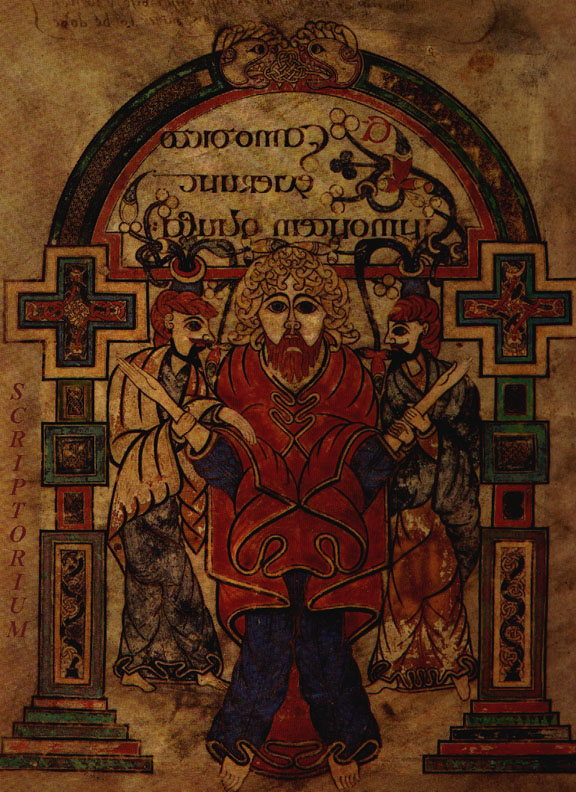
SCRIPTORIUM
-they wrote the Book of Kells- c. 800 AD
Chapter 1. Scriptorium
2. The Book of John
3. Monologue
4. Osla
5. Beltane
6. Easter
7. The Root Cellar
8. Peace
9. The Bishop
10. Blackmac
11. Plain Page
12. Herbarium
13. Journey
14. The Bard
15. Blessed Land
16. The Letters
17. The Return
18. Parley
19. The Trial
20. Peril
21. The True Tale
22. Attack
23. Sanctuary
24. Wise Council
25. Kings
26. High Mass
27. Compline
1. Scriptorium
It was in the year of our Lord, 800, when the Viking invasions had begun, and we feared for our lives. We had set to writing the fourth Book of the Evangelists, the Book of John. It was to commemorate the death of our dear Saint Columba by our Abbot Father Cellarch, who says our great abbey was named when our founder first laid eyes on our island and exclaimed "I see her! The island of John," and thus was founded the Abbey of Iona more than two hundred years ago. The books of Saints Matthew, Mark and Luke, are now near completion, and thus we begin with the image of John. Together, the Book of the Gospels will be a gift to our sister abbey at Durrow, in the hands of our Bishop Ailebe. May God help us in our glory to Him.
We six who are the writers and illustrators set long ago to work together in diligence and love for our Lord. Brother Fiotan colored and gold leafed, while Brother Ronant, whose mother was a Pict, drew the beautiful designs. I and my fellow scribe Brother Ion, the Alexandrian, wrote the text in our fine hands, which were identical. Brothers Eogan and Enon, both from our sister abbey in Durrow, were the parchment makers who also mixed the inks. When pressed, they too painted illustrations for the small works. I, Aedan, am master of works and writer of letters, and designer. It was also assigned I be the chronicler of our works. By our Lord Jesus Christ, we give you His word. Amen.
* * *
It was the leeward of Springtime, on the dawn of a new year, and a new century, entering the month of the Resurrection, that woke on that early gray morning. After Matins prayers, while the brothers were finishing their breakfast of porridge and milk, as was my habit, I was preparing the scriptorium for our day's work. This usually meant restarting the dormant fire in the central pit, which I did today, satisfied that it was not too smoky, watching the smoke curl up into the roof timbers, escaping through the small hole there. A cheerful glow soon dispelled the darkness, and first light came filtering through the thick windows. The usual inks were placed in their horns on the writing tables by the small windows, there were six of them, and the freshly cut goose quills laid by each one. The pigment inks were then likewise distributed with their brushes, each to their work station, and the parchment cases were taken down from the rafters, where they stayed dry and safe from vermin. The room filled with warmth and all seemed to my satisfaction. Now came that moment I daily cherished, when I open the page on which I am working, thanking God and asking for His help in that I am to do His will today.
"Good morning sweet Brother."
It was the voice of Ion, as he first entered the scriptorium. Then followed by Ronant, who in his usual cheerful manner greeted us with a great smile.
"Peace to you in our Lord, my brothers," I answered.
"Enon will bring your porridge shortly," Ronant let me know.
Ion walked in his usual calm manner to his work table, looking out the window into the cool light, the water of the sound laying still and gray beyond.
"We start a new book today," he mused aloud, "it is fitting for Pasqua."
Ion sometimes used his native word for Easter, since his family came to Ireland from Alexandria many years ago. His face was darker than ours, and so his humor, but he loved us in the same we love him, as brothers in Christ.
"The Resurrection is most fitting," answered him Ronant, "for new beginnings. So much already done, and still so much to do, when does it end?" He looked up smiling. "I hope my eyes do not fail by the time we are done, or what good is a blind scribe?"
"Your images are gifts, Ronant, and may you always have them for us." As I said this, Enon entered holding a large cup for me, with a thick wooden spoon standing in it. "Ah, my breakfast! After Matins, I thought I would faint from hunger."
"Why not join us first, and then here?" Enon wondered, though he knew the answer.
"After song and prayer, my stomach does not want food, though does my mind," I answered same as before, "so I come here instead." Enon left the cup on my table. "Thank you sweet Brother."
"Eogan will be at the skin shed this morning," Ion voiced to us. "The brothers have been sheering sheep, and new lambs are plenty. So we will not want for pages, as happened when we were finishing Lucas."
"Father Cellarch assured us, Ion, we will not be short... Blessed Saints!"
Through the window I could see two skiffs just landed from Mull. This was a day of pilgrims coming to our shore, to do penance, pray, and be blessed, or be healed. For this they usually pledged gifts, for which the Abbey is most grateful. The Abbot and a small welcome group were already at the landing. More than a dozen people were getting off, all dressed in the habit of penance, white smocks over their clothes.
"They will be here momentarily," I announced, "after they stop at the chapel."
"This gives us just enough time to appear busy," added Ronant.
"And we must look good," spoke Ion, almost under his breath.
Enon went over to the window and gave off a low whistle, "There is a king amongst them."
I went over and too could see deference, both from the monks and penitents, as well as from Cellarch. The Abbot paid special attention in the manner required of great personages, so we knew this was likely a king, or high lord. Just then Fiotan walked in from the door that leads to the Abbey chapel, which is adjacent to our scriptorium, with his usual sleepy look. His large nose bobbed as if he were to sneeze, which he did, and then he walked over to his table.
"Good morning, sweet Brother," I offered.
"Good morning Aedan, but I still feel poorly. My nose is itching, though I do not feel to have a cold. But one must not complain, if it is God's will." He then looked up and smiled, which did not make him look better. Fiotan was not cheerful this morning, but he was amiable just the same. He must have a cold.
"We must set up quickly, Fiotan, all, and put on a show of hard work."
All knew this and were already spreading the parchments they were working on before them, pressing them down and securing the corners so that they would not slide, and then inked their brushes or quills. I did the same, as Ion was already hard at work on his part. In a few moments, we could hear the Abbot speaking from within the chapel through the open door. Other monks were now coming and going with their duties, only Eogan absent at the animal sheds. Outside the fine morning mist had lifted, and it appeared the sun would show .
The words began "In principio bid erat verbum," and so began the Book of John. We worked like this in silence, only the sounds outside the door and gulls flying over the channel calling their high pitched cries. My quill carefully formed each letter, which gave me an inner tranquility at once. This I could do for hours without pain or thought. Ion was lettering the last page of Lucas, and Ronant was working on his design of the lead page, where was found the likeness of John. Fiotan set up and added color to the letters marked on the last pages of Luke. We quickly fell into our patterns of work, as we had been working on this manuscript these past three years. The pilgrims were coming through the chapel door.
"And in here, my dear Blachmac, is where we are doing our most important work. These brothers are crafting the manuscript dedicated to the two hundredth anniversary of our founder being called to the Lord."
King Blachmac stood tall and bear chested amongst the small throng of pilgrims, his strong arms filling out the white smock he wore. Though we were all bearded, his was rich and red, framing a large mouth set with strong teeth. He was a northerner, we could tell. The other pilgrims filed into our scriptorium behind him.
"May I see your work, Brother?"
He came over to Ronant's table and examined his rudimentary drawing, still devoid of color.
"It will be finished in the style of these pages, my Lord", Ronant held up some finished folios.
"Such fine lines, such color. It is beautiful." He looked over at the rest of us, the Abbot hovering close to him, solicitous and slightly bowed. "I could commission a book like it for my kingdom, to celebrate our entry into Christ, my good Abbot. But we are plagued still by the heathen barbarians in our land, so it would be a shame to have it fall into their barbarous hands. The devil take... oh, I beg your forgiveness, my Lord."
Cellarch raised his hand to signify no offense was taken.
"Ach, the heathens are a plague, so we hear. Their long ships steal in the night and attack at dawn."
"We have men ready to protect our settlements," Blachmac answered. "They find if difficult, but they do strike, and we must be ready."
Just then, the last of the pilgrims entered through the small door of the chapel. She stood wide eyed for a moment, and all eyes turned on her, as did mine. Ronant had a wolfish grin, when he looked at me, and Ion studied her quietly. She was tall, long full ringlets of dark golden hair fell to her shoulders, slim of build, and in her sandalled feet looked natural in her white robe.
"May I present to you my daughter?" the king addressed us. "Osla."
"Thank you father, I was most curious to see their scriptures. May I?"
Osla came over to my work, and looked at the first few lines of the page on which continued John's Gospel. She studied my rounded letters, and looked at my quill, then at me.
"Your hand is very fine, my brother. Mine is not so even." She smiled at me.
I smiled in return, feeling lost for words, but managed to answer. "It is in the practice, my child." She was no more than a child, having just reached early womanhood, and she was elegant to look at. "We do as the Spirit guides us. Can you read this?"
"Yes, a little, but I am still in my studies."
"She is a bright scholar," her father quickly intoned, "not without letters like me."
"We can teach, my Lord, without difficulty, to read in both Latin and your language, if you wish." So saying, Cellarch quickly came to his rescue. "Your gifts have already greatly benefited our little Abbey, and we are most happy to show you the way to the Word."
"Perhaps my daughter, when she is of age, but not now."
This brought air back into my lungs, but the group, after all had a chance to look at our folios, were now turning to leave. Osla lingered, as she had done in the chapel. Cellarch now directed them to see the crosses of the stations of Christ. The Abbot gave us one quick kind look, in appreciation for having been gracious in our appearance, and they filed out. Only Osla remained.
She did not speak, but casually walked over to the fire to warm her hands, and then looked up at the rafters, as if studying the smoke curling there. The brothers tried not to show they looked at her, and fained studious industry, while I held off the quill from the page, fearful I might blot ink. My hand was not steady enough to resume. So I rose and walked over to her.
"Would you like some dried apples?"
"Oh no, I could not, for I am fasting from yesterday." Her eyes did follow the bowl I placed back on the table. I looked over at my bowl of porridge, with the spoons still standing it in, but dismissed it.
"Do you have a scriptorium at your abbey?" I tried to make conversation.
"Yes, we have scribes there who copy our holy texts, but much smaller than yours. And the work is not so fine."
I fought off pride, knowing it a sin. The others now looked at us. Ion had a smile on his face. Ronant also. Fiotan turned back to his drawings and Enon stirred his inks.
Osla seemed content in silence, so I also silently turned away, when she called to me.
"We also have heathen scribes in our land, who do very fine work, though not for our Lord Jesus." She looked at me wide eyed. "Is it wrong to encourage them?"
"Ah, well, no, not to discourage them from the written word." I thought about it a moment, not sure of her reason for asking. "If their work is dedicated to the love of God."
She stayed silent a moment longer, pondering. "I suppose so. They do worship witchcraft, and magic, which is against the Church, so I am told. But if their work brings them closer to God, then it is not evil."
"Tolerance is too a virtue. And magic is no sin if given in the name of the Lord. Our Lord Jesus brings to Himself through the Holy Spirit even those who are lost. To forgive makes us all soldiers of Christ."
Osla liked my answer, and thanked us for allowing her to stay. Then she turned away from us as if in meditation, and silently went out into the chapel door. In a few moments I could see her outside joined with the others, and my heart fell quiet again.
"You are a king at heart, Aedan, by your birth. But you are a brother now, given to chastity," reminded me Ronant, with a roguish smile.
"I am a man given over to God, but I still find God's work wonderful," I answered him with a grin.
All became jovial, and an air of lightness reentered our midst. Even Ion fixed a smile.
"The ladies of Alexandria were devout too, and just as pretty. Perhaps someday we will be the pilgrims and go there."
This launched us into a discussion of the holy places of the world, a topic we often bring up while working. Now that we were back to our task, I looked again at my breakfast bowl, but my heart was not in it, so took it to a side door that led out of the scriptorium.
"Luru!" I called. "Here boy!"
My faithful friend came trotting over, hints of gray around his muzzle, and eagerly lapped up the contents of my bowl. Afterwards, I took a handful of dried apples, and returned to my table. My involuntary fast forgotten, the apples tasted as if they had been blessed.
2. The Book of John
We resumed our work in silence, as is our habit for long stretches of time. Though our order is not given to silence, we prefer it to preserve the spirit whenever it is called for. Only the swift sandalled feet of acolytes or brothers bringing refreshments, or called for fire wood, could be heard in our scribe's hall. Brother Domnall would send us milk, or on rare occasions mead, as he saw fit, which we accepted gratefully. His secret wish, though not secret to us, was to paint his likeness somewhere into the manuscript, which we did into Luke, as a small Abraham. His happy thanks continue still. Tierce prayers had long been held, and I had seen the penitents filing into the main church for them. We did not attend this, for the need to make up for lost time. Now it was Sext, and the bell was ringing the noon hour.
"Stretch your legs my friends. It is time for chapel."
We laid aside out works and filed into the chapel and took our places. Father Cellarch was in the sacristy, wearing his vestments. The Deacon Fergus prepared the Psalters. Acolytes took their place at the rear, with the penitents standing amongst them. The chapel was very full. We were nearly a week away from Celtic Easter, so more pilgrims arrived from abroad daily. Our chapel was smaller than our church, though much older, the church built later during Saint Adomnan's tenure, blessed were those times, and only now nearing completion. The thick old stone walls of the chapel date back to blessed Columba's time, ColumbKil in Gael, so it was used with great reverence. Light from a pale sun came in through the vaulted windows encrusted with multicolored glass, and the air of the chapel carried the sweet incense of its venerable presence in the Holy Spirit. This was where our Saint Columba placed his staff upon arriving, pointing it towards Jerusalem, and thus was built our chapel on this consecrated ground.
"All rise," called the Deacon.
The brothers in the front raised their hands palm up to receive the blessing, and the sound of hymnals opening could be heard from the rear. I tried consciously to not look behind me, though I felt eyes were focussed on us monks. The Abbot entered and took his place at the lectern near the altar, facing us, and in his clear voice commenced the singing prayers.
Brothers who were out in the distant fields of the machair on the island would have stopped their work upon hearing the bells, and faced towards the Abbey to pray. We in the chapel raised our voices to God, to our Lord Jesus Christ, and to join with the angels above so that the whole world could hear us. We sang well, the mellow chords of the brothers mixing with the clear bell like voices of the acolytes, followed at times by hesitant singing of the lay pilgrims. From within that rear chanting could be heard the high well timbered voice of a young woman, singing flawlessly the words of the prayers. It warmed me to hear her sing with such devotion, so pure of heart, for I knew from her voice who she was. The chanting carried well over the Abbey, and far out over the sound and fields around us. Sometimes, I imagined we could be heard, if the wind favored, all the way to my native Ireland. In some part of my heart, I believed we could be heard as far as Rome, and Jerusalem, for the Glory of God.
"Peace to you my sweet brothers."
"And peace to you in the Lord dear Abbot," we answered.
Cellarch had approached us from the sacristy, as the other brothers and laymen were filing out the chapel. The penitents, being on fast, would go back to the big house where they would meditate and pray. The brothers not fasting were making their way to the midday meal at the dining hall off the kitchen sheds, and we lingered a moment.
"May I walk with you?" Our eyes met, and Ion and I looked at each other. Though it was not uncommon to have Cellarch join us for consultation, we wondered the depth of it. "I just this morning received from Ireland a letter. It was from Bishop Ailebe, he is now at Durrow. And he has a visitor from Rome, Father Claudius, who came with a message from the Holy Father to instruct him to spread the word to all the abbeys in Pictland."
We had fallen behind the others now, so could speak freely, though we spoke softly.
"Is it on the question of Easter?" I inquired. With this highest holiday approaching, knowing this was still on the Church's mind, we of the Irish Church were urged to follow the calendar of Rome. There were those who wanted to resume the old ways.
"Indeed, Aedan, it is, for fear that we should celebrate the wrong day."
"But that is dependent on the full moon, and the Hebrew Pesach," Brother Ion reminded us. His was a greater knowledge of these matters.
"Yes, we know that Easter always falls after the full moon preceding Passover. And we of the Abbey have observed this day from the days of our dear Saint. However, there are those, and our prominent guest King Blachmac amongst them, who want to celebrate it earlier, saying Roman Easter is too far from the new year this year."
"Hmm," we pondered this. "So there is the conflict, that we are to celebrate, by way of the Church of Rome, on 19 April, and those who oppose would celebrate it 22 March, as does the old Church, to usher the new year. What do you plan to answer, Father?"
"Enon, do you have a suggestion? Fiotan?" Cellarch asked.
"No," they both regretted.
"Then why not celebrate both? Ronant added. "If Easter is just after the full moon, it happens twice. And thus both Churches can be satisfied."
The Abbot pondered this in silence, as we were about to enter the dining hall.
"Then this is a solution I believe acceptable to both the Bishop, and our King present. Ion, do you think it right?"
"Yes, my Lord, I believe so. There has been precedence at Antioch for this, and Alexandria, where both days were honored, in the name of Jesus Christ."
"Then it shall be, and I will answer Bishop Ailebe thus. The Roman Easter will be celebrated, though I suspect more quietly than will be Celtic Easter." Cellarch seemed inwardly satisfied with this, his wizened face smiling to himself. He was thinking of the old ways, when bag pipes and dancing was the joy of our Lord's Resurrection. "Thank you Ronant, and you sweet brothers. I will now go and bless the bread, to join you presently."
We returned after our midday meal of thick bread and hard sheep's cheese, washed down with good Gallic wine, which we ate in silence while a brother read to us from Romans 13 and 14. The acolytes served the monks, and when done sang a hymn to close the meal. The pilgrims observing a day of fast had spent the time in their cells dedicated to prayer for their souls. Eogan had joined us, and now after the meal was bringing in freshly cured parchment folios. We stood in the door facing the sound, enjoying sight of the sunfilled grounds of our abbey, watching the lay men and women about their chores. Some of the priests were married, and their wives worked in the abbey as attendants to what always needed doing about. The air was cool, but the sun pleasant, and thin white clouds hung in the sky. A fishing skiff was upon the sound making its way back to its village, to the accompaniment of a flock of gulls.
"The lay butchers slaughtered more lambs on Mull, so not to disturb the pilgrims here with the cries of the butchering," he volunteered to us.
"Even Jesus was a shepherd," Ion answered. "So we are only following in His footsteps."
"Though our sweet Saint Columba would not harm a fly, yet the skins are needed for our work," replied Eogan, without ceremony. His was the way of reason without embellishment, and he took his office seriously, though the killing of lambs was left to those outside the order. We ate no meat at this time, it being Lent. Shearing of sheep was another matter, performed gladly by the brothers, however, for the wool brought the abbey much needed revenue. When we resumed our labors, Ion felt the need to speak.
"Why would you think that Love worketh no ill to his neighbor, therefore love is the fulfilling of the Law?" He was referring to a line from the readings. "Would it not be truer to say that the Law is the fulfillment of Love?"
Our quills stopped a moment in contemplation, as I had just penned The light shineth in darkness, on the second page of John, having worked on the drawing of the first all morning. Then our work resumed, and only Ion seemed poised to answer his own.
"That was the way of the Hebrews, who put Law of God above all."
"Yet Christ came to simplify the Law, by saying Love is the Law," I finally answered.
"The Golden Rule is Thou shall love thy neighbor as thyself," Ronant reminded.
"So it is, but is it not better to obey God first?"
"Unless God sends His son to teach us a better way," Fiotan spoke through his nose.
"That is the fulfillment of Scriptures, that the Messiah should come to us as God's Word," as Enon now felt the need chime in.
"So is it with Easter, which is of Love, and which of the Law?" Ion tempted us again after a spell of silence.
"We love our Church, so we obey her," answered Eogan with finality. "If it is the law to hold Easter as Rome decrees, then it is for her love of Jesus that we remember that Christ had risen."
"So this is it, that the Law is fulfilled in His Word," pondered Ion. "And that word is Love."
"And so that love is the spirit of the Church, in her law," I finished his thought.
"Love came to simply the Law," Ion mused again after a moment of silence. "Therefore, Love is more powerful than the Law."
We again found silence in our work, with only the sweeping sounds within the chapel for company, where two women were making ready to wash the stone floor on their hands and knees. The fire had died down, leaving behind its natural incense mixed with the smell of blossoms outside, to remind us of the fragrance of the beauty of our Lord.
We were near Nones, the ninth hour of the day, and I stopped to stretch and look outside. The monks in the apple orchards, trees showing white bloom, near the rocky knoll at the back wall of the monastery, were stopping their labors of clearing the brush in preparation for garden plantings. Many of our healing herbs will be grown there by the wall, in the care of Brother Ernan. We suffer for lack of greens in the Winter, except for cooked cabbage, so they will be eagerly awaited in late Spring. The apples will not fruit until the Summer, though cherries will be out sooner. All was peaceful in our Abbey on this lovely afternoon, as it should be. If angels were about, they would have been visiting here now.
This said, there was a sudden commotion outside at the grounds near the boat landing. A large ship was seen in the distance, approaching our island. It was a coastal longboat, the kind sailed by the Northerners of western Pictland. It was approaching fast, yards high at full sail. One of the charwomen who cleaned the chapel came running in.
"Master Aedan," she cried, concern on her face. "There is word the sailing ship is hoisting danger flags. What does it mean?"
"I don't know, good woman, but we will find out shortly, I am sure."
As the ship approached our shore, wailing women could be heard aboard. I turned to the dear woman, she was the lay wife of Lugad, who tended cows in his Lord's service to us, and said: "Go down to the landing and see what they are wailing about. And then report to me."
She ran holding the hems of her skirt as fast as her wooden shoes would carry, down the sloping field to the banks. There she raised her voice in a shout, wailing back to the women aboard.
The prayer bell rang, more furiously than usual, and we turned to give thanks to God.
The service was shortened, for all were eager to hear the news, and some of us sang a bit hurriedly. When I stepped into the doorway of the church, Lugad's wife hurried over to me, she had been waiting. The ship was now docked, and there was much excitement about.
"They said they had seen long ships attacking a coastal village yesterday, so they have been sailing here with God's speed. They are from the kingdom of our visitor's, Blachmac's people," she was running all her words together, "and the king is now with them, and they had gone three days, and he is going back with them to attack the Vikings."
She stopped to catch her breath. I placed my hand on her head, that I understood, and she lowered her face, glad to have delivered her charge as asked.
"Thank you, good woman, you are a kind soul to give me this. You may go."
I then awaited for the others, who had helped putting away the Psalters. The ship stood regally in the Sound, her long oars up, her prow tied to the pier. Blachmac stood tall amongst his kinsmen, Osla by his side, and another woman who also made up his retinue. She did not appear his wife, far too young I judged, but she and Osla were speaking together.
"Let us see what is at hand, sweet brothers," I said when Enon and Ronant exited.
"What is all the commotion?" they asked.
"A northern Pict village had been attacked. Let us learn more."
We approached the landing, and Osla left her companion to come to us.
"Have you heard the terrible news?" she asked, her eyes wide, but without terror. "They attacked one of our villages. The people scattered into the hills, and their properties were burned. All on our ship could see the smoke."
"Did they stop to help, God help them?" asked Ronant, clearly concerned.
"They did not have enough men, most of the passengers were women, so they could not. It grieves them terribly that they could not, so placed on shore further down the coast two couriers who are to make their way home, and raise armed ships to pursue the vikings. My father will be sailing after the sailors stop to rest, maybe tomorrow."
Just then her father saw us and came striding over, clearly anxious.
"It is the first of Springtime, and those marauders sea-wolves have started already, those heathens. I believe they had been camped all Winter and are now beginning to raid." Blachmac looked like a man with suddenly much on his mind. "I will leave first light with the ship, but I want my daughter here, safe from danger, kept company by her cousin."
This was when we first looked over to the new woman, who had a family resemblance, rounder of hips than Osla, and not as long legged, but sweet of face with the same doe eyes.
"They are welcome amongst their new friends here," I answered. "May God show favor in your journey home.
"Her name is Dolina," added Osla, "and we will do penance together."
"Welcome Dolina," both Ronant and Enon and I answered earnestly. "It is a solemn time on these shores, "I added. "You will be safe here." Dolina lowered her eyes in answer to us. Blachmac spoke again.
"I am also leaving behind some men to help the monks of the abbey to protect my kin."
Blachmac was now alive with strategy, thinking war, like a military man, putting his daughter and niece first under his protection. "I must seek the Abbot and speak with him, for these raiders may make it all the way south, to here, if we do not stop them first."
By evening, in the time approaching Vespers, all in the Abbey knew of what had happened. Cellarch held council afterwards, attended by all, including the brothers in the fields and laymen. It was decided to set up defenses, and to empty the guard towers at the rear walls to hide all who could not escape into the fields. Doors were to be strengthened with fresh oak floated over from the mainland, and special prayers would be held to call on the help of God, and our Lord Jesus Christ, in the event our Abbey was attacked, to protect the churches and properties, and our cattle and orchards, and all the monks and people present. A blessing was called upon from heaven for all the living things of our island. Cellarch ended the meeting with these words, "All the people of the One God, who are under His cloak of Blessedness, who are in service to His Son, Jesus, in the name of our dear Saint Columba, may the Lord protect us with His Power and His Love. Amen."
We finished what needed doing at the scriptorium, putting away our tools, and securing the folios in their leather cases, safely suspended from the rafters. Fiotan and Eogan cleaned the quills and brushes, while Enon put away the colored inks and cleaned out the jars and ink horns. I carefully gathered on what we were working, and put that away onto a shelf in the stone, and then covered it, so that vermin could not eat at the parchments. I had written by day's end, "I am the voice of one crying in the wilderness." And thus by nightfall, I put away our pages of John.
When done, we turned in for the evening meal, and prayers for our salvation. The pea soup and cabbage was heartily enjoyed by all, the penitents free to break their fast, while the candles cast their warm light upon our dining hall.
Compline rang in the silence of the Abbey, and all who could attend made their way to the chapel. I stood behind the others this night, to better see by the torch fires and candelabras all who were present at prayer. Osla and Dolina were amongst them, as was their king and his attendants. Having broken their fast, they had all shared in the fruits of the labors of our brothers. There was a large moon outside, ushering in the week of the new year, and the silence of the heavens was broken by the voices of song escaping our lips into the dark world outside. I knelt with the others in prayer of thanks that those who had arrived did so under God's grace, and that we shall all be protected. If there was fear in our hearts, it was cast out by the strength of our song. A lay brother, not yet taken of the vows, read the solemn closure of our mass. In it, he said "And God sent us His only beloved Son, followed by a host of angels who sang Hosanna to Jerusalem, to bring Love to His Kingdom. Peace be upon the world, for He is come. Amen."
When we dispersed into the night, shadows walking to each his or her quarters under the pale light of the moon, I thanked God that all were safe in the Abbey, and that God protected us with His powerful wing.
So ended the first day of the writing of the sacred Book of John.
3. Monologue
I knelt on the cold floor of my cell, as I always have done, upon undressing down to my thin gown for the night, ready to enter into that world of my much needed sleep, and dreams. Upon my lips were the prayers I had always recited, prayers to the angels of the night who watch over my soul. As I whispered the words in the cold room, my small bed to my side, a lone candle upon the bench beside it, my mind ran back to the events of the day, to let me ponder them in the solitude of my spirit alone.
In the earthen bowl, I washed my hands and feet, and then let the soiled water into my chamber pot, which I covered carefully for the night. My candle flickered in the breeze that came through the small shuttered window, casting dancing dark shadows on the walls. There was room to stand, or sit, or even lie down, but not much more than that. Yet, in its smallness I found comfort. The breeze had picked up in strength, and the candle flickered more violently, the only other sounds heard were the muffled footsteps of other brothers making ready for the night. I could hear a chamber pot emptied outside, then more footsteps. My cell was the northern most corner facing the Sound, so the cold entered here first, and then spread like a spider's web throughout the great house. I thought of the pilgrims housed at the other end, where it would be cold last. Then I resumed my prayers.
I began reciting silently a prayer of St. Patrick.
"I surrender to you my Lord
Through all my strength, the invocation of the Trinity,
Through belief in the threeness,
Through confession of the oneness
Of the Creator of Creation.
I surrender myself to You
Through the strength of Christ's birth with his baptism,
Through the strength of his crucifixion with his burial,
Through the strength of the resurrection with his ascension..."
As I was saying these words in my mind, different images began coming to me, images I could not repress, for they were with me same as the angels who come when in prayer.
My knees began to hurt on the cold stone floor, but these I dismissed immediately as weakness of the flesh, and turned more inwardly my mind to forget them, same as I forgot the creeping cold.
Then images of the day danced before me like so many temptresses, trying to pull me away from my meditation. I could see my hand penning the letters carefully, each one a separate creation. And the birth of images beginning each important sentence, creatures of God blessed to be here on Earth with us, their lives equal in His love to ours. The songs of the hours once again rang in my ears, like the sweet bells of the angels singing the praise of God. And I could hear my brothers talking, Ion doubting the Trinity is really an equality of three in one, that in Alexandria, there were those who believed Christ was only the Son of God, but not God, same as the Holy Spirit was with God, but not God. I puzzled over this a moment, while reciting my prayers. Why would someone believe such a thing?
Then I thought of the long ship, and the women wailing, and how we could all feel in our hearts their fears. The news was not good, for though we had never been attacked, there were stories aplenty of what savagery the norsemen were capable of. Why were they coming this way? What did they want? Surely they were called to these evil deeds by the Devil.
Then I thought of evil things, why do we have them? Why is God, who is so perfect and good, also a God who allows such terrible things? Are we not visited by demons enough, in sickness, in injury, in lies? Why add these vikings to the list? What could we give them to stop their savagery? Why were they heathens and could not see the beauty and simplicity of Christ's love?
These things were swirling in my head like a troublesome breeze, then new images came to the fore.
My prayers continued.
"I summon today all those powers between me and those evils,
Against every cruel merciless power that may oppose my body and soul..."
And now I could see the penitents entering our scriptorium. Osla was amongst them.
Osla.
My prayer stopped a moment. Then I remembered my tired knees and resumed.
But her images was most persistent of all, and I could see how she looked at me, the sound of her voice, how she almost took the apples from my hand, but her mind did not let her. How she walked to the fire to warm her hands. I remembered the warmth of the fire, her face lit by its glow..
Why was I thinking of this? I was not thinking of her in the flesh, but saw her in the light of the spirit. She was beautiful to look at, and so pleasant to be near. My mother was beautiful. Why did she have to die so young? I was but nine when she went to the Lord. But I had taken my vows, and unless I were to renounce them, to become a village priest instead, I could never know her as a man knows a woman when they are married. This did not trouble me much, since I had made up my mind long ago to dedicate myself to God, and to His Son Jesus. They are the most beautiful of all, so a woman's beauty pales by comparison. But she is tangible, a living person made by God, whereas Jesus is now but a powerful memory, and God unfathomable as the Creator. Would it be so wrong to enjoy God through the joy of His creations? No, this cannot be. Surely the Devil put that thought into my head. By the Grace of God, I must be more cautious in my meditation and focus on the His goodness instead. I must forget idolatry, for the flesh is only a carved image. I must be stronger than my passions, with the firmness of a rock, or the demons will find ways to invade me. My love is reserved for the Almighty, for the Trinity, for our Lord. Still, she was an image in my mind who would not go away.
I heard of brother monks who whipped themselves at night when these images came to them, and they would have difficulty sitting or walking the next day, for they had hit every part of their body with a brambled branch. None had died, but sometimes their sores were infected, and they could not work for a day or two. I decided my work was too important to risk infections, not out of pride, but out of necessity, for we had to deliver the finished books to our sister abbey at Durrow as a gift to the Bishop appointed by Rome. The Papa had decreed the blessedness of this holy man, Ailebe, and we should not divert our labors. Though, we have had to write other manuscripts on demand to educate newly converted kingdoms of the Picts, so our labors never cease. Enon and Eogan sometimes did not have enough time for their preparations of inks and folios, and were instead assigned to write and draw designs, in their hands less fine, so we all could finish in time.
The room was getting colder, and I had to hurry and get under the blankets. And now the beer was calling also, so there was need to be done with prayer. Why did God make beer so good, but also so demanding?
"Christ on my right, Christ on my left, Christ when I lie down..."
But her image did not fade, and rather grew. I knew she was under the same roof. Oh God, do not make me have to whip myself. I beseech Thee to grant me an easy sleep, for I am tired. You have decreed in your infinite wisdom that I take the calling, the habit of a Benedictine monk, and for which I gladly surrendered my body to you. But what about my soul? How could beauty and love be evil things? Surely you did not make woman for man so to punish them both. Is there not some compromise that can be found to allow for a love of God and a love of woman? No, You say? The Scriptures are firm on this point? Christ said to leave all behind and to follow Him. I have done that. Am I a bad servant for thinking of beautiful things? It is not out of lust, I assure you, but out of the love of spirit, for though she be flesh, she is also a fine being full of the love of God. If this were not so, she would not be here as a pilgrim of penance at our sweet Abbey. Is this not so?
But Father Cellarch had warned me before that it is not good to argue with God, for in His wisdom, my arguments could never win. I am beginning to sound like Ion, I thought.
"I arise from my prayer
Through a mighty strength, the invocation of the Trinity,
In the multitudes, I am
In the oneness of One."
I rose on my stiffened knees, and rubbed back into them circulation of the blood that fed all my limbs. My hands were warm, though the rest of me shivered inside my thin gown of coarse linen. It is good to suffer the cold, to remember the warmth of heaven. When done, I slid the chamber pot into its corner, too tired to empty it now. And then pulled on my stockings for the night, careful not to dirty them on the floor, so in one step swung over to the bed and slid under the cold sheets. This lasted only a moment, and in the growing warmth of the blanket, sleep soon called to me. My eyes looked over at the candle, and I let it flicker a moment more, then I blew it out.
4. Osla
Father Cellarch was in the scriptorium early on the next day to remind us that we needed to add new songs to our Abbey's Psalters. When he left, his man servant, Brother Colman, remained to help us with the Abbot's notes describing how he would like the pages to be drawn.
"Sweet brothers," he instructed us, "the margins are to have braided borders. We want to continue the patterns already on the first pages. Same as we used in Deuteronomy, or was it the Song of Solomon?" Upon pause, he added, "Aedan, would you be so kind as to have Brothers Enon and Eogan assigned to the letterings, as I know you and Ion are working on the Book of John. Fiotan can help them with the drawings, if that does not interfere. The Abbot would like to leave Ronant to continue on the design of the images of Christ and John."
"As you wish, good Brother," I responded. "Father Cellarch has a good understanding of our need, as he is eager to not disappoint the good Bishop of Durrow."
Colman smiled, knowing that not all agreed that Ailebe was a good bishop, but he let it pass. It was not of his office to share in our private joke. When he felt satisfied all will be set as requested, he returned to his other duties, but paused at the door.
"Do you think you can have our ancient baker, Brother Norix, the Gall, included somewhere in the illustrations? He is aged, but a good baker, and we bless his bread daily. Perhaps we can do this little momento for him, it would please him greatly."
"Of course dear Colman. We value Norix's bread as you do, and it would be an honor to include him, blessed be his baker's hands."
Ronant had remained silent through this, and then felt to ask.
"Should we show him as he really is, hunched over, gray of beard, or should we make him look a younger man?" Ronant had a smile with his question. Colman smiled in return.
"As you wish, sweet Brother, it is by your hand. My preference..?" He paused, thinking. "I would show him as he is, an old man. A face would please him, so to hide his crooked body."
"So we can add Norix into the third folio of the Book. I have an idea where to put him, as Ronant already designed which letters will be illuminated. Ronant, what do you think?" I asked.
"Let us put him into the N, where his grizzled face can peer from inside, like when he stands before the vaulted oven. White hair and Gallic nose, that should describe him, no?"
Ion then joined in, putting down his quill.
"I will pen that page, so show me where, and I will draw him in. Then Fiotan can color it. He should be pleased, Brother Colman, as Ronant still has much to do on the image of John."
"So it shall be sweet brothers. The Abbot owes a small debt to our good baker, and by this all will be very pleased. I will not disturb you further, as there is so much work to do. The Psalters need to be finished by Roman Easter, as the Bishop will be here with us to celebrate the Holy Eucharist."
"Ah, that is most wonderful!" I exclaimed. "To be blessed on the day of Resurrection by the Bishop appointed by Rome, how wonderful."
"Do keep this a secret, for now, my dear brothers, as the Abbot is still in a quandary about Celtic Easter, which he must celebrate too. Let it be a surprise to our fellow monks, that this year, they will have two Easters." At that Colman gave us a wink, in the true tradition of conspirators. "We do it in the name of Christ."
Blachmac's ship sailed after Prime, as expected, loaded with some returning pilgrims, though the women were left here for safekeeping. This led to a new feel to our Abbey, having so many women who were not penitent pilgrims, staying with us. But they made themselves useful and helped with the animal pens and the gardens. I might add that this added a certain level of merriment we do not have daily, and even the dour monks had smiles on their faces. The lay men and women took to them instantly, so we found lodging for all. In the afternoon, after the midday meal, I watched Osla and Dolina amongst the women, their penitence forgotten for now, enjoying the company of their kin and kith. The day rose rainy, but cleared, and by afternoon, it was a pleasant Spring day. Ion took up finishing the second folio, while I resumed on the design on the first, recto, having finished lettering the first verso. Our hands were such that Ion could take it from where I left and continue. By the bell of Nones, we were hard at work in silence, with only the movement of our hands to be heard in the scribes hall.
We had already forgotten the threat of heathens from the north, and instead thought of the celebration soon upon us. A Celtic Easter is celebrated in the manner of old, before Saint Patrick's days, and the day of Easter and first of Spring, the new year, were all enjoyed as one. This being also the beginning of a new century should lend us more merriment, I thought. It is good to have the women here, so that the preparations for the feasts should be easier on our kitchen monks. In fact, Brother Domnall already had made arrangements how to use the new arrivals.
"Would they think it proper to help us with the feast?" I asked Ronant, as we were ready to leave for the office of the hour.
"The women? I am sure so. Blachmac gave them instructions to help us in all ways they could, so they will do it without complaint. And if they complain, they know they will have to answer to him later, so I am sure they will be very happy in their work."
Ronant smiled when he looked over at Osla beneath the apple blossoms.
"And what about her?" he asked.
"Well, she will help, I am sure of it. Why? Should the king's daughter be treated unequally in our Abbey?"
"Oh, I was not thinking of work, sweet brother. Only how she had affected you. It was plain to see that you blush when she comes near." He eyed me sideways, as he said this. I blushed again, for I felt it on my face.
"The breeze if freshening again," I quickly responded, as to not think of her. "Do you think we may have a squall?"
"Only in your heart, dear Brother. Watch that the faeries of love do not sink their barbs into you too deeply, my dear Aedan, " he grinned, "or you might have to use the whip."
I shuddered at the thought.
"No, I am pure of heart, as I am sure so is she."
"Then let us go and sing our praises to God, and listen to her sing hers."
Angelic voices could not have surpassed us that afternoon in our church. The chapel was being made ready for Vespers, as it is our tradition to use both churches. I examined a Psalter nearest me to remember how the pages looked in the first part, and thought it simple to duplicate the patterns in the new. I tried to keep myself from looking towards Osla, same as I noticed, without being obvious, that she was doing her best to not look my way, as we both stood with luminous faces towards the altar, where Cellarch conducted the mass. When came time to prostrate ourselves to renew our vows to our Saviour, I did so with as much elegance as I could, lying face down with my arms stretched out, while the lay people stood at the rear. Then service was over and we filed out into the bright sunshine.
As we walked back to the scriptorium, the other monks went back to their labors, and the lay people to theirs. Norix came running over to us, as I was walking with Ion and Ronant, and he hobbled next to us.
"I am so happy what you will do for me. That I shall be eternalized forever." He said this in his Gallic accent, which was never unpleasant. "Will you paint me a little handsomer than I truly am?"
"Vanity is not a grace," reminded him Ion solemnly.
"Oh, I beg your pardon to have suggested it." Brother Norix was about to turn and leave us.
"Not at all, sweet Brother, your likeness will be a handsome one," quickly replied Ronant.
"Ah, thank you, thank you. God had not been easy on my body, but I am of clean spirit."
"And so it will show," I said to him. "We will be happy to do as you wish. But it will be a small likeness, I hope you understand."
"Not too small for me, dear Brother, not too small. I will leave you an extra loaf after dinner, if you like, to enjoy while you work into the night."
"No doubt we will, as we have to complete Psalters as well. Maybe Domnall could add a little pitcher of beer?"
"I will see that he does, dear Aedan, that he does."
He left us happier than he arrived, now that his immortality was assured. Ion smirked at us as we entered our room.
"You do the poor man kindness, this Gallic brother of ours. Who knows where our work will be a hundred years from now. But with God's grace, it will live forever, and he with it."
That evening, after Vespers, we were again at our work tables. Though dinner was a sparse stew of cabbage and parsnips, the bread was good. And now a new loaf found its way into our scriptorium, soon followed by an acolyte bearing a pitcher of beer. By the light of the candelabras, it looked a veritable feast to our eyes, so hunger would not gnaw at us in the night. We were about to break into it when we had visitors.
"I came to show Dolina the fine work you do, sweet brothers," Osla announced upon entering. "Surely we are not disturbing you?"
"Oh, no, not at all, dear ladies," Ronant picked up before I could answer. "You are most welcome into our scriptorium to relieve the tedium of our work." His eyes were shining as he looked over at me.
Osla came over to my table and made herself comfortable on the bench, sitting next to me.
"See, Dolina, how beautiful this work is?"
"Ah, the colors are beautiful." She examined the first page. I could sense that Dolina was not lettered, so did not press her on the words. "And you have so many."
"Do you like the filigree designs? They are Ronant's." I tried to take attention away from myself. Ronant was pointing to his cheek knowingly, to let me know I was blushing.
Dolina examined other folios, again with vacancy often seen when people cannot read, but she admired the drawings. Osla started reading the Latin, slowly, then noticed the loaf and beer and became more cheerful.
"Oh, you have fresh baked bread!" she exclaimed gleefully. I judged she was perhaps no more than five or six years younger than me, but seemed to have a child like joy about her, when not in the presence of her father. Her penance fast over, she looked inquiringly at us.
"Let us break bread together, then." Ion came to our rescue, since I seemed simple of speech, and Ronant was trying not to break into laughter.
"Do you have to say a prayer first?" Osla asked wide eyed.
"The bread is already blessed," Ion answered, so we may eat it as we wish. "Here, Aedan, bring it here." I did as told. "Now, you Osla take one end, and you, sweet Brother, take the other." Ronant turned away not to give himself away, while I turned to Osla as told and took hold of the other end of the loaf.
"Now, this is an old Alexandrian tradition, but you must both pull, and he or she who gets the larger piece is doubly blessed."
It was a game just invented, since I was sure Ion made this up on the spot, but Osla thought it wonderful and began pulling with strength, almost pulling the loaf out of my hand. I held tight, and soon the loaf parted right down the middle.
"Oh? Who wins?" Osla wanted to know.
"Why, I am sure you did, my dear young woman," Ion said, as he examined the bread. I do believe your piece is slightly larger. I am sorry Aedan."
"Oh no! The glory goes to the more deserved, of course. You were right to win, Osla."
This brought a smile to the girls' faces, and they then broke their loaf in two, leaving us four brothers, since Fiotan was a shyly silent but jovial observer through all this, to share the remainder. So we broke bread, and poured beer into empty ink jars, so that all could enjoy a good toast and fill our bellies some more, to the merriment of all.
In the days that followed, our brothers and the lay women became more comfortable together. This raised eyebrows for some of the older monks, who did not have memory of this happening before at the Abbey, but it was looked kindly by our dear Abbot, who said we are all God's children. When not in the scriptorium, Enon and Eogan were out in the animal pens, helping prepare the parchments there. So mostly, only four of us were working at the same time on the Psalters. The Book of John also got attention, but only in the times we waited for each other's pages to come to us for our task. Fiotan's nose had healed, stopped dripping, and now he was as his usual cheerful self again. By the Grace of God, our work progressed well. Norix was immortalized under the letter N, and when he came to deliver a loaf of bread to us, was most ebullient, dancing about the scriptorium in his hunchbacked way. Same as Cellarch, and others before him, their likeness was worked into the images of our work for the Glory of God and our dear Saint Columba. On Good Friday, our work ceased by Sext, the noon hour, and we joined after our meal in the preparations for the Easter Feast that was already well underway throughout the monastery.
The Abbot had ordered the carpenter monks to use the oak we had stored for strengthening doors, all doors, even those of the root cellars. The chapel doors and church doors were the first reinforced with extra thick planks and cross beams. The same was for the stone great house, though the dining hall, being a wood structure, was left. Cellarch's reasoning was that if the heathens needed to break into the pantry, they are welcome to the food that is there, since it was already blessed by God. The moon was just past full, so we worked at night as well, to prepare not only for the great feast, but also to protect our monastic village. Some of the monks lived in beehive huts, and those had their doors strengthened also, though windows were left with merely thicker shutters, when possible, since they were too small for a man to climb into, though he might throw in an arrow, or fire. Many left their fields at the machair to do this work.
These preparations were also being done in the lay village of Fionport across the Sound in Mull, since word had carried to them. Our currahs cross the Sound daily, and now they were bringing us slaughtered animals for roasting, as the Lenten fast would be broken day after the morrow. Our cooks were preparing mutton stews, now again seasoned with herbs and salt, saving the other meats for Easter Sunday. But some celebrations were already taking place this evening, this being the eve of the new year, coinciding with the Spring equinox, and our brothers were very happy to share in the joys of the lay men and women as they ring in the new year. By Vespers, the fires of the old Beltane were already lit, and bagpipes had been brought out for the special night of revelry. The second Beltane, or new Beltane, was in May, for those who are to be betrothed, but here we rang in the rites of Spring, where unmarried women can chose their men, and dance. The air filled with the cheerful tunes of our homes in Ireland and Pictland.
Complines were short tonight, as many of our guests did not attend. Outside, under the rich moon low over the Sound, and many fires, the Feast of the New Year was in full progress. By God's blessing, the night was clear, with the moon hiding only occasionally behind passing clouds. Then all would fall into darkness, except for our bright fires, only to realight again when the clouds passed. A light breeze blew from the North, but it was calm. It promised to be a magic night.
I walked with Ronant and Ion to see the fires, joined by Fiotan when we got there. The Abbot was already amongst them, sitting in a circle around the largest blaze. Horns of sweet mead were passed around for all who would take them. Fish from the sea had been roasted and allowed for this feast, though meat was not. Bones were tossed into the flames, and happy faces were all around as the bagpipe players raised their tunes to heaven.
"Ah, dear sweet brothers, what a wonderful night. It reminds me of the old days," Cellarch greeted upon spotting us. "Come! Join in and be merry! Tomorrow we do silent vigil, but today we celebrate like in olden times!"
"There are so many here, more than last year, to celebrate," Ion answered matter of factly. "Thank you Abbot, I will take a place by you." He took a seat at the bench. "Aedan, here is a place for you too. Brother Fiotan." Fiotan took a horn and sat down. Brother Norix on break from baking was there too, a broad florid smile on his old face.
"I will walk a little, to see more, dear brothers. But enjoy!" I took Ronant by the hand and we walked over to where the music was loudest. We knew Matins would ring two hours before first light, so could not stay the full night, but we were determined to partake in the meriness, even though we may fight sleep at first prayer tomorrow.
5. Beltane
"There is you new friend, Aedan," Ronant pointed her out to me. "She dances well."
Upon seeing us approach, Osla came running over. She, like other young women, had garlands of flowers in her hair, and looked the prettier for it, dressed in a new gown of gold rimmed cloth. "Come on Aedan, you can dance, and if you have forgotten, I will show you how!"
With this, she skipped merely away to join in with the others who were in a lively circle, bagpipers to one side, fire to the other. Ronant and I joined in, and lifted our gowns to step lively in tune with the music. We danced until our legs hurt and were verily out of breath, but Osla and Dolina seemed tireless, laughing as they skipped and twirled.
"Oh, come Aedan, Ronant, let us stop and have refreshments. Hah! I am so out of breath!"
"Oh, Osla, it's been a long time since I danced like this!" She and I sat down on a bench by the fire, while Ronant danced some more with the others, paying special attention to the village girls, and Dolina, dancing close to her. She returned his smiles.
"When did you dance before you took the vows?"
"My father's house had many festivals like this, when mother was alive, and we entertained guests and nobles alike, and inviting the common folk as well. Those were grand times."
"Is it true what they say, that you are a king?"
"No, my two brothers are kings. It was passed to them when father died."
"Then why..." she paused not sure if this was proper to ask.
"Why did I take the cloth?"
"Well, yes, that was what I wanted to ask, but dared not, for not to offend."
"Oh, no offense, for I took to joining Iona gladly. I was called to the work of our Lord by our family priest, who was also my tutor, and he said that my spirit had come to him in a dream, and begged that I be allowed to be amongst the brothers of Saint Columba. This is how I came here. We all have similar stories, when a special moment came into our lives and we were called. I was so happy when I found out, or else..."
"Or else?" Osla was more curious.
"Or else I would have to take up arms and be a warrior like my brothers and kin. This I did not want to do, not from fear, but for serving God instead, to bring in His Kingdom to Earth."
"And that Kingdom has no violence? But how would we protect our villages?"
"I know that in the world as it is now, so possessed by demons, the Kingdom is not yet. But when it comes, when all the world understands the message of God's Son Jesus, then there will be peace. He is the Prince of Peace, you know. His message is Love."
"Like love for a man and a woman?
"Like that too, but still more. This is why I write what I write."
"Your hand is beautiful." Then Osla looked away into the fire.
We drank our mead quietly, and our breath steadied. Osla looked earnestly into my eyes, her eyes sad, though they had a smile in them.
"I understand. Your Abbey is such a peaceful place, that I could almost believe that someday the whole world will be like this. But you know, for how things are, men of arms are needed. Though not all men are called to this."
"You are wise, Osla. I am who God had decreed me to be, so I must follow my calling." The thought of this also made me sad, since it placed a distance between my world and hers. It was an impossible distance. But then I gave it no more thought.
"Come, let us dance again!" I took her hand. She gladly took mine.
As late evening turned into night, the revelers continued their merriment, but the brothers were now sitting quietly by the firesides, enjoying the last of their mead. Some had already stolen away to their quarters, though Cellarch was still amongst those present, and Ronant had not stopped dancing until now. Ion was gone, as were Fiotan. Enon and Eogan, being the youngest, were long gone, having put in the hardest day, working at their labors both at the scriptorium and helping in the skin sheds. The same for the acolytes, younger still. Some of the lay people were also gone, but for reasons different than ours, for Spring was also a celebration of the joy of being alive as man and woman. But young girls were forbidden this, until they had found the man who they would marry, with approval of their parents and elders. So many young lasses were also now alone, talking excitedly with one another, though most of the village girls were gone.
"Will we need to keep this old Beltane from the Bishop, Father?" Ronant asked, now that he had rejoined our quiet circle. The fires were still roaring, with fresh wood added as needed. This was also on my mind, as I am sure it was on Cellarch's.
"We will tell the truth, and the cause why. The Bishop will understand our reason. Even the good Bishop Ailebe is an Irishman, so he will understand. The question is, do we let it be known to the emissary from Rome? That is a more difficult question."
We pondered this, watching the remaining dancers slowing their pace, the mead now taking hold of some, so they had to be held up by others. Then abruptly someone shouted "Happy new year! Happy Beltane!"
The cheer was answered by a chorus of others, and soon we were all shouting so that all the demons would be chased away, and the new year dawn pure and true. The moon shone brightly at that instant, but the shouting stopped as abruptly, for all eyes turned to the Sound, and we fell into silence.
A ship was passing by in the night, which is not common here, unless one was expected and delayed by weather. This was most strange. The fires now were the only sound, crackling their sparks into the night. Trouble struck into our hearts, for though it was far, we could see it was a viking ship. We could see the curved prow and square sail, shields reflected in the moonlight. All their men were silent, watching us to assess if we were easy to take. Osla came over to my side and held my arm. I squeezed her hand to not be afraid.
"Be still everyone," Cellarch warned. "If they come for shore, you know to give the alarm, and then we run for shelter. But be still." He then motioned to some of the brothers who had been soldiers, and directed them to watch after the ship. Just then clouds once again darkened the waters, and the ship was lost from view. When they parted again, the moon revealed nothing there. They were gone.
"Let us pray to God they will not return."
That night a watch was posted at six locations, so that each man could easily call to the other. Upon Cellarch's orders, all the food and mead were left on their tables, only the knives were removed. I walked with Osla back to the great house, as we all turned to our quarters. The night was full of demons, she had said. But I assured her that we were on holy ground, and that God will watch over us.
Prayers were held audibly in the great house when we turned to sleep. No one ventured outside for fear, but the night watchmen did not call an alarm. Still, sleep was light for me, and I suspect for all the others. The great house is stone and solid, so not easy to breach, but my fear was for the village people, and the brother monks who were in their small beehive cells, as they are unprotected. Fire is a favored weapon of the norsemen. They are well known to burn whole villages, and kill everyone they find. What manner of men they be, I wondered, who would kill so wantonly, and what for? For gold? For glory? Why would God allow such things? I thought of young Osla, and the other young girls, and how unprotected they are, though some of our order came from fighting men. But could they resist if so outnumbered? Though it was only one ship, there may be others. The thought filled me with dread.
"Where are you Jesus, Son of God? We need your message of Love so urgently tonight, for we are in the company of evil. Is the power of your message strong enough to overcome the weapons of evil men? If I have doubt in my heart, it is not for myself, but for the others, who are more innocent than I am. In the name of the Father, the Son, and the Holy Ghost, please hear my prayers. Save us from these demons of the night."
I closed my eyes, for I very much needed sleep, but it came slowly. In the stillness of the night, a solitary piper filled his bag and played a slow mournful tune, almost as if to caress us all to sleep. As the fires died down to embers, the night watchmen were heard calling to one another. I remember nothing else until the bell for Matins.
Before dawn there was much commotion from outside as I was finishing my morning prayers. A shout rose, and others answered. I could not see for the dark, and only torch lights moving about were seen through my window. I washed my face and dressed quickly to go and see what had happened. No alarm was called, so it could not have been an attack.
When I came down the stone steps, men were running in and out of the great house, brothers with them.
"What happened?" I asked to the first who came my way.
"All the food is gone! Blessed Virgin, how could it be? It must have been demons, for no alarm was heard. The night watchmen, saw nothing!"
Indeed, when I got to where the tables were, the pots and dishes were empty. Murmuring was heard all around us as we puzzled how this could be. Even the mead barrels were empty. This was a mystery indeed, for thieves would have been spotted and called. But there was no report of anyone entering our monastery.
"Have you looked for tracks?" I asked one of the night watchmen who had just come off his duty.
"Yes, Brother. They had dragged what they could to the beach landing, not where we tie up our boats, but where the sands are. But no damage to any of them. Very strange, isn't it?"
"It was God's protection over our Abbey," I answered, though only half believing it.
"Why did they not attack, if they were here?" he replied.
"Because we prayed for deliverance from their evil."
"It was God's will indeed, Brother. Your faith is greater than mine, for I have known war, and had to kill. God Bless you in your good faith in our Lord."
I found the Abbot. Cellarch was as puzzled as all the others, but his was a serene quiet puzzlement, not frantic as for us. Now that I think of it, he knew what he was doing when he ordered the food left behind. The vikings no doubt knew we were a holy order, so had no booty which they were after. Our gold is only on the altar, though they may not know this. And if we were threatened for it, I am sure Cellarch would give it to them in the spirit of Christ just the same, if only they did not harm the living.
"We were saved, Father, by your hand." I approached Cellarch saying this.
"Yes, sweet Brother, we were saved. But more by the Grace of God than my deed, I suspect. For how else can we explain the stealth with which the food was taken?"
"They are called sea wolves, for their stealth," I answered. "But even they cannot be so clever as to steal so much without anyone alerted. Truly this is a mystery."
"Mystery is the way of heaven sometimes. Remember how our dear Saint who founded this Abbey would go alone into the machair to pray, and how the angels would come down to him in a tower of light. That was a true mystery, and yet none can answer it."
He put his arm upon my shoulder, and squeeze it lightly for reassurance. It brought instant calm into my soul, and I was grateful to him.
After the long night, and the mead, the brothers of the scriptorium were more quiet than usual. We moved slowly. Prayers and songs had lapses in them at Prime, where the flow rose and fell as we either remembered our words, or forgot them. We continued to press on with the Psalters, since our hands were not steady enough for the Book of John, so all six of us took to penning the Psalms to be added. There would be twelve new books in all, our work was progressing well, though without as much joy and enthusiasm as for the great work. But these too needed doing in Praise of the Lord.
"Do you think they did not attack because of all the fires?" Fiotan asked, in his quiet way.
"That is a thought, isn't it?" Enon replied with a question. "Would they have thought the same of the bagpipers? That we had an army here?"
"Strange to tell, but I felt fear from them when they passed in the dark," added Eogan.
"I thought over this when at breakfast," returned Fiotan, "though we may not speak then." Enon spoke again.
"The porridge went down slowly, even with milk. I thought of it too, why not attacked?"
They were working steadily as they spoke softly, each in his own hand concentrating on letters, though their minds were elsewhere. Ion and I did not intrude on their thoughts, though Ronant wanted to add his.
"I think they were jealous of our celebration and were sad they could not attend. So by the Grace of God, they could enjoy the feast, which they stole, though not our company."
"They are the enemy, are they not?" asked Enon.
"Only enemy of the teachings of our Lord Jesus," finally added Ion. "In the ethics of ancient Greece, it was called Summun Bonum, which Saint Augustine mentioned in his writings. The Good is an end in itself. This is why we forgive."
"So the heathens are the enemy of that, of the Good, which is the Peace brought to us by our Lord?" asked Ronant.
"Verily so, though even our own people here do not always know this," continued Ion. "We have wars amongst our tribes too, same as there were wars amongst the Christians of Alexandria. And Constantinople." Ion became solemn in his speech.
"Christians fighting Christians in the Holy Land cannot be possible. Yet, I have heard of it," I finally joined in.
"The enemies of Christ are even within us, same as when we have to fight off devils within our selves," replied Ion.
Enon and Eogan stayed quiet, listening, since we were now speaking at heights they were little familiar. Then Fiotan asked again.
"Do you think evil is not just a heathen thing?"
"Surely not. Every man of free will can have evil thoughts, and do evil deeds. It is God's way." Ion thought of his words some more. "But how do we teach to do Good? That is the question."
We worked again in silence, waiting for the bell to ring in prayers at Tierce, but this was still some time off. Fiotan, breaking his characteristic shyness spoke again. The threat of danger had made him bold.
"Had Jesus told us everything he knew to bring it all to the Good?" he wondered. "Can it be that we have not yet heard all of it, for if so, then there would never have been wars amongst the Christians?"
"But the Christians of Rome never war on each other. Is this not so Ion?" Enon now asked.
"I do not know if so or not. I do know that it is their teachings that had brought Christianity to our shores, though there are those who believe we already had the teachings here by the time Saint Patrick came to Ireland, that these teachings were brought to us by Joseph of Arimathea." Ion looked over to us to see our response. We were puzzled to hear this, as he expected. "But this is not certain, though the old ways do not go easily. To Rome's regret, I am sure."
"Then we should have had peace for a longer time, if this is so, that the teachings of Jesus had reached us first," again ventured Fiotan.
"You are a philosopher, Fiotan, and I agree, that would be true. However, heathen tribes have plagued us since the beginning, so peace is as much a cause of their evil as it was a cause of our own." Ion was beginning to speak in riddles. "Our Lord only gave us the teachings. It is for us to make them real if the Kingdom of God is to be with us."
"The Romans brought peace to The Britain," I reminded them. "And they were pagan."
"There peace was of the sword, whereas our peace is of the Word," Ion replied.
"The vikings would understand the sword," Fiotan answered. "I am not certain they will understand the Word. Or turning the other cheek."
We all nodded in agreement on this.
"Yet, being soldiers of Christ, we must try with the Word, and not with the sword," I finished their thoughts. "Sometimes prayer is more powerful. God works in mysterious ways."
"Such as not being attacked," Fiotan added. We again resumed our work in silence.
The fire pit had died down when Tierce rang. By Sext, all the festivities had been cleaned away, with the help of our many guests, and the Abbey once more regained its usual serenity. Tonight would be the vigil, so preparations were made at the church. We delivered the finished pages to be added to the Psalters, only for three books, which were sewn in by the brothers there. The rest will have to wait until Roman Easter.
That evening, after Vespers and when we had done with the evening meal, the church filled with all in attendance. We prayed silently in the dark. Leeward of midnight, the candles were lit, and the Glory of God was proclaimed, for He is Risen, and a great joy was proclaimed by all. Cellarch, dressed in his finest vestments, and carrying the shepherd's staff, his Deacon carrying the flabellum, as had the angels, and they both approached the altar to break the bread and pour the wine of the Eucharist. This was a most solemn moment, for we thus reenact the words of Jesus Christ at his Last Supper.
"He who eateath my flesh, and drinketh my blood, hath eternal life. And I will raise him up at the last day, and he shall live forever."
The Abbot then brought the sacraments to us brothers in front, and we took them. The rest of the congregation then lined before him, kneeled, took a morsel of bread, and drank from the gold chalice, as the Abbot said his blessing over them. They crossed themselves, and then rose and returned to their places. This took a long time, as there were many. By the end of the service, all sang Hosanna is the greatest, in praise of the Messiah, and then we ended with the Psalm of David, to deliver us from evil men. Inside the church was now a blaze of light.
My eyes met with Osla's at the end of the service, and she had an illumined glow on her face, so enraptured she was with our Easter service. She smiled at me, to let me know her inner joy, and I smiled in return. Later, when we stepped into the dark night, for the clouds again obscured the moon, she came over to me.
"Listen to the bells!" she exclaimed upon reaching me. "The whole Abbey is ringing!"
"For the Glory of our God, that He is Risen."
"It was the most beautiful service I had ever witnessed. The Eucharist brought tears to my eyes, and when the candles were lit, I thought I had gone to heaven."
"It is when the Holy Ghost enters, and all evil things are dispelled," I answered her. "I always feel His presence when the Abbot raises the chalice to heaven. A strong force takes over me."
"Me too. I felt it tonight, when he blessed the bread and wine." Her eyes were shining. "Oh, but if the heathens only knew this, they too would be like us."
She took my arm, and we walked back together into the darkness, except the moon was now once again between the clouds. We both looked over to the Sound, half in dread, but no ship was there. All the other monks and lay people were filing out of the church also, the chapel bell alone still ringing in the night. A warm breeze blew from the south, mixed with the murmurs of those around us.
"I wish it were like this always, this beauty, when the world is all peace, and there is love in everyone's heart." Her hand tightened on my arm. "I wish my father was here to see this."
"We are all joined in one spirit tonight. My mother is here too, as are all who had gone to the Lord."
"Is this how we have life everlasting?" she asked innocently.
"Perhaps. That is what He meant. Or perhaps there is a greater mystery still."
At the great house, Osla paused before releasing my arm, and then her hand reached over to me and caressed my cheek.
"Thank you, Aedan. You are a dear wonderful man."
With those burning words, she left me, and I returned to my cell.
6. Easter
The day of rest, the Sabbath day, was also Easter. Lenten broken, now all could partake in the joy of food denied for these past forty days, and a great feast was awaiting.
But first there was the traditional washing of the feet during the noon day mass. Father Cellarch came to the brothers and washed their feet. My turn came also, and he gently released my sandals, and placed each foot into the cool water, and blessed it as he proceeded to wash them. Then the Deacon washed Cellarch's feet last. After the sacraments, all were free to join in the food prepared, of which there will be much.
Most of us brothers, as is also traditional, took to the baths before the meal. These were located by the animal pens, a large bathhouse for the men, and a smaller for the women. They were partitioned by a solid wall, though we could hear them on the other side. The cows had been milked, and lounged lazily in their stalls, chewing, while the sheep were let free to range over the rocky knolls beyond the monastery walls, where they can feast on the lush green grasses growing around them. They dotted the small hillsides like so many white flowers, heads down. I came to the baths a little later, having finished putting away into the stone niche the Book of John, for safekeeping, as we were suddenly in uncertain times. The other three Books were already placed there, hidden by a stone that blended like all the others, so none could tell it was there. The Psalters were left open on our tables, for when we returned to our works. By the time I arrived, many had already departed, but Ronant and Ion were still languishing in the warm waters with a few other brothers, steaming water poured at intervals by the acolytes who were ready to serve us. Luru came trotting over upon seeing me, but I told him to stay, outside. The good old dog gave my hand a lick.
"Join us!" called Ronant when I entered, his boyish grin always ready. "This bath will refresh your spirits and take away all the cares of the world."
I answered in kind, that I was ready for just that, and unclasped my gown and carefully folded it on the bench. In my nakedness, I felt momentarily shy, but quickly stepped into the warm bath. It felt instantly good, not too hot but most pleasing.
"Can you tell whose voices those are over the wall?" Ronant teased me. "They are having a merry time, I dare say."
I was glad the water was already murky, so to hide my shame, for the voices next door did have a stimulating effect on me, as I suspected on the others. I smiled. Ion had his eyes closed, enjoying the splendor of the warmth. It rained last night, and the grounds were muddy, the air cool, sky gray. So this was a welcome respite.
"The women, God Bless them, are splashing up a storm, like children," I responded. "Do they wonder why we are so quiet here?"
"They know we monks are not given to loud merriment, alas. I am sure they would drive us into their laughter if they could," smirked Ronant.
The other brothers were also quietly bathing. When one of them left, he would sneak out of the waters, saying "Peace be with you, sweet brothers." And then they would wrap in the great cloth towels to hide themselves.
"Why so much laughter from you ladies?" called Ronant over the wall.
The giggling stopped a moment, and then resumed, as they realized we could hear them.
"For the love of God, why are you so quiet?"
It was Osla's voice who responded, and Ion gave me a big smirk.
"Our misfortune you cannot join us, to make our side more merry!" I called back to them.
This brought even louder laughter from them.
"You could! But not look at us, for we are naked!"
"Blessed Virgin." Ronant bit his lip, as I did mine. Ion continued his knowing smile. The other brothers smiled also.
"Then you would see our nakedness too!" I called back. The laughter intensified. "And you would have to cover your eyes!"
"Why would you need to hide?" Osla called back. "Are you ashamed of being men?"
"No more than you being women!" called back Ronant. Their laughter never ceased. More splashing could be heard, as they no doubt teased each other.
"We are not monks!" called an unfamiliar voice. "So we have nothing to hide!"
"God made Adam and Even naked in the Garden!" Ion broke his silence.
"Gloria!" they responded. So we broke into song, "Gloria, gloria!" and all the brothers joined in.
This exchange of taunts continued until we all decided it was time for the meal. Each rose in his own time, as we could hear the laughter subside on the other side, for they were leaving too. When it was my time, I too rose and grabbed a towel handed to me by an acolyte, who was grinning broadly, for I had to hide my shame quickly. Ronant and Ion were already dressed, and thus we left the baths.
The banquet was spread before us at table, and the usual silence was not observed, for this was for the Glory of the Lord. When my eyes met those of Osla, though she were on the other side of the great hall, her smile continued for a long time, even when she looked away, as did mine.
The roast meat tasted wonderful, after so long an absence, as did the stews. All forms of cakes were also piled high, and good wine poured generously. Laughter would rise in pockets, then move to another part of the hall. With the feast it seemed our cares were forgotten, as was the clean feeling I now had over myself. This was truly a day of Resurrection.
There was no reading today, so we were free to speak as we wished, which made the feast so much the merrier.
"Welcome sweet brothers," Cellarch called to us upon entering. He was sitting with Colman with their plates still full. "Please join us here!"
"Thank you, dear Abbot. Brother Colman. We will be pleased to eat with you," I answered, knowing I spoke for Ronant and Ion too. We seated ourselves as asked.
"Do forgive me, sweet brothers, from bringing up affairs of state on this festive day, but there are heavy things on my mind, and I am in need of council. You here are my best heads, so let me ask." He looked at us all to see if we were willing in this. Satisfied, the Abbot continued. "It has been on my mind as to why. Why did they not attack us?"
We were of one mind on this, as were many others. Between mouthfuls, we responded in turn.
"They were observing us only, is my guess," Colman volunteered first.
All nodded on this. Then it was Ion's turn.
"My thought is this. They are a raiding party, perhaps only scouting to see what lay down the coast, since they had never come this far south before. If so, and they think us defenseless, we should expect them back. At their leisure, they will attack."
Frowns met his remark, but again all nodded that this was very likely so.
"By stealing ashore, they had a chance to see that we are a monastic order, not a military garrison, as they might have feared when they first passed by. And this means trouble, because they will be fearless." I looked around to see if all agreed. They did.
"Then why did they not cause trouble when they were here?" asked Ronant.
"I think Aedan is right, that they stole ashore to inspect the compound, to see how best to attack. This same happened three years ago, when we were all celebrating summer feast at the machair, and then they damaged some, stole what they could of our livestock, but they did not return. Remember, how Brother Norix hid inside one of the unused ovens? The good Lord saw to it that no one was killed that day." Cellarch allowed himself a small chuckle. "So this time also the food and drink was a prize they could not pass up, but it will not stop them." Cellarch looked somber at the thought. "Many at the Abbey think that by leaving out food for them, they will leave us alone, by the Grace of God. But I fear that is simplistic. They will not be deterred if they want more."
"The sea wolves are known for terrible things when they raid a village, not one house is left standing," added Colman.
"Indeed, this is true," agreed Cellarch. "They are to be feared."
"Would prayer stop them, Father?" asked Ion. "We already sing David's thirty-fifth Psalm, to deliver us from evil men."
"We all believe in the power of prayer, for then it is God's will. But we are also free to defend ourselves, for that is God's will also. I think we should be realistic. They had attacked our sister monasteries in Pictland to the north, and we know how much damage there was then. The vikings have no respect for Admonnan's Law of Innocents, which protects women and children, and the clergy. This is respected by our kings, but not by theirs. I fear that the abbey at Hinba may never be rebuilt, since her position was indefensible, and too far for help to arrive in time. We cannot allow that here." Cellarch added emphasis on his last.
"Indeed, we cannot. This is the Abbey founded by our Saint, so it must be defended. And our position is more defensible than Hinba's, which was all flat land surrounded by water." I agreed with Cellarch, that we must defend ours. "Would the good king of the Dalriada help us?"
"He is a powerless monarch at present, so we can only pray his young Lordship, Kenneth, grow into manhood."
"We have the fort tower," added Colman, "so many can take shelter in that in the event of attack."
"But not all," Ion reminded us. "It can hold most of the brothers, but we have many guests who could not join us. So that is a poor solution." We nodded, as we continued eating. The wine helped wash down the mutton and beef. Norix had again proved his skill at the bakery.
"By the will of God, many can escape to the fields of the machair, except that now they are barren, and it is a long way," Ronant thought aloud. "There are woods and shrubs where they can hide."
"No, I think the best is to further fortify the great house, and the churches. The chapel is all stone, even her roof, and the doors had already been strengthened. Even the scriptorium has a new oak door." Cellarch thought some more. "I think it might suit us to also strengthen the doors to our root cellars, but the monk's huts are too fragile to take shelter."
We agreed, that the monks' huts were made of loose stone, and could easily be picked apart. It would be better to give them shelter in the cellars, since they were underground, or the tower.
We discussed these matters at length in the same vain. It was also decided that guards should be posted continuously until such time that the danger is past. A thought occurred to me, and though it embarrassed me to ask it, I thought the occasion rose above my feelings.
"We have many women from king Blachmac's clan here. Perhaps we should send a courier to warn him of the danger they are facing, since he left them here thinking them out of harm's way."
"Excellent point, Aedan, excellent!" All beamed in approval at my idea. "I will do so.
We will send a courier north next week."
Then the Abbot rose and called across the hall, "Osla, come here my child, please this instant!"
Osla looked up puzzled, and came over, quickly passing through the many guests, a questioning look on her face. She looked at me, and I only nodded at her, to let her know she did not have to worry.
"How fast can a courier reach your father?" Cellarch asked her.
"By sea in maybe two or three days, if the wind be fair. By land a little longer, maybe aix days. If I may inquire, my Lord, why you ask me of this?"
"Do you think your father would send us armed men, if he felt we were in danger?" Cellarch could see Osla set her jaw, so he added, "Do not be alarmed, we are only exploring all possibilities."
"Yes, I am sure he would. Perhaps enough to guard the island, and Fionport across the Sound, if that is your question."
"Indeed, well indeed, for we may have to beg of his generosity, if trouble should arise again." Osla was relieved that it was not now. "Would you like to join us here for a spell, so we could all talk?"
This made my heart pleased, and Ronant knew it instantly. Osla sat down next to me with her meal, and more wine was brought for us. Her face brightened notably. Ion moved a little to give her more elbow room, and we continued our wonderful meal.
"We had been exploring possibilities, only possibilities, that should the sea rogues return, we must be ready for them. But our armed monks are only a few, so I think we should prepare the compound as best we can to withstand their siege." Cellarch did not want her be kept out of what we were discussing.
"They are merely brigands and pirates, not warriors in the real sense, so they will not stand to fight my father's clansmen," Osla added sincerely.,
"I think we should ask for his help soon, if not immediately," volunteered Colman, visibly shaken by our discussion.
"I think Brother Colman is wise in suggesting it," agreed Ronant. "Together with prayer, we may be safe from the marauders."
"We will pray, good Brother," responded Ion. "For God works in many ways that are not known to us, so even when all looks dark, there is light in it."
"Have you hidden your treasure?" Osla wanted to know.
"No, but we will, now that you suggest it. We have never had to hide the gold cross, or the chalice, nor the silver bound Holy Books. But now there is need."
"The Book of the Gospels is hidden in its stone niche," I reminded them. "It is not likely to be found there, though this would be of little interest to the norsemen, since it's silver and gold covers are still being made in Durrow."
"So it is set," finalized Cellarch. "We will hide our treasures, reinforce the doors to the churches and cellars, and for the great house, what had not yet been done. And I will order the work tomorrow to do it in all haste. Not that I am alarmed, for no great grief had visited me in a dream, but I wish to be cautious."
The week passed by without alarm. The sentry had been posted, armed with pikes and swords. It was not common to see monks armed thus, but these were uncommon times. The fortified doors were installed, though the scriptorium had a wooden roof, as did the great church, so there was concern that they could not be fully protected. The great house had a stone layer over wooden shingles, same as the chapel, so it was decreed the same should be done for the other buildings. The church was to be covered first, so it could provide needed sanctuary for our guest, and the scriptorium last. We celebrated the week after Easter enjoying good weather, calm, and much of our work on the Psalters had been done, though not quite finished. And then, as the day broke for the Sabbath, they returned, two ships lay in the mist upon the silvery Sound, still far, but it struck terror in our hearts.
7. The Root Cellar
The alarm was sounded, and all the bells were ringing. Monks released the animals from their pens and stalls, so that now the pigs were running and squealing through the compound along with terrified monks and pilgrims. There was general confusion as to who would go where, but the armed monks directed the lay people to the church, and monks to their tower. Some chose the church instead, and others ran into the chapel. The few who were in the fields would stay there, hidden, as they were instructed at a general council held by the Abbot earlier in the week. It was the Sabbath, so most work had been stopped for the day. The ships had turned toward us, but not yet advancing, as if studying their prey. I was about to enjoy the baths, when I ran to the scriptorium instead, to see what could be saved.
I checked to see that the stone niche was secure, put away our tools into another hiding, and gathered up the folios of the Psalters on which we had been working. These I quickly put into a leather satchel, which I then threw over my shoulder, and was about to lock the door when a lone woman came running my way. God help us. It was Osla.
"Why are you not with the others at the church?" I asked her frantically.
"Do not be cross with me," she pleaded. "I wanted to be where you are."
"Oh, Osla, my dear Osla. This is not a good time, but God save us, we will survive these barbarians." I looked over at the chapel door, already heavily bolted, and then remembered the roof was still unsheathed of its stone. "Come, quickly!"
I took her hand and we ran for the nearest root cellar at the monastery wall, the one that had been carved into the rocky knoll by the wall. "In here!"
We both climbed inside, and I quickly lowered the heavy timbers over the reinforced door. It closed with precision, so the sounds of alarm now seemed a distant muffled rumble. The light had vanished with the door, but a thin ray came in from far above, where a crevasse was cut to let in air. When our eyes adjusted, I looked at Osla. "We can be safe here."
"Unless they are very hungry for turnips," she answered half in jest.
"Or unless they saw us enter," I added more seriously.
The noise outside abated, and soon it was totally silent. Even the bells stopped. Inside our dark shelter, we retreated away from the door and sat down on the mound of roots left over from the winter. Osla took my arm, and we waited.
In the low light, I could now take the time to examine her. She had put her hair up in a braid, and her gown was the simple gown of women who helped around the Abbey, except that on her it looked more elegant somehow. Her hands were fine, not accustomed to hard work, but strong and well formed. Our breathing had not slowed, and we were still fixed on the door, holding each other tight, when our eyes met at last. Then she smiled at me.
That smile lit up the darkness. The fear that had lodged itself in our hearts, like a stone in one's eye, melted away with that smile. Her lip trembled, but she bit it to stop. Then she buried her head into my shoulder like a small child afraid of the dark. I stroked her head, and held her like this, not thinking of anything, only of what was in that strange unknown world outside.
The silence remained a long time, and I had begun to wonder if they decided not to come ashore after all. I knew the armed monks were in the church and other buildings, as well as in the tower. A cow bellowed. Otherwise, all was still. Maybe they decided we were not worth their trouble to attack.
Then it came like a violent storm. A low rumble in the distance which sounded like wolves howling, then broken by what could have been barking. They were shouting to each other. Then audibly and close we could hear "Ulva! Ulva! Ulva!", which at first sounded like "Woof, woof!" Or was I hearing Luru?
"They are calling to their wolf god," said in a whisper Osla. "I can understand some of their tongue, as it is not too different from ours."
"You can speak that barbaric language? I have heard it once, and could not understand it."
"It is different from your Irish, or Pict. Our dialect is closer." She said this in Gael, though I know a little of her tongue. We again fell into silence, wondering what they were doing. Then we could hear things crashing, tables overturned, pottery shattering. Gruff voices calling to each other.
"They are like bulls," I whispered to her. "No. Bulls have more grace."
Osla looked up nervously, almost a smile, but then focussed on the door instead.
"I hope it holds," she squeezed me again.
"I hope so too."
I could hear her heart beating against mine, we were so close. I covered her legs with my gown, more of instinct than for any good reason. The smell of turnips was more noticeable now, along with the dank mustiness of the cellar. The pile behind us was quite large.
"Come, let us hide further back, against the wall," I suddenly urged her, as if going back a couple of paces would make us safer in the small space. We climbed over the mound of roots and huddled there.
The noise seemed to have moved off into another direction, towards the church, I believed, and the cows began to bellow out of fear. I could no longer hear Luru, and wondered where he went to. I should have taken him in with us, but he would have barked and given us away. It was a sad thought, that he may have been pierced with an arrow and lies dying. I dismissed the image from my mind, and strained my ears to hear what was going on outside. How many of them were there?
Then the sounds returned again, and now they were very near, as if searching, banging on doors, yelling oaths. I swore.
Heavy foot steps came to our door. They stopped there, and then called something we could not understand. Then a loud bang on the door made us both jump. Our eyes widened in the dark. We dared not look at each other for seeing the other's fear. Osla slipped her harm into my gown and held me around my bare waist. I reached into her arm and held her there too. The man outside was breathing heavily. Other heavy footsteps ran by. Then another blow struck the door, followed by his grunts. He hammered like this several blows, that I thought the door would give and he crashing through it, but it held. Then he left, where we could hear blows on other oaken doors, followed by more yelling.
"Maybe they decided a root cellar is not worth it," Osla whispered.
"Oh, God, grant us safety and peace in this world," I answered.
We continued holding each other tight, while the noises moved away from us. We could not hear people screaming, they no doubt too terrified where they were holed up, and concluded the noresmen barbarians were not succeeding in their raid. Our arms relaxed, and we looked at each other in the semi-dark, and both smiled again.
"Maybe we win. And they get back to their awful ships." Osla sounded suddenly more optimistic.
"Do you smell fire?"
"Yes, but it is not close, not at our door. I wish I could see where they are."
"Me too."
Then the door gave off a loud blow again, like something big and heavy had landed against it. I instantly thought of a battering ram. Why would they want this root cellar so much, I asked myself in my fear. Surely they must be hungry. Then light began showing through a crack in the oak door.
"Oh, we are lost!" cried Osla in a frantic whisper.
"Not until it is gone," I tried consoling her.
She reached up to my face and looked me in the eyes.
"Kiss me, now, for I may never know the moment again."
"Oh, beautiful Osla."
I put my face close to hers, and the blow sounded again, but we were lost in each other and did not seem to care. Come what may, our lips joined together in a strong kiss that brought our souls together. Then, when the door was starting to splinter in earnest, I quickly let go her sweet mouth, and had a thought.
"Quick! It's me they're after. I will hide you."
The space was so small that it made no sense to hide. I began digging aside the roots into a hollow at the space to the rear.
"Come here and lie down."
She did as asked, wide eyed. I then covered her completely, until only her face was showing.
"What are you going to do?" her eyes spoke with fear.
"I will go out and face them."
"No!" she almost shouted. "They will kill you."
"But not you."
I reached down to her face and kissed her again, and she hungrily kissed me too. Then I covered her face with the shoulder cloak over her gown and covered it completely with more roots, so that none of her showed anymore.
"Be still," I commanded her. She did not make a sound.
Then I went over to the door and, with difficulty, as the hammer blows were still coming at us, lifted the now cracked cross beam. A few more blows, and the door would have given, I am sure. When done, I yelled "Halt!" the only word I knew in their language.
The hammering stopped, and a grunt like from a wild pig was heard the other side, then some strange words I did not understand. I pushed open the battered door, and it gave. I stepped into the bright light, my eyes blinking, and raised my hands to God.
Before me was a great tall man, like a large bear, who stood amazed at my courage to go out and face him. In his hand was a large doubled edged ax, and his incredulous small eyes studied me through the red fur of his large face. He yelled something at me that made no sense, so I held my ground. Then I lowered my arms and held tight the satchel still strapped across my shoulder, and held it out to him, making the sign of the cross. He staggered back, unsure of what magic I was using, and then yelled something else in his barbarous tongue, and began lifting the large ax into the air, held high over him like the devil himself. He made advances at me, as if to strike, but held back. Prayers trickled down the back of my neck and back. But I would not be afraid, afraid only that they would find Osla in the cellar, so started moving away from the door, towards the animal pens. Some were on fire, and smoke filled the air.
The great man lowered his ax and came over to me, grabbed my head by the hair and made me kneel. I did not resist, since fighting was futile against this savage man. My nerves suddenly steadied and the fear I had left me, as if lifted by the angels themselves. Inside, I felt only calm, like the Grace of God had entered my soul, and for that I smiled at him. But this only infuriated him more, and he again raised his ax, when one of his murderous companions came over. He was also tall, but of finer build, piercing blue eyes, and thick yellow hair, almost a handsome man. He had a big sword in one hand, and a dead chicken in the other. So I began to laugh.
They quickly began talking to each other, as if deciding how to best kill me. The ax lay limp in the big man's hand, and the sword raised in the others. It seemed they thought to run me through rather than behead me. I did not see anyone else of our kind on the grounds, and only that small groups of noresmen were still hammering at the doors of the church and tower. Other barbarians lingered by their ships, waiting for the signal to attack. But with no one to attack, they were rounding up sheep instead. For some strange reason, they did not pay attention to the chapel or scriptorium. Bless you Saint Columba, I suddenly felt in my heart. Find a way to bless me too, I thought second.
The man with the sword, truly a good looking man, for a barbarian, looked my way when they were finished, and pointed at the satchel I now held to my breast. From the way he pointed his sword at it, I guessed he was curious as to what was it I held inside. I answered him only with my silence. This angered him, though his eyes showed fear, and he stabbed at it with the point of his sword, so hard I fell backwards. There was a hole cut into the leather. Then he came over me, and threateningly, shouted at me again, which I did not understand. So I opened the satchel, and showed him the parchments inside.
He took these in his hands, studied them with a curiosity that almost rendered him human, and then threw them down on the ground, shouting something again, clearly angered. Did he think I had magic there that could stop him, or cast an evil spell? I crossed myself again, though I was sitting on the ground. Then he yelled again something, and raised his sword high in the air as if to strike my head, when a loud woman's voice yelled "Halt!"
All stopped, and we all three turned to see whose voice it was. Listening to all that happened outside was too much for Osla, and she could keep still no longer. She flew out of her cavern like a demonic witch, fury on her face, and rage in her hands.
"Stop you monsters, children of the Devil!" she yelled at them. Then she repeated with the same fury words I did not understand. She said her name twice, however, pointing to herself, and then the name Blachmac. The men stopped, and looked at each other, not sure what to do with this. A woman as prize is always welcome on their raids, especially one so pretty who would fetch a good price on the flesh markets. The first man, the big ugly one, started reaching for her, taking large steps, when the other tripped him, and shouted something which made the first fall and cower. It was obvious who ruled between them. Then the second man, lowered his sword, as I sat watching. And with a gesture that I could only describe as gracious, he bowed to her.
Osla's rage had not disappeared, but now her words poured out, which sometimes were stuck on her tongue as she tried to explain in their language. A few times, as she spoke, she pointed to me, and the man looked like he understood. Then she motioned to all our other buildings of the monastery and explained something, which again was received in silence. The bear of a man, now sat up and listened also, while away from us continued the raging efforts to batter down the doors. Now some had turned their attention to the great house, but this was empty, except they might find food in the pantry. The two men gruffly said something to each other, and the one sitting got up and took his ax. Then he straightened his helmet and walked away to join the others. The tall man stood there, eyeing us both, thinking. I was afraid he saw us as hostages, especially Osla, worth more alive than dead. I looked over to her, and she me, but neither gave away what was inside. Me, because I did not know, and she because she was still engaged in disarming this dangerous moment. And this is what happened. The man threw down his sword at her feet, and expressed something that sounded like an apology. It was as if the devil had left him, and he was human after all, not only a barbarian. Oh, dear Osla, how the angels have worked a miracle through you.
In the distance, I could see the big man ordering the others to stop, and pointed to the ship. The same order was given to those who were hacking pointlessly at the tower door. Then word was spread to others, and those rounding up sheep herded them into their ships. Then the remaining one again bowed to Osla and asked her something, to which she replied hesitantly. She looked straight into his eyes, and he looked away, then picked up and his sword, looked at me once more, as if he had forgotten I was there, and turned. His other men were already returning to their ships. In stunning quickness, they whipped their anchor and sailed away. Calm once again slowly descended on our Abbey. God Bless you Saint Columba. Thank you God.
8. Peace
When calm had returned, and I saw the others hesitantly opening their shutters to watch the departing ships, I finally got courage to rise. Osla stood her ground still in the depth of her fury, but now softened visibly before me. Then she looked once again as she was herself before. I finally found the courage to speak, though I remained sitting, not trusting my legs yet. I gathered the scattered parchments instead. Then she gave me her hand to steady me, and I rose heavily.
"What did you say to them? They were like children before you," I asked.
"I knew the man. And I knew of his father, though I never met either. His name is Vodin." She gave off a sigh and then began to weep softly. In between her tears, she explained what had just taken place.
"He had come to court me not so long ago, and I saw him them, but my father never let him set eyes on me, for I was hidden away for fear they would attack." She wiped off a tear that had come down to her nose. "Vodin had heard of me from others, and wanted to join his kingdom with ours. But father refused him, telling him he is a barbarian, and that we no were longer like him."
"Beautiful Osla, you would be a fine bride for any man. But is this man a king?"
It was beginning to dawn on me what had just happened.
"Yes, in his land, which is the other side of Pictland, though his clan comes from the far north. They had settled there, many years ago, and had taken to our ways. But still keeping to theirs. I spoke to him in my language, to explain everything."
"How quiet he became in your presence," I offered.
"He said he did not know that I was so beautiful, he told me. And this was why he stopped. I am not a vain woman, but I am told that I am attractive to look at."
"This is so," I said to her through my tears, for the depth of her words were sinking into my heart. "And you made him a promise?"
"Oh no! I did not such thing!" She stopped to catch her breath. "I told him that I am a Christian, and that these were my holy fathers, and that to harm even one hair on their heads would rain the punishment of my God on them forever." Then she smiled through her tears, no longer weeping, almost laughing. "And he was afraid of me! Afraid of us!"
Tears again came to my eyes.
"It was the Love of God, that made him afraid. It is so powerful that all who know it tremble, for we mortals are but reeds in his Love."
Osla had relaxed visibly upon hearing this, that there was a force greater than that of the evil barbarians. Then she almost laughed, her tears drying in the sun.
"They were afraid of your leather bag." She held her hand over her mouth as she said this, about to burst into laugher. "Ha! They thought you carried magic inside, that is why they were afraid to touch you! They thought you would let the devil inside go after them, the ignorant brutes. That was why Vodin tested the bag with his sword's point, to see what would come out!"
"Ha, ha!" Now we were both laughing, more out of remnant fear than humor, but it seemed funny at the time. "If only they knew that inside were only words of love sung in our Psalms! The ignorant brutes! Ha, ha, ha!"
We had both visibly relaxed again, the ships now far out over the Sound, moving north, so much smaller than when they were beached.
"But there was one thing that troubles me still," she added when our laughter ended. "I told him that it was impossible for me to ever marry him because he was a heathen."
"Did he reply to this?" I became seriously afraid of the answer.
"He did. He asked me if he took to our Christian ways, would I reconsider."
"And you replied?"
Osla gave me a pained look, almost on the edge of tears once more. She did not answer immediately, but thought silently to herself inwardly, how to answer. Or whether her answer to Vodin was wise. Then she looked into my eyes, and touched my hand.
"I said it might be possible, but that this was not a promise. That is all."
She took my hand and pulled me towards the church, as others were now beginning to come outside, to better see the ships that had caused such terror in their hearts, when they were sure they would all die. Upon walking back to the others, I asked her.
"What was he doing with that chicken?"
"God Bless you my children!" Cellarch came running over to us. We parted our hands reluctantly. "When I saw them raise their weapons to you, I thought you were lost, and I prayed to God, to our Lord Jesus, to spare you. And He has!"
Cellarch embraced us both together as one, holding onto us, tears in his old eyes.
"We were sure we were lost, too, Father," I answered him, "The Lord saved us."
I looked over at Osla, who stood proudly next to me. "But truth be known, it was Osla who saved our Abbey from the heathens. Come, I will tell you all, Father."
And so we did, Osla in turn telling her side of what happened, and I mine. The Abbot nodded nervously as he took in all we had to say. Neither of us spoke of our special moment together, when we held each other tight. God is our witness, but it would be our secret, and none can undo what God had witnessed. Cellarch then said his piece.
"We were all hiding inside the church, for I forsook the sturdy tower for the house of God. They banged on our doors like the demons of hell, but they held firm, thank be to the Lord." He was clearly still deeply agitated. "When we saw they had gone after your hiding place, we prayed deeply. For we were certain we were about to lose our children."
"She saved us, by the Grace of God," I responded.
Cellarch looked over at Osla lovingly.
"You were sent to us by God, my child. We owe you a great debt."
"It was God's will," she answered meekly, dropping to one knee to kiss his hand.
"Amen, my child."
Others had gathered around us, and we again retold our story, being so different from theirs. None had faced the enemy the way Osla and I had, come so close to feel their breath, to see into their eyes. We could not say enough, for they wanted to know more, but to say more would have been a tale. So we merely repeated the story again.
By the time we reached the scriptorium, Ion and Ronant and Fiotan were already there, inspecting for damages. There were none, for this holy place was spared, as was the chapel. Not even the deep gouges of the battle ax were seen, for it was as if they had been invisible to them. And for this, we were glad.
It rained all the next week, hard, as if the heavens were washing away the sins visited upon us. The cattle had been rounded up, as were the other animals, and once again secured in the pens not damaged. We lost many sheep, which were not to be found, and some of the chickens were gone. Luru trotted back to us, tail wagging, when all had stilled. And even the cat mousers surfaced again from their hiding places. Though it rained, and the Sound was gray day after day, a peaceful calm settled on our monastery once again. When the currahs came from Fionport, we told our story again, and by now all knew it, so it was told and retold many times. They in turn told us how when they saw the ships approach our island, all fled into the hinterlands, abandoning property, to save their lives. But the heathens never stopped there, so nothing was lost.
At the Abbey, the inner sides of the doors were reinforced anew, with fresh green oak, so that it would harden in place. Hinges were recast stronger, and the same was done for the great house, for next time. They had been inside, and many things were broken, food scattered in the pantry, and the smell of urine still strong. As a reminder, however, the outer doors to the tower, and the church where the most damage was done, were left as they were, with their deep battle scars. The same was done at the tower, where the inner door was added, but the root cellar was left alone, also as a reminder, though the door was patched. It was decided in council with the Abbot that the heathens will not return, at least not as things would stand. We had with us a daughter of a mighty king they respected, and a daughter they coveted, and would not venture to offend him again. Though we were not formally in the protection of Blachmac, this is how the will of God had decreed it to be. And for this we were deeply grateful.
Life returned to normal, and when the sun came again, all were glad. We began making preparations for the new Easter of the Roman calendar. But what the rains did not wash away, and of this we were not aware until some time passed, that now we had fear. Though no new attacks occurred, we began to feel uneasy. It was as if God had somehow abandoned us, our Abbey, and we were no longer free on our little island to do only God's will. For now we also had to mind the deeds of the devil, and in this our monastery had lost its innocence.
The Psalters were likewise nearing completion, their hymns written with a new sadness. The scriptorium was more quiet now, as we talked less and concentrated harder on the work demanded. Ion and I had resumed working on the Book of John, leaving the others to finish the last pages of the Psalters. Fiotan finished drawing the braided borders and now resumed illustrating our pages of John. Enon and Eogan continued penning the Psalters. Ronant turned his attention to the image of John. It was to be in his own likeness, so we teased him for it, as he had already made his likeness for the image of Christ. Ion's dark beard was seen in the first page of John, and Fiotan's red
was in the image of Matthew. Enon and Eogan, and others, were angels, while Cellarch was reserved for the last page, where it will be written "A blessing on everyone who copies these Gospels faithfully in this form, and not put any other on it. Amen". So it was decided that I would be John, much to our mirth. Later, the two secret figures kissing behind the cross, under God, would be added by Fiotan, in my absence.
"Sweet brothers," Ion looked up from his face close to the folio he penned, "how would you understand where it is written that Jesus made a scourge of small cords, then he drove the merchants out of the temple?" Ion was now writing from this passage. "If Christ is the Lord of Peace, is this a peaceful act?" He looked up clearly puzzled.
We pondered this a moment, each in his own mind, for it was indeed a paradox. Enon, always ready with a simple answer, spoke first.
"The Kingdom cannot come to us if His temples are impure."
This seemed to satisfy us, but then Ronant added his.
"Could He not have talked with them instead? It might have been a more peaceful way to change the ways of the temple, if he talked to both the money changers and the priests, to help them understand they needed to change their ways."
Again, all felt this was a good thought, for that would have been more in peace.
"Violence begets violence," Ion reminded us, "as hatred begets hatred. Neither removes itself, for as our Lord taught us, we must forgive and turn the other cheek."
This too was sensible, but itself proved the paradox, that Jesus used violence to do peace. We did not have an answer ready for this.
"But think of it this way," Fiotan now spoke, "that we had violence here at our peaceful island, and we responded with armed monks."
"Yes we did, but they did not fight anyone," recalled Enon.
"So violence to protect against violence is allowed," I offered, "but not to attack first."
"Aedan speaks truth," Ion and Ronant both agreed, "and never would hatred solve hatred." Ion added, "So to have peace, we must not have hatred, but as Christ taught, love instead."
"Now we are back to the merchants in the temple," Eogan answered, almost laughing, "and so the paradox is still with us."
We all were amused by this closed circle that would not let us go. Then Ronant, who always ready, added his wit.
"Maybe Jesus loved the merchants, and thus he scourged them for their own good."
This brought more laughter, for it was obviously absurd.
"I think Jesus was not thinking clearly that day, though He be the Son of God, and thus was violent to save His Father's temple from the merchants, who are filled with sin."
Ion made this grave pronouncement as if he were a prophet.
"No, I think this will remain a mystery, as to why He did this," Fiotan consented.
"But is a paradox from God, or from the devil?" Ion responded.
"This is asking too big a question," we all agreed, for we all knew everything is from God, except evil, and Christ could not be evil.
"Then blind faith in the Scriptures is one answer," Enon thought out loud.
"And the other?" Now Ion had a clever smile on his face.
We pondered this, but could think of no other.
"That the scribe who copied this got it wrong, and Jesus did not strike the merchants, but merely scolded them?"
He looked at us to see our response. But we all agreed this could not be so.
"So there must be another answer," I replied. "Perhaps, and this is only a thought, that Christ, as the Son of God, as God and without sin, could punish at will, whereas we mortals who are also sinners cannot. So we could not follow His example in this."
All thought that was a good response to Ion's paradox, that only he who is without sin may cast the first stone. This settled the question, for the moment. So Ion completed our reasoning by adding his.
"So to scourge the money changers in the temple, you would have to be Jesus, Son of God, and allowed to do this only in the house of God, His Father's, but not anywhere else. This means that if we were to do this, it would be violence in violation of peace, but for Jesus Christ it was not."
All agreed this was true wisdom, for it did not violate the principle of peace, and was only an important exception to it. Thus we all felt we had solved the paradox.
When we presented this dialogue to Father Cellarch later that evening, he agreed with us, that only he who is without sin can punish, but because this is not practical in the world, we punish all those who disobey God's laws. Or, as he had put it, "We cannot be the writers of God's laws, only their executors as soldiers of Christ."
Still, the idea of violence for peace left me troubled, and I was not convinced that anyone can punish transgressors of God's laws. For if so, then he who punishes puts himself above God, and if God is God, then why would He not punish the evil doers directly? But then God allowed the Norse heathens to attack His house, which was clearly an evil deed. How would Jesus have responded to their attack on the house of His Father?
This troubled me into the night, both as a sinner, for I had kissed the sweet lips of Osla, and also as author of my God given free will. How does one know that what we do of our own free will is a sin? I kissed her of my own free will, I confess this to God, but was this necessarily a sin? Where was the evil in it? And instead, there was the good, that she came to my protection, and in so doing, saved the Abbey from further attack. I pondered this before sleep, and finally fell into peacefulness thinking truly God is a mystery.
9. The Bishop
When Osla came next to the scriptorium, she got a hero's welcome, as she already had from everyone in the Abbey. New pilgrims heard her tale, and those visitors who were not yet Christians asked her many questions, by the Grace of God, for her fame had grown so. She answered them in the Spirit of the Lord. At the scriptorium, everyone present did their best to make her most welcome. It was for me to show her how to do the letters and drawings, for she proved a capable student, which I enjoyed greatly in my heart. She was ready to help us, and we were warmed by her offer. Even Dolina asked to learn the letters, so she too joined us. Osla's hand was steady and fine, so in no time we had her helping us with the Psalters.
"You copy like this," showed her Enon, "and do not worry if you make a mistake. We will correct it later, or circle a word with dots if it is wrong, so the brothers will know not to sing it."
We gave Osla the new folios prepared for this, and she assumed her work with great seriousness. Dolina was given parchments too defective to use, so she could continue practicing her letters. She was a good Christian and applied herself to her studies, which she mastered surprisingly quickly. A new work table was brought in for them both, so they sat apposite each other by the light of the door.
It was not against Abbey rules to have women help us in the scriptorium, though we are told that this is not done at the monasteries closer to Rome, for there it is frowned upon. But we did not find it a distraction, rather a greater celebration of the Love of God in all His children. When Osla finished a page, she would eagerly turn to the next, so our work progressed at a fair pace. These would now be finished well before new Easter.
"Can you show me how to do the drawings?" Osla asked eagerly when she had written both sides of a folio. Ronant took pleasure to put aside his work and show her.
"Enon has mixed these colored inks, and we use both quill and brush for it. Dolina, may I see your page?" Then Ronant showed them both how to draw the capital letters, which he then painted with color. Both students took eagerly on this new task and within a day had mastered painting, as they were quick studies. Soon we had the Psalters illustrated with color as well, which made us all glad. A woman's hand is as fine as that of a man.
This was the week of the new Lent, since it was decided that forty days had already been practiced earlier, so only the last week in preparation for Easter would be observed. Cellarch thought this most sensible, but also prudent, since we were about to be visited by the great Bishop from Durrow. He was our honored guest for the high mass, and all awaited his Grace. The monastery had been cleaned and all things put in order for our valued holy visitor, a representative from the Bishop of Rome. Ailebe is Irish, but he had spent a year in the Holy City, and we were most eager to hear tales of his time in the Church of Peter, Christ's church founded on His rock.
When the storms passed, Blachmac's ship appeared. He was not on it, to Osla's sadness, but the clan had sent thirty armed men to defend our monastery compound. Her father had been called North to fortify villages there belonging to his clan, thus he was not present when our couriers arrived. In his absence, it was decided by his lords that men should be sent to our aid. They quickly set up camp near the beach and kept us company, though not all attended mass. Still, they were respectful, showing great reverence to the king's daughter, and thus made welcome. The men in turn lent a hand in our preparations, especially in rebuilding the animal pens that had been damaged in the raid. Our Abbey was now very full, and the quiet serenity of the grounds had taken on the busy air of a market town. The men also took turns in standing watch, so all monks and pilgrims felt more protected.
The ship from Ireland bearing the Bishop arrived the day of Sacred Friday, and all rejoiced upon his arrival. Blachmac's armed men met him at the landing, bearing arms, standing in formation. The monks stood to the other side, heads bowed, and when his Grace step foot on shore, we all kneeled on one knee before him. Father Cellarch, dressed in finery for the occasion, came to greet him formally.
"God Bless you, my Grace, for your safe journey. We are honored with your presence on this most Holy Day. Our Lord Jesus Christ is with you in your blessing for our humble flock."
"And God be with you Abbot, for I have long yearned to be in your Abbey, to share the Love of our Lord on the day of Resurrection. Thank you my dear brothers, and men, for your warm welcome. In the name of our Lord Jesus, I bless you."
The Bishop stepped toward the Abbot and the two prelates embraced. Then Cellarch dropped to one knee and kissed his Roman ring, as they did in the ancient days of Britain when Rome still ruled. Osla stood with her cousin along with the other pilgrims, and also dropped to her knee when the Bishop arrived. Then stepped off the ship another man, to whom the Bishop turned and led him by the hand to us.
"This is Father Claudius. He is visiting us from the Holy City, to bless us with the wisdom that comes from our Papa Leo III, the Bishop of Peter. Make him welcome, though he speaks little of our tongue, but you may check your Latin with him, in which he excels."
All eyes turned on Claudius, who was a small dark man, pleasant of face, but his eyes looked us over as if to inspect the wares in the market place. He then turned more pleasant and pronounced "Pax vobiscum", and made the sign of the cross over us. Then he fell silent by the side of our Bishop.
In truth, Bishop Ailebe was a thicker man than I had imagined, this being my first time I laid eyes on him. Through his magnificent robes, I could see a heavy paunch, and his hands and lips were likewise thick. But he had a pleasant smile in his ruddy face, and all were glad for his safe arrival. When I had spoken with Cellarch and others of this, all expressed amazement how a year in Rome had changed him.
The clouds darkened suddenly, and a squall came from nowhere, with a chill wind, so we made our way to the great house in haste. The men returned to their camp to hide from the rain, as the pilgrims followed us in. A Lenten feast was ready, for we were about to eat our midday meal of leak soup and bread with cheese. Beer was poured and we all sat down to sup together.
The good Bishop was the center of attention, and the usual silence was broken. But then he stood up and called out in a strong voice.
"There is no need to change your ways for me, my children. Resume your usual silence during the meal. Dear Abbot, have a brother read from the letters of Paul for us. I will say a short prayer, and then let us hear of how Paul says to the Romans, "Let every soul be subject unto the higher powers, for there is no power but of God, that any who resist the power shall receive on themselves the damnation."
An acolyte hurried into the church's vestry and quickly found the passages to which the Bishop referred, and after prayer, a Brother Benen, who had the sweetest voice of all, commenced reading to us. After reading what the Bishop had said, he continued.
"For rulers are not a terror to good works, but to the evil. Do not be afraid of the power, but do that which is good, and you shall be praised. For he is the minister of God to thee for your good. But if you do what is evil, be afraid, for he bears not the sword in vain. He is the minister of God, and revenger to execute wrath upon he who does evil."
The reading continued, and the joyousness of the gathering turned to inward introspection, as each of us asked within oneself whether we do good or evil.
"For though shalt not commit adultery," continued Benen, "though shalt not kill, nor steal, nor bear false witness. Thou shalt not covet, for though shalt love thy neighbor as thyself." This continued for many more passages.
When he had finished, and the meal was done, the silence was lifted. A lighter air entered the great eating hall.
"Tell us of your time in Rome, your Grace," Cellarch offered. "Or perhaps you are tired from your journey and would rest before Nones?"
"No, no, my good Abbot. I am well rested, and would be pleased to tell you of Rome."
The Bishop began a long monologue, while we were all transfixed by his words, and Claudius sat silently mournful by his side, hearing the word Roma repeated many times.
"And the Romans truly enjoy life," he continued, "with good food and drink. Merriment is common for the people on feast days, as we watch lovingly over our flock. But they are also strict in their rules. We observe the hours of office strictly, for all priests and monks must attend. And none may sleep with their acolytes, for this is strictly forbidden. This is especially forbidden of the successors of the Apostles. Bishops are only allowed two servants, and none may be women, for they are unclean."
A murmur of shock went through the hall, for none would even think of such a thing being possible. Even if a brother preferred boys to women, and there are some who do, he would never dream of such a thing. Though some had whipped themselves over this. All were shocked to hear women were unclean, since they bathed like all the others, but it was not for us to argue with the wisdom sent to us from Rome.
"And what of Papa, what would your Grace say of him?"
"Our dear Father to all the Apostles, His Holiness Papa Leo III, has sent through my assistant a message to the good Abbey of Iona. Father Claudius, if you will?"
Claudius stood up, and in a slow, badly pronounced Gael spoke to us words he had memorized.
"I bring to you my children a new Creed of Nicaea. " He looked around to see that he had all of our eyes on him. Then he began reciting it in Latin. "We believe in one God, the Father, maker of heaven and earth, of all that is seen and unseen." He continued the Creed, "the only Son of God, eternally begotten of the Father, God from God, Light from Light, true God from true God, begotten, not made, one in Being with the Father," until it was coming to a close. "We believe in one holy catholic and apostolic Church. We acknowledge one baptism for the forgiveness of sins. We look for the resurrection of the dead, and the life of the world to come. Amen."
We all replied "Amen". The he sat down, his speech done, and the Bishop again gained our attention.
"He was born of the Virgin Mary, he died for our sins, was laid to rest for three days, and then he Rose again, so we may have life everlasting. He is the Light, the Love come to us to wash away our sin for being born of woman. With the holy sacraments, we remember his body and his blood, and in that holy office Christ joins us in the Spirit, so that our sins are forgiven, as we confess our sins, so we can forgive those of others."
This again had a shocking effect, for we had never heard such words before, though we all in our hearts believed it is good to forgive the sins of others. But confession was a private matter, between ourselves and God.
When the speech had done, we were dismissed with a prayer, and returned to our works. Father Cellarch left for the Rectory with the Bishop and Father Claudius, followed behind by Brother Colman. I had a thought and sought out our new helpers at the scriptorium.
When I entered the scriptorium, Osla and Dolina were already at their tables, ahead of all the others. Before the brothers came, I spoke quickly to them.
"It is best, my dear children, if you are not here when the Bishop comes to visit our scriptorium. If he comes, I will say you are charwomen cleaning the chapel."
"But why?" Osla wanted to know. It pained me to answer her.
"Because the Bishop of Rome sees things differently from how we do things here."
"But I did not understand why he is against women. Do we not bring life into the world? Are we not able to do men's work, equally well, except bear arms?"
"Oh, yes, dear Osla, you are right in all you say. But the Fathers of the Church have chosen not to see it this way. You heard him after the meal. He thinks women are unclean, which I do not agree with, but that is how he sees it."
"It is grievous to hear such," answered Dolina, "that we are unclean. I am a clean woman, and a good Christian, as is my cousin, even more so."
"I know. Yet, while they are here, we had better be prudent. I will consult with the Abbot to his thoughts on this. I whole heartedly, deep in my heart, agree with you. But Ailebe is the Bishop, and as a successor of to the Apostles, he must be obeyed. By the Light, I fail to see why such ideas have entered our Church, for surely Jesus would have never said such a thing. His was a message of Love."
"I love the Church," answered Osla, "as does my father, and my clan. We are good Christians. But while he is here, we will do as you say."
Later I explained the same to Ronant and Ion, and all the others. We all agreed that it was best to hide the women while the Bishop was present, but to let them do their useful work while he is not about. It was not a rebellion to his teachings, merely that our customs were different from what had been communicated from Rome. Without meaning disrespect, we loved our new helpers and were truly thankful to them, same as we loved Jesus and His Church. The Psalters were done.
Presently we heard the Abbot speaking in a high voice to the Bishop within the chapel.
"I will show you the scriptorium first, dear Bishop, so you can see how your children do the good works."
Thus they entered without warning, and both Osla and Dolina froze at their work tables. Bishop Ailebe entered with his girth filling the small doorway, followed by Cellarch, who was grinning with self satisfaction. The Bishop looked us over without a word, then came over to our tables.
"Ah, these are the Psalters you had finished in time for the high mass, I see. Very fine work." Then he cast a suspicious eye on our young helpers. "And you allow women here in the scriptorium while the brothers are working?" he asked with an eyebrow raised.
"They have been God's blessing," Cellarch quickly added. "Without their help, the Psalters may not have been done in time. And Osla here, please rise my child, is the daughter of ours I mentioned earlier."
"It was the will of God, that you should work such a miracle for the brethren here," answered Ailebe curtly. Then he picked up the parchment she had just penned. "And this is you work?"
Osla dropped to one knee before him in humility, and answered shyly, "Yes, your Grace, it was done by my hand. But the brothers had been my fine instructors." She remained head bowed, awaiting punishment to rain down on her.
"Well done, I do say." Ailebe allowed the folio to drop from his hand unto the table. Dolina now dropped to her knee also. "I cannot say that I am pleased, nor displeased, as God had chosen you for His instrument. But we do not do this in Rome, nor the other abbeys of the Church. You have acted properly to ward off the devils, but you should be kept from the eyes of men who may hunger for you, as the women are kept from the eyes of men in the lands of the Mohammedans in the Holy Land, so I am told."
Osla remained silent, head bowed. I felt it not proper to speak, though I had much to say, and held my tongue. Cellarch came to her rescue.
"The good brothers here had fallen behind, with all the disturbances from the raid, and these young women were quick to help them, as you can see their hands are fine." There was a look of concern on Cellarch's face, perhaps concern that this will be reported back to Rome, but he persevered. "It is for the love of Christ these children of God had come to our aid, and I am sure God in His wisdom will forgive them if they gave offense."
This seemed to satisfy the Roman prelate, for he turned to Osla and let her kiss his ring. "Rise my child. You have not acted out of malice, merely not knowledgeable of our ways. You may join the other women now."
With this, both Osla and Dolina were dismissed from our scriptorium. The Bishop seemed satisfied for having corrected an error in the ways of his flock, and now turned to reenter the chapel, to inspect how Saint Columba's house of worship was being kept. Claudius had waited for them there in Colman's company, examining the altar, and he spoke up in Latin loud enough for us to hear, when the Bishop reentered.
"They lack refinement, but they keep the chapel clean, dear Abbot. Perhaps a finer linen should be laid under the cross and chalice, the kind your people know how to embroider, as I had seen in Ireland. Do you have women who embroider?"
"I do not wish to express my anger," I said to the brothers in the scriptorium when all the others had gone, "but they make a mockery of our vows, and I know in my heart Jesus would not have agreed with them."
"Women are not unclean," responded Ion. "Even in Alexandria, which is now heavily influenced by the Arab hordes and their infidel religion, women are highly regarded, both as mothers and as supporters of the church there. Only the Mohammedans have some confused idea that women are property, but even they truly do not believe this, since they are valued as wives and mothers. Men of means will have four of them."
"Every man had a mother," added Enon. Then with a wry smile, "I wonder if the good Bishop thinks his own mother unclean?"
"In the Mohammedan scriptures, it says that they are, as it does in the Hebrew writings. But we are very far from there, so it should not be the same here. Our women are clean," said Ronant with emphasis. "If they are unclean in the Holy Lands, then they should teach them to bathe."
We all laughed at the lightness of his remark, which we knew was meant only in jest.
"True, women menstruate," Ion spoke next, "but it is from the same instrument they give birth. And if God saw it fit to build them this way, then it was God's will. They are not unclean in our Gospels," he added with emphasis.
"Only Jesus had a virgin birth, but would his mother be called unclean too?"
"It would be blasphemy," answered Fiotan, who now joined us reluctantly. "But we do not know if she bled like other women."
"Well, it is the will of the Church of Peter, who was the rock for Jesus, and so we must obey," finally concluded Ion.
"And if we, who are so far away from Her, stray on occasion, then may the Lord forgive us for our sins." Ronant had his boyish grin on these words.
We were not filled with Light that afternoon, and rather our workmanship showed in its poor quality, for what is in a man's soul will surely show through the works of his hand. But being good soldiers of Christ, we continued on our task.
Out of rebellious passion still in me, I pulled out one of the manuscripts copied from the pagan writings. It was Virgil, and began studying it.
"Let us copy some of these poems, of Publius Vergilius Maro, until our anger is gone, for I do not wish to pollute the sacred words of the Gospels with our thoughts. And in reading these, we will become so much the bolder and merrier."
Just then Eogan returned from the newly built animal sheds, still smelling of skins. We told him what had happened, and he gave us a clever look.
"Women are unclean, you say? I suspect his Grace may have another problem about women." He gave us a knowing look. "Watch him at Vigil tonight, see where his eyes go. If I am right, I suspect the good Bishop may be more than familiar with the whip."
10. Blachmac
I found Osla alone in the apple orchards the next morning. We had bathed, in silence this time, for the Holy Day. She looked saddened amidst the falling blossoms, so I thought it best to speak with her.
"Why the long face, Osla?"
"Ah. The Bishop was not pleased with my work."
"Nonsense, his Grace has another problem."
I explained to Osla how we scribes watched the Bishop during the darkness of Vigil, only the light of a few devotional candles allowing us to seem him. And indeed Eogan was right, for his covetous eyes often strayed to where sat the women. We all elbowed each other every time this happened, so that we all could witness.
"So you see, it is not you, nor women as a whole, but rather something amiss in the mind of our poor Ailebe."
I said this in a low voice, so none could hear us. She brightened at my story of what we saw at Vigil, and her long face returned to her usual beauty.
"Then it was not me?" she asked, smiling again.
"No. Not you. Perhaps something happened in Rome, perhaps he was caught with a concubine, it happens, perhaps we will never know. But God is his witness, and if he sinned, then it is between him and God, and not for us to question."
"And if this is so, then God forgive him," she added.
"But this is a day of rest, and New Easter is upon us, so we have an hour before we attend the high mass at Sext." I took her by the hand. "Come, let us walk to the edge of the monastery, and climb the knoll so we can survey all God has given us."
We walked in silence to the edge of the orchard past the animal pens and climbed over the stone wall of the Abbey. Then we climbed higher up a rocky knoll once favored by our dear Saint Columba, a peaceful place to sit and meditate. He called it In Cacumine.
Birds flew by us, chirping their sweet song, in harmony with a breeze that blew gently through the knolls. Beyond lay the Sound of Iona with its chorus of seagulls, and behind us were the green fields of oats and barley that led to the machair.
"I feel my father is coming," Osla said after a long silence while we watched the waters beyond the Abbey in the distance. "I will tell him everything that had happened here, but not how I kissed you. That is our secret forever."
I did not reply her right away, and we both sighed. Then I spoke.
"I had taken my vows, dear Osla, so cannot undo what had been done. Same as our kiss cannot be undone. But in my heart, there will always be a special place for you, always. And I will be with you in my prayers, so that though you be far from me, you will also be near."
She took my hand and squeezed it. It felt warm to touch her, same as it did by being near her.
"I will not leave here right away, but I know that in time I must go."
"God may have a destiny for you, Osla, same as He has already shown. I will do what work I need to do, but it may be that our paths of destiny will cross again, as they already have."
"If only you were king, Aedan, I would marry you."
Again we sat silent, and sighed a forlorn sigh. We could see monks and pilgrims in the distance making their way to the large church, and we thought we should begin on our way also.
"If I were king, I would marry you too..." I fell into silence. "But leave it to God's hand."
And on this we took each other's hand and descended. By the time we reached the outer wall, our hands parted, and we walked separately to high mass.
When we entered the church, candles were lit and the smell of incense filled the air kept cool by the stone walls and floor. Beneath arched columns were already gathered a great host, assembled by monks and lay people, but also by Blachmac's men and visitors, some of whom were not yet Christians. The Bishop, dressed in gold trimmed vestments and a high cap, sat in his high chair by the altar, next to the slightly smaller chair of our Abbot's, who was next to him. Acolytes and brothers were preparing for the opening prayers and songs. Light came in bright colors through the colored glass windows casting rainbows on the worshippers standing below. The sun had brightened for the midday, and all of God's creation was ready for the celebration of the Resurrection of His Son Jesus. Then the Deacon called the assembly to prayer, and the high mass was launched like a ship out into a great sea of voices singing the Psalms.
I held my Psalter, shared with brothers to both sides of me, as we sang the words. We were turned to the new pages, and I recognized where the letters were by Osla's hand, and this made me glad to be holding them. In my row were also my fellow brother scribes, and their voices rang true in the opening hymns. Truly this was a blessed day for all of us in this spot of Iona, and the rafters rang with the rich chanting of our prayers.
Brother Benen, who is of clear and a sweet voice, then read the Scriptures for us, from Exodus when the Hebrews were delivered from slavery by Moses, and he read thus.
"And he put the golden altar in the tent of the congregation before the vail. And he burnt sweet incense thereon, as the Lord commanded Moses. And he set the laver between the tent of the congregation and the altar, and water there. And Moses and Aaron and his sons washed their hands and their feet. And a cloud descended upon the tabernacle and the glory of the Lord filled the tabernacle. For the cloud of the Lord was upon the tabernacle by day, and fire was on it by night, in the sight of all the house of Israel."
Then the Deacon read from the Gospels. He read from the last of the Book of Matthew. I recognized it as the part that in our Book was penned by Cellarch, as it was his favorite.
"In the end of the sabbath, as it began to dawn towards the first day of the week, came Mary Magdalene and the other Mary to see the sepulcher. And behold there was a great earthquake, for the angels of the Lord descended from heaven, and came and rolled back the stone from the door. His countenance was like lightning, and his raiment white as snow. And the angel spoke, fear not, for I know you seek Jesus, which was crucified. He is not here, for he is risen, as he said. Come, see the place where the Lord lay, and go quickly and tell the disciples that he is risen from the dead. And they go quickly from the sepulchre with fear and great joy. And as they went to tell the disciples, behold Jesus met them saying, All hail! Be not afraid, go tell my brethren that they go into Galilee, and there they shall see me." Then he ended with, "This is the word of God."
All sang Hallelujah in response to this wonderful news, for the slaves were freed from the world of the ignorant heathens, and the Son of God had come to redeem them, and free them from sin for all time in the Kingdom, through his Resurrection from death.
Then the Abbot stood to speak, while the Bishop sat listening to him. And from Cellarch's lips came the most beautiful and Light filled words to inspire us all into the Spirit, before we were to prepare the Eucharist. He spoke of the Love of God that is in all things, and that love is not merely from God, but also for God, and that this love as taught to us by His Son Jesus was always present when we loved one another. That this love is present even in the stones of the garden, same as on the wings of the bird, and in the clouds, and the trees of the forest. And same as it is present in the hearts of each one of us, it is for us to investigate this truth singly to find it in our breast. All is Light and Love, they are from God, everlasting. It was a most inspired speech, and some cried upon hearing it, it was so beautiful. Then came the Bishop's turn to speak, which I will report verbatim.
Jus then a loud commotion was heard outside, as it seems a ship had come into our harbor and the men on it had already stepped ashore. King Blachmac stepped into the great doorway entrance of the church, and all turned to see him. Osla beamed upon seeing her father, and came over to him quickly. They kissed on the cheek and then he stepped into God's house.
"I am grieved to be entering at this time of service, but please do not let me disturb you further. I am glad to have come before the end of the high mass. Thank you."
And with this he joined in with all the others standing, for though the church was crowded, many were happy to make room for him.
Then the Bishop, upon waiting for the disturbance to settle, began his speech.
"Jesus is with us on this blessed day of Easter, the day of His Resurrection.
I use the Apostle's words, that all men must offer prayer and supplications, and thanksgivings for the intercessions of kings, and all who are in high places."
This seemed a most appropriate statement, I thought, since we just had a king enter our midst. Then Bishop Ailebe continued.
"Those who are well off, and who are willing, gives as each chooses, for it is in our charity that we express the bountifulness of God who had given to us. And it was by the Grace of God that this dear Abbey, loved by God, was spared from the violent rampage of the northern heathens, who have not found their way to the Lord."
A murmur of approval was heard from the congregation, for all still had fear in their hearts.
"The Scriptures teach us to be teachers of men, but they are less clear on the teachings of women. And it is not written anywhere that women may be the teachers of men, but rather it is men who teach women. Mary Magdalena was not an Apostle, though she were a companion to them, and thus she was not their teacher. But the laws of the Church make clear that Christ's love is for all, and thus women may also partake in communion, but they are barred from joining the company of men at the altar. Yet, it is in their charity that we find God's Grace, same as it is in the charity of us all. So women may work for the Church, in their assigned tasks, but not teach, for that is against God's Commandments."
A silence was upon the congregation of worshippers as they struggled to understand where the Bishop was going with his words.
"I challenge anyone to find it otherwise in the writings of the Church, of God. We of the churches of Ireland and Pictland, and Britain, come from a tradition of heathen paganism, so it is easy for us to slide back into the old ways, of giving men and women equality before the gods. But this we must guard against, for it is dangerous to do so. The Church of the Apostles in Rome is clear, that we must root out pagan influences where they surface in our devotions to our Lord."
A new murmur rose again, either because some agreed with this, while others disagreed instead. No doubt some felt guilt over their recent joy at Beltane.
"Christ died on the cross for our sins, though he was a gentle and good shepherd, so that we would forever forsake our heathen ways. It is not for us to challenge this fact, that we are now children of God, of His Son Jesus, and disciples in His teachings. And in this we must guard against the influence of the devil, who will use all he can to undo the good news of victory over death, and especially those who are the weaker of sex, and fall prey to his machinations more easily. So we must guard against the devil, with a book of Scriptures in one hand, and the power of the cross in the other, so that devils can never invade our bodies, and drive us into sin. We are the soldiers of Christ, who was born of a Virgin, and now He is Risen, and in this battle for men's, and women's souls, we must be unflinching in rooting out the pagan devils who so tormented us in days of old, with fornication, with unclean practices, with magic and enchantments, and superstitious divinations. For now we can turn our fresh faces to the Beauty and Light of the Lord, for only there will we find ourselves pure of heart, and pure of spirit, to do the good works demanded of us, to give charitably, and to be pure in the eyes of God. We must resist temptation of the flesh, for temptation is of the devil."
The Bishop seemed clearly roused by this, as my eye caught sight of Eogan, who was smiling inwardly.
"As we enact the Eucharist, remember my words, because the bread and wine you are about to receive is blessed by Christ, and the Holy Spirit, and only those who are clean, pure in their thoughts, will be forgiven, so none may take part in it unless he believes that what we teach is true, has received baptism for the forgiveness of sins, and reborn in a new birth. We keep with our lives what Christ had taught, and for this we give thanks. Christ is Risen. Amen."
The speech was over, we all answered "Amen", and the Bishop turned, holding his shepherd crook, to prepare communion. But a loud voice called from the back. It was Blachmac's.
"Your Grace, my Lord! I am impassioned by your speech, and am blessed to be in the company of the disciples of Jesus. I have instructed my men who are not yet Christians to step forward of their own free will when called, and accept baptism. I would instruct the same for my women. But truly, with all due respect, your Grace, should we now believe that women are no longer equal to us? They work hard, raise our children, bring us new life, and are like the other hand for us. If man is one hand, then woman is the other, and together they accomplish so much the more than alone. Would you help us clarify, for we are lost, and I fear that some of my men, and women, may shun the baptismal font."
It was as if the whole church could breath again, for all had gotten so solemn at the Bishop's words, so much against what was in our hearts, that to hear a voice from our hearts made us whole again.
"Dear King Blachmac," the Bishop answered. The two men could not have been more different from each other. One was tall, strong, in prime of health. The other obese, red of face, slow of movement, and no doubt troubled by flatulence. "I come to clarify, not confuse. Your gifts to our monastic family have been most generous, and for that your charity is highly appreciated, for we are deeply thankful. Do not think that in my heart I am against woman. Nay, I recognize their strength, their beauty, and their intelligence. But remember that the devil may use these to thwart us, and it is of this that I give warning, not to despise women, but to let them know that they can be an instrument of the devil, and for this both we, and they, must submit humbly to the teachings and be vigilant, so that this cannot be allowed without punishment. But remember my brother, we must punish, but we must also forgive. Do I make myself clearer in this?"
The king nodded in ascent, for the reasoning was clear. This time, Eogan looked over my way, and winked, for when Ailebe said women are beauty, we knew what he meant. When I had asked Eogan later, when we met after service, how did he know about the nature of the Bishop, he replied he guessed as much from when he saw him at the animal pens. He said it was the way he looked at the animals, and what part, that gave him away.
The high mass was concluding, after both Cellarch and Ailebe had raised the bread and the wine to heaven for the Holy Spirit to enter them, and communion was given to all who came forward. Then was left only the ceremonial washing of the feet, and the baptisms. Water was poured into a shallow basin for this reenactment of the humility of Christ, who washed the feet of his disciples. Here, only the feet of the Bishop and Deacon and Abbot and Brother Benen, to represent all the brethren, were washed, each in turn by the other. When the Bishop took off his slippers, his feet were red and swollen, but the Abbot washed them with his bare hands, as if caressing them lovingly. Truly Cellarch is a blessed man, I thought. Bishop Ailebe had difficulty in performing the washing ritual in return, for it was difficult for him to stoop down, and then get up again, but all was performed as ritual demands.
The new converts lined up by the step to the altar, where stood the stone baptismal font, as each was given a blessing by the Bishop, who then assigned to them a Christian name in addition to the one they already had. These names were Latin, or Greek, and some were strange to our ears. Athanasius, Hippolitus, Guigo, Basil, Teresa, and others. The newly chosen were stripped to the waist, except the women who only lowered their gowns to their shoulders, and water was poured by both the Bishop and the Abbot, in the name of Jesus Christ, washing them of their sins, and welcoming them into the Church of the Saviour. Upon completion, they then kneeled before the altar and prayed silently, hands folded in supplication before them. It was this time used by the villagers to bring in their food baskets to be blessed by the Bishop and Abbot, which they did by sprinkling holy water on them. Many of the villagers came from Fionport, but some from farther beyond, one family all the way from Skye, so we heard. Then Cellarch called upon all to hold the hands of their neighbor and kiss in the name of the Lord, so all cheeks were kissed, and thus mass was finished. The Bishop with his staff, and Cellarch holding the Scriptures, followed by the Deacon carrying a large cross, and Benen holding the chalice, all processed out through the door out of the church. Roman Easter had been celebrated, and now all could turn to the dining hall for the feast.
At the end of the feast, which was lavishly prepared and arranged in the manner of feasts at Rome, with meats piled high in the center of the great table, and all the cakes and garnishes spread to both sides. Blessed wine, a good wine from Iberia brought by the Bishop, was also served. Many ate with their hands, as usual, but the Bishop and Claudius used forks for the meat, which they cut with a knife, and their drinks were placed on embroidered place coasters, so that any spill would be caught by these. They also used linen kerchiefs to dry their lips. But the rest of us, when not using a spoon for soups and sauces, were quite happy using our fingers, which we then washed in the water bowls passed around by the acolytes.
When I saw Osla again, she was ebullient with joy, for her father was here.
"I spoke with father at length, and explained all that had happened. He was most pleased with me, and said that I was a great woman, not the kind so feared by the Bishop." I did not tell her what Eogan told me of the animal pens, for gossip is a sin. "Father will be heading north in a few days, but he agreed to let me and Dolina stay until the feast of Saint Columba, then I will go home."
This made my heart sink, that I would lose her then, but I brightened.
"The you have nearly two months with us! The feast is not until June the ninth."
Osla gave me a sweet smile.
"So we can practice the letter some more," she added. "And when I return, I shall take the knowledge with me, so we can pen Psalters of our own."
"Yes. You will carry in your bosom the knowledge of the Love of our Lord."
"And he also said that the Bishop has spoken with him privately, and asked safe passage to our kingdom, so that the clansmen may meet him. He says it would be good to have a representative of the Church go with him. They had talked of taking you, but after father spoke with me, he decided against it, saying we need your work here, until the Book of John is finished. They will take other monks, those who build, so that we can begin our church. All had been praying under the trees until now, and it is time we too have a house of God."
"You are wise, Osla, and you see more than most women, or men."
"I did not want to be here without you being here too," she answered. "My love for you is like a love for a brother, but our souls are also mixed in other ways I can never divulge to any."
"And so they are, for we are as one soul together. And I love you as a sister also, but you are the other part of me."
11. Plain Page
The Bishop and Claudius left on their ship three days after Blachmac had set sail. Spring had fully flourished its fruits, and now the cherries were near ripening. Apple blossoms had all fallen, and these were replaced with small green fruit enjoying the warmth of the sunshine. Trading ships arrived, to trade our wool and grain and beer, for their goods of linens, clay vessels of wine, oil for our lamps, and minerals for our colored inks. The Abbey was largely self sufficient in most things, candles made from the wax from our bees, same as honey used for our mead, or on bread, and cattle for leather, sheep for parchments, which we also sent in trade w hen there was a surplus. Spices were rarely encountered, but greatly prized by our cooks when they were, for our meats. However, all the meats we needed were our own, as the fish which was plentiful in the Sound. It was a pleasure to see brothers casting their nets in the fading light of evening. The vallum of the monastery returned to its usual peacefulness, and all of us monks who had suffered last winter with poor health now felt vigorous and strong again. Full Spring is a blessed time, even when the fine mist of rain covers the land and water, even in its grayness, it is a blessed time.
We of the scriptorium did not resume our major work right away, but lingered on the Aenides of Virgil, for they were enjoyable to read and copy. Manuscripts of Scriptures were never traded, but always given as gifts in the name of God, though the writings of the ancients might be sold in trade. In time, I again pulled out the Book of John from its niche in the stone, and distributed the folios we were working on.
"It is time, sweet Brothers, that we resume the work commanded by Cellarch in the devotional celebration of our Founder Saint." Thus I announced one morning that we would resume the work on which we had commenced long ago, when Cellarch penned in the opening lines with his own hand.
"How do we color the capitals?" Ronant and Fiotan wanted to know.
"And why should we color them?" Ion added petulantly, as if an angry child.
"Do you think we should have a page in protest, with no art in it?"
"Several," was their joint reply.
"Indeed?" I thought of it as I looked at them all turned towards me. "Well, it is not becoming of us, though the Book is a gift to the Abbey at Durrow. Though, come to think of it, we had a duplicate page once, also done under duress. Odd, but it was Ailebe again who vexed us so that Brother Ion made so many mistakes the page needed recopying. Remember..?" but I let my words drop, to not recall the unpleasant moment then.
"And this work is for Ailebe's Abbey," Ronant reminded us.
"Yes, it is. But we must also be mindful, for though we may not agree with him, he is to be respected as an elder of the Church."
"What he brings of the Roman Church is not its best," Ion announced flatly.
"Do you all feel this way? I must admit that I am not in disagreement with you if you do." They all held their silence at my words. "All right then, we have one page of protest, the verso of the page already completed, so Ion, you write. Enon and Eogan, you all prepare the inks and parchments for future use. Fiotan, research the folios finished to see where they may need additional color. I will resume my work on the title pages, which still need attention, and you Ronant will resume where you left off on the image of John. Agreed?" All seemed heartened by this, that we would have a page of protest. "Then let us begin. And if the women wish to join us later, I already have Cellarch's consent that they may do so, God bless him. He is of the old ways, which are not altogether bad, to my thought."
Serenity once again returned to our scriptorium, for the ill will left by our visitor like the airing of a bad smell left us. Soon we had forgotten about him, and prayed that he not anger those whom he was visiting up north, for we cannot afford to lose our recent converts. We observed the hours of the office with care once more, now that all festivities were behind us, but I must admit it was difficult to rise upon the Matins bell when the night slept poorly, and my thoughts turned to the one soul in the Abbey I cared about most. She later told me she had slept poorly many nights also.
Osla, I thought of her one night, where are you in your dreams? I am lost in mine. The next day, she came to our scriptorium.
"Hello sweet Brothers." She came in smiling at us as she entered. "There is only a month left, before I depart, so I wanted to come and visit to see how your work is going. Going well I trust?."
"Welcome sweet Osla!" we all greeted her in unison. "The scriptorium has been a sad place without your pleasant smile. Welcome!"
She cheerful took her seat next to mine, tossing her full honeyed curls from side to side, and began examining my works. Then she skipped over to Ronant's and each in turn to see how our labors had progressed, and she was pleased.
"May I join you again?" her voice was almost plaintive.
"Yes!" all agreed.
"Then show me what I am to do."
And thus Osla, later joined by Dolina, were once again part of our small circle of hearts who labored on the sacred words for the love of Jesus. The one page we started on was left plain, without color as we agreed, but the pages penned with Osla's spirit flourished once again in our scriptorium with joyous colors. To celebrate her return, we painted a likeness of her father above, and hers below on the same page, and she was most pleased to be revered thus for as long as these pages shall be worshipped. Though I should say her image did not do her full justice, for her lips are fuller and nose less so, for which was teased the artist whose name I shall not say, for my shame. And when she once again mastered brush and pen, we asked her to help us as before.
"Would you like to paint a bird?" I asked her. It is to be here, where the words say Caro enin mea vereest, as you see Ion already painted the capital letter C. Can you take it from there? The bird will be after these words, cibus asan potu, I pointed to the master from which we copied."
"Of course, I know how to draw, and I have examined the birds of your earlier pages, so I can copy."
"Oh no, do not copy, dear Osla. Create! For this is how we show the Love of God." Osla seemed pleased by my words. When Ion had finished his line, Osla took the folio from him and with a very steady hand started the next, which copies his hand exactly in the high style of formal script, and then stopped to create her design, as the Spirit moved her. And it was good.
"There," she announced upon finishing her bird late in the day, "does this please you?"
We all came over and studied her work, and all gave her praise for a very fine bird, with curved wing painted in blue. It was inspired work, and we all cheered her for it, as did her cousin, who now also wanted to ink color into letters. We all were the merrier for our work, for now we were once more in the joyous spirit of creation, as it had been from the beginning, with the hand of man and woman working as one, and so blessed by God.
The happy weeks flew by too quickly. If the sun ever did not shine, we did not know it, for May was celebrated with new Beltane, and my heart celebrated the joy of Spring with it. For us of the scriptorium, every day was beautiful, and we marked its beauty with color and creations dancing on our pages for our hearts were glad. Soon, the feast of Saint Columba was almost upon us, and we sailed easily into June with a warm westerly wind at our backs. Cherries were harvested, so that they decorated everywhere in the Abbey. And the birthing of the lambs reached its peak before the great feast. If God held a blessing for His children, these days on Iona were the most blessed of all. But the storms of the horizon are never far off, and a biting squall can descend on us as fast as the sun can fade behind its cold and heavy clouds. A ship had arrived into our little harbor and dropped anchor. It was Blachmac's ship, and it had come for Osla.
"Father has news for our Abbey," Osla announced when I next saw her. "Come, walk with me to the water's edge, and I will tell you what he said."
It was after Vespers, but the days were especially long now, sunrise before Matins, and not setting until Complines. The evening was warm, and the main meal of the day was not yet served. So we walked side by side on the soft white sands.
"You were right to fear the Bishop visiting our lands, for he has already found ways to make enemies," she said to me when our feet reached the wet sand. "So now war was in the air."
"What did he do?"
Osla had taken off her shoes and was now standing in the water, her smooth white feet caressed by the small waves of the Sound. She stooped to lift a small stone from the water and examined it, tracing her fingers on its polished surface.
"A woman from a neighboring clan came to trade goods with her kin, but as is the custom there, one breast was showing through her gown, and the Bishop had her stripped and whipped against a tree in the village for all to see, that she was possessed by the devil."
The thought of it was shocking, that he would so disregard the customs of the common people.
"The man has no conscience," I responded, solemn at the news, for a great insult had thus been committed.
"When she went back to her village, her back bloodied, the clansmen swore to avenge her. They are not Christians, so they did not understand why she was thus punished."
"Neither do I. The poor woman was innocent of any crime. Did a battle ensue?"
"Not at the time of the letter's writing. If war had happened, it would have been after the courier had taken it for me."
"This is grievous indeed." We both now walked along the Sound, down towards where the cemetery banked down to the sea, for where both our brethren and the kings who were buried here could lie peacefully by the Sound. "I fear to send you back to your land where vengeance may be brought. Is your father's army a match for the other clan?"
"I believe so, though we had never fought before. I hope he finds a Christian way to bring back the peace."
At the borders of the cemetery with its small stone crosses standing like sentinels over the souls of the departed, we turned back and walked up towards the landing where the ship was. I too took off my shoes, and we walked in the water's edge together, leaving footprints in the sand that washed away with each passing wave.
"Then I should go back with you," I announced, "and I will ask the Abbot for permission. I fear that there will be work to be done, to prevent our foolish Bishop from causing any more harm."
"No" she answered, her lip trembling. "You must finish your work here. I will be safe in my father's hands." She looked up at me earnestly, her eyes smiling while misting over. "I will send for you if there will be need, and with my father's seal, I am sure Cellarch will let you come."
Her wisdom was true, for now the Abbey was also commissioned to write hymnals and Psalters for a king in Northumbrian Britain, so in addition to the great Book, there was more work to be done. By the time Osla's ship left our island, we had penned in together the fateful words of Jesus, Let he who is without sin amongst you, let him cast the first stone at her.
"And if your father does not bring back the peace?" I asked her after a long silence lost in our solemn thoughts. Osla answered plainly.
"Then I will find a way."
12. Herbarium
Osla's ship the day after Saint Columbcille's feast of summer, and tearful goodbyes were said that morning. She arrived at the scriptorium with Dolina not dressed in the usual gown of her pilgrimage, but rather in the fineries of her station amongst her people. Dolina had the simple square gown and triangular shawl clasped at her neck with a bronze pin, her long chestnut hair tied in a knot behind her head, then falling down her back. She looked elegant in this. Osla had a similar gown but which was embroidered with brightly colored silk thread, and with two golden clasps holding the gown over her shoulders. Her shawl also had golden thread embroidered on the edges. Her hair was in a braid that came down her back, golden hair framed her smiling face in a cascade of curls, and in her braid was another golden pin. They both looked radiant like the morning sun, and we were cheered to see them, though this only hid the sadness felt by us all at the parting.
Cellarch was first to wish her well at the scriptorium where we gathered to send her off. All had gifts for her. Enon had mixed powders for Dolina to mix into inks and colors. Ronant gave both of them brushes, but he looked at Dolina in new way when he gave her a drawing they had finished together. Eogan gave Osla fresh parchments, and Ion gave Dolina a small wax tablet and stylus on which to practice her letters. Then Fiotan gave Osla a parchment with many Celtic drawings on it, so she could copy, or better, as he told her, from which she could create. And I came in with one of our Psalters they had worked on so diligently.
"This is for your scribes, and for you, so you can make more for your worshippers."
"Oh, I will cherish it always, Aedan," Osla said breathlessly, again tears formed in her eyes. As the same tears formed in ours, for she had become so much a part of us, of our little group in the scriptorium.
"And I will give you these herbal medicines," Cellarch added, "prepared for you by our brother monk who grows them in his herb garden, Brother Ernan, so that you will stay healthy in that cold climate of yours. I have been to the upper west coast and so know your winters."
"And here is bread for you, my dear child," as Brother Norix hugged her. By now her baskets had become so full that Osla's women attendants had been called to help carry them to the ship.
"My dear brothers, " Osla spoke to all of us as one family, "you have been most dear to me in these months that I spent with you, and it grieves me to be parted from you. But I am sure God in His wisdom will have us meet again, before we depart for the Lord. Thank you so kindly, all of you." Then she reached over to a basket held by Dolina, and lifted the cloth that covered it. "And here are presents from us women to you!"
Osla began deliberately handing out beautifully embroidered coasters, some with fine thread trimmings on them, decorated with scenes from life in her village. All eagerly took their gift in turn, admiring the fine works. Father Cellarch got a longer one which is meant for the altar, as Claudius had once suggested.
"Ah, blessed child,'' exclaimed Cellarch. Maybe I should wear this with my vestments instead." He said this as he held up his embroidered cloth with frank admiration. It was not lost on us that Ronant and I each got one that was especially beautiful, and slightly larger than the others.
"And who made these?" Ronant asked out of curiosity.
"We will not say, for it is a woman's secret." Osla answered him coyly, which cheered us greatly. Dolina was a tight lipped as the others, so we will never know.
When blessings were said all around by all present, for a safe voyage, and to deliver word to their clansmen, that they are loved by the brothers of Iona, the women made ready to leave. Just then, our sweet Brother Domnall ran in with his gift.
"And last but not least, from our pantry, is this basket of new cherries for your voyage," Domnall presented this to Dolina and Osla, who took it gladly from him.
"There is one more thing," Cellarch spoke again. "These little crosses were made by our brothers who are carpenters, in the same footsteps our good shepherd had walked long ago. There are forty of them. Please take them, for they will be your protectors from the heathen worshippers who may wish to harm you and take you from the true path to the Lord. God Bless you my children." He handed her the leather satchel with crosses, "And there is also a letter enclosed for your father from me."
Both Osla and Dolina and their ladies in waiting, all bowed to the Abbot, and then Osla fell to one knee and kissed his hand. When she rose again, he embraced her with his arms wide around her, as to have her stay with us in spirit forever. To us, she will.
While the women walked ahead, I accompanied Osla to the waiting ship. The tide was high and about to turn, so we were not left much time to say goodbye. We walked hand in hand together as had become our accepted custom, for we had expressed to the others our brotherly and sisterly love for each other, so none would gossip about us. It was not strange for a monk to hold a woman's hand in our Abbey, for it was not against the teachings of Christ, same as He had given his hand to Mary Magdalena. Though it was not prudent to show affection beyond the holding of hands, it passed as a signal for us of our love for each other, which we felt deep in our hearts. And for this there was a deep sadness in us both.
"When will I see you again, Aedan, my dear friend?"
"God in His wisdom will not let us forget how beautiful our time was together," I answered, a heaviness upon me.
"I will write to you, and send my letters when couriers come this way." We walked slowly. "I will always find ways to have father send couriers here. I am sure Cellarch told my father of how we were together, in God's love, in the letter he gave me."
We did not notice that all had already boarded, and the men on the ship were waiting for us, while the monks who gathered to say farewell at the landing were standing there and watching us. I turned to Osla and had her facing me one last time. Our heads came together, while we held each others hands, and her forehead touched mine.
"I must confess to you that I love you dearly, my beautiful Osla."
"And I must confess to you my dear Aedan, that I love you, so help us God."
When our hands parted, it was as if leagues suddenly separated them, days and years passing between where our finger tips had just touched. We could not kiss in the open, so she raised her hand to my cheek and caressed it gently before letting it fall to her side.
"Be well my brother, I will have you in my thoughts always, especially when I pray for God to keep you safe and in good health."
"And I will pray for you, dear Osla, to be happy and safe, and to raise beautiful children for your kingdom."
She smiled at me through a tear forming, and then she hugged me, as I put my arms around her shoulders, as if protecting her. Then she turned and took the last steps past the brothers to step on the plank that took her up into her ship.
"Safe journey," I called after her. All the other monks called a safe journey to them as well. If was as if they too were losing loved members of their family.
When the ties of the ship were loosed and she floated off upon the Sound of Iona, north before a freshening wind, we all turned our backs on them and returned to the duties which called to us at the Abbey. Osla was now no more than a tiny figure in the distance, standing upon the stern watching land fall away from her. She did not wave, but merely stood there. Though she were far away, I could still see the tears in her eyes, same as they were in mine.
Life returned to its usual norm at our monastery vallum, tending to the chores needed doing. The sheep were pastured as always on the hills in the distance, goats milked, and the cows, fields tended, fruit picked through the summer, and finally the hay taken in for winter fodder. The summer passed without danger, no long ships were reported in the area, though word got to us that there had been raids in the south of Britain, and in East Anglia. Great battles were fought, but the sea wolves were not driven back, and had set up war camps instead. We did not know whose clans they were, but they were not here, and for that we thanked God.
The work at the scriptorium went well, and we continued on the Book of John when other duties were not pressing, though not in the same happy spirit we had before. There was a latent sadness at first, but it passed in time, and we mentioned Osla and Dolina less and less as the weeks went by. Soon it would be time to harvest the grains, for it was a fine summer with plentiful rain and sunshine.
My duties were now spread between the scriptorium and, at the suggestion of the Abbot, also at the herbarium, helping tending to the ill who came there seeking medicines from our dear Brother Ernan. He knew best how to mix potions and broth teas to make them well. There had been a sickness on the mainland which came to us on the islands, as the pilgrims passed through here, so no one was spared from its effects. Few died from it, mostly they were left weak for a long time. Mine passed quickly, by the Grace of God, and I was up on my feet again after a few days. But the older monks had a more difficult time, and some could not resume their duties for a month of more. Brother Norix was stricken hard, with boils under his shoulders, in the pits of his arms, and a heavy fatigue set in on him. Brother Ernan treated him as he did all the others, with a potion I helped mix. It consisted of a nettles tea, which was salty, combined with verbenas he added to it, and then mixed with a drop of honey to make it more pleasant to swallow. This was served cold, with instructions to take it at every call to prayer of the hours, which the brothers and pilgrims did as told. This potion made them healthier through forcing them to drink more, but also to pass the fluid from their bodies as quickly, though this may not be why they healed. Perhaps, it was more in their prayers that helped than the medicine, but it made everyone convinced that Brother Ernan was guided by the hand of God, so none questioned his wisdom in this. Brother Norix recovered in time, but his usual strength failed him, and the bread from the bakery did not have its usual Gallic good taste, but was more flat, like the breads of our native Ireland. Still, every morning at Matins, he would be seen huddled by the bake ovens, giving instructions to his helper monks, and hopefully passing onto them the secrets of his good breads and cakes. By the time of the harvest, Norix had recovered his strength again, though he had slowed visibly.
The sickness had not touched our blessed Abbot, until now, when suddenly he too took ill. One morning, while I was tending to the sick at the herbarium, he sent Colman to call on me. I went to the Abbey rectory as bid.
"Aedan, my son, sweet Brother, I have just received a courier who came on the currah from across the Sound, and he has letters for us."
My heart jumped, at the thought that there was a letter for me. Cellarch was bed ridden, and weak, his speech slow. His eyes looked hollow and his thinning hair seemed pasted to his temples. Still, there was a blessed shining glow about him, even in ill health.
"Is there a letter for me, dear Abbot?"
"Three for you. Only one for me, from Blachmac, who answered my letter to him. Here, take these, for they are yours, from our dear friend Osla."
"Blessed Virgin, I am so grateful to receive them."
Cellarch looked at me from his bed. I had just delivered fresh tea for him, which I gave to Brother Colman to administer. Cellarch could not make all the hours, though he tried, and his singing was not of the usual vigor. All the brothers prayed for his return to health, as did I, but in my prayers was also a plea to receive word from the north. My prayer had now been answered. The Abbot sat up, so he could better talk to me.
"I do not know what is in your letters, sweet Brother, but I can guess." He gave me a faint knowing smile. "Your work has been commendable, now that John is nearly half done, with the help of Ion and the others. I know you had spent much time with healing the sick, and I am sure they all are grateful to you. But you may be called away from us, I fear, and if so, I want you to know that you have my permission to travel, if it is God's will for you to do so."
"Dear Abbot, my work is here, amongst the brethren, and the visiting penitent pilgrims, for we have had many of late." In truth, we had become a refuge not only for the sick, but also for the lame who came seeking miracles at Columba's Iona. " They are coming from all the isles, and Ireland, as well as from Britain. God has seen it fit to leave us in peace from the barbarians, so the refuge here is a blessed sanctuary for them, as it is for us."
"Yes, we had been blessed, we of the Dalriada, but not the same up north, as I learned from king Blachmac. The heathen hordes had descended on our monasteries on Skye, and the Orkney Islands. Blachmac had been organizing fortified towns to resist their attacks, but they sacked the holy places, and brothers had been killed. The abbot of the Abbey in the Shetlands, Father Finan, had gone to the Lord from his wounds. They attack to steal, but other than cattle and a few possessions, like cooking pots, those small outposts of Jesus Christ are not wealthy with gold, so instead they have now taken slaves with them, by capturing our monks when they can."
"That is grievous news, dear Father. Has Blachmac's armies succeeding in pushing back the norsemen?"
"With difficulty, those of his kingdom on this side of Caithness, had been spared except for a few villages on the coast."
"So his settlements are mostly safe," I concluded, thinking of our friends who are there. "Any news from the Bishop? I presume he is still amongst them."
"Only that he has been visiting the other settlements, up in the mountains of Druim Alban, and he traveled up Loch Ness to the other side of Caithness, but no specific reports about him."
"Then the incident with the punished woman was settled?"
"It appears so, for it was not mentioned again." Cellarch reclined again, visibly tired. "There is one more thing I want you to consider, when you read your letters, dear Aedan."
My heart again skipped, knowing as it did sometimes what was to happen. Cellarch caught his breath and resumed.
"You are a most valued son of our Abbey, Brother Aedan, and a good soldier of our Lord. But you are also a man, and a very fine man. And now you are also a healing man, having learned skills from Brother Ernan, so your value to us is more than that of scribe, but also that of a healer. This is a knowledge that can give you safe passage wherever you go, even if you are called by God to visit the heathen tribes, up in Pictland and beyond. And if you do, you do so in the name of Jesus Christ, and in the name of all of us here at Iona Abbey." He stopped to close his eyes and breathe again. "If you are called, and your voyage takes you away from us, I want you to know that, if God calls on you for this, that I would release you of your vows to this Abbey, if it is your free choice to do this."
Cellarch looked at me a long look, to make me understand that his words were serious. I did not respond immediately, as our eyes met in silence, then I answered.
"I truly understand and appreciate the depth of what you are saying, my Father. Your wisdom is in your words. But I am as you say a soldier of Christ, and my vows for me are sacred, for it was my word given to God. And a man who is not true to his word is a man of no worth. I am a monk, and though my heart may at times yearn for another life, this is the life I had chosen of my free will."
"You speak well, Aedan, and that is why I called you here. I know you are a true son of the Church, but God sometimes calls on us in mysterious ways. It was not lost on me how your feelings were for that wonderful child, Osla, and I do not in any way blame you for your inner feelings for her, same as she obviously has for you. This is why I want you to read these letters in the privacy of your inner contemplation, so that you may make a choice that is in the will of God. Remember Aedan, you are not named for your famous predecessor for naught. There is power in a name. So now you know where I stand. I know you will pray on this. The rest if for your true heart to decide. Now I must rest."
With these kind words, Cellarch dismissed me to return to the herbarium, which I did, clutching the small package of letters to my breast. When I arrived, the pilgrims had completed their visits, and Ernan was alone surrounded by the dried herbs hanging from the stone walls of his herbarium.
"Ah, good Aedan, I am glad you are back, since we need to mix more potions for our dear patients. I fear that by the morrow, there will be more who will come to see us. I am now leaving to minister to those who are too ill to come here, so leave you with your works, as I know you will do them well. Peace and health, my Brother."
"And a blessing of God's peace and health to you, dear Ernan."
Brother Ernan left with a basket under one arm, and a wooden broth bucket in the other. I was suddenly left all alone, not sure where to start, so decided to take my letters outside and sit amongst the sweet smelling herbs of the garden to read what Osla said to me.
I held them in my hand thus, sitting on a wooden bench beneath the pale sunlight of late afternoon. Nones had already sounded, but I was with the Abbot then, so there was time for me to sit and contemplate. The three letters were dated, so I carefully unrolled the first. It was written by her fine hand on a vellum we had given her.
"My dearest Aedan, I write to your from aboard the ship as we travel past the fiords and mountains on the way to my homeland. At every fiord, where the mountains come down to the sea, I yearn to find shelter there and go no further, but to urge our captain to turn back instead to relive those wonderful moments I had while in your company. But the ship moves steadily north, and though the sun may shine on us, the sea looks forever gray to my eyes. There is no joy in the company of our women, and the men pay us no heed, as they are bid not to. So my thoughts turn to you, and to your lovely island where I found such happiness looking into your eyes, sharing your bench at the work table while we wrote together, and hearing your pleasant voice when you speak. I will finish this letter later, when we arrive, for my eyes are tearful again, and it is difficult to write without leaving their stains on the letters."
Oh, dear Osla, I said to myself silently. Why is this so difficult for us? Through tear filled eyes, I continued reading her fine hand. She begins a new paragraph.
"We have come safely to our settlement, and all turned out on shore to greet our arrival. Many happy cheers were heard as our ship approached its harbor for the landing. My mother came running first, so glad to see me, as did the kin of all who were aboard. Father greeted me with a large welcome, and picked me up in his strong arms and held me in the air as if I were a child. Mother, blessed Thora, covered my face with kisses and her smiles were marred only by her tears. And my grandfather, who like some of your elder monks has few teeth now, his name is Kark, also pressed me close to his breast. It is good to be loved so, but not a love like the one I have for you. It is good to be with my kin again, though my brothers are away."
I smiled at the thought of her toothless grandfather kissing her face and holding her close. I also wondered what her brothers were like, for she had little spoken of them.
"I inquired about Bishop Ailebe, since he is not about, and learned he has gone from here, like a bad smell they tell me. How can a man who upon entering a room leave a bad smell do the same for a whole village? But father managed to bring back the peace, after payments of cattle and sheep were made to the offended village, so there is no more talk of war. I fear they will not become Christians soon, however, which is grievous, for they still turn to their wooden gods, unawares that our God with His three faces, has sent us His Son so we are washed clean in the blood of the lamb. With this new message that His Love is all, there is not need to worship those ancient gods anymore, for this Love of One God is so much simpler, and total. I will write to you again after some time passes so can report more of our news. I close this letter with my love flowing through its words, as each letter was written with an image of your lovely face before my eyes."
I put away the other two letters, so I can read them at another time, with respect for how they were written, over time. When I had finished my work at the herbarium, by the time Ernan had finished his medicinal rounds, it was time for Vespers. When the time came to lie face down with arms stretched towards the altar, to God, and none could see me in the dimming light, I cried softly to myself, for I was so torn between my two loves.
At the scriptorium, only Ronant was present after prayers, and we sat together while I worked on a new page of John, we were half way now, and Ronant finished designing a capital letter for me on the previous folio. While he colored and I wrote, we talked quietly. I explained what Cellarch had said to me, and he listened with genuine interest.
"Then you may have to do as he suggests, that old wise Abbot," Ronant said to me. "Do you not think he has been preparing you for this mission? Of course he wanted you to learn the herbs, and medicines, so that you may travel in safety. We know how much healing is valued by the heathens, even if it comes from Christians, as it is valued no doubt everywhere in the world. Did not our monks who traveled to the Holy Land use the same guise, as healers amongst the heathen infidels there? So you see?"
"I wonder what Cellarch wrote to Blachmac in that letter he sent with Osla?" I thought out loud.
"I think you know what was in it. It was a report on his daughter, and how she carried herself here while a pilgrim, how she observed the fasts twice a week, not touching food until after Vespers, and how she attended the prayers of the hours, how she took communion, and so on. But do not be surprised if he also mentioned how she had become fond of us brothers, and especially fond of you, Aedan."
"With no harm to her, I hope."
"No, with no harm. Remember that in her world, love for another human being is prized, as it is for us. They are not slavers, they do not punish women for being women, and no doubt they are fond of you too."
"Then if I am called to go, I must go."
"Yes. Father Cellarch, would have been called in your place were he well, but he cannot go, not now. So if there is work for you to do there, to bring the heathen tribes to our Lord, then it will be for you."
"Would you go?"
"If asked. But now, let us turn to the present. Here, I am finished with the first page of John, the one you started. You like it? I have Ion, with his black beard, in the upper left, to remind us of the many doubts he has, and how we answered him wisely."
"And on the right you have our sweet brother herbalist?"
"As a reminder to him to not put too much distilled wine in his medicines!"
At this, Ronant gave me a great smile, and I forgot my aching heart, and smiled in return.
Surely, he is a friend.
13. Journey
The summer had been warm, but this next day woke gray and chill. Later that morning, before the bell for Terce, I had been wandering alone in the vallum. My hand had not been fine that morning, thus I stole away while the others worked at the scriptorium. Ernan did not need me, nor the usual activity of the Abbey needed my attention elsewhere. So I thought it a good time to climb the wall and climb up on the rocky knolls that overlook the vallum. In my inside pocket were the other two letters.
With a heavy heart under a heavy sky, I opened the second letter.
"My dearest Aedan, I have happy news to report. My brothers had returned from their travels, where they had helped continue the work begun by father, and then they had traveled as far as Hedeby to trade. Olaf, the eldest, looked very handsome in his new costume he acquired there, broad loose pants and a fur lined hat. He said this was the newest fashion in that trading port, where traders come from Russ and farther way in the East. Kilian, the second who is most Christian, reported he had met men there from the Holy Land, and he showed me reliquary he brought back for our church, which is now being built. It will be wood. And Adam, the youngest, still a boy, brought back a trained falcon, which he enjoys very much. But I must admit that they did tease me upon laying eyes on me, for they said of all the men who are in our kingdom and beyond, that I would choose a monk. It is impossible, isn't it, my dear Aedan. But I carry my love for you in my heart regardless, for it is your soul I love, though I may never have you in the body..."
Her letter went on to explain how the brothers had met bad kings, those who forced conversion on their people, unlike her father who is a good king, for he lets his people chose the baptismal font of their own free will. She also mentioned the raiding parties were intensifying, for their personal glory, because it was known the Christian settlements were largely unprotected, being mostly peaceful, and monasteries were the easiest prey of all, and that was very grievous news. They also met some heathen kings who made them welcome, and who were curious of this new God, if he was as powerful as Thor, or Bal, whom they worshipped. I read it many times, and then put it away again, as it had begun to rain a light drizzle, so I slid down the knoll and returned to the scriptorium.
"You are wet, sweet Brother," they teased me when I returned. "Here, stand by the fire to dry your gown." Enon restoked the hot coals and a small blaze cheered the gloomy day. When dry, I returned to my desk and quietly resumed my copy. The others worked in silence also. My fine hand had returned, so we worked in peace, though I was troubled by the news of renewed viking raids. I shared this with the others.
"Do you think they will come here again," I asked them, "though Vodin's men are not likely to?"
"We have to assume as much," Ion spoke first. "When the infidels attacked Alexandria, they attacked many times, often with the help of duplicity of the local people who had scores to settle."
"It is not Christian to do that," Enon responded plainly, "for we should not aid those who bring violence."
"It is a troublesome fact, but they do," continued Ion. "I have heard the same of travelers from Constantinople, though that blessed city did not fall to them. But many Christian kingdoms are now no more, for the infidels are not lenient on the people unless it suits their purpose. Mostly they kill them if they do not relinquish their believe in Jesus, and take on their heathen Allah instead. Though in fairness, they do profess that their Mohammed taught them that Allah is merciful, a forgiving God, but they do not act it."
"What a horrible thought," Ronant added, "that the heathens will come and conquer us and make us pray to their superstitious gods. What a tragedy that would be, what a waste."
"So it is imperative we defend ourselves," I answered, "for we must not let our people be brought back into that slavery Moses liberated us from long ago."
"This time it may be the Danes, or some other clan who had not been here before. It is heard they already attacked Lindisfarne, where Aidan had built his monastery. What happened to the Book of Eadfrith?"
"It survived, and they have taken it into hiding. Perhaps that will be the fate of our Gospels, when they are done," Ronant added gloomily.
"If they return again, God willing, we will be ready for them."
I had begun thinking of the journey Cellarch spoke of, whether in fact it will be demanded of me. Then, on the third day, I opened Osla's third letter. Her words ran through me like a blow to my body.
"Oh, my dearest Aedan, I have grievous news. There had been a murder in our village, a man had been killed by the draining of his blood, and his heart taken out. It was not a revenge murder but more fearful, for it was a human sacrifice. Bishop Ailebe is again in our midst, and he is trying to put the blame on who had done such a fiendish act. No one is exempt from his poisonous inquisition, so that now all are suspecting all the others. You must send someone here from Iona to help us discover the truth. I so much in my heart pray that Abbot Cellarch will let you be the one who comes to us, and help us once again see the truth, for the truth is what is being sacrificed in the wake of this terrible death. Even my brothers had been implicated..."
Oh why did I not open this letter first? I immediately presented it to Cellarch, who looked at me knowingly.
"I said before that your destiny will take you to do God's work away from us. And so, here it is, as I had dreamt of it. Do not be grieved by this, Aedan, for it is the hand of God that has laid upon you. And as our Saint Columba used to say, when the hand of God is on you, the angels will appear and help you."
"Then I must go." I pondered my own words in silence a moment, trying to understand what I had just said, when a thought occurred to me. "Can Ronant come with me?"
"If he is willing, then it would be well to have a trusted companion with you. And don't forget the medicines. They will be handy."
So the die was cast, and whether from it will be the work of God or the devil, I still did not know. But I was ready, as was Ronant, to sail on the first ship traveling north. In fact, a slow trading vessel was in our harbor, anchored in the deeper water, so it was to be our transport, though a faster ship would have been better.
"Do you go towards Skye, good Captain," Ronant and I inquired when we climbed aboard.
"Aye, I can go as far as that, though your destination lie beyond. If you cannot find a ship, it will still be a two day journey by land."
"Then you will take us?"
"When you are ready, good brothers. We sail on the morning tide."
So this was done. Ronant and I rushed back to Cellarch to tell him we have passage, and he gave us his blessing. I then visited with Ernan and arranged for baskets of herbals to be taken aboard, which he did.
Finally, I gave directions to Ion and Fiotan, for they would now carry on the work we were forced to abandon.
"Ion, dear Brother, you may add another line per folio, if you feel this will complete the work sooner. I fear that time is a luxury now, and that we may be attacked again before long. And Fiotan, your drawings are equal to Ronant's, so add the illustrations we had discussed, and they will be good. Enon, I will need some inks to carry with me, and Eogan, I will take some of the surplus parchments as well. We will have quills and brushes enough for our work at Caithness, in the land of Blachmac. Bless you my Brothers, and may God find the time in His wisdom to let you work in peace." Then I added. "We must not fail now, that we are so close to completion, and have it placed in the gold and silver cover already made for it, so it can last through eternity. I fear for the Book on Iona, so it must be sent there immediately when done."
All agreed this was the thing to do, when it is done, though the Bishop may not be there to receive the blessed gift for the Abbey of Durrow.
The next morning, all was arranged as planned, and our wardrobe chests were brought on board. I carefully packed my letters from Osla into a dry packet, so that sea water would not damage them, and placed them in the satchel I would carry on my body. Ronant had made his plans for the journey, and thus by Prime, we were ready to sail.
"We are going to Pictland!" Ronant announced cheerfully to the brothers who had assembled after prayer to wish us a farewell. "And we will bring the Word to the heathen pagans we encounter there, in the footsteps of our dear Saint who had gone before us."
Cellarch came to see us off, though he needed to walk with assistance, with Colman by his side, since his sickness still left him weak. I was cheered to see his wise face, for the glow of health was slowly returning to him.
"Blessed you be my children, and may the Lord Jesus protect you. When our Saint Columba had been to Pictland, he had said that these were not a people without sin, but the plague that ravaged Britain and Ireland did spare them, as it had again this time. So you are going amongst a blessed people, some of whom had already discovered God, and the others who may be ready. Go in peace, good Brothers, in God's protection, and may the angels watch over you." Then he turned to me specifically. "Aedan, my son, be sure to pay my respects and give my blessings to our dear king Blachmac, who is a man of wisdom, and high worth, and who will help you find the truth."
With this, we climbed in the small skiff that would take us to the large ship. There were only ten sailors aboard, and their captain, so with Ronant and me, we would be thirteen. Strange to tell, I told Ronant, that this is the number when we found new abbeys, twelve monks and their abbot.
"It is God's hand that moves us," he said, "and its signature is in the numbers." He grinned broadly, for his adventurous soul loved travel. My sea legs were never good, but in a ship as large as this, I felt comforted.
As the tide turned, the captain called for his men to hoist the sails and fix the sheets. The large side rudder was lowered into the sea, and the skiff that brought us had already returned to the landing. As we looked there, all the brothers were standing and waving to us, and we waved in return. In short order, they had begun to recede and soon were small figures on a distant beach, with the lovely buildings of the Abbey behind them. The breeze freshened when we reached open waters, and the large ship slowly groaned into the waves.
"So you will see your Osla again," Ronant said half teasing. "It's been three months."
"And you will see your Dolina," I answered, tongue in my cheek, to which he blushed.
"How did you guess?" he looked at me puzzled, while we stood in the prow of the ship, no longer looking back, but forward now. Strings of sea gulls followed us as they are wont to do, crying their mournful caws.
"The angels told me, and they approve."
"God bless you, Aedan, for you know how to keep your word to yourself."
"You are my friend, Ronant."
14. The Bard
We pulled in the first night into a cove, where we anchored and the crew slept under their tarps. It was a deserted spot, silent in the stillness of the night beneath stars that shined down on us from parting clouds, except for the soft ripples of the sea against the bow. An extra tarp was found, and thus we slept inside the prow beneath it. The gentle breezes of late summer in rhythm with the soft rocking of the ship made sleep easy for us, and when it rained, we were covered from the wet.
At first light we sailed again, the crew springing into action, raising the sail, casting their oars into the deep clear water, and soon we were upon the open sea again. Ronant and I said our prayers in private, guessing by the sun the hours of the office. Our meals were like the crews, hard morsels of bread with dried meat, or hard cheese, washed down with beer. By mid day, we had sailed steadily past stony cliffs that came down to the sea, though we kept our distance from them. The sailors said the inhabitants there would sometimes roll large stones from the cliffs to sink the vessel, which if successful, they would then plunder. Often, the crew was killed as well, for these were savage lands.
"God's mercy on them," I whispered to Ronant upon hearing these tales.
"They are in need of our message of the Lord more than they know," agreed Ronant.
The next night, as the sun set, we pulled into a deep fiord flanked by a tall cliff. We rounded past a rocky outcrop that forced us into a narrow channel beneath the cliff. The fiord then opened unto a valley that sloped into the hills. As we slid beneath the cliff,, our captain stood with us at the prow and called in a loud voice.
"Ahoy! Men of Mugrock, our ship sails in peace!"
The captain cocked his ear to hear if anyone answered, as he wearily scanned the tops of the cliff above us.
"Ooohh! Is that you, son of a sea dog, Owain?"
"It is the same!" our captain cried in return. "Is that you, U'Neil, the scourge of Skye?"
"I am who I am!" cried the voice from above. "And our brothel is made ready for you, you bastards of the sea!"
The men now gathered around their captain were grinning, some showing teeth missing. It seemed they were coming into a port they knew well. No large stones rained down on us.
In the rapidly dwindling light, we carefully rounded the last bend in the fiord, for there had been stones piled in the waters to force us into a narrow channel, and then came to the end of it. Fires marked the settlement, which was surprisingly large, for they were a successful fisherfolk who also traded on the coast, as we later learned, or perhaps they were sometime pirates. In the dim light we could make out the pathways that climbed between the small houses against the hills. These hovels were gathered behind a great long house which abutted the loch. This was where we were preparing for shore, where a solid wooden landing dock rested. Owain called to his men to lower the sail and row us into the landing. The large ship responded without scraping, for the water was deep here.
"Aarchhh!" A man on shore called to our captain was ready to leap ashore. "We've had not seen your wicked face for many a month!"
"We've had profitable trade keep us away!" Owain called back to him.
"And so you will spend your profits here!" the man answered, who we later learned was the Irishman U'Neil, who was also the leader of this clan. How he got there so quickly from the cliff we never knew.
The sailors made fast the ship's anchor and tied it to the dock. Then they debarked with haste as if the devil were after them, or with them.
"We will rest here for the night, good brothers," Owain instructed us, "and then we're only a short sail from Blachmac's clan. But we cannot go there, for we are not welcome." Owain gave us a worried look to make us understand he was serious. "Perhaps there will be a skiff that can take you. But for now, make yourselves at home in the long house, where you will find easy lodging."
"And there is drink to be merry," U'Neil confided with a wink. "Welcome brothers!"
On shore were men and women, some dressed in fine wools and linens, others dressed like the northern savages in skins. Most men carried arms, and the women were loud. The village was so unlike our Abbey, I said to Ronant, and he agreed, though in the dark I could also see he grinned with amusement.
"They may be devils," he said, "but they are free, and of good cheer."
"They are Scottish Picts."
Thus we made our way ashore.
The captain walked with us into the village.
"Do they have a chapel here?" I inquired of him.
"Oh no, these are a heathen people. Though I am Christian, these Picts here do not care for our Lord. They worship their old gods instead. But they are a friendly lot."
"Then we will say our office prayers in private."
"Ah. But do come here by the fire, where they will serve a good stew. I had the skins of milk offloaded, which is why we came here, for they use the curdled milk for cheeses and their special cream, which they add to their stews."
When we got to where some men and women were gathered by a fire, Owain introduced us to them.
"These are the good brothers from Iona, Aedan and Ronant, and make them feel welcome. I will buy mead for any man who does so, same as I will pay for theirs. And do not refuse them a meal, by my oath, for these are holy men."
With that, the group acknowledged our presence, and we sat by them on the rough logs that were used for seats. It was dark now, and laughter could be heard from the village, where the sailors had gone. Amongst the half dozen who were with us was a young man with a dark face, who dressed differently from the others. He introduced himself as Moluch. Then mead was poured for us, and we were bid to take it.
"Good brothers," asked Moluch, "what brings you to this desolate rock?"
"We are on our way to Blachmac's kingdom," I answered.
"Ah. That is still a long day's sail from here. I had been there once, and enjoyed their hospitality."
"Do you know Blachmac?" Ronant wanted to know.
"Ah yes. I performed at his court, for I am bid to do so when I travel through."
"You are a bard then?" Ronant asked.
"Indeed I am, and here is my trusted friend, a companion to my song."
Moluch showed us a beautiful harp, small but finely crafted, and then he proceeded to pick off a lively tune, which rang merrily into the night.
Then as we sipped of our sweet mead, he sang us a lovely song. It was an English ballad to our Lady, though in it was also Latin.
"Be glory and grace divine, Hodierne, modarn, sempitern, Angelic regina.
Ave Maria, gracia plena, Hail, fresche floure feminine."
When he had done, all clapped their approval. Ronant and I were curious of him.
"Then you are English?"
"I am Pict, though of the English side. And you, good brothers? I gather you are Irish?"
"Yes, Irish," I said.
"And Pict." Ronant grinned. "Then you know the lands to where we are going?"
"In a manner, I do. What do wish to know?"
"Do you know of Blachmac's daughter?"
"Ah yes, Osla, a lovely lass. Why would you ask?" Moluch looked at us with curiosity.
"She stayed with us at the Abbey, as a penitent," Ronant answered for me. "We are headed for their village, as there had been trouble, which we wish to correct."
"What kind?"
"Human sacrifice," I said. "And we have a bishop there, so we must protect the true believers ."
"The people, or the bishop?" asked Moluch with a sly smile.
"You know of the bishop?" I asked.
"I know bishops, though not necessarily yours," was his clever reply. "Ah, here is the stew they are bringing."
Indeed a strong woman was coming forward with an iron cauldron, and we could tell all the others were eager for it. Owain had left us when the singing started, having other business to attend to. When the woman poured out our bowls, we saw it was a fish stew with greens and turnips, and it had the light coloring of cream. Upon tasting the hot stew, all expressed approval, for indeed it was salty and good.
"Are you headed our way, or south?" Ronant asked as we enjoyed the stew.
"I might, or I might not. Depends."
"On what?" I was curious.
"If the good captain will take the likes of me, for I had been known to sing songs that turn the men against them."
"You are a rabble rouser!" we answered in good cheer.
"That I am, if I may indulge in vanity. My sharp tongue can sing love songs, or songs of sedition, as is my spirit at the time."
Moluch and we talked into the night, learning more of the land where we were going. He explained how the people of the north are suspicious of our church, fearing their freedom will be stolen from them, and being too independent to answer to some power in far off Rome. In truth, he said, they had no knowledge of Rome, nor of where it was, but they were sure they were not to be trusted. He also said that human sacrifice was still practiced in the highlands, but did not know it was so on the coast, so our news was a surprise to him.
"So you would not take to accepting Jesus Christ?" we wanted to know.
"I am under God as I am under the stars, for He is everywhere. And whether or not Jesus was His son is of no matter to me, for I am a free man who believes from his heart."
"But you were born of sin," I reminded him.
"Maybe, or maybe not. I was born of woman, and though I never knew my father, she was a good mother to me. The sin, I don't know. Why should love be sin, I ask you?"
"True, it would appear a paradox. But these are the teachings."
"And so is the earth and sky, and the rivers and mountains, and the birds and trees. They are all teachings. And though I do not worship with the drui in the forest, I do respect them, same as I respect you of the cloth."
"But Jesus died for our sins," Ronant reminded him, since Moluch was well versed in our faith, or so it seemed.
"Rejoice o Lord," Moluch again picked at his harp, "O ye righteous, for praise is comely to the upright. O praise the Lord with harp, sing unto him with the psaltery of ten strings, sing a new song, and play loudly, for the Word of the Lord is Light, and all his doings is Truth."
"Not exactly as we know it, Moluch, but it is a fine song," Ronant answered, smiling. "So did Christ die for our sins?" we persisted.
"If it was as a human sacrifice, then yes." He grinned at us in the dying firelight. "But not because we were born into sin, as your teachings say. That is a Hebrew idea. But because we in our evil ways killed him. And that was the sin he died for."
"Then we can see why you would not be a Christian!" we joked with him. Though, upon reflection, what he said was sensible.
The others had already left us, for it was late, and the hour approached of the night spirits, of which they were weary. But they did not retire until after they emptied the last of their stew bowls into the loch. "For their sea gods," Moluch explained. We did not fear the spirits, not being superstitious in their ways, but did say our prayers upon reaching our sleeping places in the long house, to keep safe our soul for the night.
The next morning, Moluch arranged for us to have transport with a fisherman who was headed our way, for which we were very grateful to him. Owain did accept to take him on board to go south, with the agreement that he would not sing to his men, who looked as if they were beyond caring for song, and only in need of sleep. Our ship was to head further north by east, to the coast of Caithness.
The sailing was fine, though we were wet from the choppy sea, as was the fisherman, who was a man of middle age, Einarn by name, and a man of few words. The sea was gray that day, clouds low over the waves, and land visible in the distance beneath them. When the day was again coming to an end, he pointed out our destination.
"Thar, the people of Blachmac's make their home, beyond that penult yonder."
"You will sup with us, good fisher?"
"Aye, if it pleases my lords."
Ronant and I again resumed our places on the prow, looking out at the land rising towards us. Our hearts cheered when we could see the first houses of the settlement, for we were sailing into a land in which our hearts had already arrived.
15. Blessed Land
The sturdy masted little craft set full sail for land, racing the sun. Another fishing skiff was ahead of us, so we fell in behind, as if coming in from the day's catch. As we came around the last promontory, we could see the settlement clearly, and it was well built.
The fortifications Blachmac had been constructing stretched down to the water's edge, a large embankment of earth and stone through which was only one passage out to sea. Behind it was another embankment smaller and higher up, which we could tell was the main fortification. No doubt that was the center of the town, for larger homes were there inside. At the sea's entrance was a large construction of wood logs poised to be slid down into the channel so as to close together like large fingers, making entry difficult. When we got closer, we could see the logs had been sharpened to points, so that if they were to close in on an uninvited vessel, they would puncture it and pin it there.
"That is Terridha," our good sailor called out to us as the wind had picked up and waves were now chopping over the bow.
"Terridha? Is that a Pict name?" I called back to him.
"It is of three languages, so I am told. Latin, Gael, and Pict, which means Blessed Land," Einarn called back.
We wondered on this, for the word terra was clearly in it, and i was Gael for is, but dha we did not know.
"A good name," Ronant and I agreed. We slid past the large pointed logs now poised ominously above us, and could see the ropes holding them there. With the drop of a lever, they would come flying down on us, pinning us to our doom. Fast we were past them, and sailed into an accommodating harbor, and made our way to the banks of the village where other boats were tethered.
It was not yet dark, and since other boats were coming in, no one paid us heed. Einarn said he would spend the night at lodging he pointed out to us, and we paid him the silver piece promised. We made no other arrangements. Then we stepped ashore, with our sea chests still in the boat, and familiarized ourselves with this new Blessed Land.
Though the landing was busy with sailors tying up and storing their gear, no one seemed to pay much attention to us, except give us a curious eye.
"They must be accustomed to strangers here," Ronant said to me.
"I suspect we are not the first monks to come ashore, since the Bishop and his retinue are already here." We walked past the first shanties, which to our surprise had glass in their small windows, and towards the inner fort.
"We should ask someone where to find the king," we both agreed, "since we come unannounced."
"Good man, is this the way to King Blachmac's castle?"
"Aye, 'tis yonder behind that wall," he answered us in Gael.
When we entered the large inner fort, the walls being higher than a man is tall, and twice as wide across, we passed the massive doors which were open and stepped into the dirt plaza surrounding a flowing fountain. To one side was a large building, which we guessed was the livery, for the sounds of horses could be heard. On the other side of the plaza were the first upright timbers of what would be a great church, and this made us glad. Dogs barked upon seeing us, to give warning, but as we made no threat to them, they withdrew growling to themselves. Ahead of us was the great house of the king.
"Hallo! We are here to see the King!" I shouted, for all ears to hear.
A small man of advanced age eyed us suspiciously, but turned friendly upon approaching, better seeing our habit.
"The King is away, my good lords, but his household is there. And what be your business with him?" he inquired.
"We are visitors from the Isle of Iona."
"Ah. You may go and inquire at the gate."
The clouds had gather into a thin rain as now fell as we stood by the gate waiting for someone to recognize us in. A courtier approached us, armed with a sword by his side, and we explained our purpose. He let us into the gate, and then disappeared into the great house set back from the courtyard. There were lights showing inside the glass panes. As the rain had begun falling in earnest, we made our way below a overhanging enclosure which surrounded the new church, though it offered little protection. At long last, the fellow came back out again and waved us to come in.
Servants and maids were seen busy in the great hall, a dense fire at the center, and rafters lost in the smoky haze above. There were doors to chambers and halls to each side, and thus we waited by the fire, hoping we would dry and improve our ragged appearance before we were met.
"Please be seated here by the fire, good brothers, a servant invited us. The Lady will be here shortly, as you came unannounced, she was not ready to receive visitors."
We did not want to ask directly of Osla and Dolina, for that would have been rude, so we waited in silence, faces towards the warm fire. Footsteps were heard behind us.
The woman who was approaching us, of Blachmac's age, was a regal and finely dressed persona, her graying hair tied in a knot atop, gold brooches and arm bands bespoke her station, and she walked with elegance towards us in her soft boots.
"May I inquire who you are, good brothers?"
I spoke first.
"We are Aedan and Ronant, scribes from Iona Abbey."
"We are here to inquire of the Bishop," added Ronant.
Her face brightened visibly, and she smiled knowingly at us.
"So, you are the famous monks of Iona. We have heard much of you." She bowed slightly, holding her hands together, and then added, "I am Thora."
"We are most pleased to meet you, my Lady," we both replied, bowing in return.
By the crackling of the fire, a silence followed, and then she spoke again.
"Then you will join us for the evening meal? We are about to begin." Our hungry silence answered her. "Then please come in. May I offer you a change of habit, since you are wet?"
"It would be most appreciated my Lady, as we traveled the last in a fishing boat."
"And you smell of fish," she completed our thoughts, amused. "Very well, my attendants will find attire for you. And they will bring water basins to wash."
A servant led us away into a side chamber and returned shortly with clothing that was not what we knew, but reminded us of the times before we took our vows. When we dressed, Ronant looked a prince, and I no worse. We waited until summoned, and then were led into another hall, very well lit by candles hanging from the ceiling on chains, that gave the whole place a cheerful glow. A large table was set in the middle, and we were bid to sit. As no one else had arrived, we waited alone.
"Do I a smell of fish?" I asked Ronant.'
"No, you smell of fresh clothing. And I?"
"The same, thank God. Our travels had not given us a chance to bathe. But our hands and faces are now clean, so we will not appear too travel worn."
When a door opened, two large mastiffs came trotting in, directly to us, and smelled us immediately. One licked my hand, and then footsteps were heard, so they retired to their respectful places by the table, expectantly.
Thora entered first, with her naturally regal bearing that spoke of decorum, behind her a woman attendant. We stood upon her entrance, though neither spoke. She took her place at the center of the table, with us to one side. The woman stood behind her. Then entered a young man fast approaching manhood. He was a handsome young prince, with golden hair not unlike Osla's, and in some manner resembling her features. His chin had not yet grown hair, but it would soon. He too took his seat, at the end of the table. Two more places were set, to the other side of Thora, and we waited in silence, still standing. Then we could hear low voices approaching, a light laugh, and then silence as soft footsteps approached the hall. Suddenly my heart began beating faster, and Ronant stood with eyes fixed in the distance, as if awaiting a dire sentence, as no doubt did I.
And then she came.
Osla entered first, and she stopped at the entrance. Her eyes widened. I stole a glance at both Thora and the young man, who both sat straight, with the faintest trace of a smile on their faces. They had not told her. Dolina followed and she too stopped, as if frozen in place.
"Come in my children," Thora announced to them. "We have guests."
Over their shock, both Osla and Dolina moved again. Their dress for dinner was splendid, and they glowed like magic golden faeries as they walked past us to take their places. Neither spoke, but I could hear Osla's breathing quicken, and Dolina tripped on the edge of her chair. They sat down without a word, and both looked straight ahead as if expecting another to enter. But none came, for we were all here. Both Ronant and I then also took our seats.
"I will introduce you to my son, Adam, who is our youngest." We both bowed slightly to him, and he to us. "You already know my daughter and my niece."
"We are pleased to meet you, Adam," we said in turn. "And are most happy to see our penitents again, my Ladies." We stood up and bowed upon saying this, to which they bowed in return while remaining seated. We then resumed our seats. My clothing felt surprisingly soft and comfortable, and suddenly I was overfilled with joy to be here. "May the grace of the Lord bless your household, and your Blessed Land, in Jesus' name."
"Thank you, good Aedan, and Ronant, for your blessings. It is we who are honored, for it is with your presence we are blessed."
Then Thora gave a signal to the attendants, and they came over to serve us.
It was with great difficulty I did not look at Osla, nor she at me, for we both could feel the terrible need to do so. But decorum in a high household such as this demanded that we restrained our feelings, though they boiled inside us like hot fire.
While a warm soup was being served to us in large and well crafted earthen bowls, Adam broke the silence.
"Did it take you long to sail here from Iona?"
"We had fair winds," Ronant answered first, bursting to speak and dispel the silence. "We made it here in three days."
The servants were making their rounds.
"And is it beautiful country, where you come from?"
"Our island home is lovely, as is our Abbey," I answered Adam. "Though it does not have the elegance of your fine hall, I might add."
"Thank you. Father has put a lot of pride into Terridha. We are the envy of all the kingdoms in these parts."
"We noticed your strong defenses, when we arrived. They are well thought out."
"My brothers Olaf and Kilian designed them, as they learned from our viking neighbors to the north. These are fortifications they use to protect themselves against their own."
"Do you travel to the north much?" Ronant was curious.
"I no, only once, but they yes. We trade with the heathens, and they with us, mostly in peace. But the brigands who had ravaged our coast are of another land, further north, and those we do not know."
The soup had been served now, and Thora looked at me, as if to give me a signal.
"Would you be so kind as to bless the bread, Aedan?" I sat closest to her.
This I did, and then passed it to her, who passed it on to Osla, until it came back to Ronant, so that all broke bread together. Then the servants poured wine, again into well fashioned glass goblets, which were a pleasure to hold.
"May I toast our guests," Adam stood up, as did Ronant and I. "To the blessed soldiers of Christ who defend us not with weapons, but with their love."
"And may the love of Christ defend us all," I responded, "in the name of the Lord."
Osla and Dolina had not touched their soups, though Thora had begun hers, as did Adam. Ronant and I picked up our spoons, but our throats were not yet ready to receive nourishment, though not from lack of hunger. Then Osla gained the courage to speak.
"May I speak, mother?"
"Of course, my dear, you may."
Osla looked over to us, and swallowed, then spoke. Her voice was a like soft bell tolling in a distant glen.
"Father is away hunting in the highlands, as are my other two brothers." She turned to Ronant and me, and our eyes met for the briefest moment. "Will you be traveling to join them?"
Then suddenly dryness in my throat kept me from answering immediately, but my voice returned.
"No, my Lady, we did not plan to do so. Our mission is here, in your land."
"Then you are here to see the Bishop?" Dolina now found her voice, looking at Ronant for an answer. Their eyes did not let go immediately.
"We will be here to assist him in what ways he needs." I could tell Ronant also had difficulty, so he reached for his goblet of wine, and then put it down without drinking. "Our mission is to assist with his tending to the new church, if we can be of assistance."
"Then you will be with us awhile," Adam added cheerfully.
"I am sure our guests will stay as long as they need, as guests here in our great hall," said Thora, answering to the question that was on everyone's mind. "But please, you must eat, or the soup so well prepared by our kitchen will go cold."
At that, we all dipped our spoons and began eating, again in silence, except for the sometimes forced swallows that came from either side of Thora's table. The warm soup smelled and tasted wonderful.
We dined thus, with pleasant conversation, until the meal was done. Then Thora instructed us as to our lodging. The dogs helped themselves to the scraps of food given them, as they ate noisly from their bowls on the stone floor.
"You will sleep in the guest quarters normally reserved for the Bishop, but as he is away at the time, and not to return for two more weeks, you may stay there. My servants will have fresh bedding for you, as I no doubt you will find pleasing after your journey. You must be tired."
"Indeed, my Lady, we are, for the journey did not have good accommodations. You are most gracious." I then turned to our other hosts. "May the angels protect you in a peaceful sleep, my dear friends."
"And you," they responded. Osla again looked at me as if I were an apparition she was not sure she was not dreaming. My eyes met hers, and volumes were spoken in that brief moment. Then the servants showed us the way, and we followed, being the first to leave, though we expressed our deep gratitude again, for dinner and the kind hospitality. Thora was pleased to have us, she said. And Dolina and Adam both were cheerful when they bade us goodnight. Osla and I were more reserved, not from not wanting of speaking, but for wanting too much.
In the middle of the night, I rose and woke Ronant gently.
"What is it, Aedan, it's the middle of the night?"
"I know, but I have a mission I must do." He looked up sleepily, trying to understand. "I must see the man who brought us here. If anyone asks of me, tell them I needed to relieve myself and would be right back, though I do not expect anyone will.."
"Very well, I will stay awake until your return. But why are you going now? He will still be there by morning."
"I cannot chance it, and must see him now, or my plan will be spoiled."
"As you wish, but tell me in the morning, for I would understand nothing now."
With that he resumed his sleep, though it may have been light. I could not sleep, and had to see Einarn.
When I slipped outside, only the guard spotted me, and I explained I needed to see the fisherman who brought us, as he would be leaving in the hour. He understood and let me pass, with the understanding that I would be back shortly.
When I got to the hut Einarn showed me, I found the door easy to open, and stepped inside. By the glow of the faint fire I could make him out amongst all the other sleeping men in the small room.
"Einarn," I called softly to him. "I must speak to you."
"Oh, master Aedan," was his sleepy reply. "What be?"
"I must ask of you a very important request. Can you come back here in exactly two weeks? This is most important that you do." He blinked in the dim light, trying to understand what I was asking of him. Then reason returned to him.
"For what purpose? Will you be leaving then?
"Possibly, or maybe not. But you must be here, and I have two silvers to give you, with more when you return. Will that be good?"
He brightened and awakened visibly at the sound of the silvers, and I reached into my belt for the money pouch and retrieved two coins.
"Here, my good man. But you must repeat what I have just said."
"Aye. To return in two weeks. Is that so?"
"That is so. Have you eaten?" he answered that he had. "Good. Now go back to sleep, but do not forget, and keep this notice only to yourself, for none must know of it."
"My confidence, and my word, my Lord," was his again sleepy reply.
"Then we are agreed?"
"Agreed."
"Good, and have our sea chests brought to the main house before you leave. God bless you."
He understood, and so the deed was done.
Blessed Virgin, I thought to myself as I returned. I pray I am doing the right thing.
16. The Letters
Bowls of warm milk with boiled oats were brought to us. The household attendants waited outside our door while we finished morning prayers, and then entered. The milk was sweetened with honey, and it tasted wonderful for the morning meal. We were still in our white linens given us for the night, as our habits were being washed. The only other clothing for the day was what we wore the evening before, which suited us here in this new setting. Though we were true to our vows, it felt good to be ordinary people again, with no remorse. Dolina came almost immediately after we were finished with the milk.
"Can I come in?"
"You are most welcome, dear Dolina," Ronant was happy to reply.
"Will you walk with me in the gardens, so we can talk and catch up on news?"
No sooner said than done, and they were out into the early sunshine. I rested some more, lying down on the comfortable feather bed, when I heard a shy knock on the open door.
"May I come in?"
Osla stood in the entrance, still dressed in her morning gown, which was plain, though she filled it beautifully. It was the first time I truly noticed how slim she was, though her breasts were firm beneath the cloth, and her well formed ankles showed below. She had a light mantle over her shoulders.
"Blessed, do! I am so happy to see you this morning."
"We could not talk last night, though there is so much to tell. Mother is formal in the presence of guests, and demands the same of us. She is very high born."
"Of Dane Viking birth?"
"Yes. Father wooed her persistently until Kark, my grandfather, gave them permission. But Kark died within a month of my return, and now our household is made up of Father's and Mother's people."
"I am sorry." Olsa looked down, but then smiled at me, so I spoke again.
"Your household seem a gentle folk, and well loved. Are they Christian?"
"Yes, all. They accepted the new faith gladly, for they love whom they serve, as free men."
"Tell, me, did you miss me?"
She threw herself at me and put her arms around me, bringing my head into her breast.
"Oh, so much! I could not believe my eyes last night when I saw you. You got my letters!"
"And I came directly."
We sat down together by the window where the morning light was filtering in, making Osla look more angelic, with her honeyed curls falling about her shoulders. We did not speak, but looked at each other, a smile filling the space between us.
"Oh, Aedan. My heart is so glad to see your lovely gentle face again."
"And I yours, my dear Osla. But tell me, why the urgency? What happened here? What is this about human sacrifice? Are you in danger?"
She took my hand, and kept touching me with the other, as if to make sure I was real. Her words came like a torrent.
"I could not write everything, because the letter might be intercepted, and I did not want to worry Father and Mother. I have more letters for you, but they were too personal to deliver by courier, so I kept them hidden instead, and the ones I sent you, I held back a long time. But what I said is still the way it is, that there was a murder, a man was garroted and bled in the old ways of sacrifice. There was much concern over this, and no one has spoken to say who it was, or why. Father was very angry, and he spoke to the Bishop, who said the crime must be avenged, in the name of Christ, which is wrong, I think. Don't you think?" I nodded that I agreed with her. "Ailebe tried to say that everyone who is friendly with those who still follow the old ways are sinners, and he knows I am friends with them, as they are with me. Oh, I did not want to be a sinner."
"You are not. He is in error."
"And then he questioned my brothers, until Father made him stop. They are innocent. He then went with Father to the Highlands to find the truth, since he thought it was someone from those lands, but I know it is form here."
'You know who did this?"
"I swore that I would not tell, but I am torn."
"You can tell me, and I will keep my silence. You have my word."
She whispered into my ear, and I cannot divulge what I know, as I have given my word. But I did ask her as she was telling me, "Did Kilian know the man?" She then whispered the rest.
"But that is not the worst of it. I wrote all this in the letters. We had another visit from Vodin, who again asked my hand in marriage. He is not an ugly man, but I fear him because of what he did at the Abbey, for which he said he was truly sorry and repentant. Father again repeated that I would marry only a Christian king, and thus he departed with his clan again without a promise. But first he begged me to give him a sash of mine."
"Why did he want a sash?"
Olsa seemed distressed by this, and I guessed she gave him one.
"He said that in his land, a man would sew the sash into his bosom, into the skin, and if it festered, then the woman was not right for him. But if it healed well, then she was meant to be his."
"This is a ridiculous custom, and I never heard of such a thing. Did it heal?"
"I don't know, since this was only three weeks ago, and he said he would let me know in one month."
"Not a Christian custom, I am sure."
"He is a heathen, but he had been asking Father about Jesus. I fear, my dear Aedan, that he may become Christian, and then I cannot refuse him. Oh, why would you not gain a kingdom from your brothers? You are entitled, no? I could come to your land, and our two lands would be joined."
We fell into silence over this, thinking it could be possible. Then I spoke.
"Cellarch said to me, when I told him I am leaving, that I am free to renounce my vows, if it would better serve God. But how would it? I love you, that is truth. But how would that serve the Abbey, or God? Mine would be a small kingdom, unlike Vodin's. His would better serve your kingdom's needs. And if I were to be a parish priest, neither of us would be happy with this. Still, Cellarch is wise."
"I would follow you to barbaric Iceland, if it were so."
"We have priests there," I said aside. "But that would not be good. It is a very hard land. When will you get word on Vodin's wound?"
"He is to arrive in two weeks."
"Same as Ailebe, alas." We thought of what that would mean for us, for Osla. Then I explained that I had arranged passage, if we needed it to escape conditions we could not accept. Osla was much cheered by this news, and praised me for my prescience.
"And Dolina loves Ronant too. Oh, we women are made to suffer, for we are not free to choose whom we want. Would he renounce his vows if she asks him?"
"I do not know. I know he cares for her. No, he loves her, though we talk little of this."
"I wish God in His wisdom could see a way out for us, for them, and make it all well. I have spent nights on my knees praying on this, and no clarity comes to me. I am lost, my lovely Aedan, and do not know what is God's will."
"We will find it in time," I comforted her, "for He answers us in mysterious ways."
"Will He hear our prayers?" she asked plaintively like a little girl, her hands held before her breast.
"Trust in God."
Osla again took my hand, stroking my cheek with her other as she is fond to do. I reached over to her and kissed her lightly on the lips, but our lips locked in a strong kiss, which did not let go until we heard footsteps approaching. Dolina and Ronant were returning. Our cheeks were red.
"Ah, here you are! You should see the gardens, they are lovely, and we walked them many times over, talking until we were lost."
"And we talked until we were lost," I answered Ronant with a sad smile.
"Let us get dressed and visit this Blessed Land, for it is a beautiful place."
The women departed, holding each other around the waist, talking and in high spirits. For at least the moment, they had their men with them, and though we all were not free to do as we pleased, it pleased us greatly to be together for this short time. Before she left, Osla slipped me the letters she had been hiding close to her breast, and I hid them into mine.
We learned later that day that the Bishop would not be returning soon, as he had gone as far as Vodin's kingdom in the east of Caithness, on the coast near Domnarch. Now we expected that Vodin and Ailebe would travel back to Terridha together. It seemed to be building itself into a sure disaster for me, and for Osla.
Though not dressed as monks, we attended the church service under the large oak trees of the forest, as did the others. Osla was so happy to show me her land, where she played as a girl, what streams were her favorite, and the views of the loch from a high point on a hill. Summer had already passed here, and the fall was being felt in the air, but we did not mind this. We were lost in each other's company, that even lovely Iona had become in short a distant memory. When my monk's habit was returned to me clean, I did not don it, but folded it neatly and stayed in my new clothes, since they seemed to suit me so well, and my vanity, for in them I looked a king.
Ronant was the same, and he too enjoyed his time with soft natured Dolina. They spent much time together, not to anyone's disapproval, for even Thora, in her strict ways, was nevertheless kind to us. I did not read Osla's letters, but kept them sealed and hidden, for when I will be in dire need of them, as I knew this would be. But for now, I enjoyed our blessed freedom, and the stolen kisses, for we were blessed by God to be in each other's love. I so loved her company, that the love of God seemed distant now.
"I miss the letters already," Ronant said to me abruptly, as if he had been listening to my thoughts.
"You have letters too?" I let slip out.
"No, not letters as such written letters. I mean the letters on which we worked in the scriptorium. The ones I designed and painted, and the ones you so lovingly wrote. It had only been a week, and already I miss them."
"There was a peaceful serenity there, overseen by our wise Father Cellarch. The world is so full of trouble outside."
"I am sure Ion and Fiotan, helped by Enon and Eogan, are working on them even as we speak. They are beautiful letters, aren't they?"
"The Gospels when finished will be an inspiration of God's love for all mankind, I am sure."
"If they may only survive the ravages of our savage times."
17. The Return
The two weeks joyfully passed in time. Adam and Osla and I picked apples. He was still a boy, and delighted on climbing a tree to shake the apples loose, which Osla and I would then race around to gather them up, to see who would have the most. We played like children, running up the hills that overlooked the great loch of Terridha, and skipped through the barley fields ready for harvesting. Thora, though serious, would tolerate our amusement, and even at times join in. It was easy to love them, same as they loved me.
Ronant was seen only at times, when he was not off with Dolina sailing on the loch, since this had become their favored pass time. And the thought of our worries seemed distant for the present, as if we would never face the day when they would return. But the long days had now gotten short, and return they would. And deep in our hearts we all knew it well.
The time of Einarn's return was fast upon us, and there was much to do, if I was to clear Osla and her brothers from the possible threat of being implicated in the crime. And I still did not know what was God's will in Vodin's return. It was all so confusing to me that sleep came slowly after Ronant and I said our Complines prayers. Yet, I prayed, I would trust in my Lord.
Couriers came to announce the return of the king and his men from the hunt. Later that day a great host approached the village from land, led by Blachmac and his two sons, followed by the hunters. Packed on mules were their trophies of elk and boar, gutted but not yet skinned. They arrived in great triumph and jubilation by the villagers who gathered to greet them, for the king was well loved.
Osla and I sought audience with her father immediately upon his arrival. The king granted us this as requested and, after our good wishes for his safe arrival, we were gathered together in the audience hall. Blachmac was joined by Olaf and Kilian, and his wife Thora. I and Osla were the only others in attendance. Osla was the first to speak.
"Father, there has been grievous news in our kingdom, for a man had been killed. And your sons and I have been implicated."
"So I know," replied Blachmac, "a man was killed ceremonially in the old drui glen by the great rock. But how would this implicate you, and our sons?" He looked down on us from his throne, his pedestal shared by the equal throne of Thora.
"Rumor was started that we had renounced our Christian ways for the old ways, which is not true. No human had been sacrificed in our land for over a hundred years, we are not barbarians. The rumor is vicious and meant to cast division upon us and our peaceful kingdom. The word about is that I am to be given to a heathen king, and that I had practiced the black art to make the match acceptable to me. This is truly a vicious lie, for I have no such intentions in my heart. I would marry only a Christian king, and none less."
Blachmac stroked the beard of his chin, thinking. He was still travel weary, but this was an important affair of state, so he disregarded his fatigue.
"And you, good Aedan, you have knowledge of this affair?"
"Yes, my Lord, as Osla had confessed it to me. I am in her confidence, so cannot divulge to any what I know. But I do know her innocence, and of this I would swear to God."
"Well, indeed we have a problem. For I know from couriers who reached us in the Highlands, that even as we speak, Vodin is heading towards us with his proposal to marry you. And with him is the Bishop Ailebe, who has given him the baptism, so that Vodin is now a Christian, and thus I am obliged to listen to his offer of marriage, as agreed. I am a man of my word, and thus must await him for when he arrives, to make him welcome amongst us."
"That is grievous news, Father!" Osla cried out. "Then I am to be betrothed to him, even against my will?"
"No, never against your will. But let us see what he offers, and then let us decide."
I felt compelled to speak again.
"If I may implore you, dear king and queen, and fellow princes, that we change the conditions of Osla's suitability for marriage. I have sent for a trusted man to be here tomorrow, by evening, who will transport Osla away from your kingdom for a time, so that she is not present when Vodin arrives. If so, then neither the accusations by Ailebe, nor the proposals by Vodin would have immediacy, since she would not be present to either accept or reject, nor to defend herself against accusations. By your customs, she cannot be tried without her presence. In so doing, then we remove her from the immediate danger."
The king again pondered this, and then looked at Thora. She raised an eyebrow to his unspoken question. Then Olaf spoke. He was a handsome young man, about my age, dressed in fineries which gave him an elegance not seen in these parts. His brother, Kilian, remained silent, but eyed me inquisitively, as if to say what part did I have in all this. Indeed, it was a good question, though he did not voice it. Olaf asked of me.
"You are wise, Brother, for this would buy time indeed. I know you are fond of Osla, as I know she is fond of you, but though you are of a very fine kingdom in Ireland, in southern U'Neill, I believe?" I nodded yes. "But you are not a suitor, being a monk, and thus can offer no challenge to Vodin, if he seeks my sister's hand. This is a matter of state, not merely of the heart. Would you clarify why we should consider your offer to spirit Osla away from here?"
A lump rose in my throat, for all he said was true, and my position in this was tenuous at best, maybe even improper. But I persisted.
"True, I consider Osla a dear friend, and would wish for her happiness over mine. But if it is God's will to have her choose rather than be chosen, then I stand by her to help her in that choice." Osla gave me a supportive look. "I would have her removed from here, into a hiding that I believe would be safe for her, it being a rock in the hands of a kinsman I know, though he does not know my identity, and though he may be a rogue, upon learning who I am would protect her with his life. But I would send a man with her, just the same."
"But that does not answer my question," Olaf persisted.
"Indeed, there is another matter. I do not wish to see Osla humiliated by Ailebe, which I think he is capable of doing, to gain advantage for his newly converted kingdom, and thus to gain for his own power. Two Christian kingdoms are better than one for his purposes, for this consolidates his mission from Rome, for which he will be commended. That in itself is not amiss, except that he can be heavy handed, to the detriment of your sister's good reputation."
"So you fear your bishop, a man of the cloth, of your own church?"
"Not fear, my Lord, but weary, for I know the man, and know what he is capable of, in the name of the Cross. For this, I suggest we be prudent and keep Osla out of possible harm's way."
Then Blachmac, who had been listening attentively spoke.
"Your reasons are good, Aedan, and you are kind to consider Osla's good reputation. She is virgin, and will remain so until she marries. Can you swear that this is being done for her sake, and not yours?"
"I swear my Lord, upon my heart, and upon the Cross of our Saviour."
Blachmac turned to his wife, and sons.
"What thinks you? Should we put our daughter into hiding until this matter clears?"
Thora nodded in ascent, and gave me a smile, which I did not expect. Olaf did not answer right away, though he did not say not to. And Kilian surprised us.
"Then I will go with her," he announced, "as the man who is her protector. But where is it we are going?"
"I cannot say in an open hall, for the walls may have ears. But I can tell you in private."
"Approach us," was Blachmac's reply.
I whispered to them each individually, and then returned to my place by Osla, who remained silent throughout our exchanges.
"But that is not a suitable place," Olaf interrupted. "Could we not have a better location?"
"I think it suitable because of its unlikeliness, if it pleases you to consider this, my Lords, and Lady."
"Osla," Thora spoke her turn, "do you concur?"
"Yes, mother. I think it would be wise, especially with Kilian at my side."
"Then it is done as said," Blachmac stood up upon saying this. "Kilian, you go with her."
Osla threw me a great look of wonder, that I managed to pull off this unlikely offer for her. Now, she could be safely away while the rest of us negotiate on her behalf. Decorum prevented her from throwing her arms around me, but I felt them just the same.
With no time to lose, I instructed Osla and Kilian to dress as humble people, fisherfolk, so they would not arouse suspicion when they arrived to U'Neil's rock at Mugrock. Einarn came as promised, and that very evening, I packed them into his small vessel for the journey at night, for there was a large moon in a starry sky, and it would carry them to their hiding place by morning.
"My dear fisherfriend, here is the silver I promised you," as they were about to depart into the night. Kilian had his arm around Osla's shoulder, and they looked the humble folk I hoped for.
"No, master Aedan, I cannot accept ten pieces."
"Why not, good man?"
"Because you already gave me three, and that would be thirteen, which is unlucky."
"Then take eleven, and be certain that all is understood by U'Neil when you see him."
"Thank you, my Lord, but I can only accept nine, for that brings it to twelve, which is the number of our apostles."
"You are a Christian?"
"I was baptized last week."
"God bless you, Einarn."
It was all done quickly, and not too soon, for as quickly as Einarn's boat left, so the great vessel carrying Vodin and the Bishop arrived. By the moonlight, I could see the small craft far out over the sea, heading south by west. The large long ship of the now Christian Norseman was passing though the locks of the giant clawed fingers at the harbor's entrance, filling the passage entirely, so that the men who worked the oars had to lift them as they slipped through. Their shields were down. By torch light aboard, while they were still out at harbor, I could again see my old nemesis standing at the prow, the man who had stabbed me in the heart, and I saved by the Psalters. Amen.
The Bishop would be aboard.
18. Parley
"Ronant, I did it!" I cried to him when we again met in our guest room, now moved to a lesser part of the great house in expectation of the bishop. "They are safely away."
"You rogue, may you succeed in what you are doing." Then he reconsidered. "Exactly, what is it you are doing?" I explained everything to him so he understood. "But that is a terrible place to send her, to that rock of brothels!"
"Not so loud, I pray of you, for this is a most delicate secret. It is the most unseemly place to choose for her. Unless they are as wise as Cellarch, they will never guess."
Ronant gave me a wolfish grin.
"You are right in your thinking, just incase they decide to go looking for her."
"And now you know as much as I, except we do not know who is behind all this. Would you venture a guess?"
"I no," answered Ronant, "I can have no reason to guess. Do you have a guess?"
"No, not yet. But there are several possibilities, which will become clearer in time."
"What would Cellarch do?"
"That is the question."
The great long ship was now maneuvering into position to align with the long dock that stretched out into the bay. The men aboard were standing at attention, holding their oars upright as the ship was tied into place. Then at the call of a signal, they all laid their oars down with precision within the ship. Then we could see from our vantage point of shore Blachmach surrounded by his men approach the dock. A great host of villagers had turned out to see the long ship. At attention stood Vodin, dressed in fine regalia, waiting to meet him. When the two were within eye distance, Vodin stepped down in great steps, and Blachmac and he exchanged salutes. They spoke, though too far for Ronant and me to hear clearly, so we moved closer. Then they both turned as the Bishop appeared, supported by his companion Claudius. The man looked heavy and florid, which we could see plainly even by the high held torch lights. Behind him were two ranks of monks, six on each side, ready to disembark with him. With difficulty, Ailebe negotiated the gang plank and came ashore, followed by the others.
Ronant and I stayed close to the docking area. We had again donned our monk's habit. Now it was a matter of seeing what will happen next. Osla was by now safely out at sea, along with Kilian, and the threat to her was at least temporarily at bay. How long they would stay, once they learned she was not here, I could only guess. But I had to find my way to the great hall where the meetings would take place.
"He is giving them directions to the king's hall," Ronant advised me as we watched.
"You can understand them?" I asked, unawares he knew the language.
"My mother was northern Pict, and Dolina taught me what I had forgotten, so I can understand some of it, though not all. Speaking is very hard still."
"Then we will ask for entrance into the hall once they are there, and you can interpret what they say, as they are bound to speak in their northern tongue, when not in Gael."
"Convenient, if they need to keep things from the Bishop," Ronant added with a sly grin.
We followed the procession to the main house, and when asked our purpose for entering, we explained to the guard that we were from the Abbey of Iona, and had business to attend to with the other monks. They let us in.
Inside the great hall, by fire light and suspended candelabras, we could clearly see everyone attending, though we stood in the shadows of the walls. The king and queen were seated at their throne, with the Bishop standing to one side, Claudius behind him. We noticed he did not have an interpreter with him. Vodin stood with his men before them, looking tense. Blachmac's men were within easy interception reach of Vodin's men, though this looked a peacefully meeting. When all had finished assembling, court advisers now standing to the other side of the throne, near Thora, a silence fell upon the hall.
King Blachmac was first to speak, and he spoke in Gael.
"Welcome to our friends who had returned from their journey. And welcome to our guests who had come with them to honor us with their presence. I speak for all of the court, and for the people of Terridha, when I say we are truly glad you are here with us."
Then he went on again, but now changed to the Pict language, and when he had done, Ronant explained that he had repeated the same again. Then it was Vodin's turn to speak, which he did in his tongue.
"He says he is honored to be accepted by the king and queen in their great hall as their guest. And he said that now that he too is Christian, he is present as an equal of the members of the church, and the honor is his to be welcomed again such by the gentle and good people of his kingdom." Ronant had whispered this to me. "Now he is describing how he had accepted the new faith because of the good bishop's teachings, and his desire to see peace between his kingdom and that of his praiseworthy hosts." Vodin spoke eloquently, with an occasional sweep of the arm signifying he meant his words for all present. "And now he is instructing his men to bring forward the gifts he had brought for the king and queen."
A silence followed as the men retreated momentarily to gather their gifts, and then returned carrying them. By the light, we could see there were great gifts indeed. An audible murmur went through the assembled guests, though the king and queen remained impassive. The men brought in great bronzed shields held high, on which were piled treasures of precious stones and gold and silver. There was fine cloth from foreign lands, furs from the far north, and finally a great shield filled with gilded weapons that shone in the candle light.
"That is their custom, I am told, when they come in peace," Ronant whispered aside.
"Strange custom, but it must mean they offer their arms to them."
The king then stood up to come and admire the shields placed at their feet. The men now stood back, behind Vodin, and he stood expectantly.
"These are great gifts, dear Vodin, and we hope that our gifts to you will be equally valued."
Vodin smiled, now expecting to have Osla presented to him.
"Is he in for a disappointment," I whispered to Ronant, who raised his eyebrows in answer. "Alas, I cannot bring to you the gift I know you would cherish most, as my daughter is at present away from the kingdom." Vodin suddenly turned serious. "Though, I assure you, this need not interfere with our negotiations." All this was being said in Pict, with Ronant whispering to me in translation. "And as gifts to you, while we await her return, I order my men to bring them now."
Again men gathered at the entrance and held in their arms shields filled with goods of the kingdom, finely crafted wooden crosses, worked metal and decorative jewelry piled high, and embroidered cloth which shone like the sun from its gold thread, and last, finely bound in silver, a large Psalter. This last was brought to him by one of Ailebe's monks. The Bishop looked on with obvious approval, while Claudius looked bored behind him.
"These are my humble gifts to you, from our kingdom, which we pray you will accept with gladness in your heart."
Vodin stepped up to examine them, and then expressed approval, that he was well pleased. This opening being done, the king took his wife's hand and they both stood.
"My great king, Bishop, and our valued guests, you must be weary from your travels, and thus I offer to you our banquet hall for you to feast and refresh your bodies, in the name of Christ."
This last Blachmac said in Gael, and then repeated it again in Pict. Vodin accepted generously, and the assembly was over. The Bishop stepped down from behind the throne and joined the queen and king as they stepped down and made their way to the banquet hall.
"I don't suppose we are invited, since the other monks are not," I said to Ronant.
"I'm afraid you are right, though they will no doubt parley once they are seated together."
"Pity we cannot know what happens."
"Dolina will be there."
Indeed, the next day Dolina reported to us all she had heard. That Vodin assumed Osla was once again at Iona, there as a penitent until came her time to wed, which pleased Blachmac that he thought so. Vodin gave a great speech about how he had accepted the baptism, and had some of his men confess that they had done so too. Then the Bishop gave a speech publicly and formally accepting them under the blessing of his wing and the love of the Church. Blachmac in turn spoke of the greatness of Vodin's kingdom, and how glad he was that he too was now a servant of God. All this was said during while everyone in attendance enjoyed a splendid feast.
"Pity we could not be invited, for we would have loved to hear them speak," we said to Dolina.
"The speeches were tedious, but they had to be said, for the sake of formality. But in their voices you could tell something was being held back. What was left unsaid was where was Osla, the one person whom Vodin obviously came to court. For this, I think he felt disappointed, but never said so publicly."
"I am sure this is so, Dolina," I said, "and sometimes what is left unsaid is more important than what is said. How long do you think we can hold him off before he comes wise to the ploy?"
"Uncle thinks maybe two weeks, but that is all. That would be long enough to dispatch a courier and bring her back. Longer than that, and he will have a large problem on his hands."
"A ship full of problem, I might add," said Ronant. "I hope this does not break the peace and cast them into war."
"I think not," I added, serious in my thoughts. "The Bishop will see to it that this does not happen. He has too much at stake here. But how long can it be held from them that it is I who spirited her away in the night the same time they were pulling into harbor?"
"There will be hell to pay," grinned Ronant. "But fear not. You did it in the name of God."
"May my faith be as strong as yours, dear friend, for at times I must admit it waivers."
"Think of Osla, and how happy she was to get away," Dolina reminded us. "She knows you are a king and trusts you with her life."
"May God protect us all, for we are conspirators in a camp of armed men, which can be very dangerous."
The week passed by, Vodin's men keeping largely to themselves, and the villagers casting them a weary eye, for not so long ago they were enemies. Now that the monks had returned, work resumed on the great church. The timbers were raised and clapboards fastened over them. Blachmac was visibly pleased with the progress, and Vodin admired the workmanship. The carvers had been summoned to carve lintels and doorways, so they would be pleasing to look upon when entered. In fact, this church, being wood, was going up faster than we had imagined. It looked that in a month's time, it would be fully covered from the weather, the finishing work inside then done at leisure over the long winter months. In fact, the weather had turned colder, and though it snows rarely here on the coast, in another month the snows would become treacherous at the high passes in the highlands. It was in the second week that a disturbance at the hall told me something had gone amiss.
Dolina had come running to find us to tell us that a grand council was being called, to be presided by Bishop Ailebe.
"Is it concerning Osla?" I asked, frantic at the thought, though it had to be expected.
"Her, and Kilian, who is also missing. They want to know where they are."
"Who, Vodin?"
"No, the Bishop. He has criticized Uncle Blachmac for holding them off, for not being truthful of what had happened to them. This in turn aroused Vodin's doubts, so now this grand council is being held."
"Have they referred to me?"
"No, but I think you should be present to learn of what is said. You too, Ronant, you had better try to attend. I think this may be important, and some of it may be in Pict."
"I understand," said Ronant, though he was clearly reluctant, as I must confess so was I. Nevertheless, this is a duty that calls, and we were obliged to go.
"God protect us," I said as we prepared to go. Dolina went with us. By the time we arrived, the Bishop was addressing the assembly.
"We have here with us an honored guest who has some questions that may need to be answered, and which may not have been addressed properly from the start. So I mean to make amends, should any of this cause offense, and bring to light the truth of God, so that all parties will be satisfied, in the name of our Lord, Jesus Christ."
Everyone present, and there were many, expressed dismay and approval at the same time, that it was strange that the woman whom Vodin had come to court was still missing. The Bishop continued.
"I do not wish to remind everyone present that there has been a terrible crime committed here in the kingdom, for which those who are responsible have not been caught and severely punished, for a man was killed in the old way of sacrifice." He stopped to catch his breath, for his health was poor, then he continued laboriously. "I have had my trusted companion Father Claudius, from Rome," he pointed to him, who acknowledged with a grave nod, "look into the matter, and there are some unanswered questions I wish to address. It is for this reason that I have assembled you all here today, so that we may discuss at length the nature of this crime, and the disappearance of two clansmen of this kingdom, still missing at present."
Again a wave of concern rose from all who were there. Ronant and I looked at each other, Dolina hiding behind us.
"It is not that I accuse anyone, for we do not know for certain who it is we are searching, but I wanted to inquire of those present as to what was known, and what we still had to discover, so that we may know God's truth."
Blachmac shifted uncomfortably in his throne chair, while Queen Thora remained impassive, not looking at anyone in attendance. Then it was the King who spoke.
"I have called on my clansmen from the surrounding kingdoms to meet with us here, but as travel has delayed them, they will not arrive for a few days. Still," and he cast a serious eye on everyone, "this is a grave matter which must be settled, as our good Bishop said. I call on everyone present to come forward with the truth when asked."
The first to speak after him was Claudius, who looked uncomfortable, as his Gael was still poor, but he did the best he could.
"My fellow friends, I am come as stranger to you, but you are kind to make welcome my coming. I am brief. The man who killed the male victim is maybe here, or maybe not. It is believed by I that someone knows him, in the drui wood, and he is here."
The Bishop immediately stepped to his rescue.
"Thank you my son. What Father Claudius is saying is that amongst us is a man, or woman, who knows of what happened there in the glen by the great rock, where the drui used to practice their witchcraft, and that this knowledge is not hidden from us, for we have a sense of who it might be."
"Who! Who!?" cries rose from the audience.
Ailebe raised his hands to order quiet. Vodin did not say anything, as this was not his affair, but I watched him carefully just the same, also careful not to attract his attention to me.
"I need to call some members of the kingdom to step forward and swear before the King they will speak the truth, in Jesus' name. The first person I call is a man called Ingiald. Is he here?"
We all looked around waiting for the man to step forth. Thus he did.
"Place your hand on this Psalter, and face the King, and repeat after me." The man did as bid. "I, Ingiald, swear upon my soul before God and my King that I will speak the truth. Now swear it."
"I swear," was the man's faint reply. He seemed a small balding man, probably a woodsman, in the king's employ, who was obviously shaken by being called thus.
This followed with a series of questions about what he knew of the woods, who went there, were the old drui rights still performed, to his knowledge, and whether anything suspicious had happened on that day.
The man replied that he had seen on that day a small group of men he did not know, who were dressed as woodsmen, and that they were retreating from the glen, though they did not see him. When he got to the glen, he discovered the body. He did not know if it was a drui rite or not, but he saw that the man was killed in the drui way, and he reported this to his superior, who then reported it immediately to the King.
"Ah, ha! So here we have from the mouth of the man who had found the body, that a group of men were escaping from the crime scene." Ailebe looked around so that all of us understood that this was important information. "Now, I ask you, was there anyone else present?"
Now the poor man was clearly shaking, for his next words may incriminate him in the crime as well, so he spoke very carefully, all the time not looking at the Bishop but looking at his King instead.
"I did not see another, your Grace, but heard this only later from another."
"Well? What is it you heard? Speak up!"
"I, I, I am told," he looked truly downcast now, "that the King's son and daughter were there too."
A roar rose throughout the hall, of men yelling "Foul! Foul!" But the Bishop again restored calm.
"And what were you told they were doing there?"
"They prayed over the body, your Grace, my Lord. That is how I heard it."
"And from whom did you hear this?"
"I heard it from the guardsman who accompanied them to the glen."
"You heard it from the guardsman who accompanied them to the spot," Ailebe repeated. "And why was this not communicated to us directly?"
"Because the person was told to keep this secret."
All in the hall expressed shock upon hearing these words.
"Then another one amongst us knew of this, and it was not reported. Why I ask you? Why? I will tell you why. Because in this knowledge lay the guilt, for they knew who did it, and kept it from us to protect them!"
"No! No!" was the common outcry.
"Yes! I tell you there is another amongst us, besides the guard, who knows. And I present to you that this person, or persons, are none other than those who are away from the Kingdom at present. They are Kilian and Osla!"
At these words, the king stood up, and held his arms wide for all to stop their protests.
"That is not proof, Bishop, and there is no ground on which to make such a rash claim."
Vodin nodded to himself in agreement, as did all the others. Still, the accusation had been made, and now a shadow of doubt had been cast on the good names of Osla and Kilian." It was my turn to step into the stirred hornets nest.
"My Lords, Bishop, your Grace, I volunteer that I too have knowledge of this crime, and that I have information that may be pertinent to its solution."
Shock was heard from many, as they turned to see me standing away from the others, for now Ronant and Dolina had retreated a step upon my speaking, so I stood alone. Surely, either the light of God was upon me, or merely the eyes of the Bishop and all the others, but my fear left me as soon as I spoke. It was the first time Vodin noticed me, and it took only a moment to remember who I was. He looked straight at me with interest now, wondering what part this monk played in this.
"And what do you know, Brother Aedan, that makes you a party to this?" the Bishop wanted to know.
"I have confessed a person who was there, and who told me everything."
"Then you confessed this person in the name of Jesus Christ?"
"No, my Lord, I confessed this person as a brother of the cross, and as a friend."
"Explain yourself, because what you are saying sounds too much of a riddle."
By now King Blachmac and Thora were both eyeing me, knowing that I was party to there secret of Osla's hiding, and Kilian's, and their eyes spoke to me to be careful of what I said.
"I cannot name whom it is I am referring to, because of the nature of the confession. But I can say with certainty that the two parties named by the guardsman are innocent of any crime, for they were summoned to pray for the soul of the departed with instructions to speak to no one about it."
"Then can you tell us who this instructor was?"
"That I can, your Grace." I looked around at all the eyes now staring at me. I was glad to have their attention, and inwardly told myself I will not disappoint them. "It was you, my Lord, your Grace. You told them to hold their tongues in such matters."
"What! What was that you said! This had better be an explanation that will please me, monk, and the King."
"Indeed, in all humility, your Grace, my Lords, and Ladies, my answer is true. For I learned from my confessor that the two parties who are absent in their defense had been instructed during their catechism instructions to not divulge to anyone any knowledge of heathen practices of worship, for this may influence others to regress back to the old ways."
Again a loud murmur was heard, and I looked at the King and Queen, who had the faintest trace of a smile on their faces.
"Is that not part of your instructions to them, if I may ask with all due respect, your Grace?" I asked.
Ailebe looked momentarily embarrassed, but then puffed out his large torso again and answered plainly for all to hear.
"That is true, for those were my instructions, but the purpose of them was misunderstood, for I never meant that they should conceal a murder." He looked again at me.
"I am only reporting what I am allowed to report, your Grace, as God is my witness, from my party's confession but no more, for this is all that I know of the matter, in the name of Jesus Christ. And yes, indeed, it was a horrible crime to sacrifice a man to the heathen gods, and the punishment assigned for such a crime should be given to he who had committed it."
My statement deflated the Bishop's argument in some way, for he had to stop and think of what to say next. Then Blachmac again took command of the hall.
"Let it be known that there is a killer loose, and that we must find this killer before he kills again. I propose that we rest this inquiry for now, until more evidence is produced, and that we will resume it again in a few days time, when I will reconvene this gathering. I will announce the day, when I think it appropriate, or when new evidence has arisen."
With that, the audience was dismissed, and I quickly looked over to Vodin to see his response to the events just passed. He did not look at me, but eyed the Bishop and Claudius instead. My suspicion then was born that he somehow was behind this crime, and I had to find the way to discover what was his part.
When I found Ronant again, he was alone, Dolina having returned to her group of women.
"What do you make of it?" I asked him.
"I think you have earned the enmity of the Bishop, but he has to understand that he cannot cast blame on anyone not present, who are not there to defend themselves. I agree with what you said, that you cannot divulge the confession, though you did not take it as a priest but only as a brother. Ailebe seems to have accepted that."
"Then are you any clearer of what had happened, why this man was killed?"
"No clearer. It could have been a vengeance murder, disguised in the ways of the old drui to throw off detection. Or it could have been truly a heathen murder, but for what end? I am at a loss. Do you have any ideas?"
"Not any clear ideas, but I will think of this some more, and share them when I am clearer on them."
"I wonder who would want to kill like this?" Ronant said almost to himself.
"I wonder if his wound healed?" I answered, almost to myself.
19. The Trial
"In truth, I am lost, Ronant."
We were being called once again to council, and I was personally summoned by the Bishop to appear. Ronant was walking with me as we left our quarters for the great hall where the council would be held. Dolina was not with us, though I explained to Ronant her role she was to play.
"Has she been practicing her letters well?"
"Her writing is now fine, and she can read too," Ronant replied.
"Good, I may need her help, but not yet. I have a plan."
"What will she need to write for you?"
"I do not know yet. This is why I am lost. Yet, I feel something is coming my way that will need her help in this."
We walked the remaining steps in silence and entered into the great hall. Most were already gathered, the King and Queen on their thrones. The Bishop besides them, with Claudius. Vodin was also present, his men by his side. The hall glittered with the fineries of their lavish dress, though Ronant and I, and the other monks present, looked dim by contrast. Yet, we were a well respected order, and were not expected to wear other habit than what we had. My heart held itself in consternation, knowing that my summons was of some important to this gathering. When all had arrived and settled, some standing, others sitting on benches, Blachmac rose to address the audience.
"As you all know from our last meeting here, several days have past, there is no sign of return from Kilian and Osla. Olaf here has advised me that I send word to bring them here, and this I will do. His Grace, Bishop Ailebe, has advised me there is new evidence in the case of the murdered man, which he wishes to present to us. With this having been said, I turn the hall over to the good Bishop."
Ailebe walked to the center, standing before the king, and addressed the assembly.
"As all of you no doubt know, a man named Flann, who was a simple yeoman, was killed in the forest at the glen, in the drui way, by having his throat slit and left to die on the sacrificial slab still present there." Ailebe then went on to recount the testimony heard thus far in the matter. Then when he finished updating everyone, he proceeded to tell us what the new information was that he had received. He paused before he did this, so that all waited in silence for his word of this news. When he had satisfied the suspense, he proceeded.
"I now know the blood from his body was trapped in a metal bowl and carried away. There is physical evidence of this being so, since the ring of blood on the ground clearly shows such a round bowl present. Now, that is not the main of it. What I have also learned, is that one of our monks," and here my heart jumped, "had knowledge of this sacrifice, and did not report this to me. For this, I am most grieved, because this monk is a good Christian, and of royal blood, from the southern U'Neil province of Meath. And his name is Aedan."
By now, all knew who I was, and involuntarily eyes turned on me. The Bishop continued.
"The nature of this new knowledge now casts him as a main character in this hideous sacrifice, though he may not have been aware of it at the time." Again Ailebe paused for effect. Then he turned to me.
"Now, Brother Aedan, will you answer to my questions with the truth of what you know?"
"Yes, my Lord, I will answer with the truth, so help me God."
"It grieves me deeply to ask you this, but did you have knowledge of this murder before you came here to Terridha, while you were still at Iona?"
I did not like where this would lead, because his next question would be my source.
"Yes, your Grace, I did know of it."
"And how did you come about this knowledge, if I may inquire, since you were so many leagues away from here?"
"I learned of it in a letter I had received while still at the Abbey."
"And who sent you this letter?" Now his eyebrows were raised in his thick set face, redness suddenly appearing as if to express anger.
"I learned it from a penitent who had visited the Abbey last spring and summer."
"A penitent," the Bishop repeated in a large voice. "And not just any penitent, some poor soul from the country. Is that not so?"
"No, my Lord."
Then will you divulge who this penitent was?"
"She was Osla, your Grace, daughter to King Blachmac and Queen Thora."
A loud and long murmur went up through the hall as everyone repeated this with shock to his neighbor.
"And what did you do when you learned of this news? Did you not come here directly?"
I looked over at Vodin, whose eyes were fixed on me. Then I looked at the Queen, whose fine face looked impassive, and then at Blachmac, who looked at me with wonder.
"I came directly, my Lord."
"Why?" was Ailebe's sharp retort.
I swallowed, knowing this was an important moment, and if I said the wrong thing, things could go badly for Osla.
"It was because I thought it best to examine the evidence on my own and solve the crime before she became implicated wrongly."
The King leaned back, and Thora also looked relieved. The Bishop was now pacing back and forth, his hands behind his back, as if pondering his next words.
"So. You learned a murder had been committed and you immediately spring into action to solve the crime. But, I ask you, is this not a bit odd for a monk from a monastery far away to take it upon himself to do this? Would it not been better to let me handle this? What was your motif, if I may know?"
"My motif, my Lord, as you were away, was to see the truth and justice done."
Vodin looked keenly at me now, as did so many others, for it was becoming obvious to them that I had some personal interest in this.
"To save the woman of whom you had grown very fond, while she was at Iona? And because you cared for her, she who would write with you at the scriptorium, which I saw with my own eyes, then you came to save her." He lowered his head and looked straight at me. "I need not remind you of your celibacy vows", he said in a lowered voice. Then he resumed his normal posture. "So, is that it?"
I tried not to laugh, since this did appear humorous, for a monk to care so much for a young penitent, especially one of such high birth. I maintained a calm face.
"I came to know the truth of the matter, my Lord, for the information I received did not make sense to me. There were rumors even then that Princess Osla was somehow connected with this murder, which I was sure was not the case."
"But this you do not know!" Ailebe shot back at me.
"No, your Grace, this I did not know. And for this reason, I came."
"And who else knew of this? Did the abbot, Cellarch, know?"
"Only of what I told him, and why I asked leave."
"And then you come here, speak with Osla, and decide that she is better off away from here, especially knowing that I and King Vodin were about to arrive."
"Not specifically for that reason, my Lord. It was have her be absent until her name is cleared of any implications with the crime. I believe I acted rightly in my suggestion."
"Did the King and Queen agree with this?"
I looked over at them, mindful that my answer needed to be carefully chosen. Vodin equally was now fixed with this line of inquisition.
"My Lord, good Bishop, I cannot answer for those who are present."
"Ah." But he said nothing else to pursue this. Then he took another turn. "Master Aedan, I accuse you of masterminding Princess Osla's disappearance, for reasons that I do not know, and thus hold you personally responsible for her return."
"Your Grace, this may be a grievous error, since she may then be in danger, possibly with her life, as the killer is still loose."
"Why would he want to harm her, if she is innocent?"
"Because she might be a material witness."
My last statement again raised a murmur from everyone, for this was truly a serious matter, that I may know what Osla knows, and why she may be in danger.
"I think she would be better protected in the presence of her family, her father and mother, her brothers, then where you sent her. I know for a fact she is not at the Abbey in Iona, for I have received word of this today. Where did you send her, and Kilian?"
"They are under the protection of a trusted fellow kinsman."
"A kinsman? In Ireland? Surely you would not send her so far away. Are your monk brothers in this too?"
"No, my Lord, they know nothing of it."
"Then you are being purposefully evasive, Master Aedan, and I recommend you tell us where she is to be found." He fixed a hard stare on me. I ignored that and answered at my leisure.
"She will return, with the King's approval, when we know she will be safe."
"That is exasperating! You are not cooperating willingly with us. And this leads us to then conclude that you know more of this murder than you say. If so, then you are an accomplice in the terrible crime, for not confessing what you know."
I had to catch my breath, since now I was being accused of being in league with the criminals. Blachmac gave me only the slightest indication with one eyebrow that my testimony is acceptable to him, and that I should not buckle under the Bishop's questions. This made my heart glad.
"I am here to uncover who did this, why, and for what motif. I only request that I be given some time in my inquiries, so that I can unearth the truth."
"Unearth? Indeed, interesting way to put it. What else is buried in the truth? I will give you some time, but not much. It is not in the interest of the Church, of Rome and her dominions, to have young monks running around trying to solve murders. Your duty is to your Abbey, to your scriptorium where the Gospels are now being copied for my church at Durrow, and which is behind schedule. And it is not in the laws of the Church to find compromise in these matters, but they must be adhered to by the strictest conduct. The Church Law is unyielding, and you are in contempt of that Law."
By now, the blood had rushed to my cheeks, and I futilely looked for Ronant in the audience, but found myself standing alone. Vodin now had a smile on his face. The King looked down at me, and Thora looked away. Truly, I was lost, for now it was my word against that of the Bishop, and though I may be a valued monk at Iona, I was not needed here. I flushed at the thought that I would be dismissed, or worse, punished.
"That is not how I know it, your Grace, my Lord!"
It was a loud voice that suddenly rose out of the audience, one not familiar to me, who spoke in my defense, or so it seemed. When we all turned, we could see it was a tall man, who was dressed like a king, and who had the bearing of a man who had seen the world, and fought well in it. He resumed.
"I have just now returned from Rome, with my daughter, who had been living and studying there, in her mother's care. But my wife had departed to the Lord, so I brought her back." A commotion arose, as all tried to see this man. "My name is Uther, I am king of the land just north of Terridha, for we are kin in our kingdoms. And if I may present to you, my lords and ladies, my daughter, Ariana."
He then let Ariana step forward before him, and she looked shyly at the gathered crowd. Indeed, she was Roman, for her hair was nearly black and curled, and her eyes a deep color of coal, her face fine and oval, with well formed lips and a straight nose. She was smaller than the women of here, generously shaped in her bosom, and indeed she was a beauty. I immediately looked around the hall and spotted Vodin, to see his eyes. It was a prayer answered, for here was a woman who could capture his attention. When she stepped back, King Uther resumed.
"As I said, I just returned from Rome, and I know Pope Leo the Third's policy well. He has survived the attacks against him, with God's help and help from Charles Magnus of the Franks, and I know for a fact, that there is no such law of the Church of which this young monk is being called into contempt. With all due respect, your Grace, if I may speak my mind. I would say that this monk acted properly, with deference for the young princess whose life he obviously values, and he should not turn her over into the hands, wittingly or unwittingly, of those who could do her harm. I am sure that King Blachmac, and the Queen, would agree with me on this."
Blachmac then stood up, and now commanded attention, the Bishop stepping lightly to one side, head bowed.
"My kinsman Uther speaks well. And welcome, to you and Ariana, for your safe return from that distant Holy City. I will pursue the matter in private consultation with the monk Aedan, and with Bishop Ailebe, and King Vodin, as to what is best in the interest of my daughter, and of justice. I thus close this council, and we will again meet in a few days."
A relief sounded from most of those present, that the Bishop would not be allowed to press his case against me further, for now. Then Blachmac continued.
"However, and I must be strict in this matter, I must know the whereabouts of my son and daughter's hiding, and there I must send word to apprise them of these proceedings. And in deference for our dear King Vodin, who has displayed great patience in this, I must tell him where she is."
With that he looked at me sternly, and I nodded I understood. Queen Thora looked at me also, but hers was a friendly face. Nevertheless, my heart sank, for once Vodin knew where she was, my case could be totally lost.
That same night, while all slept at the great house, I stole from my guest quarters, without waking Ronant, and in my bare sandalled feet walked briskly into the forest by the light of a faint moon. I knew the direction to the glen, having seen it once before. While the wind blew leaves around me, I clutched at my gown for the air had turned cold. I walked as fast as I could, and quietly to avoid detection. I needed this time to do this. When I finally found the glen, I searched for the stone sacrificial block, which stood beneath the great rock of the drui. There, on the cold ground, I kneeled. With the wild wind blowing mocking voices around the glen, I raised my hands to God, and thus I prayed for a very long time, to pray for the soul of the man who died here, and asking for Jesus' Love.
20. Peril
The next day, I was summoned to bring to the king the letters I had referred to in my testimony at the council. Blachmac explained to me, while we spoke privately together, that the Bishop did not ask this of me the day before, as to not publicly embarrass me, for which I was grateful, but as Osla's father, he had the right to ask for them. I agreed to give the letters I had read, and returned with them in a short time.
"Thank you, Aedan, you are an honorable man. I do not wish to have these for myself, but their contents must be examined for what information they may contain regarding the human sacrificed man, Flann. You understand, I'm sure, as you prove to be an intelligent fellow." Blachmac gave me a grave smile, but his words were true. "A pity you are not a fellow kinsman, for you are a fine man, in my estimation."
"Thank you graciously, my Lord. But will the letters be returned to me at a later date?"
"Most assuredly, for they are mine to give back. But, if I may ask you privately, Aedan, are you fond of my daughter?"
"Yes, my Lord, I am most fond of Osla."
"To what purpose? You cannot marry her, even if you had a kingdom, which is in the hands of your brothers, Brendan and Huinin."
"I love Osla like a child of God, for I believe she is a very dear soul. She is intelligent, gifted, and a very fine and honorable person."
"Then your interest in her is that of a brother for a laywoman."
"Yes, my Lord, my love for her is pure."
"As I believe hers is for you too. Thora and I have talked of this much. Though, if I may say so, I wish you were king. You would be a very fine king." I awaited my dismissal, which he gave, and thus I left to find Ronant.
"Oh, Ronant, what am I to do? Blachmac now has Osla's letters, which I know he will show the Bishop."
"All the letters?" he looked at me inquiringly with earnestness, for he understood the depth of this.
"No. May God help me, but I only gave him the ones I opened. The other five I kept sealed. Since I do not know what they contain, then neither should anyone else, since they were sent to me, for me."
"You are right, but be careful not to let anyone know you have them, or this will look bad for you."
"I know. I also know now why I will need Dolina's help."
"How can she help you?"
I then told him of how I stole into the night to pray at the glen.
"And while I prayed, until it was almost light of dawn, in the cold of the night, I suddenly felt a warmth around me, like a hand had been placed over my head."
"Really? Did you see angels? Was there a light?"
"No, just that warmth. But it felt kind and loving. I was praying to Jesus for His Love, when I suddenly saw Iona, the Abbey, Cellarch, the brothers of the scriptorium, even the smithy working iron. It was a most strange scene, for I felt as if I were high in the air over the vallum, and there was no sound, no cold, no wind. It felt, God help me in thinking this, that I was being held up by our founding Saint."
"Columba?" Ronant's eyes went wide. "Then he came to you in your prayer."
"I wish Cellarch was here so I could ask him. But that was how it felt, that I was being held by Columba, that most gentle soul."
"Oh, God Bless you, Aedan, if Columba saw it fit to leave heaven to hold you. What a miracle that is, for his touch was miraculous and known to heal the sick, and make well the lives of men."
"If it was the Saint, then I am doubly bound to resume my quest to clear Osla's name."
"You said you know what Dolina must do for you."
"It must be by her hand that the remaining unopened letters are sent to my brothers."
"To Brendan and Huinin?"
"Yes. They must remain in their safekeeping, and she must write them a letter to explain everything that has happened. Can she do that?"
"Yes, I think so. I will help her with it."
"I also need her to do one more thing, but of this I still do not know what."
"Well, when Saint tells you, you can tell me," Ronant answered with a smile, which gladdened my heart.
"Thank you, Ronant, you are a friend, and so is Dolina."
"Oh, I almost forgot. But remember that young bard we met at the rock?"
"Yes, what was his name? I think Moluch."
"That is him. He is here."
"Ah! That is what I know I need. Where is he? I must meet with him before I am summoned again by the Bishop."
We ran into the village, followed the trails around the dock areas, and came upon a small group entertained by our good bard. Moluch was there, telling them a tale, for a few coins. We sat until he finished, and then approached him.
"Brothers! So good to see you again. How is it going here, with your new church?"
"I'm afraid there had been developments that have put the church secondary, though men are working on completing the roof for it, before winter sets in."
"A fine church it will be, I'm sure. But what has been so pressing that it became second?"
"There had been a murder, a man sacrificed to the old drui gods."
"Oh, yes, I know of this. Word had traveled down the coast, to where I was, south of Iona. But nothing much was happening there, so I came back north, and now here."
"Did you pass through," and I said the next word quietly, "Mugrock?"
"I did. I saw the king's.." but I quickly put my hand up to stop, which he did.
"This is why I needed to see you so urgently. How is she? Is all well?"
"Well, the young man with her is having a gallant time, popular beyond measure." Moluch gave off a short laugh. "And she is well, though lonely. We spoke a bit."
"What did she say? Did she ask about me?"
"Well, in a general way. Mostly, she wanted to know if I was going this way. And then to let you know all is fine. But she did sound like there was a concern. Was it to do with the murder?"
"Precisely so. That is the whole problem now. This murder has everyone pointing fingers, and the Bishop is pointing it at her."
"Grave." Moluch sat pensively. "But there is not need, for she is clearly innocent."
"You know this? For fact?"
"Yes, for fact. The men who killed that hapless fellow did it for love."
"Now you speak in riddles," Ronant added, though seeming amused, while I was deeply concerned to understand.
"Well, the story goes like this. That Viking king, what's his name?" We told him. "Yes, him. He was not being lucky in his pursuit for her hand," Moluch was careful not to mention names out of discretion, "and thus he used magic in the old ways."
"But he is Christian."
"We are all children in Christ's love, whether or not Christian, though the old gods have not left us completely."
"So you say that his magic was to gain her hand? And for this he sacrificed a man?"
"The story goes that if a man of her kingdom was bled, though not necessarily to the death, then the blood would make the woman desired, from that kingdom, suddenly desire the man who woos her."
"Did she express desire for him?" I asked, anxiously.
"Well, no. These are superstitions, and maybe they work, and maybe not." Moluch allowed himself a smile, and we grinned in return.
"Then he may pursue her more ardently, now that the sacrifice had been done? He will be emboldened."
"It would be the way, that he would seek her out, and once she lays eyes on him, she would be his, if the magic works."
"Ah, that is bad," I replied. "So you are saying that the viking king is behind this?"
"Maybe not him directly, but his old priests, or some new priests, perhaps."
"The Bishop," said Ronant sardonically. "I would guess him."
"Interesting point. Some thought so. But is his wound, the one over his heart, is it healed?" asked Moluch.
"You know of the wound too?"
"I am a bard. So it is important I know everything. But I know less than U'Neil, so he may be the man you need to seek out."
We talked into the late evening, and then went our separate ways, for I expected to be summoned momentarily for more questions. But none sent for me that night. I had learned an important news that suddenly strengthened my case, for Osla, and cleared Kilian as well. But how to present this to the king? This I still did not know.
Indeed, the next day, shortly after morning prayers, I was summoned. Ronant had told me that Dolina had written the letter, with his help that very night, and a courier was already on his way to Ireland, where it would find its way to my brothers. The five unopened letters were with him. I prayed they would go unhindered and find their mark. When I entered the king's private chambers, where he carried out matters of state, both the Bishop and Vodin were already there, eyeing me with grave interest.
"Thank you for your immediate response, Aedan," Blachmac said to me upon my entering. "We have been discussing your situation, and I think there is no doubt that it is time for Osla and Kilian to return to us. I will sign the letter and send it by courier today, though the courier who was here just had left, so we will wait for another, maybe tomorrow." Blachmac gave me a kind by pained look. "This had been discussed with Thora, who is in agreement, and the Bishop. Your Grace, anything you wish to add to this?"
"I fear that our young monk had too much of his own interest at heart, and for this, he will be called to do penance. I will assign a penance for him." The Bishop tried to look sympathetic towards me, though now I knew in his heart that this was not so.
"And Vodin, you?" the king asked.
"Only that I am glad Osla is safe, and that I look forward to seeing her again. Brother Aedan, I do not have ill will towards you, for I might have done the same, to protect her against harm." He did not mention the time he ran a sword into my breast, when I held the Psalters there, though this was not at issue now. "However, knowing what was in her letters to you, I must say that your love for each other is not to be. She will be promised to me, and that you must understand, as man to man."
I drew in my breath, for surely this was the end, and there was nothing left for me to do but face the inevitable, and accept my defeat. For, though I may have told myself all this was for Osla, there was truth in the fact that it was also for me.
"Then as man to man, I accept. Has your wound healed well?" I asked him without malice. I had spoken without thinking, for the words came out of my mouth almost involuntarily. Once said, I felt shame for asking him, for this was not man to man as equals, but a humble man of letters to a strong man of arms. May God be my judge and executioner, for they were words also spoken from the heart.
Vodin's head jerked involuntarily, and his face flushed instantly.
"What is this about a wound?" Blachmac immediately picked up on it. No doubt, he knew of the old ways, and suddenly remembered Osla's sash demanded on Vodin's last visit.
"What wound?" the Bishop inquired. "Do you have a wound?"
I suspected this may have been a sudden ploy to distance himself from what was to follow, for Ailebe was no fool. He knew I had just opened a large trap.
Vodin looked pained, his tall bearing shrunk visibly from the thought of what was being asked of him. His intelligence was keen, and he knew where all this led, but also his will was strong. So he stood up, and unloosed his shirt. And there, on his bare chest, over the heart, was a festering wound, the sash ribbon still embedded in his flesh where he had sewn it with gut thread. Indeed, it was an ugly wound. None spoke, and Blachmac looked extremely grave. Vodin fixed us all with his eyes. The Bishop looked away, in sympathy for the man's pain. I returned his look in the eye, for it was my doing that brought this brave man to this humiliation. There was no reason for him not to stand and cut out my heart in that instant, as I had now cut into his. Though no one voiced it, we all knew that his body had rejected her, as she rejected him. He shared this pain with us by baring his shirt. This was no longer a matter of state, for now it was a matter of the heart. It was done. Vodin then refastened his shirt, turned and left without a word.
The King and Ailebe sat silent awhile, looking at me, I truly sad for wounding a man so. Then the Bishop spoke first.
"You know what that means, don't you?"
His formality gave in to plain talk. We were no longer king and bishop and monk. We were merely men.
"War."
Blachmac spoke only that word. I did not respond immediately, but then broke their silence.
"It does not have to be war, if it is God's will. There is still a mystery to be solved. We do not know who the killer is. And in that discovery, Vodin's pain will be vanquished."
"Aedan, you are an innocent. How do you propose to find out?" Blachmac asked.
"The killer must be found, and a confession extracted. I may have a source who can help me. And my source may not be innocent in many things."
"No need to pursue it to the end," Ailebe quickly replied, "for though we may punish the culprit, as we should, all the work done to bring your two kingdoms together is now ended."
"No Ailebe, it is not. There is a way to bring your kingdoms together, without having to marry Osla to Vodin."
"How?" they both turned to me, giving away the importance of this.
I explained what I saw when King Uther presented his daughter Ariana, and how Vodin looked at her.
"You saw his eyes gave him away?" they both wanted to know.
"Eyes do not lie."
"I should send for Kilian and Osla immediately, today, with no time to waste. I do not want them on the seas if we are attacked."
"We will not be attacked," I insisted. "But we must contact Uther to see if his daughter would accept our suitor. My inner soul's voice tells me that Vodin is on his way there already."
Suddenly our dark mood lifted, for now we were all conspirators in love, and we began discussing how to bring about an introduction. This indeed might yet prove to be our salvation, for the new Christian king of East Caithness, and for the Christian kingdoms of the West.
"Who will you contact to find out who is the killer, or killers?" they asked me.
"I will go to Mugrock myself, for I need to speak to U'Neil, my kinsman. I suspect he knows. But I have my suspicion already, from having talked with the bard, Moluch."
"You have an idea of who it was?" the Bishop asked me pointedly.
"Is any man missing beyond the acknowledged time from here?" I asked.
"Why yes," answered Blachmac. "It was reported to me yesterday that one of our couriers is gone, and had been due back more than a week ago, and he is not returned. I believe they said his name is Loddek. Would you suspect him?"
"Possibly, yes, though not alone."
21. The True Tale
It was agreed, that I would go to see U'Neil, and in so doing bring back Osla and Kilian. That day, I prepared for travel skipping the morning meal. Food was not needed fuel that day, for what carried me was as much to do with the spirit as with the body. I prayed before setting sail that God deliver us from all evil, and that I would carry Osla safely home. There was no distance between us, though the sea was rough, as is common this time of year. Little was said between me and the captain, or the small crew of the medium craft. I spent the whole time standing at the prow, looking into the gray distance where lay the island rock. My only company were my thoughts and the mournful cries of gulls. By dark, we were within sight of land, and by the light of the torches over the treacherous entrance to the Mugrock, our vessel called into port. I did not need to look for Osla. She was standing on the wooden dock looking out into the dark harbor of the loch. Then she saw me, and her face lit up like sunshine.
"Aedan, Aedan, oh my gentle Aedan!"
"Osla, God's beautiful Grace. You are beautiful."
"You know my name!"
"In your language." I smiled to her from deep in my heart.
Our eyes would not let go of each other, for we were so glad to see each other's face again. It was only a few short weeks, though it seemed years. Arm in arm we walked together into the village, and I began to tell her everything that had happened. Osla asked questions at every new information, especially as it applied to Vodin.
"So he showed the wound, and it was bad? Thank God he did, for if he had kept it secret, we would have never known that God rejected our union."
"He was pained to do this, but he too could see there was no union, except as arranged by the Bishop, which is less powerful than the mysteries of God."
"And you think now he will pursue another? This Ariana, from Rome, is she pretty?"
"In all truth, if I may confess, she is beautiful."
"More than me?" Osla gave my arm a light squeeze.
"Not to me, but hopefully, perhaps to him."
We set out to find Kilian to tell him of all that happened, but he was not to be found easily, nor U'Neil. So we shared a meal together, with beer, and then set out again. When we did find Kilian, he was downcast, though cheerful upon seeing us.
"It seems my love goes unrequited," he confessed to us.
"Then be of good heart and find another, one true," Osla consoled him.
"You are my true love, dear sister," he cheered up. "Ah, Brother Aedan, what news?"
So we again went over all the events, especially the part about Vodin's confession, and his wound, which Kilian was most eager to know about, though I warned him it was a pagan practice. We spoke of the decision to avoid war, and to have Vodin woo King Uther's daughter instead. He thought a good idea, except with reservation, since he had not yet laid eyes on her, and was intrigued to hear of her beauty.
"Where can we find U'Neil, since I have some inquiries to make, and he may know things."
"He is due back today, I believe, since his affairs had taken him south. But if it is already late, and he is not here, then tomorrow. If I see him, I will tell him."
Then Kilian and we talked late into the night, him telling me of his exploits with the ladies of the rock, with which he made good sport, and they not sorry for it. We also discussed returning to Terridha, once U'Neil and I had spoken, and attend to the things we needed doing there. Then Osla and I retired for the night, though we slept in different rooms of the lodging. Still we stayed up past the midnight hour, holding each others hands and, when all the other guests had fallen asleep, stolen kisses as well.
"I have been thinking, Aedan," she whispered to me as we sat by the fireside. "I want to become like you, and take my vows to the Lord. When I am married to Him, then we can build a nunnery at Iona, and you and I will be together always."
"My beautiful, you are God's child. And as children of God, we are not our own, for we must do His will. And what that is, is a mystery we must face together."
"You do not think I should do my vows?"
"I think you should wait. You are young and beautiful, and I hope to be with you forever, even if you should marry another. But a vow once given cannot be taken back, especially one to God."
"I will never marry another."
When we parted in the early hours of morning, our bodies called to each other, but we would not answer them, though sleep came with great difficulty.
The next day, U'Neil's ship sailed in. When he had disembarked and attended to the ship's goods unloading, Osla and I sought him out to speak. He was a harried man, saying there was trading to be done with the north, at Orkney, but he could give us the time to answer our questions.
"Brother Aedan, my Lady, I know of several versions of what had happened, to the man who was killed, made to look like a sacrifice. Though of those, only two really make sense to me."
"How did you learn of these?" Osla asked.
"Traders, from both the north and south, have talked of it. It has become quite a tale, since human sacrifice has been banned mostly. But it does happen in the Highlands still, so is of great interest when there is one. But my sources are true, and what I am to tell you is a true tale."
Then U'Neil went on to tell us of the versions he believed, though it may be possible that the truth lie elsewhere.
"The man killed was a simple man, though a freedman, and he had no debts known of that would have attracted revenge," I said, to dismiss those stories circulating.
"Indeed, that is how I see it. The debt story is nonsense, just to frighten those who are slow at paying." He gave us sly grin. "But the story of murder for magic, that is the ones I believe. And the one that is the most trustworthy, to my mind, is that the men who traveled with the courier were from Vodin's kingdom. But he did not hire them, though they are known killers, you might say, assassins. I believe this tale the most, because the courier was killed too."
"He was killed?" we both asked in disbelief.
"Yes, robbed of his gold, and left to die by the road. This is why he never returned. His messages carried were scattered in the woods, to show that it was a robbery."
"And you think no?" I asked.
"No. This was painted such, so to throw off pursuit. The money behind the killing traces back to Vodin's kingdom again, for it was taken from his treasury."
"But not by him?"
"True, not by him. So there leaves only one other who would have had interest in a sacrificial killing, to gain profit."
"And you know who this is?" we asked.
"Alas, I do. But the answer will not please you, good brother." He looked pained at having to reveal this secret. "It was your Bishop Ailebe."
"For profit and for gain?"
"For gain, of a kingdom, of more souls saved, of a new Christian king."
"But how? How would a killing do this?"
"Because he convinced those in his employ, that they would gain immunity from punishment, and from their gods, if they converted to the ways of Jesus, and their king would be highly honored. Mind you, their king is well loved by his people, though they are occasional raiders of the coasts." He gave us a wink. "But well loved, and they will do much to please him."
"So they thought that by carrying out this sacrifice, they would be serving him?"
"True, most true. But the other tale is that the Bishop was not part of it, and only the king asked to commit magic in the old drui way. But this story does not hold."
"Why would you say so?"
"Because my sources tell me that he was infuriated by what happened, and said it was an insult on his kingdom now that they are Christians. So, unless the good king is a fine actor, I tend to believe him. True, his is of Viking blood, from Jutland, and raiding is in his blood."
"We all raid, even the Irish," I reminded him. But Osla took offense.
"I too am of Viking blood, on my mother's. But we do not raid," she answered coldly, but she let it pass. Then Osla and I conferred, to ask U'Neil one more question.
"Do not think us forward, dear U'Neil," I said, "but we need to ask this, to make certain we have heard the true tale."
"Yes, you may ask. I shall not be offended."
"What was the name of the man sacrificed?"
U'Neil scratched his chin, looking up, trying to remember. Then he lit up with the answer.
"Flann. It was Flann, no?"
"Yes, it was. And the name of the courier?"
"He was, ah, can't remember for sure, but something like Lodhet? I truly am not sure of the courier's name."
"It was Loddek, close enough my friend. But he is dead, so that trail runs cold. Who do you think killed him?"
"I suspect the assassins, who were in the employ of the bishop. But stop and think of this. What purpose would it served to catch the bishop in this? His motive was political, not for the Church of God, but for his own ambition. Vodin will not marry you, Osla, that now is certain, from what you said. The sacrifice was a mistake. Would it not serve God better to forgive him, and let it be?"
"You speak wisely, though the Church should know of this, if there is more evidence. And the king, Osla's father, should be apprised of it too, not out of revenge, but for the sake of knowing the truth. And if all comes to pass, Rome will send a new bishop, hopefully one closer to God."
"True, killing in human sacrifice is a strange way to gain convert souls for the baptism."
We laughed at the contradiction of having Jesus teach love, which ends in killing, in the way He was killed.
"It's been done before, and it started with the cross," I answered only half good humoredly. "But tell me, for kind friend and kinsman, you have served us well. How can I repay you?"
"Pray for my soul, good brother, for I am a sinner, and there is much praying to be done."
"I will, I will pray." We laughed. "And have no doubt, friend, for though our words would augur otherwise, Jesus' teachings of love is a tale most true."
"What shall we do now, Aedan?" Osla asked.
"I do not know, though the way he tells it rings true to me. And you?"
"Yes. It is the Bishop, alas, who was behind it. Neither do I believe it was Vodin, for he is too noble for such."
"I agree. His nobility was proven when he did not cut off my head at Iona, nor at Terridha." We both gave off a small laugh. "Do we tell your father immediately?"
"It would serve no purpose. Let God's hand manage this, and we will see an outcome that will surprise even us."
"You are wise, gentle Osla, and we will do just that, and wait."
The next day, we set sail, all three of us, back to Terridha. The weather was fair, and the wind at our backs, so we reached there long before the end of day. However, when we arrived to see the village in the distance, our good humor turned to shock. Our gravest thoughts were at the sight of a viking ship trapped in the entrance of the loch, great wooden poles imbedded in the stern, pinning it against the bottom, with its prow high above the water. There was smoke in the distance, which reached our nostrils, though the flames had been out, for the smoke was now white. We could recognize Vodin's ship at anchor just beyond the walled fort. There were men at arms guarding it. This made no sense, for the attack would have brought more ships to plunder, and yet there was relative calm beyond the wall.
"What do you think happened?" Osla held onto my arm.
"We've been attacked, dear sister. We've been attacked," answered Kilian, "and I was not here to defend our own. Pray that father and mother are alive."
22. Attack
We anchored, and clambered over the wall with some difficulty, for there were still bodies lying about. The battle was fresh, for the signal fires were still lit, so we raced along its length until we reached the shore. Indeed, a great battle was fought, for there was much carnage about, and the wailing of women and children was still to be heard, as they cradled their fathers and men in their arms. The tragedy was fresh, and we had arrived only in time to see its sadness. In the distance, the castle dun of Blachmac still stood, without flames or smoke coming from there, so there was hope. The church we could also see, so it was not damaged, though the edges of the town, especially by the docks, were badly charred and smoldering. The most bodies lay there, for that was the center of the battle. Inside the village walls was put up a hasty hospital shelter to tend to the wounded and dying. We rushed there first, to see if there were any we knew. Indeed, there was.
"Ronant, Dolina! You are wounded!"
"Not life threatening, though there are those who will no doubt die. They are kept separate in another shelter. But you are back safely." Ronant spoke softly.
Ronant had a serious wound in his hand. Dolina had one just above her left breast.
"And are Blachmac and the Queen safe?" I asked. Osla immediately unclasped her cloak and began tending to the wounded. Kilian walked amongst those lying there, knowing many, and asking of the battle he missed.
"Ah yes, they are safe." Ronant was in pain and it sounded in his voice. "Dolina and I were on the loch in our small boat when it happened."
Then Dolina spoke up, since it was difficult for Ronant to continue.
"They came like beasts over the wall, crying their evil yells as they descended on us. We were prepared, having seen their sail early enough, and all thought treachery was at hand. But it was not, for Vodin was not with them. Instead, they were raiders from the north, and they killed everyone near them."
"But we saw Vodin's ship here."
"Yes. He came, but he fought for us, not against us. Word is that he came when he learned of the raid being prepared, his men told him, and he rushed to help us."
Dolina was much agitated, and Osla now returned to check her bandages, which were well in place.
"Osla, you know where my herbs are. Will you fetch them for me? I think I have some that will help wounds heal, and prevent infections."
She rushed off to the great house, her long legs carrying her swiftly. I returned to Ronant.
"You were saying about being in the boat?" Dolina again took over for him.
"My angel here is my saviour. He put his hand over my breast when the arrows began to fly, and held me down. He was about to place his body over mine when an arrow found its mark and hit us." She sighed, remembering the moment it happened. Then Ronant roused himself to speak.
"I held her down, but the arrow went through my hand, and it pinned my hand to her breast."
"You saved her life then!"
"Oh, I am sure it was God's hand that guided mine, if not the arrow. But her wound was slight. Dolina, God bless her, rowed me to shore amidst all the battle, and when we landed, she found an ax and chopped off the stem. I did not feel any pain, in her work. Then she pulled it all through, so that my wound was clean. I felt no pain, Aedan. No pain." He managed a weak smile.
"It was a miracle, Dolina. You are a brave lass," I said to her.
"He is my man, and I would do anything for him. If his hand had not been over my breast, I would have died, with an arrow in my heart."
Tears welled up in her eyes, as they did in Ronant's.
"Truly, you two are blessed by God. Thank the Lord, our Jesus, that your lives were spared, my friends."
Osla came running back with my medicines, and I quickly checked for what I needed. Then I administered the potions that prevent infection over Ronant's and Dolina's wounds.
"We must make the rounds, and see how many we can save," Osla spoke with urgency.
"Are our father and mother safe?"
"Yes, they are with Vodin in our great house."
"Did they say anything?"
"Only that Vodin came in time to fend off the attack, and it was his men who fought bravely, along with ours, to slay the enemy, the bodies you see."
"Blessed Virgin," I said. "Did he say where he came from?"
"He was most cordial to me, in the short time we had to speak. He explained that he had visited Uther's kingdom, and was there when he heard of the plot to attack us."
"Blessed Jesus. It was as I suspected, that he went there directly."
Osla managed me a smile.
"And I think Ariana and he are seriously discussing their joining together, so tells me father."
"If there is nobility in deceit, then their wedding will be its sanction. God is the greatest," I said with true humility and sincerity. Osla smiled at me. But then we forgot ourselves and turned our attention to those around us.
"You should have seen our men fight, brother," a wounded man said as I administered the potion to his wounds, which were many cuts on the arms and face. "When the savages came over the wall, it was like devils of fury, so fast and fierce. But we fought them, undaunted by their numbers and their skill. The big man, with a large hammer, crushed heads like egg shells, but our warrior killed him with one blow of the ax. He ducked and the hammer went over him, then he brought his ax up against his belly."
The man agitatedly relived the battle as he told me of all that happened. Others had similar tales, of arrows covering the sky as the heathens came over the walls. The large logs pinned their ship, so this slowed them.
"And when Vodin's ship came into sight, those barbarians at first cheered, while our men cried "treachery!", but then he fought against them, and all ours cheered for his victory over them. He is our friend true in time of need, isn't he?"
"Yes, in times of need. Do not move so much, my friend, while I bandage this."
Osla was hearing similar tales from the women, who spoke of the attack as if they were soldiers in it. Each had a different way of seeing it, but all agreed that the battle was well fought by the men, and some women who killed with knives when they had the chance.
"And they have no respect for women or children, the heathens," one woman told her. "They killed any they found alive, the devil take them, for they'll rot in hell forever."
"And have you seen the Bishop?" I asked a monk who was also wounded. It was now time to go and tend to those with fatal injuries.
"We have not, Brother Aedan. He was not seen when the battle raged. I hope he escaped."
"And Claudius?"
"The same. He was not seen. But the brothers who were there fought, though some are in the next shelter, dying." He looked at me, puzzled. "How did you learn to minister to the wounded?"
"I too fought in a war, before my vows. And I had killed, though for this I have never felt glory, only regret."
"Sometimes killing is the only way, my brother."
In the next shelter, now that it was beginning to grow dark, I came first with my satchel to a fair faced young man who had a terrible gored wound in the belly. Osla stayed behind with Dolina and Ronant, now that she had done what she could do for the others.
"Let him drink this potion," I said to the woman holding his head. "It smells strong, but if you do not smell it in the belly wound, he may live."
She did as I told her, and the man lifted his head weakly to drink the broth. I then went over to another man, also badly wounded in the chest, one arm hanging from its socket at the shoulder.
"Oh good brother. Please send my soul to heaven, for I will not live, this I know."
"You may yet live to see your children grown," I said, lying to him. His children and woman were by him, watching him with vacant eyes, for they knew. "And then you can go when called by the Lord."
"We bested them, brother," he said in between gasps for air. "I killed them for my children, and my woman. They would never be slaves."
"I know, my good man. Rest easy, let me see if I can set your arm."
He groaned when I pulled on it, but it did set back into its socket. But his breathing grew heavy, and I feared that I would lose him in a moment. However, he came to, and again looked into my eyes.
"Do not despair for me, father, for I have lived a good life. They say those who are born unlucky die young, but I am not so young." Then I could feel the life ebb from this fine man. "I am not a sinner, father," he said to me, "but confess me just the same, incase..." He did not say another word, and the wail of his wife spoke into the depth of me, for he was dead. I did the sign of the cross over him and commanded his soul to join the Lord in heaven.
There were many more like this, men, and some women, who would not live to see the next day. When I returned to my first patient, his woman came running over to me.
"He will live! He will live!" she cried out. I went over to see the man, for she could not smell the potion in his belly. But he had bled inside, and his vacant open eyes told me that he did not. I crossed over him, and held the woman in my arms while she sobbed with great shaking of the body. He was a fair young man, no doubt her love, and now he was gone. I watched a brother die before my eyes, his soul called to heaven. He had my name, Aiden, God bless him.
"Why do we do war, Osla," when I came back to where the others were, those who may live. "Is this God's will, that men should kill one another?"
She only shook her head and took mine to her breast.
"The world of God is not perfect, my love, and we of our own free will must make it so."
"So much death. How do the words of Jesus stop this carnage?"
"We must have faith, or else all is lost."
I sobbed gently in her breast, unable to hold back the tears any longer. She stroked my head gently, like with the hand of an angel. I felt so comforted in her touch.
Later, when we had done what we can do, and we both kissed Ronant and Dolina, who lay side by side, she holding his good hand, we joined the others in a steady stream to the great house, for all wanted to see their king.
"All hail! All hail!" we could hear shouts coming from the king's house. Men and women and children had gathered there to hear him speak. Vodin was by his side, and Thora stood on the other, as did young Adam, his face grave by his mother's side. Blachmac was comforting his people, telling them what great fighters they were, and how with the help of their new ally, the great King Vodin, they beat back the attackers, that no slaves were taken, and for that this land was blessed by God. The people were much heartened to hear these words, and though some had lost dear ones, they all rallied around him as their great protector. Then Blachmac went on to tell of the great heroics some had witnessed, including Vodin's killing the chief of one of the attacking ship, though the other ship escaped with the remaining raiders who survived their evil deeds. Olaf and Kilian, we learned, were in the village preparing to make repairs and rebuild the defenses.
"Let us never forget this day of glory, for we are victorious against the savages, for they are heathens, who do not know the word of the Lord." Now Vodin was speaking. Osla stood by my side, for we had been pushed towards the throne and heard all said with clarity.
"Let us not forget that our great kingdoms are stronger together than apart. And it is for this that I have declared to marry one of your own, a kind and gentle kinswoman from the kingdom north. She is Uther's daughter, Ariana the fair, and in so being wed, I give my word to you forever to be by your side in time of need. There was talk of my marrying Blachmac's daughter, but that is not true, though it had been discussed. I will be wed to Ariana, and for that my heart is most glad."
A great cheer, for no apparent reason, went up amongst those gathered, since most did not know who Ariana was, but it did not matter. The spirit of victory was in the air, and all gathered were glad to be with those who are victorious. Then Vodin looked over to us, and addressed Osla and me directly.
"And to this young man and woman, I give you my word that there will never be enmity between us. I commend you in all that you do, that you do this in the spirit of love, for God, for king, and for the great people of your land. Please accept my blessings to you, for we are now to be kinsman. I swear to you my friendship, and my trust."
"I accept, great Vodin," Osla spoke first. Then she turned to me.
"I accept, great king, that our past wounds are healed, and that your words are spoken in the true spirit of trust and love. May I offer my congratulations for your choice of a very fine woman as your wife. May you be blessed with a long life together, and many fine children."
Vodin smiled at me, I believe for the first time, and our eyes met in a spirit of friendship. Now we needed to know of the Bishop.
23. Sanctuary
"He will not draw again," Osla said with sadness.
"No. I believe not. But his hand is gentle, and if he chose to renounce his vows to the
Abbey, I am sure Cellarch would find way to release him, if that is his wish. Then he could take the hand of the woman who has stolen his heart."
"She has stolen it, hasn't she? But he saved hers." Osla's eyes looked into mine.
"I am glad for them. And now that he saved her life, I am sure his offer of his hand in marriage will be accepted."
"It is the custom of our people," answered Osla. "I wish I had saved your life."
"We are meant for greater things, alas. But I am glad your life was never in danger as was hers. Better that we find protection under God's wing."
"I feel that somehow we cheated death, though we were not here to witness it. But in seeing those who died, I shared in the pain that goes through those left behind as the living."
"It is a terrible thing men do to men. We have much work to do if history is to be rewritten for our children, and our children's children. Peace sometimes comes at too high a price, called victory. There must be a better way."
"In God's kingdom, there is. There is hope."
We got back to the great house in the midst of a great commotion.
"The bishop had been found!" men and women were crying.
Indeed, Bishop Ailebe and Father Claudius, were surrounded by a small throng of well wishers who were glad for his apparent safety.
"My good people!" the bishop called to them. "We had been saved! By our prayers and your hardy courage, by our mutual strength against the heathens, we have prevailed!"
There was a whisper going around Osla and me that the bishop and his companion were found safe by the great rock of the glen.
"I had prayed for you from all my heart for your deliverance, and those prayers were answered! We fell on our knees by the great rock of the drui, and there we sent up our word to God, and He answered us, that you will be safe!"
Great approval was heard from all who could hear him, though he shouted at the top of his lungs.
"By the power of the ancestral sanctuary, and by the power of Jesus, our new Lord, the Blessed Land is saved! And you my children are the inheritors..."
The bishop went on with his speech while Claudius stood mute by his side, and then they both were ushered into the great house to give blessings there for the safe deliverance of the kingdom. Osla and I shook our heads, for we suspected the truth to be otherwise, and rather than being on his knees in prayer, the Bishop and Claudius were on their knees cowering. But the people were happy to once again see their bishop, so to have said otherwise at that time would have been amiss.
"I will go and investigate more of what actually happened," I said to Osla.
"And I will return to care for the wounded, but I should see father and mother first."
I got to the glen by following the torchlights in the distance, for there were still people there, and though it was difficult walking in the dark forest road that led there, I did not lose my way. When I arrived, small groups of men were gathered discussing amongst themselves.
"Welcome, good brother," one of them said to me upon seeing me enter the glen.
"Thank you brother, for I cam here in need of quiet and peace, after all the terrible things I had seen today."
"You had been tending to the wounded, we know," he answered. "Have many died of their wounds?"
"A score died while I ministered to them. I would guess from seeing what I saw that there may be a hundred dead, maybe more, all told."
"We killed more of the vikings," he replied. "There were three ships, not two," the good man confided in me. "My men were stationed here, so we fought them by the shore when they landed. You will see more bodies there. When the heathens fled, they did so with only a handful of men. It's a miracle the bishop was not killed by them, for they came through here."
"Yes, we know. The bishop was on his knees praying during the attack."
"Ha!" the man laughed. "Not hardly praying. We saw him hiding in the bushes by the great rock with another."
"Then how did the vikings miss him?" I wondered.
"That is a miracle, that he survived them. But the glen sanctuary was always a refuge for those too afraid to fight, even in olden times."
When the men departed, I was left alone. They left me a fire torch, so that I would not remain in the dark, though this would go out in time. I found the great stone slab where sacrifice was once done, and fell to my knees in prayer, to thank God, and to ask for deliverance. From what deliverance, I could not form in words, but felt it deep in my heart, that I needed to pray, for my confusion was great.
"Oh God, oh my God, why is your hand so heavy upon us?" I prayed in whispers to myself. "What great design is there in the norsemen descending upon these good people of your faith? They believe in the Son, the Father, and the Holy Ghost. Where are your blessings for their good faith? Even the bishop you sent them has a wicked heart? How are you testing us?"
I prayed in this way until the torch began to flicker, for its pitch fuel was becoming spent. In my prayer, I could feel a calm descend on me, and as I stayed on my knees in the dark, I again felt that heavenly warmth around me, as if in answer God's hand had come down on my head. I stayed this way in my soul's inner calm, for my head felt warmed as if by a loving hand. In the last flickers of light, I opened my eyes, and thought I saw a shadow. I looked up, and it was a surprise that greeted me, a warm smiling surprise. The hand I felt on my head was Osla's.
"Ah, my beautiful soul. When did you come here?"
"I was on my way to help the others in the hospital shelter when I learned from soldiers returning that you were here. So I came to be with you, and to be sure you were safe in the woods."
"You are an angel sent to me by God." I looked up at her, and rose. "As I prayed here, I had a vision of things to come, which made my heart glad."
"God spoke to you?" she asked in wide eyed innocence.
"In a way. I suddenly felt that many new things would open for us, not for me, but for us."
"Is God telling you that I will be with you, as I am now?"
"I suspect you will always be with me, for we are already married in our hearts."
"This rock had always been a special sanctuary for my people, and we always came here in times of need, as you did now."
"I am in need, by dearest. I am praying that in our need, we will somehow do God's will."
The torch had gone completely, and we stayed undisturbed together in the glen for a long time. When our eyes adjusted to the dark, we walked back arm in arm together, holding each other in the glow of love, such as we had never known before.
We felt a great clarity descend upon us as we walked back in the dark. There was no time to waste now, and we both knew what needed to be done. I had to return to Iona and finish my business there. Osla needed to make preparations for her travels too, for we would not be parted again. This we knew in our hearts.
"When did you write to your brothers?" Osla asked me in whispers.
"Now nearly two weeks ago," I whispered back.
"Then there may be a letter waiting for you. It would have gone to father."
"Dolina is not in any danger, I hope?"
"No. That she wrote it will not be known, except to her and Ronant and us."
"What will happen to them?"
"She already confessed to me that Ronant will marry her. They are very much in love."
"An arrow pierced their hearts," I smiled in my whispers, "and now they are pinned together, truly as if by God."
Osla squeezed my arm in answer. For now we were pinned together as never before, and in our hearts was the same love and joy felt by them.
"I know she wants him terribly," Osla added. "I hope they will find the way to join together in God's will."
"Even in the breath of death, there is life."
In a few days a letter did arrive, and my heart was in turmoil over what it would contain. It was from Brendan and Huinin. Osla brought it to me, for it was delivered for me at the great house, as she predicted. I opened it with a trembling hand, for this was what I had foreseen in my prayers.
"Our dearest gentle Brother," the letter began. "We did not realize we were not to read the letters you enclosed with the note written until it was too late, for they had been read first. Please forgive us for this trespass, for we did not mean to intrude into what was clearly written for your heart by a heart who loves you more than life itself."
I called to Osla.
"They read your letters! Oh, how can you ever forgive me?"
"They are your brothers, and I am not ashamed of what I put in them. Now they know my love for you."
Osla was smiling broadly at me, unblushingly.
"But I sent them unopened, my heart was tortured so. I will read them all, by and by, but regret not having read them first."
I then continued reading, some of which were salutations to wish me well, and Osla was included in these, for my brothers understood totally what had become between us, and the love we shared they envied, as they said in a teasing way. But then the letter turned serious, for this was why they wrote back to me so urgently.
"Let it be known that we had consulted with the high council of kings, at Armagh, in the presence of King Aedh, and all present concurred, though they did not read the letters, only from what we told them, that it is time for you to seriously consider returning to Ireland. In their words, you are to join us in our kingdom, nay, not merely join us, but be our king. This was presented to them by us, and they wholeheartedly accepted, that you will be inheritor of father's kingdom, what we shared now, and that we as your lieges will be vassals. For this, we ask only that you consider this, if your Abbey will permit it, and renounce your vows to the Church, ask for forgiveness, and in return we ask that we be give duchies, one for Brendan and one for me, Huinin, so that we may serve you as your dukes of the kingdom. As you know, Meath is a great kingdom within the southern U'Neil, and we suggest that you consider this with all sincerity and all humility, to be our king. The old dun at Kells is free for you to establish your kingdom there, with the lands all around, though still in wood, can be cleared and made into a productive estate, for the land is good. The old fort dun already has a small village, but still no church. So, dearest Brother, there would be much work for you to do, to bring this kingdom into fruition, but with the help of your dear Osla, whom we know will be by your side, and God, I believe you can rule over our kingdom with gentleness and wisdom, for we stand ready to be your strong men at arms."
Osla and I looked at each other in silence Neither could speak for the depth of the love that was being sent in that letter, to give us a land and kingdom. Osla looked into my eyes, her face close to mine.
"You must accept, Aedan. This is the kingdom of which you saw, and for which I had been praying all these months. If the Bishop lets you be free, then you must accept it."
I kissed her on the lips, in answer.
"It will be our sanctuary, my beautiful, and we will make it a great kingdom."
She hugged me about the waist with all her strength, almost lifting me from the ground.
"Yes! It will be a great kingdom!"
"But there is more here," I answered.
"Though we know you are in the land of the Picts at Blachmac's kingdom, you should know that Brendan and I are planning a penance pilgrimage to Iona, and we are to leave in a few days' time from when this letter is dispatched. It would gladden our hearts greatly if you could be present there at the Abbey when we arrive, and give us your answer in person."
Again, I put down the letter, and we sat in silence, thinking, trying to understand how God's hand had come into our lives.
"This is a gift from God," Osla finally broke the silence.
"I am to be king."
"Yes, a king. And then you may have my hand in marriage!"
"I accept!" I said suddenly jubilant, as understanding dawned what this meant for us. Then I turned solemn again. "But my vows to God?"
"Oh, I do not know how to answer for you, my dear Aedan, for that must come from your heart."
"Then I must not waste time, for I must go to Iona immediately. My brothers may be there by the time I arrive. What is the fastest way?"
"Usually by sea, but this time of the year, the winds are contrary, and may blow in terrible gales. If you go by land, there are the high passes of the highlands you must cross, and some of them will have snow. But then you can command a boat on the great Loch Ness, and that will speed you home in safety."
"You are wise, Osla, my love. I will take the land route, and though it may take me a few more days, I will avoid the perils of the gales at sea. And when I am there, I will seek council of Cellarch, for our abbot is wise in these ways."
24. Wise Council
I kissed both Ronant and Dolina on the lips in our farewells, to wish them God's Love in His hands in facing all they must do. Osla and I were sad at parting, but in the same time glad that I will be with my brothers soon, and the Abbey. What had been my home and sanctuary for so many years was being taken away from me, but in a gentle way through the hand of love, in God's mysterious ways, and a destiny that awaited me beyond the walls of the vallum. In truth, it frightened me, to build a kingdom, but it also emboldened me to face my new world. The perils of the journey shrank before this newfound courage, for I was heading into fortune and the great challenge of the unknown, which made my heart glad. In truth, I was so looking forward to seeing my old friends at the Abbey again.
The Bishop and Claudius had made themselves the heroes of the great battle that took place only a short time past, fervent with prayers and great homilies, though I thought they should have been penitent instead. But the people were not concerned, and thus we decreed to leave it be. On the peoples minds was more to do with rebuilding the damage done by the norsemen, and give proper burial to those who went to the Lord. Those were buried at sea in the old ways, sent off into the deep on burning ships, while some were lovingly placed into the ground by the glen sanctuary, as they had for all time.
The wounded, those who survived their wounds, were now mending, with the help of Osla and the others, though by now my medicines were well depleted. As long as infections did not return, they would soon be well again. And the same for Ronant and Dolina, for their wounds had healed as much through their love as from our care. Osla visited them often, as had I, and they were moved from the hospital shelter to the great house, where they rested in each other's company.
My travel plans were as we thought best, over the land, and because winter was fast approaching, I was given warm woolen clothing for my journey. On the day after Sunday mass, which was now held under the roof of the new church, though it still needed much, I set off in the company of my brother monks, in the early light of morning. Amidst tears of joy and pain, Osla and I parted, with the King's and Thora's blessings, "Blessed Saint Columba, deliver our son Aedan safely to your Abbey of Iona." Thus I was blessed by their words.
Twelve strong armed men accompanied me, and a courier. The road was as hard as expected, and we rode thus for three days, staying at rustic courier lodgings along the way, eating dried food on the trail, but hot meals when at a village. And the cold was as told, more bitter in the mountains, where snow already carpeted the higher peaks, and we had to wade through it but twice, where it reached to our knees. The men and women along the trail were either friendly or taciturn, as was their place was either joyful or mean. It is hard to imagine how what is in a people's heart projects on a place, but God sees to it that it does. Though we were ready with armed men, no bandits approached us, but my courier companion assured me that this was not always so.
My thoughts raced ahead of my body, for already I was with Cellarch and the others discussing my case. It made me think of why was it that those who lie best are in the best position of power, whereas those who love the truth are often devoid of it. If Ailebe had been an honest man, would he be a bishop? I wondered. Yet Cellarch loves the truth, and he is the abbot. Which is more powerful? The bishop, I would say, but they both celebrate mass together and raise the wine and bread in the Eucharist. And the canonical laws interpreted by lawyers? Which wins in a case, the truth giver, or the liar? Which does God's will, but which wins? These troubling thoughts ran through my mind so that I had no peace from them, even at night when I fell into the small humble bed too tired to go, until the next day. No, I resolved upon waking, it is those who do not love the truth who win in this world, another evidence that we are fallen. And yet, would it be different in God's Kingdom? Would the truth become more powerful than the lie? I posed this to my travel companion, the courier, named Oran, a Scottish Pict, also Christian.
"I dunno, master Aedan, which is more powerful, the truth or the lie." He rode alongside me, as he pondered the question. "Take the man who was killed for his gold, Loddek, a fellow courier. Was he truthful, or was he a liar? There are those who say he was a murderer. But is that truth, or not? I knew the man only in passing, being in the same trade and facing the same dangers, and to me he seemed a good man. But was that the truth of it? Or was it not?"
"There was evidence he had connection to the bishop, and that in this connection he earned the gold for which he was killed," I said to him.
"Perhaps he did, or perhaps he had gained it through some other sort, hard to tell. If he had lied and died for it, then there is God's justice at hand. But if he died innocent, then evil took him away from us to the Lord. But how can evil serve the Lord?" he asked, again pondering the thought. We fell into silence, for thinking was as much work as riding.
That was the question that now plagued me as we descended from the highlands into the great loch of Ness. Can evil serve God? Or, to put it into more immediate terms, can the evil Bishop serve the Lord through his devious ways? Indeed, that was a valid question, for it also applied directly to me. Can it be that in his machinations to wed two kingdoms, and thus offering human sacrifice, even in the name of He who died on the Cross as a sacrifice for our souls, even then, would this evil have served to bring about the good? This was the main theme of my soul on the journey, can evil serve good. But the answer must be yes, that even evil serves God, when it brings about love. God so loved the world that he sent His only Son, to be killed by evil men. What came of it? A great message of miraculous Love. Bishop Ailebe sent a courier to kill an innocent yeoman by sacrifice. What came of it? I journeyed to Osla to protect her from accusations, which I knew were wrongly voiced, and from it came love, and now perhaps a kingdom unto me. Is this not a good? My head hurt from these thoughts, and even the courier Oran began avoiding my pesky questions, for they made his head hurt. We human beings are not so well suited to deep thinking, except those who want to retreat and do nothing else. It could drive a man insane, I would think. And yet God's hand does all this effortlessly, to bring about the good, even out of what we do that is evil. And if so, then the devils have no power over us. Is that God's message through His Son? Is that what it means to be a true Christian, that in truth, evil can do us no harm? Yes, I thought, in that is our redemption.
And what would Father Cellarch say to me, that it was God's will? But it if is God's will, then the line between good and evil becomes blurred, since He can turn everything to the good, or evil. Or is that what prayer is all about, to bring good even in a world of evil, through God's hand? So many thoughts rushed through my heads in these highlands that I ached to quit their mysteries and return to the sea where my mind was troubled less. When I was too deep in thought, I turned my mind to Osla's gentle face, and marveled at her beauty. Is that God's hand also? That things are beautiful in this world, though they may be contrasted by ugliness and pain? Or is pain and difficulty another one of God's tests for our love for Him? Can we ever escape in this mortal world the difficulties we need to face? And then there is love and joy, and beauty, and somehow the burnt offerings of the temples of ancient times become meaningful, for they were giving away their best offerings to offer thanks. Is this what we should do for God, offer thanks, for being alive, for the love we feel for one another, for the good that comes through Him, and His Son? Such depth of love cannot be evil, and indeed it conquers it. Would Cellarch remind me of that when I ask him what am I to do? Do I not already know what I must do? But in doing so, am I not breaking a covenant I made with God? Oh, cursed questions, I wish to quit these lands. Blessedly, my mind cleared upon seeing the flat stillness of the great loch, and for that I was glad.
The soldiers left us at the shore and returned by the route we took. A boat commissioned by Blachmac awaited us, and the courier Oran and I boarded it for the coast, beyond which lay Iona. It was a small boat, but on these still waters, its single square sail carried us well, though at times the wind died and the oarsmen, of which there were four, would take up the task. While upon the waters, under the heavy laden skies beneath surrounding hills, a single thought came to me. It was this, trust in the hand of God. That was what it was all about, to trust, with love in one's heart, to believe, to pray, and to do as God's will has us to do. But what a great task that is, to do God's will in a spirit of pure trust. Not to be confused with not doing, but to clearly understand that we must do. That is the question, how do we do God's will? Is this done through peace and good deeds, of helpfulness and service to others, as well as to resist those who would do wrong? Is there peace in resisting trespass? Clearly no, for then one must use force. But is there not a difference between using force to coerce and force another against his will, as opposed to using force to prevent the same? I began to feel that if my questions persisted, I would become as wise as Solomon, or a philosopher king, if that is a good. Is the world ready for a philosopher king? I wondered. Very likely not, and it is better not to rise too much above the tidal sea of men, for in their ignorance they will kill you, to become sacrificed, as was our Lord Jesus. No, it is better to remain humble and not try to outguess God, for then in our arrogance we may think ourselves God, and that cannot be. This the good Abbot had once said to me, that it is no good to argue with God, for God in His infinite mysteries is far more brilliant than our mortal minds could ever be. Best to trust in God, and let it be as it must, with us only doing what it is we must to do His will.
Courier Oran confessed to me that he carried in his satchel two important letters for the Abbey at Iona, both addressed to Cellarch, though they were sealed and he could not know their content. One was from Ronant, and the other from King Blachmac. I could guess what Ronant's letter would say, but could not guess the king's. Or perhaps I could, but was afraid to think of it, for though my heart was totally with Osla, there was fear that in my breaking my covenant with God, I would be punished somehow. This was a gnawing fear that left my heart uncertain, though I knew deep in it there was only love. How can this be? How can love compete, for God on one side, and for a woman on the other? Or was it all the same anyway? Trust in God, I told myself. Love is love, for as it is from the Father, so is it for each other. Strange, there was no letter from the bishop.
We arrived at the shore and trekked to catch the boat already awaiting us to take the courier and me to Iona. This was a day's sail, and we were blessed with calm but steady winds from the north, which made our sailing easy. By the time we arrived to the landing, it was just dark and Nones had already been sung, and Oran and I quit the vessel without attracting attention. Smoke was seen curling from the great house's dining hall, as it was seen from the roof of the scriptorium. My heart felt glad as I saw in the dark twilight all the vallum again in one fell sweep of the eye. Here, in such a humble land that it was, my home was again. I bid the courier thanks, and we parted company after five days together. We never did resolve the questions we had in the highlands, about good and evil, and I suspect he was glad we left them there.
"Good evening, sweet Brothers," I said upon entering the scriptorium
"Ah! Aedan, sweet brother, you are amongst us once more! How wonderful to see your face again." It was Fiotan who spoke first, looking up from his folio where he was completing what I thought, the Chi-Rho page of the Gospels, the one designed and outlined by Ronant. "What do you think? Is this a fitting page?"
"It surpasses my expectations, for it is a work truly for God." Fiotan smiled broadly at the flattery, though I meant it from my heart, for it was truly beautiful.
"What do you think of this," Ion asked almost without looking up from his lettering, "where it says that when Christ returned, they knew him, and yet they knew him not? How can this be?"
It was as if I had never left, and Ion continued his questions in the manner of which he was fond, to find where lay paradox, and then to answer it.
"That is paradox indeed, Ion," I responded, as if we had this conversation for the past two months. "Can you figure it?"
"Well, it would appear that the apostles were puzzled to see Jesus, since they assumed he was dead. And yet, there he was in the flesh again, but," and Ion held up his finger to make the point, "they did not recognize him. This I find hard to understand. Why would John tell us something like this? What was his point?"
"A good question, " Fiotan joined in. "Do you think he introduced this mystery so that we would have to accept it on faith?"
"That may be it, that this was a trial, both to the apostles and for us. Do we dare to believe what is obviously contradictory, in the Gnostic sense, that he is and yet he is not?"
Just then Enon came in, for now it was dark outside, followed by Eogan, who smelled, and this I had forgotten, of the animal pens.
"Good to see you again, sweet Brother Aedan!" they both cried out loud together.
"And you brothers! So much work you have done, that you are nearly done."
"We will have it completed in a week or two. Pity Ronant and you were not here, for it would have been done by now. But instead, we chose whom we wanted for our illustrations, and so we are not so sad of it." Enon smiled upon saying this.
"Good brothers, you have no idea how I missed your company, though in truth, there was so much ado in the north, that for long spells, I did not think of you at all."
They laughed at my words, though they did not know the depth of them. And they too expressed that they had missed me, though again, often too busy to give me much thought. In a way, it was as if I had never left, but was a son returned home after a long journey, and all was the same as before.
"Ah! My son! Brother Aedan, you are with us again." Father Cellarch was most pleased when he looked up at me from his work. We met at his work study at the rectory. His hand was designing the final page of the Gospel, where Fiotan sketched in the main drawings, and his part was to add the details in the empty spaces. "What do you think of this? Is this a fitting ending?"
"In truth, dear Abbot, this is beauty."
I examined the folio, with an image of Jesus, again in Ronant's likeness, and the image of our Saint Columba to his side, more in the image of Cellarch, I thought, though I did not say so. There were six figures around the edges, and an additional one of a woman, which made my heart glad, for this was a much better in Osla's likeness than I had managed on my own.
"As you can see," the Abbot continued, "we are at the end of this manuscript, done in such a fine hand, and with such love. It will be a fitting gift for the abbey at Durrow, would you not say?"
"Indeed, I would. This is a most wonderful gift, that was nearly four years in the making. It is a gift for God."
"Ah yes, that it is. And at the bottom of the page, will be these words. "A blessing on everyone who copies these Gospels faithfully in this form, and not put any other form on it. Amen."
"Amen," I answered. "Though they might have difficulty recreating the fine art that had gone into them."
This brought a smile to Cellarch's old face, for he was truly pleased with its outcome.
"But tell me, there is so much that you have seen and done, up at Blachmac's, that I must know all. And of the viking attacks."
So we sat together, he with his hands folded and eyes closed as I relayed all that I knew of what took place in that blessed kingdom of the north. Then, as the fire was dying down, he got up and placed a new log on it. Then he went over to his work table where lay the two letters just delivered.
"I know your brothers are coming here, though they are not yet arrived, for they had written begging permission to do penance here. I know what it is they have in mind, and I know of what you have just told me." Cellarch looked serious as he said this. "For you, my dear son, there is a difficult task at hand, for you must answer from deep within your heart what is right, for you, for Osla, for your brothers, and for God."
"And for you, my dear Abbot."
"Oh, I already know what is right for me, my good Aedan. I already know." He nodded and winked, as if he knew a fine secret. "But, do you know?"
"In truth, I believe I do, but I am still torn, for there is a paradox I cannot resolve."
"And that is?"
"How can I serve both God and man, or woman?"
"And why do you think this a paradox?"
"Because I gave my word to God. And if I give my word to marry my wife, then I must break my word to God."
"Ah. I see your point. Well, this is indeed one of those moments when you, being a man of free will, and being a man of truth, under God, you must choose. That is the way of God, that though He may control all, in the end, we must choose. Do you understand?"
"Not fully, because then I am trapped by the paradox. If I choose to serve God, then I cannot choose to serve man, my kingdom, my wife. But if I choose to serve them, then I must break my covenant with God."
Cellarch thought about this for a moment. Then he slowly undid the seals of the letters and, by candle and firelight, he read what they said. When he had finished, and while I waited in a silence broken only by the crackling logs, he looked up at me.
"There is a simple way to see this, my dear Aedan. It is in fact very simple, because God, in his infinite wisdom, is simple."
"I do not understand, dear Father."
"Because simplicity is a gift. Think of it this way. If God gave you a gift, would you refuse it?"
"I could not, not a gift from God."
"Precisely. You have been given a gift, in the form of Osla, of the love of the King and Queen of Terridha, for that is what they express in this letter, and a gift from your brothers. Is that not a miracle, a gift from God?"
"Yes. They are from God. Love is a gift from God."
"And do you love Osla?"
"Forgive me, Father, for I have sinned. I love her with all my body and soul."
"Then you cannot refuse the gift, can you?"
"Ah. I see your point. A gift from God transcends all mortal commitments."
"Yes. You gave your gift to God in your word, and now God has given His gift to you. If you choose to accept this, then you are absolved of your vows, for the gift is from God. It is that simple."
I thought of it, of how sublime were his words. His wise eyes looked at me with simpathetic love. Tears came into my eyes, for the simplicity of it was so intensely beautiful. I had not seen it until now. Truly, Cellarch is a blessed man, for he could see it as plainly as day what for others was a deep mystery.
"Then I accept the gift," I said quietly. "I accept the gift from God."
"Then may you rule your kingdom with the wisdom you have shown in your choosing."
"Thank you Father."
I never learned what was in Ronant's letter to the Abbot, but then I did not need to, for if his wisdom was so clear in my case, it would be no less in his. That night, after I managed to get food from Domnall's pantry, for he too was very pleased to see me again that he gave me a crock of fine red wine, I retreated to the chapel of our Saint. By then Complines had sounded, and while all were preparing for sleep, and though I was tired to my bones, I kneeled before the altar and cross to make my peace with God. I would break my small mortal word to accept His infinite gift. Suddenly, the weight of all my cares were lifted, and before me shone a bright light of truth, for I could see God's hand in all that had been. I was blessed to be in His presence, a humble monk who would one day be king.
As I thought of these in my prayers, I again felt that wonderful warm presence I had felt twice before. "Osla" I said to myself as I felt the warm hand sheltering my bare tonsured head from all the cares of the world. But I knew it was not Osla, for she was home with her mother and father and brothers, though her soul was always close to my heart, this I could feel deep inside. It was the hand of that blessed man who made this sanctuary Abbey in the image of God.
25. Kings
It is not that all the cares of the world are removed when one accepts a gift from God. No, quite to the contrary, for the responsibility of such a gift is great. But it becomes bearable, and even light, when one trusts in the Gift, and accepts it with humility and love, as an expression of the Love of God. Trust in God, was the message I received at the chapel. That was the simplicity of it all, that we are in hands far greater and more powerful than we can ever hope to be on our own. For those hands are infinite hands, and when we are blessed to receive from them, we remain in their shelter like an infant in the care of a loving parent. Love is like a great wing that covers us with warmth and sanctuary. For though I knew I was but a man, and as such I was weak, in that wing I felt nobility and strength.
I heard no more of what was to be with the Bishop, at the time, though this was still an injustice that needed resolution. My brothers, God bless them, were to arrive in few days, but before they landed, I had the time to once again feel the peace and love of the scriptorium, as we completed the work of the Gospels.
"I think that the answer to your riddle, Ion, is that Christ was two men."
A shocked silence answered my strange idea. Then Ion answered.
"But if he was two men, how can He be the Son of God?"
"Julius Cesar was the son of God, as was Alexander," I replied, not sure why I was saying this. "And if they were in the same tradition, than the ancient Hebrews in their prophecies of the Messiah were following only that."
"But, sweet Brother," Fiotan had to say his, "that would be blasphemy, no?"
"Yes, it would. Certainly heresy. For it would mean that the man was less than the Word. The Logos. Whether it was Jesus who died on the cross, his work carried on by another, or not Jesus, but another who was crucified in his place, it mattered not to God. For the message was delivered."
"And the message?" Now all had my attention and wanted to know.
"That we love one another, same as God loves us."
We all pondered this in silence, each thinking of it to himself, not looking up. Ion had his nose to his folio, carefully penning his last letters, as I colored the capitals. And Fiotan was inking the last page, with Cellarch on it. It was blasphemy, we all knew in our hearts, but none dare say it again. Then Eogan, who was the least to indulge in such discussions spoke.
"This could never be accepted by the Church, for it would be too confusing. Jesus was one man."
I could almost see Ronant's smile in my mind, adding that if this is what the message John wanted us to know, he said it with such grace that only a few of us, those of us of the scriptorium, would ever guess his riddle. But for the common folk, none would ever know. To this thought, I spoke at long last.
"Yes. It is better this way, that Jesus was one person, and none should ever whisper it otherwise. Jesus was the Son of God, and maybe even God, Himself made flesh."
"Aye, aye," all agreed, that it was better this way. This we all could understand.
We were done in our works. And on the day we finished, except for coloring the final design, my brothers arrived.
Their ship flew the colors of our kingdom as it approached into the landing. The orange was for the sunset, and the green was for the land. I could see men standing on the side of debarkation. Brendan and Huinin had already donned the white frock of penitence, though there was a man of the cloth standing by them. Cellarch and Colman, and other monks who made up the welcome for dignitaries, were in place by the landing. I was with the other brothers of the scriptorium a few paces back, and behind us were other monks of the Abbey. With their ship secured, my brothers both descended onto land. When they set their sandalled feet on the land, they both in unison bowed down before the Abbot and then kissed the soil.
"Blessed Iona," I heard them say as they rose to kiss the Abbot's ring. The man of cloth then came down next with an important retinue in his train, for we learned shortly he was an archbishop from Rome named Liviticus. Then Huinin spotted me and took leave of the Abbot and came running over to me, while Brendan spoke with Cellarch and the Bishop.
"Oh, my dear brother! We have not seen you for ages! So good to set eyes on your sweet face again. You are well?"
"Indeed I am, and so good to see you!" We embraced generously, Huinin almost lifting me off the ground. He was larger than me, as was Brendan, for though we shared the same father, not so our mothers, and mine was a small woman, God rest her soul. "Here, meet my fellow monks of the scriptorium, for you will see our work completed just this day, as God willed it, for your coming."
We introduced all around, and Huinin was pleased to know my companions, as they him. Brendan joined us, and we repeated the introductions again.
"My dear Aedan, how the times have changed you, since we saw you in Ireland. You seem a wiser man, calm and steady of gaze. My, but you are thin. Will this happen to us, while we are here?"
"If you pray at all the office of the hours, get no sleep, skip meals, and work all day, then there is hope! But I know you to be a rascal, so do not suspect for you to change much in the short time you are at our blessed Iona."
We laughed and smiled broadly, for my brothers and I had always been each other's friends, since we played together as little boys. Though I am older, and they twins, we had been equals from the start.
"There is so much to tell, so much to catch up. And your letters, your life has taken such turns, there is much we must discuss. But later, for now it is protocol that we must attend to."
Indeed a reception was held in their honor, and the honor of the high bishop. Liviticus spoke Gael, and I learned he had visited at Durrow, then Armagh, and now here. His mission was to inspect the provinces of Rome, to bring word from Pope Leo III and the Church. His high standing was impressive, that a man of such stature should be sent to Iona, but then our Abbey serves as the gateway to Pictland, and thus since the days of Saint Columba, it has had an honored place in the Church.
Over the evening meal, as silence was broken for the visitation of important guests, when my brothers broke away from the Abbot and the Archbishop, we had a chance to talk.
"Liviticus is here at our bidding," Brendan advised me. "After we got your letters from Terridha, and told him their content, his Grace thought it important to follow us to meet with you. What we have proposed is good and true, as well in his eyes, and the bishopric of Durrow may be open for change." Huinin concurred.
"Has word reached Rome already of Ailebe's doings?" I asked.
"No, but Liviticus has summary privilege, so he can act on Rome's behalf. We know of what happened north, and so his decisions will have the finality of the Papa."
"Has he confided in you his decisions?"
"We only know that he is most eager to see Bishop Ailebe, as he is to discuss the matter with Father Cellarch, and you. We will all sit in conference together, likely tomorrow." They beamed at me continuously, as no doubt did I, for we were fond to see each other again. "Tonight, after Vespers, we will be shown our quarters. Our men will be staying with us, though only as laymen. Our penance is part and parcel of our surrendering our kingdom to its rightful king."
They looked inquiringly together. Huinin asked for both.
"Then you will consider our proposal?"
"Yes. I already cleared this with the Abbot. He led me to understand that as all this is not of my doing, but by God's hand, I cannot refuse. For indeed, I did not ask of all that you are giving me, as I would not have. But your offer is generous beyond measure, my brothers, and for that I am sure that you are being guided into this, as am I."
They both were visibly relieved.
"And you will make us your dukes?"
"Without question, for I can count on your loyalty unto death."
"Unto death," they both repeated. "We know this is how father would have wanted it."
Then their cheerfulness surfaced again, for now we were enjoying the fine wine after our humble meal.
"And tell us of Osla! We are truly sorry for having read her letters before you did, truly! But her hand reveals a fine character and a sincere soul, a loving soul."
"She is wonderful, I am sure you will love her. She is the second gift from God to me."
"Then we will arrange all for the transfer of the titles. Kells is the most suited seat of the throne, we think. Would you accept that?"
"I have no other preference. Is there money in the treasury to build a kingdom there?"
"You will have it, on our word."
The Archbishop Liviticus then looked over to us, as he was in the company of Cellarch. He nodded to me in acknowledgement, though that evening we did not speak.
We discussed further into the night, I explaining how it was that I came to the decision to renounce my vows, and what ache of heart this was to me, but also how the Abbot had made it easy to see the light of it. When the hand of God reaches for you, all mortal things become secondary, I explained, and the blessings on me I could not consider otherwise, for indeed I was glad in my heart. Yet, in my joy there was also a sadness, that my way of life would now change, and what had been a blessed serenity will soon be cast only into memory. For I must now join the world of men, and their cares, and leave my frock behind.
"But you will keep your tonsure, no?" Huinin asked in good humor.
"Ah, yes, that I will. I will be known as the tonsured king."
Both laughed, as did the other monks around us, for we had gathered an audience.
"And you will speak for us at the high council," spoke a monk cheerfully. "And give generously to the Abbey!" For now the wine was going to their heads.
"I will solemnly do all I am able to make the Abbey safe and prosperous."
"No need to be solemn, good Aedan, for this is a merry time!" Another monk added. "It is often we have kings come here, and some in their old age to become monks. But seldom we have monks leave here to become kings!"
This last brought much laughter, and we heartily joined in the merriment.
The next day, in the presence of Cellarch and Liviticus, all three brothers signed the documents brought forth, formally turning over the kingdom to me, with my brothers as my trusted dukes. The lands were partitioned on paper, and all the estates with them. And though my land was heavily wooded, it was a good start.
"Congratulations, young King Aedan, may God help you rule with dignity and wisdom," the Archbishop offered me his hand, which I took gladly. He made the sign of the cross on my forehead. Cellarch did likewise. Hands were offered by Brendan and Huinin, and finally Colman, who was our scribe in the proceedings. When the ink dried, I was a king of my kingdom. My private thoughts turned to my queen, who was not here except in my heart. Word was dispatched, in my hand, to the king and queen of Terridha, that I ask for their permission to wed their daughter.
That night, after all had retired, I again retreated in private time at Columba's chapel in prayer. My old friend Luru followed me in, nuzzling at my hand as we entered. First, I needed to see again the scriptorium, to examine the now completed Book of the Gospels. Missing was only its silver and gold binder. Fiotan had completed the gold leafing, so that by the light of candles as I turned the pages, it glowed with its own holy light. When done, in the silence of solitude with my sole companion, I lovingly placed the Book back in its wooden cover which would now serve to protect it, and then replaced the satchel back into the stone niche in the wall where it would rest safely until taken to the abbey at Durrow. This was a solemn moment, for my eyes misted upon doing this. Luru nosed into the dark corners of the scriptorium, looking for his own hidden secrets of years gone by, an old bone, a mouse, a scrap of bread. Like mine, our secrets were all in the past.
When on my knees in the chapel, I said a prayer for its safekeeping, for all time. The hours and years of love that were in it, by Ronant's gifted hand, now pierced as Christ's was pierced, and by Ion's fine lettering, and Fiotan's art, and Enon's loving mixing of inks, and Eogan's care worked into the folio parchments, and Cellarch's hand, and mine. All these had gone into the pages, even Osla's hand, into making it perhaps the greatest gift we of the scriptorium could offer God. It was done, not for vanity, nor for glory. It was done for God. By all the saints, by the love of our Blessed Virgin, it was done for our Lord Jesus Christ. Amen.
In commemoration for the two hundredth anniversary of the departing of our dear Saint Columba to the Lord, we of the scriptorium at Iona wrote the Book of the Gospels. May God give it everlasting life in the Resurrection of His Kingdom to come.
26. High Mass
There was not much I could offer Blachmac and Thora for their daughter Osla's hand in marriage, except my kingdom, for I am a poor monk of no worldly possessions. And yet, when they sent word back by courier, that they accepted this marriage with all their hearts, though I offer them nothing other than myself. They said, in their words, " Gentle Aedan, you are a most valued son for whom none could wish better, and for whose heart our daughter yearns for with all her might." Now it all was real, for God's hand was not to be denied.
When Osla saw me again, she flew into my arms like the wind, nearly knocking me to the ground as she covered my face with kisses.
"Oh, Aedan, Aedan, Aedan, my dearest Aedan, my heart had been aching for you from the moment you left."
"You never left my thoughts, not for an instant, you beautiful child, for your heart was so entwined with mine. My dear Osla, may we make beautiful children together."
"We will. Remember, the ladies of the rock told me of secrets that will make them not only beautiful, but joyous in the begetting."
"We are, ah, virgins, and my education is very lacking."
"Then I will teach you, and you will enjoy in the learning, I assure you."
Her smile was rich and genuine, as I could feel mine. Truly, she was a blessing to behold. "But I am to be held from your sight until Sunday, when we do high mass."
"That is the time of the coronation also," I reminded her.
"Then we will be doubly blessed." She thought a moment. "And when we go to our kingdom in Ireland together, can we climb Cnoc Patrick? Can we do it barefoot?"
"Yes."
"And can we hold a great feast for all who can attend, to commemorate our great kingdom?"
"Yes."
"And can we build a castle, one that will not only be strong but also beautiful?"
"Yes! Yes, yes, yes! We can have all that. Because we are blessed."
"Yes! We are blessed."
"We are blessed by God, my beautiful Osla."
King Blachmac and Queen Thora both came to give us their blessings, as did Kilian and Adam. Olaf regrettably was called upon to stay behind to oversee the needs of the kingdom, but his good wishes were sent to us through them. And so did all in the Abbey, from Cellarch to the humblest monk, to the acolytes, for all were wishing us their blessings.
When came the day of the high Mass, my brothers of the scriptorium made me ready. I had not seen Osla from the day before, as she was being made ready also. Brendan and Huinin had already visited, to assure me not to be frightened, which in truth I was not. They recalled their wedding days, and how their nerves tortured them into a faint. I was amused by how others were nervous for me, for in my soul, I had calm, for the flow of love that was around me sustained me with its infinite strength.
When Mass was at the Eucharist, I made preparation to enter. Upon my breast was s necklace of small tokens given to me by my fellow scribes, which included little wooden crosses, a piece of painted parchment, a prayer, some colored string, a tiny shirt clasp, all of which were important to them, and all of which were to be blessed with me when the blessing from God came down on me and Osla. When I entered, all eyes turned on me, and some were aghast that I was still dressed in a simple monk's habit, though it was white. I walked steadfastly to the altar, where the Archbishop Liviticus and the Abbot Cellarch were waiting for us. Then she came.
It was as if the angels had descended from the heavens, for she was so radiant. Her dark golden hair had been curled into rich ringlets that fell down past her shoulders, with golden brooches fasted over her fine temples. Her dark blue eyes looked steadily at the altar as she processed with her mother's dignity. She was a queen, from head right down to the way she walked. Her gown was richly embroidered with silken threads, so the rainbow paled next to her, and gold thread sparkled in the light that came down through the windows from the heavens. Her lips, slightly rouged, parted upon seeing me, and her fine mouth curled into a faint smile. "You are your mother's daughter," I thought to myself, a regal queen on whose every eye in God's church was turned. My moment of pride arrived, for suddenly I felt as if the heavens had brought me the most beautiful gift from God.
The monk's choir started into a chant, which rang like bells throughout the Abbey. And the Archbishop looked down on his book of prayers, with Cellarch standing besides him. When Osla reached my side, and the choir fell silent, he began with these words.
"The matrimonial covenant between a man and a woman is a partnership sanctioned by God for the whole of their lives, for Christ in His spiritual blessing of his Church, has blessed the rites of joining man and woman together as one."
He then read prayers, to which we answered Amen, and then he gave us the sacraments which had been prepared. Osla took hers first, and then I mine. When done, Cellarch delivered a short homily on the equality of God's love for both man and woman, and how when joined together as one, this love is their bond forever. Then the choir sang a hymn written by us, dedicated to the Song of Solomon.
"Let him kiss her with the kisses of his mouth, for her love is sweeter than wine. Draw me close, we will run after thee, the king had brought you into his chambers, be glad and rejoice in the virtues of thy love. Tell, you whose soul loves me as my soul loves thee, if you know not, thou are the fairest of women. Your eyes are pure jewels, and your neck comely with garlands of gold, my well beloved, for thou art fairest, who hast the soft eyes of doves. Behold how thou art fair, my beloved, in our bed of green, and rafters of cedar, by a fire of fir. I bring you into the banquet house, eating the sweetest fruit, from my mouth, of love."
When the singing stilled, Cellarch then came over to me and read the proclamations of my kingdom, which he read in a clear voice. As these were being read, attendants came over to me and slowly stripped me of my monk's habit, so that at the mid point of the readings, I was standing before the altar wearing only my thin linen undergown, and my token necklace. From my feet my sandals were gently removed, and my feet washed. Then over my head was lowered the richly embroidered gown of a king, and gold chains hung from my neck. Then over my feet were pulled on soft leather ankle high boots, also done in brightly colored leather. My brothers then placed our family rings on my hands, so that I had a great ring on each hand. Then all stood back as I stood next to Osla by the altar. Brendan and Huinin, and Blachmac and Thora, as did Cellarch, looked upon us with approval. For in these proclamations, I was being declared publicly that I am a king. When they had done, Liviticus then placed a small golden ceremonial crown upon my head. A great applause and cheer rose through the Abbey Church, in approval of all present. Osla looked over to me and winked, as I did to her. Now the wedding could proceed in earnest.
We made our vows to each other, Osla saying hers to me softly, and I suddenly nervous as I had not been before, stammered mine in reply. But when we came to "I do", both our voices were strong and clear. The Abbot then presented the gold rings we were to place on each other's right hands, and this we did. And thus, by the hand empowered by God in the Abbey Church of Saint Columba on the Isle of Iona, with Archbishops Liviticus's final words ending with, "Trust in God," we were wed. Then Cellarch placed a small golden crown on my wife's head. To the glory of our marriage, the choir broke into a rich and beautiful song. "We are in the company of angels," I whispered to her, though Cellarch heard me and smiled at us. Osla was now my queen.
The day was cool but bright with a strong midday sunshine outside as a great roar was heard from all monks and laymen and women gathered outside. Osla and I took each other's hand and ran through them as they threw flowers on us, and we made for the great banquet held at the great hall. There more cheers arose, in honor of our wedding and my being made king. Truly, there were no words to describe the joy that surrounded us, for in that moment, we were in the company of jubilant angels.
The festivities carried far into the night, with much wine drunk, though none had so much as to cause disturbance, for some were too merry to try, and others were to unconscious to know. The bagpipers blew their time honored songs, and voices rose at times in great cheers to make it be known that we are man and wife, which we answered by strong and long kisses. Osla was radiant, and my merriment knew no bounds. So we danced, and danced late into the night, until we thought our lungs would burst with joy, for it was such a fine gathering in our honor. And as we approached the time to part company with all the great people still sitting or standing, an old friend came. It was the bard Moluch.
He was dressed in his best bard's costume, wearing the drui green, and he boldly strode into the hall with his Celtic harp under his arm.
"Do not despair, dear friends, for your night is not yet done! Salutations, to you my dear king, and queen," he announced upon entering. And thus he proceeded to play a tune for us, now that silence had returned to the hall, to the accompaniment of his fine harp. When he had done, and all the remaining guests were nodding in approval of the fine tune, those who could still do so, Moluch announced to us.
"And now I will sing a song I composed for you. You will know if for the popular tune of the ages, though some of the words are new."
He played with his harp a moment, like a lover might coax a reluctant partner, and then began his song.
"Alas, my love, I have loved you well, and sought your hand so courteously. And now my love, that my heart is yours, I give you my kingdom most generously. Greensleaves was all my joy, Greensleaves was my delight. Greensleaves was my heart of gold, and who but my Lady Greensleaves." Then he began the next verse.
"I am at heart and at your hand, to grant your wishes as you demand. I've wagered both life and land, for your love I lost all so gallantly. Greensleaves was all my joy, Greensleaves was my delight," and by now all who still could joined in did as the chorus of Greensleaves was sung in the praises of love and life, amid much laughter.
Our dear bard then played and sang more lines, each meant to elicit good natured humor, which they did.
"My bard!" I called to him when his song was done. "Will you grace our kingdom with your song?" Osla agreed that he would be most enjoyable to have at court.
"My most gracious host, and hostess, king and queen, I would be most honored to do so." He then paused, with the effect expected. "Provided that I may sing my songs without reserve."
"Your songs of sedition?" I asked him good naturedly.
"Aye, and more love songs, my Lord! My Lady."
"Done! My good bard, you have a welcome always."
More wine was poured for those still holding their glasses, and our bard was amongst them.
"Aedan," Osla whispered to me. "This was the first time someone called you My Lord."
"Ah. Yes. We had better get used to it. And you will be called my Lady, and often as well."
Our brother monks had long retired, after each came over to us to wish us well. Our pantry keeper Domnall came over to us grinning broadly, thanking God that the monk who had immortalized him in the Gospels would now be a king. And Norix, showing a toothy smile, asked if the cakes he had baked pleased us, which we said they did most assuredly.
My brothers had found good company and were still among the guests, but Cellarch and Liviticus had departed as well. Before they left, they both came over to bless us formally, and to wish for us a long and fruitful life, in health and peace, and God's love. We had bowed our heads, and they blessed us by placing their hands upon our crowns, which had slipped in the dancing from their proper place, so now we wore them jauntily on our heads. It did not matter, for the joy that was around us made us as giddy as children, and we were all so glad for it. We kissed their rings in return. When Blachmac and Thora, whom now we could both call father and mother, came over to us, they held their hands, which reminded us of the love that is between them. We held our hands too, and they kissed us both on the cheek, to wish us well, and to tell us that we were loved. And to have a blessed life. Kilian and Adam kissed us on the lips.
When my brothers came to wish us well, for they too were readying for the next day, as that would be a day of fast, which should not be difficult after the evening's great meal.
"I still see him climbing trees and tossing apples at us, when we were little," said Brendan, "and he was the eldest. But now, we will accept his orders with dutiful decorum for his office. Aedan, you are now our king, and for this we are glad." Then Huinin said his.
"And you, my Lady, are a beautiful addition to our family, to Ireland, to our kingdom, and we are most pleased that you had the wisdom to woo our dear brother monk , against what would appear truly impossible circumstance. God Bless you Osla, for a job well done."
"It was not my doing, I assure you, my good brothers, my Lords, for my heart took command of me the day I first saw him."
"And, though I confess this rather sheepishly," I added, "she stole my heart in a root cellar."
All knew the story of Vodin's viking raid, so we all had a hearty laugh.
"Then if love can conquer vikings in root cellars, may our lands have many more wonderful women like you!"
In the privacy of our bedchamber, we held each other not as king and queen, but now as man and woman. Osla slowly undid the clasps of my royal gown, and I let it slip to the floor. Then, with unsteady hands, I undid hers, and her gown fell from her body. We both gazed at each other by the firelight a long time without speaking. In truth, she is God's gift, for she has proven once more how she is a truly most beautiful woman.
27. Compline
In the year that passed, we had established ourselves in our new kingdom at Kells, the king's county Meath. The Archbishop Liviticus recalled Bishop Ailebe to Durrow, and there in the presence of great company of monks and priests and their abbot, he passed judgment on him. Ailebe was read his rights and privileges as bishop, but in none of those was it said that he could presume to use witchcraft and magic to bring about his canonical goals. He was not tried formally, nor sentenced, but only given a choice, to which he could accept, or reject, with the understanding that if he rejected, then there would be a formal inquiry, and trial. If he accepted this informal summary judgement by the Archbishop, in his office invested in him by the Papal office of Rome, then he could be spared of the formal trial, and carry out the sentence, such as it might be, without admission of guilt. To this, the clever Ailebe accepted, for he knew that enough knew of his doings to condemn him. His punishment was in two forms. First, he could not exercise the office of the bishopric for a period of three years, and second, he would have to do penance in the form of working with the most abject poor in the outlying provinces of God's kingdom. In addition to which, his penance would also entail twelve climbings of Cnoc Patrick, on his knees until the base of the mountain, and then barefoot until the summit. To all these, Ailebe agreed, though neither Osla nor I could imagine how he would survive so many climbings, unless he became a healthy and fit man in the doing. We learned that year later, in fact that he had climbed as told, and that his health had improved greatly, not only through the good air of the mountain, but because of the lost weight from the arduous journey.
We learned shortly after we settled at Kells, that Ronant and Dolina were in fact also married, as we thought they should be. They then settled on the outskirts of Blachmac's kingdom near the highlands, with him offering Ronant the title of Earl, now that he was married to Osla's cousin. His hand healed, as did her wound on the breast, without difficulty, but his art was never to be as fine. To this, we learned from couriers, he was not sorry, for he offered his best in the work at Iona, and the work could never be bettered than what had been done. They named their daughter Osla.
Ion had quit Iona, now that his work on the Gospels was done, and he went on pilgrimage to the Holy Land where, as he explained in a letter written in his fine hand, that he would seek to discover what was it the heathen Saracens believed in their God, not the God of love, but the God of submission and death, though He is said to be one God, and merciful, not so different from the God Bal of our ancient heathens. He said it was a paradox he could not understand, for they were highly cultured and savant thinkers. To prepare himself for this mission, he would first stop at Rome, and then Alexandria. In his last letter, he was making preparations for his journey, with Cellarch's blessings. As a gift for his voyage and pilgrimage, we sent him a map in our keeping, which was a good description of the holy sites of the Holy Land. There was something said in his last letter to us that I did not understand, and he did not explain. He said that the Jesus Christ story ended with His arrest.
Fiotan and the others stayed on at the Abbey of Iona, and were training new brother monks in the works of the scriptorium. No Gospels were to be written now, but there was work aplenty needed to support all the sister monasteries of Pictland. New brothers were joining weekly, and they had some very skilled members to choose from. As a wedding gift, the Abbey sent us a beautifully illuminated Hymnal, which we now have in safekeeping in the new stone chapel built at Kells. In the chapel is also a reliquary from our blessed Saint of Iona, a quill used by Columba, and a swatch of cloth from his cloak. Saint Columba is now the patron saint of our kingdom.
Osla and I are well loved in our kingdom. The coasts had been harassed by viking raiders, however, to which Brendan and Huinin dispatched troops to build fortifications as we had seen at Terridha. This has given the coastal inhabitants hope, and now the raids have had less success, though they are devastating in their speed and savagery. Inland, at Kells, we are safe, but we keep posted a weary watch at all times, for the heathens may make it all the way here, if they chose to do so, though we are fortified and ready for them. The estates around the old dun of Kells are flourishing, so we can pay tithe to our local parish as well as to Iona, which we have determined to do always. Our letters to Cellarch have indicated that we could sustain a monastery here, if he chose to send monks to establish one. We have workers who are skilled in wood and stone, and our lands, now that we cleared forest from the lowlands, are productive. When we made our barefoot pilgrimage to the top of Cnoc Patrick in the company of summer rains, Osla and I stood at the top facing each other, for there was naught to see but the mist around us, and in our eyes. No words were spoken, for the love in our hearts said all. But before we turned to descend, without prompt I said, "Sometimes the dream is greater than reality, in being king." Our foreheads touched, a silent moment longer. And then my wife answered, "Trust in God."
In the first year a son was born, much to the delight of my queen and me. He is now a cherubic little boy, older than Ronant's son, but it is for his namesake we named him. So our dear friend Ronant is now our son. The love we lavish on him is surpassed only by the love we lavish on each other. We had been blessed by God, and in this blessing is now an heir for our kingdom. Blachmac and Thora had already been to see us, and now we are planning to go to Terridha when winter is done, with a stop at Iona on the way. I at times think of my days and years at the scriptorium of Iona Abbey, but the memory is receding and the pain is less. But now we have our own scriptorium so, we both write, and are teaching others.
Osla is a most wonderful person I can ever hope to have as my other hand. In her love for me is my strength, as I hope my love for her is hers. Moluch stops by on his journeys, always ready to entertain with new and witty songs. Though, we must admit, there is no song as beautiful as that which life has given us. Life has its difficulties, for as Ion was fond of saying, God tests us continually. But in our kingdom under God, in our blessed Ireland, the people are good and hard working, and the land fruitful. We learned in the spring of the year next that Iona was attacked again, though this time by norsemen of tribes from the far north who were not so undeterred as before, and some of our brethren died at their hands. Dear old Norix was one of them. The main church was burned, but Saint Columba's chapel survived the ravages. Cellarch, though enfeebled by the attack, vowed to rebuild, with our help, and help from Osla's father. We pray God spare us from the heathen vikings and help them, and all mankind, to see the light of His love, as taught to us by His Son, Jesus Christ. And for this is our motto for all who pass through our kingdom. "Trust in God."
Saint Columba's Book of the Gospels traveled to Durrow with Archbishop Liviticus. Father Cellarch, upon its leaving his hands, he was said to have cried deeply.
THE END
By echesky on Thursday, October 27, 2005 - 09:49 pm:
You hit the nail on the head in this story with regards to Islam, see my x posting below,
In your story you write the following:
Ion had quit Iona, now that his work on the Gospels was done, and he went on pilgrimage to the Holy Land where, as he explained in a letter written in his fine hand, that he would seek to discover what was it the heathen Saracens believed in their God, not the God of love, but the God of submission and death, though He is said to be one God, and merciful, not so different from the God Bal of our ancient heathens. He said it was a paradox he could not understand, for they were highly cultured and savant thinkers.
In my cross posting on the Examined life Discussion I wrote the following:
As a work the text of the Koran contains great contradictions as has been identified in this discussion. As work of literature it is a masterpiece of work that touches both the basic primal part of the human psyche and the highest parts of human consciousness and there in lays the problem. I would submit that the Islamic concept of God being the source of all goodness and evil in the world is one of the root concepts that has given rise to the abuses of humanity perpetrated by Islam over the course of its history.
While many other great religions view God as the embodiment of good, compassion and love, Islam taints the concept of the nature of God by making God the source of all evil as well.
I would submit that in discussing the problems associated with Islam it is important to revisit its basic assumptions.
Ed Chesky
By Ivan A. on Friday, October 28, 2005 - 01:32 am:
not that God is hostile but infinitely
indifferent, and yet demanding. And it is on His
infinite canvas of Life that we learn, from
nature, from ourselves, from each other. When the
Islamics understand this, then their Koran will
begin to make sense. That was how my character
Ion in "Scriptorium", an Alexandrian of the
Gnostic school, would have seen it.
Hope you enjoy the story.
Ivan
By Edward Chesky on Friday, October 28, 2005 - 05:55 am:
Perhaps one day a man in Islam will rise to fulfill the dream of the Mahdi and that dream will turn out to be like the one of Gandhi.
History for some people like St. Paul said is like living in a pattern, Gandhi and his assassination as the hands of a Hindu extreamist, Martin Luther King, Malcom X, JFK, the Pope and the list goes on.
Change agents like the Mahdi could be draw to the surface the worst of the society they are in. Should a true Mahdi in Islam rise he would rip Islam appart like Gandhi did India as he struggled to resolve the contridictions of Islam and its view on God. This happend once in the begining with Ali whose shrine lays in Iraq.
One can only hope that should the Mahdi come that he during his struggle would not fall like Osama did but rise like Gandhi
Ed Chesky
By Ivan A. on Thursday, October 27, 2005 - 11:53 pm:
-- Story of a Black Prisoner
at a Nazi Labor Camp, 1943-1945
By Ivan D. Alexander

1. Giammai's Notebook
They say that even truly crazy people believe themselves to be sane. Actually it was my friend Giammai who said this. If those years at the camp made us crazy, we did not know it.
I knew him when we were at the camps. His real name was Jeremiah, but everyone knew him as Giammai. He first said he was Egyptian, or Ethiopian, but at other times he said his father was American, that they lived in Paris before the war, and his mother was from Sicily. I believe this was true. At another time his mother was an African princess, his father a handsome Sicilian sailor. He was once even Algerian. He spoke several languages and was educated in a manner of speaking, he knew a lot. His skin was the color of dark cafe au lait, but the Germans called him "schwarznegger". I never knew really who his parents were, since the stories changed from time to time. But I knew Giammai, and he was a modest and most unusual man. In fact, I think he was the most unusual man I had ever known.
I now live in the suburbs of Paris with my husband and children. Those strange days of long ago seem like dull memories to me, perhaps I had tried so hard to forget them, perhaps because I was dulled then of my human senses and had to regain them one by one over the years to once again be a human being. I kept Giammai's notebook, that thick and soiled notebook he kept hidden beneath the grey bare mattress in his barrack. It still smells of sweat and the fetid air, the smell of humanity doomed to hell. And in its last pages over old dried stains of blood he wrote his last testament. It remains unfinished... But when I put it in my hands, I always turn to the page that is my favorite, the one that truly reveals to me the man's soul. On it is written in his tiny hand, for he needed to say much on each page, the words forever etched into my memory.
"I dreamt this morning that I was in the Garden of Eden. All the plants, so green, were nodding to me with each passing breeze, as if they knew me and spoke. It was not each plant by itself who knew me, but all of them together as if they were one organism that warmed at the sight of me, and I warmed at the sight of them. They liked me."
What powerful memories this brings back to me. My eyes tear even now as I write this. But I will be faithful to what he had written and what I knew of him in those terrible days of the holocaust. The story I am about to tell is of a world that was darkly shut off from all the things that are beautiful in the world, that makes each human being so very special, with joy and laughter, with ideas and dreams, with hope. It was a time when those who were doomed knew they lived only for today, for tomorrow they, like their families and friends, would be dead. That I survived compels me to tell this story that must be told.
* * * * * *
I loved him in my own way. My eyes first spotted him amongst the other prisoners dressed in the drab grey striped camp uniforms as he picked through the piles of clothing and valises left behind by the teeming mass of humanity that had been brutally marched off barefoot to the delousing chemical baths. It was not because he was dark skinned, and I had never seen a dark man before, but it was because of the way he moved. Amidst all the shouting and shoving and whistles of loud violence he moved slowly like a sage of the netherworld into which we had all fallen. His movements were strangely choreographed as his hands reached for the colorful remnants of what had been adornment for those no longer here. As he worked, his eyes turned to me and, after a long pause that spoke of thoughts confusedly fleeting like apparitions just before waking, he smiled. In that cold grey dawn, he smiled at me. It was a cavernous smile, his hollow eyes sunken in dark hollow cheeks, yet it nevertheless lit up his face into a human smile. The other prisoners doing like work did not notice him, nor me, and kept their slow pace as if we did not exist for them. In their minds, no doubt, we already did not. But in his eyes, I existed, and so though wretched I was after such a long and arduous train journey, hungry and thirsty, I smiled at him too.
My journey to the camps started when the Nazi soldiers sent my university director a list of those who were to be transported for labor. My name was on that list, though I did nothing to earn this. There were others who had consorted with the partisans, or who had run away from compulsory searches, or who had been denounced. But I was none of these. As my heart sank, we were all standing in the chill school yard under heavy clouds, my mind frantically tried to reconstruct why they had chosen me. True, I liked a boy who later ran off with the partisans. He had said he was against the Russian Communists and wanted to fight them. I did not really understand why he felt this way, for the Communists were there to bring us a better world. In Ukraine there were many who felt this way, but we were Swedes by blood, so did not take much part in all of the people's sentiments about the war. My father was a country doctor in our home town, and he always said, before being sent to work in Siberia, that all these terrible things were to pass, and to not become embroiled in their politics. Our Father Stalin was a good man, and would look after all of us. But I was innocent, and had no cause to be called. It was then the beginning of my journey, and the long and cold and difficult train full of crushed souls who cried silently in the dark, that brought me to this unloading station in the camp. I was not even sure where I was, and frightened, since for some reason I was not sent to the baths, but kept aside by the officers who selected us. In that smile was the first human touch I felt since I was taken from home.
"Kostia." That was his first word to me. He spoke passably good Polish, which I understood. "I will call you Kostia." But my name is..." I was about to protest when the Slavic guard gave us both a hard and dark look, his hand reaching for his wooden club, and we both turned away from each other. The Germans did not use their own to guard the prisoners, having their hands full at the front, so they used guards of all the undermensch nationalities for their police work. Mostly they were Slavic peoples, Czechs, Russians, Poles, Ukrainians, Lithuanians. All did their dismal work without feeling, though I believed some enjoyed it. But Kostia was to become my name at the camps.
I was standing there with the other women who had been chosen. It was hazy sunshine, though still cool. There were a dozen of us, all sad and weak with hunger, exhausted. We were all pretty women, despite our sad condition, and the German officers of the camp selected us personally. They made us understand we were to be household staff, that we were lucky not to be sent to the factories and farms like the other workers. We were not called prisoners, but workers. The head officer's interpreter was a prisoner, and he haltingly translated his words into some semblance of a mixture of Slavic dialects. But we understood, even if he had said nothing. We were chosen for something else, we were lucky, and now were left standing there, alone and weary of our fate.
We women were looking at the small pile of children's shoes that had not yet been taken away. Some were fine shoes, so that they stood out from the rest, of red or blue leather, comfortable, secure around the little feet they covered. The grey prisoners had removed the valises and now were scooping up the last of the shoes with shovels, to be carted away in wheel barrows. The families were told they would get them back later, distributed to everyone. But would they ever see them again? The ground was still muddy from the morning rain, and the shoes on the bottom were wet. I did not see the children now, after the initial tumult when herded off the trains. I wondered if they were too frightened to feel the cold ground on their bare feet. Were they Jewish? Or non-Jewish? They too were captives of a fate not of their choosing, lost in the confusion of this insane war. Like their clothing and shoes, discarded lives in a crazy world.
The young woman next to me had the courage to speak. She barely whispered, and did not look at me, but I knew she wanted my attention.
"My name is Tania? I am from Romania."
I did not answer immediately, but quickly looked around to see if the guards had heard. None motioned to us, so I whispered in answer.
"My name is Olgha. I am from Romni. But I live in Lviv now."
She looked up at me shyly and let a trace of a smile cross her lovely face. I think she, like me, found it funny that we came from different places that sounded alike. She was dark, dark eyes, dark hair, even her complexion was more swarthy than mine. Perhaps she had worked outdoors, but she was young and pretty to look at. I felt very white next to her.
Just then the officer, which we guessed was one of the camp's commandants, for he looked important, returned with two orderlies by his side, barking instructions at them.
The commandant was a small man, not taller than us women, sallow faced with small dark hollow eyes, looking serious beneath his officer's cap. In his grey SS uniform, he did not strike a gallant pose, as some men do. Rather, he looked soft and paunchy, which would have us women laugh, were he not so severe in the way he looked at us. However, the swastika and medals and braids on his lapels told us he was an important man. The man swaggered over to us. I had seen men like this before, and in their smallness they make themselves big, which I feared. We stared at him in sullen silence. He motioned one of the prisoners to translate for us.
"Meine Shatse!" he began. The prisoner immediately took over.
"His commandant, who is the law of this camp, says you are not to be afraid. You will be fed and taken care of, as long as you do as you are told. Be obedient and attentive in all the things demanded of you, and no harm will come to you. Disobey, and you will be punished severely. We do not tolerate speaking until you are spoken to. You must obey the guards, for they are here to protect you. Anyone caught doing other than allowed will be beaten. Obey, and you will be rewarded with warm food and comfortable clothes."
He looked around at us to see if we understood. Our eyes no doubt told him of the fear he was evoking, which made him glad. The translator continued as the commandant spoke, now more agitatedly.
"I have not had any disrespect in all my tenure here, and no one has dared to lift a finger against the guards. Anyone who tries, I warn you now, will not live to the end of the war. But if you are good workers, then you will be liberated when our glorious Fatherland has conquered all the inferior nations."
Now he was steaming beneath his cap and small beads of sweat began forming on his forehead, so he took off the cap pulled down severely over his brow. He was bald, with only a few thinning hairs pomaded down. We stared at him, when one of the women broke out into a light laughter. But she immediately stopped, realizing what she had done.
This froze the commandant. He stared over at her, put back his cap, and took three long paces towards her. There he stopped, looked her in the eye as if to challenge combat, and with his gloved hand struck her hard, once, and then once again.
The young woman, a pretty woman, skinny but with well defined lines, curly blond hair, blue eyes, flushed instantly from the affront. She had meant nothing, no more than the rest of us, that here was a small ludicrously insignificant man exuding such great power of self importance. But none of us laughed, for now we were shocked.
The commandant motioned to one of the yellow green uniformed guards, who immediately stepped up to him, and without salute, as we would have expected, began beating the woman with his fist. Then he dragged her away from us and lifted his club, and there beat her until she fell to the wet ground, barely conscious. Then the guard, a youth of perhaps no more than eighteen, in his last gasp of rage, for now he was getting out of breath, dragged the young woman back to the others and left her there.
The commandant then dismissed him, and the guard stepped back a few paces, his face still red from the strain of the beating. The young woman, we later learned her name was Lyuba, began coming to again, her face swollen and bloody, short of breath, moaning quietly. Then she broke into tears and cried softly to herself. The commandant resumed his command.
"Get up woman! You will not insult me again. And for you will be the hardest work in the kitchen, the hardest. You will clean latrines with the other prisoners until you are fit to serve me. Look at yourself! A shame! Look what you have done! And next time I will not be so easy."
Then looking around at the rest of us, who were now stooped in submission, our eyes avoiding his gaze, he pronounced.
"You will now be marched to your barracks, which are adjacent to the kitchen, and take showers to clean yourself of the filth you brought with you. I will not have smelly women serving in our officers's personal quarters."
With that, the small man wheeled and marched off, followed by his adjutant and orderly. The guards then barked an order at us to fall into formation, which did not mean much for we did not know what formation meant, but we were mindful of their clubs, and thus we marched off as we were told.
* * *
I looked into Giammai's journal again, to find the other page that always called to me, so much of him.
"I have looked into the eyes of God, and now I am cursed, for I can see what other humans cannot, that we are the damned, and this is a terrible burden on me."
2. The New Woman
The bolts shot back and doors rattled open. The train had just arrived in the grey early morning and ground to a halt. The German soldiers, one for every four Ukrainian and Polish prison guards, immediately began barking orders at the confused human cargo peering out into the daylight from inside the dark wagons. Mothers clutched children, men trying to look brave, but on all faces were fear. The German shepherd dogs barked, held by the chains in German hands. I was resigned to another day of unloading the trains, as were my fellow prisoners, knowing that the fate for this God forsaken cargo was sealed in some papers issued from Berlin. They were to be marked, tagged with tattoos, if they were lucky, and put to work at the prison factories and cultivation farms. If unlucky, they would be sent off within a day or two to die. Though it was not always like this. At the beginning of the war, this was even considered a model labor camp. Of course, it was opened for political prisoners, though who did not agree with the Reich, or simply did not fit in with it. But as the war progressed, things got prgressively worse.
Such was the day that I faced when I laid eyes on an attractive young woman amongst the passengers. She was in the women's car, and for them was a more sinister destiny. They would be put into the camp commandant's care.
" Los Schnell! Schnell!" The Germans yelled at them as they were being forced out the wagons that only days ago they were forced into. I knew they had ridden without food or water standing up, dirty, tired, afraid. I had done the same from France. Now we were in the heart of Germany, all thrown together from East and West, into that Aryan melting pot of the Third Reich, from which only a few would survive. This was decreed by God, and no man could undo what had been ordained for them. Whether God or Satan, none could tell.
The Slavic prison guards jockeyed for position to have the best shot at hitting the new arrivals, as if to show their German masters that they were good obedient dogs. They also competed against themselves, Poles against Russians, Ukrainians against Poles, Russians against Lithuanians, for they all secretly hated each other, each poisoned by their own putrefying nationalism, same as the Germans uniformly hated all of them. So theirs was a task to please their hateful masters with increased cruelty, so no one would be singled out as a slacker in this great cause of the Aryan race, a cause to which they too were doomed. As the prisoners hesitantly jumped down on weak legs from the meter high wagon floor, they were met with shouts and blows to their bodies, quickly separating men from women and children. Children cried, as did some of the women, and some of the men. It was a fearful sight to see grown human beings emasculated of their humanity before their children's' eyes. What were the children thinking as they saw this? If they survived, would they ever be normal adults? But I could not think of these things at length, or the blows would come my way if I slowed my pace of moving the human bodies towards their destined spots. There, they were ordered to leave on a pile their belongings, keep their coats, but cast off their shoes and unnecessary clothes. This made no sense, since the ground was still cold from the overnight rain, but then sensibility was not the norm here. It was to obey orders barked by the human captors and their dogs.
She jumped down from her wagon with only a small valise in her hand, which she tossed over to the pile and assembled with the other women who were directed to be together. Her hair was a long blond, her skin like snow with a touch of flushed color to her cheeks and lips, and she walked without a sign of fear in her blue eyes. I knew she was afraid, but she chose not to show it, a mark of a strong woman. From this group were taken some to go with the other women and children, leaving behind only the best looking ones, the selection proceeding through elimination of those less comely. I knew because every month the same selection took place, only a dozen or so would be taken from the hundreds. She was alone, not waving to any of the departing men. When the wagons were empty, the men were herded away in one direction towards the men's barracks, and the women and children towards another. Soon they were beyond the gates and barbed fences of the train staging area, pursued by barking and shouting, catching blows, on their way to see the "doctors", and then the "decontamination" yard. I was ordered to load up the valises into the wheel barrows manned by other prisoners. But this brought me closer to the woman I caught briefly in my eye. When I had gotten close enough, while the other women chosen were standing quietly together, as she looked over at me, I spoke to her.
"Kostia, your name will be Kostia."
She looked over at me, and I tried a smile, which was not easy, for fear was thick in the air. She half smiled back, puzzled, but looking at me. She was about to speak when the guard looked over at us threateningly, so I quickly let go her eyes.
She had fine eyes, intelligent, set in a fine face with high cheek bones, which is why the name "Kostia" came to me. It was one of those names that materialized out of the ether, as if whispered by an angel, not bony but fine boned. She was angelic in one sense, but also regal in another. If I had met her on some ancient battlefield, I would have dropped my bow and arrow and let her pierce me with hers. Perhaps it happened some long ago, but we cannot know such things. That she came into the camp is what happened, no more, no less, and that I am here is the same, no more.
The camp commandant, whom we called "Shwarz", a good name because he was a small dark man, had approached the women and began lecturing them. We prisoners knew the story well, obey or be punished, or killed. He then proceeded to demonstrate his sincerity by having one of the women beaten. I and the others were called away, to bring the last of the belongings into the sorting barracks, where most things would be confiscated for the Fatherland. The shoes would be repaired in the shoe factory, with wooden shoes given to the prisoners in exchange. What will be returned will be laid out on long tables, glasses, photographs, useless documents, with each prisoner given five minutes to identity what is his or hers, and then they would never see their things again. Unclaimed items go to the war effort. Nothing would go to waste.
The men had already been herded to their men's barracks, the women and children still undergoing humiliation, standing naked and barefoot in flea baths, the chemicals stinging them, hurting their eyes, children crying. This was the efficiency of the German machine in action, so that fleas and lice would not be spread in the barracks, but it did not work. There were more inside the barracks, which we could never kill, and learned to live with. In fact, we envied them, since they ate better than we. Prisoners were thin, surviving on one piece of coarse bread and a thin turnip or cabbage soup, with potatoes if lucky. The fleas had real protein from our blood. We joked they were German fleas, since they were so fat, as if fattened on sauerbrotten and sausages. They gave us coffee in the morning, but it was so diluted we called it pissenwasser. Tobacco was only available when the guards threw down their butts. Once we got jam, when the Red Cross people came by, but that was only once. In fact, we were hungry all the time.
I had not seen Kostia for a very long time, maybe six weeks, for we traveled in different groups within the large barracks compound. We I saw her again, she looked well, but thinner. We briefly exchanged glances, and then recognition, and then found a way to signal each other that we needed to talk. She still had her hair long under her camp kerchief, unlike the other women whose heads had been shorn.
"I need your help," she said urgently to me. "I..." Kostia quickly looked around to see if it were safe to talk. Her survival instincts had already awakened, as it did for all who wanted to survive. Determined it was safe she continued. "I need you to pass a message to Renato, an Italian in the men's camp. His wife, Livia, is desperate to see him, to talk to him. They are deeply in love, and she misses him terribly."
"It is a wretched fact of life here, loved ones separated, husbands from wife, children from their parents."
"She says she will die if she cannot tell him she loves him."
I understood, and knew how to reach the man, and said so.
"Tell her to wander near the fence towards the men's camp, just before afternoon roll call. And tell her not to throw anything to him, or they will punish them both... or kill them."
Kostia said she knew about this, that to give anything across the fence, a cigarette, a piece of bread, or God forbid a potato, even a note, was punishable severely.
We had a few moments together, so we quickly exchanged news. Kostia was working at the officer's mess as a servant, and as a kitchen helper. The other women were there too, except for the woman who was beaten, Lyuba, who had been further beaten, because she had a facial expression of mirth when she should not have. Kostia said it was in her nature, a gentle woman, but who could not help herself, for when she grimmaced under the most bitter circumstances, it looked like she smiled. So she was beaten until she could not walk, and then sent to the "clinic" for rest. The last she heard of her, she had been put to work in the fields outside the camps where they grew potatoes. This was very hard work, because the prisoners had to walk many kilometers to get there, and then, when totally exhausted and hungry, they had to walk back.
"The capo woman is very severe with us," she said after telling me the other things.
"Do they bother you, the men?"
"They like to tease us and touch our privates when we are near them, serving them at table, but they have not hurt us otherwise." She stopped and thought a moment. "I feel like they are watching us all the time, like we are kept animals fattened for eventual slaughter."
We both laughed a little at her wording, since fattened was not at all true to the camps. Rather, we were being starved for slaughter.
"And of the other women?" I had only this question, because I had to make ready to return to the laundry barracks where I was working, only here at the officer's mess to deliver clean linens. Our clothes were grey and dirty by comparison, so it made a stark contrast to carry the white folded linens, but there was little time to reflect on this. Then we could hear footsteps, and Kostia immediately turned away from me and disappeared into the door that led to the kitchen. We did not see each other again for another week.
There was a new thinness in Kostia, her eyes were taking on the hollow sorrow all us camp prisoners carried. It was from crying, from being eternally depressed, from being beaten or fearful of being beaten. The Slavic guards always looked for an excuse to beat us, because this elevated them in the eyes of the SS command. The commandant, Shwarz, would even publicly praise a guard for having given a good beating. When they beat us, they foamed at the mouth, they worked so hard.
The Germans loved their dogs in ways that seemed out of place in this horrible place. I watched an SS officer speak affectionately to his dog, pat it on the head, give it a morsel of food, while only moments later he had his whip out against a prisoner who had spilled some soup he was carrying, raining blows on this poor man who dared not cry out in pain. The dog was held back, but could not wait to tear into the unlucky fellow. It is so maddening to see officers swagger with their little whips, more like riding crops, tucked under their arms, pistol holstered and well oiled. But there is nothing we can do, but obey. Always "shnell!" Obey quickly, or you will be beaten. Some even laughed that the workers should be beaten when they get up and before going to sleep so they will not forget where they are, and so they will never think of disobedience. Such is the mind of the Aryans, that they must be obeyed all the time, and quickly.
I returned to the laundry with the soiled linens, which had sauces and wine stains. It was as if I were carrying the shrouds of pigs which had left their filthy saliva on them. The other prisoners then set to the task of boiling the linens, and to wash them with the caustic soap of the Third Reich which turned their hands red, and made their eyes smart. What these devils put in that soap we could not guess, unless it was the poison of their great leader, their Fuhrer, whose poison coming from his mouth infected all the things that were theirs. They are a poisoned race, not the superior race. This is the poison all of us had to eat everyday of our lives, until we sickened, and died.
I sent word through our camp network to find Renato. There were quite a few Italians, but there were more spies, so we had to be careful how we asked. If found out that a secret message was being passed, this could be taken as a grievous offence against the Reich, punishable by death. Death was merciful if a pistol shot to the head, but less so if starvation and dehydration, and ultimately hanging by the arms tied behind one's back, so to die slowly and in great pain. We were not human beings here, for we had fallen into the lair of the devil. I do not believe in the devil, so I had fallen into that horrible hole where one's soul is tested and tortured, at the hands of men. The devil is us.
Capos are the biggest devils, because they turn on their own. But as it is Christian to forgive, even the Jews must forgive, for the capos are only doing what they can to survive themselves. A good capo will assign you to an easy day's work if you are ill or hurt from beatings. An evil capo will make sure your suffering is doubled, so that perhaps you will not survive. If you are too weak to work, the capo can send you to one of the extermination camps. And yet, the prisoners forgave them, avoided them, begged them, kowtowed to them, anything to live a little longer, with a little less suffering.
But I had a capo friend who had managed to fool the Germans into thinking he was a cruel task master, when in fact he was not. This took great cleverness on his part. His name was Jan, a Pole.
"I have found the Italian you are looking for, but he is about to be transported to a death camp," were his solemn words. We both knew that his days on Earth were few, and my heart sank thinking of the poor woman who was searching for him. He told me where to find him. I went there on pretense of going to pick up soiled laundry from the guards.
"Giammai, be cautious," was his only other words to me.
"Is there laundry?" I asked of the first prisoner I saw, who was sweeping the parade ground.
"The guards have left a pile for you over there," he pointed to their building.
"I need to speak to Renato, special message from his barracks capo."
"He is at the shoe factory behind that barrack there," he pointed again. Then as if I had never asked him anything, he began his sweeping again, which was painful to watch, since he moved with obvious pain with each brush of the broom.
I found Renato hunched over his machine, hammer and nails in hand, working amidst the din of the factory. I came over to him, still carrying the bundle of soiled laundry, as if coming to collect more. When I was close to him, without looking at him, I whispered the instructions so that he could see his wife. Then I turned slowly and moved away from him. His face looked up at me, but I could not return the look, if we were to not arouse suspicion. The capo in charge of his section had his back to us, so we were not spotted.
That night, back in our dirty lice ridden barracks, under my thin foul blanket, I pulled out my little notebook from under the straw filled bedding where it lay hidden. In it, by the passing searchlights which shone through our grimy windows, I wrote the following memory to myself.
"I do not believe in the devil. The devil is a black beast like me. But he is kind next to these beasts who imprison us here. The real evil, black or white, is he who has a right to beat you, and torture you, and take away your life. The real devil is a man with a gun."
I put back my notebook into its hiding place, along with the dull pencil I sharpened with my fingernails. Then I lay back on the foul mattress and pulled the cover over myself, for the night was cold. I could hear the rain and wind outside. Around me lay exhausted men, some coughing, others moaning as they moved. The sound of snoring soon took over these sounds, and I too lay close to sleep, exhausted to where my body was no longer mine. Hunger lay in the pit of my stomach, but this I had gotten used to. Somewhere on my body I was being bit. It did not matter. Nothing mattered anymore.
3. The Meeting
When I found Livia, just before roll call, I quickly passed the words given to me by Giammai. It took some effort, since my Italian was minimal, as was her German. When she understood, she suddenly lost her pallor, her crushed sadness lifted by color returning to her cheeks, and she came alive before my eyes.
"Oh, God Bless you! You are a heavenly angel sent to me."
"Not an angel, Livia, only another sad woman like you." We both wanted to hug each other, but there was no time, for roll call would be in a short while.
We prisoners were given a few minutes to linger about the parade grounds before attendance was taken, where we were made to stand at attention for an hour or two, depending upon what the guards and SS had in mind. It did not matter the conditions of the weather, or whether or not you were ill. You had to stand at attention. If you fainted from hunger or weakness, you were taken away and punished. But we had a few minutes to linger, and this was an incredible freedom for us, to linger on our own.
They soon came from all directions of the camp, from the factories, from the fields outside the camp, from the latrines, all moving slowly like living corpses. The parade ground became a human sea of drab grey striped pajamas as they moved about like a large herd of sick human cattle. Livia was amongst them, with her daughter, one about sixteen, the other woman next to her was a childhood friend. They had met up at the camp, unbeknownst to the other that they had been taken prisoners. I watched as they slowly made their way towards the women's side of the fence where separated by two layers of barbed fencing was the men's side. Roll call was about to begin, and orders would be barked by the capos to fall into formation, and to stand at attention. Just then Livia saw Renato.
"Renato!" she yelled over to the men's side. It was like the voice of a wounded animal.
"Livia!" shouted back her husband. All had turned to look at them, for this was forbidden, to shout like this in the parade grounds.
"I love you Renato, I love you. Ti amo!" Her daughter also. "Ti amo Papa!"
"Ti amo, tesori miei! Ti amo Livia, mia moglie. Ti amo Gemma!"
Tears were forming in eyes who were closest to me, as they were in my eyes, but fear made me stop them, same as fear made the others stop theirs. It was not to be to let oneself fall back into feelings of love, of being a normal person with any feelings, not here. Perhaps not ever.
They looked at each other through the distant fences, sending kisses from their lips through their hands, when the capos rounded up the women and with blows of their clubs sent them away from there, bellowing at them to stand at attention while they hit them. The same happened on the other side, poor Renato beaten about the head by a guard. Shouting was allowed by the guards.
This meeting was relived like this for a few more days, though without them shouting their messages of love, they instead looking at each other from a distance, in silence, letting their eyes speak for them, or jesticulating with their hands. The other prisoners no longer noticed them, and even the capos ignored them. But the day came when Renato was no longer there, and Livia and her daughter were heart broken into a stunned silence. When I was with them again for roll call, I could not get two words out of them. They fell into a deep dejected silence, so that even when we stood together, it was like standing next to an upright corpse. Yet I was helpless, for I had done what I could, to at least say goodbye to each other. In the camps tomorrow never comes, with dreams and hopes and human feelings. Instead it is a perpetual hell of today.
We worked hard at our labors. Though those of us who were of the officer's mess staff worked under less grueling conditions, we nevertheless had the same hunger and exhaustion. But with our labor came a special humiliation. Our hours were long, fourteen hours or more, and our meals were not much better than for the other prisoners with whom we ate, though the cook might slip us a boiled potato if no one was watching. There was a great risk in this, for the cook, who also was a prisoner, and for us. What made it more painful was that we were degraded even further as individual human beings. In the officers's eyes, we were their playthings.
"Oh, come on Liebshun! Give me a little more beer, and warm it with your nice ass for me!"
They would stare at us, tell rude jokes which most of us did not understand, not being fluent in German, and had to silently endure their touching. We were not women who were proud of their womanness, but rather became ashamed of it.
It had been a long time since I tried to look at my face in a mirror. There was no point in it. My cheeks had gotten hollow, my lips lost their natural color, and my eyes, though still blue, had a new vacant look to them. When I did come across a mirror, I tried not to look into it. Once I found a small piece of a broken mirror which had been discarded by someone in the officers's quarters. I picked it up, and secretly found a place to look at myself. From that small sliver I could see my figure had narrowed, my breasts no longer womanly, and even my neck had become thin. I suffered from hunger like everyone, especially since it was my duty to serve the well fed SS men, those men who should have been at the front fighting for their glorious Fatherland, for their Fuhrer. Instead, their bravery was paraded in how well they beat the poor wretches who were trapped inside their grasp, who were surrounded by fences and machine guns, who endured their insults and blows silently, until they either stopped feeling them, or they died. I put back the broken mirror where I found it, resigned to the fact that it told the truth, and that I lived in a world that was a perpetual lie. I could not endure the truth anymore.
The commandant one day called all us women into his private chambers for a meeting. He kept us waiting for nearly an hour, while we stood at attention. Our kerchiefs hid the heads of those who had been shorn, though mine was never touched. I did not know why, but soon it would all come clear to me. I had been a fool thinking I had somehow escaped the sickness of the minds of our malevolent keepers. My education, the love given me in all my childhood, the self pride I felt for being who I am, my natural beauty, were all to be taken away from me. Before us stood that miserable small man who powered over us, and who was ready to show his manliness by striking us with his fists, or take the whip to us if his hand hurt. We were like frightened cattle about to be led to slaughter. But we were human beings, so we had a better understanding of what lay ahead of us. We simply did not know what it would really be.
"Meine Shatze!" This was a favorite expression of his, Shwarz, the small un-Aryan looking commandant, who thought of us as his treasure, his spoils of war.
"I have important men coming from Berlin, men highly decorated from the war, men who will inspect you laborers and report back to the Fuhrer." He puffed out his small chest as if he had spoken some great pronouncement, impressing on us how important this was.
"I want you women to be at your best behavior at all times, with showing very special respect for these very important officers. Understand?" We did not answer, for it might have been the wrong thing to do, so continued to stand at attention. The fat mouse continued.
"You are very lucky to be in my staff, because you are spared the hardships the other laborers must endure. I treat you well. I know the cook gives you extra food, and I turn a blind eye to this. But if you cross me, then I will punish him instead of you, for no infraction of the rules is forgotten. But I want you to be better than the others. This is war, and this is how it is. We have no choice in what happens to us, for the war must take precedence over all of us. So it is at great sacrifice to myself that I try to make your life easier here at the camp. Do not think this is easy for me. I am watched by other SS and Gestapo too. There is only so much I can do for you. But I do the best I can, and for this I hope you will help me."
A cold shudder went through us, because whenever a German SS asked for help, it was dangerous. One never knew if choosing to volunteer for anything asked by them meant an extra day of life, or the day of death. We had heard of the experiments performed on women by the doctors of the camp, and this was what we immediately imagined, that we had been selected for medical experiments. I had seen the results of these experiments, and it made my flesh crawl. Mostly they were Gypsy women and children, but it was horrible, to where the mind cannot accept it. Their skin had turned black, full of putrid sores, until their infections killed them. The commandant's request for help turned our hearts into cold fear.
"I am fond of you. You must understand, that I am about to ask you to help me. Now, I will speak with you individually. You may sit down where you can and relax. First I will call you," he pointed his finger at one of the new women who had arrived on the last transport. She still glowed with life, unlike those who had been here some months, now autumn turning into winter. She followed him into a side office. We soon could hear voices, more than one man's voice, and then after a longer time, we could hear the pleading of a woman's voice. Soon, she came out all red in the face and without looking at us went out of Shwarz's private chambers.
Women were called in one by one, until I was last. In each case, the result was the same, for shame was clearly written on their faces when they emerged. I wondered if Lyuba, who could not help herself smiling, would have had that smile as she exited now. No, she was the lucky one, I decided, in that she was not here. Then it was my turn.
"Come in," was the commandant's solicitous words. "This is major ... a name I no longer remember, who is to assist me in my selection." The major looked at me with cold eyes, but he nodded in acknowledgement to the commandant. I was not asked to speak, but told to listen carefully.
"You are last, because I am most fond of you. You work hard, you are clean, and your health is good. I do not know how to ask you this without embarrassing you, but the other women all understood what I am about to ask you." The major was undressing me with his eyes, showing some sign of life in them. "Would you please take off your work clothes?"
It was asked as a question, almost politely, but it was an order. I dared not refuse, though it had been a long time since I stood naked before a man. The last time was with my fiancée. I thought of him briefly, wondering what had happened to him, if he too was in some camp like this. He had been part of the resistance, both at the university and with partisans. I dared not think of him dead. Mikhail, I thought, save me.
I undressed without feeling, knowing that this is one more test of my humanity in hell. When my dress fell to the floor, I was totally nude, since they did not give us underwear, only socks for our feet.
"Take off your socks." The major spoke now, appearing interested in what he saw.
They both stood there examining me like some merchandise at the slave market, something to be sold or bartered, for a favor, for recognition in the eyes of some superior. It was no secret to me that I was to be a prize offered to some important man.
The major now approached me, and began looking at my pubic hairs which were still untouched, unlike those shaved off for other women.
"I told you," Shwarz said with pride. "I kept her special". The major nodded in agreement. His cold grey eyes studied me. He was a more or less handsome man, more Nordic looking, of athletic build.
"Put your hands against that table over there, and move your legs apart a little." The major was getting excited with these words. I was about to protest, fearing what they had in mind, when a voice in my head said to stay calm. I obeyed.
The major pulled out a cigarette from a silver case and began smoking it.
"Yes, I like her. This one will be reserved for Herr Himmler himself," he said with self satisfaction. "Would you mind if I spent some time alone with her?"
"No, not at all, bitte." With that the small commandant left the room.
When he had gone, the major began to unbutton his pants and taking them down. I turned in horror.
"No! You cannot!"
This stopped him short for an instant, already his hard penis showing beneath his military shirt.
"If you resist, you will be severely beaten," was his cold response. His heat did not go down. "Do not tell me you are virgin, like the other girls." He had a smirk on his face, a face I wanted at that moment to scratch with all my might. I froze, not knowing how to respond, when that same voice in my head said very calmly for me.
"If I am to be given to a very important man, he would not want soiled goods."
His leg muscles gave off a twitch, and he stopped advancing. It was as if something stopped in his heart pump, for his erection went down immediately. Fear. It was fear of a superior, that perhaps while I was in coitus with him, I might tell of the major. This stopped him. My face had grown hot and flushed, but my body trembled with cold. I looked over at my clothes on the floor. He followed my eyes, and then nodded. I immediately reached for them and hastily threw them over myself, and my socks, which I then stuffed into my wooden shoes. As I was about to leave the room, he reached over and touched my buttocks.
"You are a fine lass, young lady, a fine lass. An Aryan lass."
The fear and trembling did not leave me until I had gone back to my barracks and threw myself on the cold mattress in a flood of tears. I had come so close to being violated of my human being, so close to being fornicated into the last refuge of myself. My tears flowed until the call for formation was announced over the loud speakers, and I had to quickly rise, dry my face with the kerchief on my head, and make myself look normal again. But the fear had reached deep into my heart, and now I was afraid. But my fear did not make me weak. It made me strong.
I was ashamed, ashamed for what I had been subjected to. But I was more ashamed for the other women, because they were weak and succumbed to their fornicators. When I spoke with them again, I only very indirectly asked them what happened. Most would not say, afraid to talk about it. I asked Tania, the Romanian, who I knew was virgin.
"Are you still virgin?" Tears welled up in her eyes. "Shwarz?" She shook her head, and looked away.
How could that butcher of a man do this to such a fine woman? I felt the hatred in my heart turn cold, like the calm voice that told me what to do, what to say. And in that same calm way, I determined at that moment that I would do what I could to help these women. God help us, but we would not be used for the meat market again. I swore this so hard while standing at attention that I felt my nails bite into the flesh of my palms. I did not know how, but I swore to God I would do this.
4. Renato
I killed a rat today. I did not want to kill it, but it was hiding near where I hid my notebook. He might have gnawed on it, so I took off my wooden shoe and clubbed it to death. It was a wretch like me, lean and hungry, no doubt infested with fleas, no doubt a carrier of the black death. I did not feel a great pity for it, but killed it out of instinct, out of self preservation. In that notebook is all of my life, and I could not let it come to harm.
When the other prisoners came into the barracks, I had already skinned it, and since we were allowed a small fire in a metal bucket, as it was cold, I skewered it on a thin wire and had it roasting over the small flames. The smell filled the barracks, and if we had been discovered by the SS, we would have been punished for it. Cooking meat was not allowed in the barracks.
The capo, Jan, came in from work with the other men and asked what I was doing. So I showed him, and he smiled a wry smile.
"Mind if I have a taste? I have not had meat for many months, over a year."
This cheered the other men, who now also wanted a taste. There were sixty of us, so not enough to go around, so we decided to make a soup out of it, so all could enjoy the broth. But the meat would go to Jan and me, and a few morsels to some very weak prisoners who needed protein if they were to survive.
Now I was known at the men's barracks as the hunter. And all encouraged me to do it again. Snails had been eaten in the fields by nearly everyone, raw and fresh off the ground, wherever we could find them, though this too was punishable. The offense was a capital one, and anyone caught eating produce from the fields was summarily shot. I had seen a man hiding carrots in his trousers, until one fell out. The Slavic guard came over, made the mans stand before us all with his head down, and with one blow killed the man. We later learned he had done this before to smuggle them to a woman in the women's camp of whom he was fond. Another time a man was caught stuffing grass into his shirt. The German overseer came over to him on horseback and with one shot of his pistol killed him on the spot. Even a blade of grass was forbidden, for all belonged to the Reich, and we were not fit to eat it. The grass was for their livestock. Our food was several days old bread left over from the SS and guard's mess, with a thin spread of rancid smelling margarine, on some days, and the thin gruelly soup made of turnips. On good days we had lentils, and even more rare beans or a cooked bone, which at least gave some nourishment. The turnips were pig food, but most days this was all we got, and very thin at that, more like turnip broth. It was not enough to keep a working man fed, and though hunger gnawed at us daily, somehow we persevered. To not work was sure death, so with herculean strength we would rise every morning and by half past five in the morning arrange ourselves for our daily piece of bread. A thin warm dark liquid was offered later in the day, to torture us into thinking it was coffee, but this offered no nourishment except boiled water. Since we nearly all suffered from diarrhea, water was constantly needed to rehydrate, but not easily available. What water we got was given to us in buckets, it was unboiled, so the diarrhea never ended. So we should be excused for losing our humanity for a moment and relishing at the thought of eating a rat. With a few blades of grass thrown into the soup, it was nourishment.
We did not steal food from each other, which is surprising, but the Aryans had not yet reduced us to that. Nor was there cannibalism at the camp, though we had heard this happened in other camps. This was a working camp, and except for its usual brutality and killings, it ran almost normally. They had not yet taken everything away from us, for if they had, it would stop working and we simply would have accepted death. In our hearts, we all wanted to live, but when the spirit was lost, whether from punishment or ill health, or the loss of loved ones, we died. This would have been the case for Livia had Kostia not stepped in to help her. She said it was her doing to bring her to see her husband, and now it was again of necessity her doing to bring Livia back to life.
"Disziplin ist gut, mein Schönheit," I heard the officer say to one of the women. He was being kind to her, speaking in normal tones, not yelling as is commonly done. This SS man had developed a fondness for Slavic women, and was solicitous when his desire aroused him into humanity. The woman looked lost, not knowing how to take his advances. Then he would hold up a small piece of bread, and her heart would suddenly warm to the bait. If she had no other lover, or hope, she would give in to him, and be his mistress for a time, until he tired of her. You could tell which women had lovers, for they were slightly fatter than most. In spite of their wretchedness, some women, both Gentile and Jew, were quite beautiful. But it is more fair to say most women did not fall for this temptation. For those who did it meant an extra day of life with a little less suffering. But the consequence were as brutal. If they became with child, the children were taken away immediately, to never be seen again. If it was a fair and blond child, it might live in some orphanage somewhere, being half Aryan, to be added to the war fodder of the superior race. But if it was not, then it was killed immediately, sometimes before the new mother's eyes. This was a terrible price to pay for a piece of bread.
The Aryan devils had found that love was a tradable commodity. So they made sure that the men and women were separated, especially if they loved each other. Then it was easier to control them, with false promises of reunion, of a moment with their loved ones, even if only across a barbed wire fence. There had been stories of men and women so desperate to be together they would approach an electrified fence and grasp it, their fingers locked together in a final death grip, as their bodies convulsed from the electric shock. They were together for a brief moment before death. I had not seen this, but it was told. Most, however, did not resort to such desperation, but suffered quietly, nursing a hope in some far recess of their hearts, that they would be reunited someday.
This was the case with Livia, for she loved her Renato very deeply. So when a call went out that they needed volunteers to fix some machinery where I knew Renato had been sent, I volunteered. I then made my way with laundry to the officers' mess to find Kostia. She was not there at the time, and the orderly told me there was a meeting for the women. This was hard news, for I needed to see her, and I was about to leave when I heard hushed voices of the women returning to their work stations. I lingered, saw the capo woman, a strong ox of a woman named Svetlyana, barking orders at the women. They all looked dejected and ready to cry. When I had the chance, I quickly moved towards Kostia, when no one else was in sight, and grabbed her by the arm.
"What happened? Why are the women flushed and gloomy?"
I had pulled her into a broom closet and closed the door, so no one could hear us. We spoke in whispers.
"We were told Himmler will be here within a week. What are we to do? The girls are terrified."
She explained what they had been told they must do, and most were unwilling. I understood.
"Do they still menstruate?" I asked her. Knowing women who lose too much body fat cease menstruating, but I suspected these women were better kept.
"Yes, why?"
"Collect all their blood."
In the dark I saw her eyes grow wide with understanding.
"Then they could share it!" She almost burst out laughing with excitement.
"Yes. Pray there will be enough for all. It is a known fact that women menstruate with the moon, so if they are menstruating collect it, and keep it moist if you can."
"But it is unclean... Won't they get infections?"
"There is that danger, but there is no other choice. The German pigs are animals, but they still do not want their women unclean."
Kostia clapped her hands together once, from sheer excitement, when we heard footsteps approaching. We froze, she pressed against me as if we had become one. It was dark, but suddenly the door opened and light flooded in. We could feel a face looking in. It was Svetlyana. There was a tense moment when neither of us dared breathe. She held the door open a moment, like she was thinking of something, and then shut it with a slam. We both jumped, but did not let the other go. When silence had returned, we slowly unclamped our hold on each other. The danger was immense, had we been discovered, especially for me. For a dark skinned man to be found with the future concubine of Herr Himmler would have dealt me a most severe punishment. Kostia would have been made to cruelly suffer for this. I would have been killed.
Kostia got word to Livia that I was in search of her husband, and suddenly she began to speak again. Hope grew in her heart, and her daughter cried by her side. I had her explain that I could not be sure I would find him, but that I would try. If there was any miracle that I could get him back, I would. Livia fell to her knees in prayer.
When she saw me again, she kissed my hands and called me her Saviour. I lifted her head and said I am only a black man. I could promise no miracle.
When we got to our sister camp, we could not believe the horror. Word had gotten back how terrible conditions were here, but they could not be believed without seeing. When the truck brought us into the gate, a powerful smell of rotting humanity accosted us, we who were already hardened to camp life. In fact, the stench had made itself known even before we had arrived. Corpses were piled high at one side of the camp, before them were more corpses. The other corpses, those still living, were being put to work to dig the large mass grave into which they all would be tossed in. A gas chamber had been erected, with the mandatory crematorium to accommodate the dead. But this was a typhus epidemic, and those starved wretched human beings were dying from it. In this hell we pulled in and stopped.
"Schnell! Schnell!" the guards shouted at us. We could see from the turrets erected at intervals along the long barbed wire fence were machine guns pointing to us, as if we were going to escape, or start a revolution. It was madness, but the Ukrainian guards there were tense because of the typhus, and were as eager to pull the trigger to kill one more dying prisoner as keeping away from us. It meant nothing to them anyway, one more or less dead man. How these men would live with themselves through life if they survived this war was impossible to imagine for me. They should pray that they do not. The capos directed us towards the crematorium furnaces and put us to work to forge the parts necessary for its operation.
While working, I put out a clandestine word that I was looking for an Italian named Renato, who was an expert on fixing hinges for large metal doors. Later in the day, when we lined up for our very thin soup, even less filling than at our camp, for it had virtually nothing in it, I got word handed to me that Renato was still alive but ill with fever. This was bad news, I thought, and asked how I could see him. I was told his barracks had empty spaces, and I could stay there if needed. It was what I had hoped for.
Inside the dark barracks, as dusk approached, I found Renato. He was a mere skeleton of a man, perhaps handsome once, but now his face had the dark grey of a fever that had run its course, and he could barely lift it when I spoke his name.
"I pass word from your wife, Livia."
He looked up with confusion, his vacant eyes trying to find me in the dim light. I was surprised he had not been killed already, for he was too weak to work. But he was alive.
"She said to tell you, Ti Amo."
At that, the man raised himself on one elbow and began making an effort to sit up. I helped him raise upright, and he breathed out a long breath, as if he had been holding it in all this time. His face cracked a little, and his lips moved. "Ti amo..." he whispered. "Dove?" I knew Italian from my mother, so was able to speak to him easily. I explained how there were women in the camp who wanted to help his wife, and that I came to see if it was possible to bring him back. At this, he gained strength and sat upright with a new found vigor, the kind that men who are about to die will have.
"Did you eat?" I asked him. He shook his head. "Then here, take a small bite of this bread, only a small bite. I will go and see if I can find a way to bring you some soup. Live man, live! Your wife and daughter, they need you."
I had no idea how to find food in this God forsaken camp, but I inquired at where were eating the capos. In my pocket I had a small bar of soap I brought with me, currency in these horrific times, and showed it to the capo I judged to be more human than the others. He quickly put down his spoon and took me aside.
"What do you need?"
"I need a worker, a man who is in the barracks who is expert, and I cannot complete my task without his help."
"Which man?"
"I cannot give out names yet, but I can trade this soap for a bowl of soup, with potatoes in it."
He nodded, and took me back to the table, where he emptied his bowl into the one I brought with me. Renato would have a spoon. I then said, "and a piece of bread."
The capo broke his in half and gave it to me, which I quickly hid into my shirt. Then I gave him the bar of soap, which he also quickly hid in his shirt. Currency is currency, and if any others saw it, they would want it from him. This was the price of a small piece of soap, that a man's life may be spared.
I ran back as fast as I could to Renato, fearful that he would die before I got there. A guard shouted at me, and I explained I was from the other camp and wanted to return to my barracks before curfew, which he waved me on, calling me a son of a bitch. I nodded my head in submission and quickly moved on. My mission was not to be stopped by guards, or they may find more soap on me, so I hurried.
When I got back to Renato, he was still holding the bread, with maybe only two bites taken from it.
"Can you handle a little soup? It is still warm. And it has a potato in it."
The man took the bowl as if it were a chalice at communion and help it in his hands, and then slowly brought out his spoons from under his bedding, and began eating it like a child. Little bits of liquid dripped from his lips, as he had difficulty swallowing. Then another, and another. Soon he had the soup half eaten and he put the bowl down. With a skeletal arm he reached over to me and brought my head into his breast. There I stayed, quietly, while the man cried.
We abandon all hope where there is no one to bring us love. But the name of his wife, and the small food I brought him became his salvation for another day of life. We sat quietly together in the darkness without speaking, me chewing slowly on my bread, and he finishing the soup by carefully bringing each spoonful to his lips. By the time it was for me to find my place to sleep, all the others were already fainted dead from this world. Only us two were still awake, and Renato again took me into his arms, which already felt stronger on me. Before falling asleep, he quietly said to me, "Ti amo."
We completed the work assigned on the ovens, and with each day Renato gained more strength. His work was useful, though he clearly was no expert, but this was a ruse, so it did not matter. The capo who had helped me before became a sort of guarded friend, and after more bars of soap, I was able to convince him that we needed Renato at the other camp for more work. He was able to get me the signed papers for his transfer, glad to get rid of one more typhus ridden prisoner, and we all boarded the truck together. God help us, but now we were potential carriers of the disease, if not already infected. But my pulse was normal, and I did not suffer headaches, nor did the other prisoners who came with me. There was hope. When we drove through the gate, the corpses had already been thrown into the large pit, but new ones were being readied. We were glad to be rid of this place, and looked forward with anticipation to return to our own misery. It is better to be miserable where one knows, rather than dying in one that is unknown.
When we got back, I found a safe place for Renato in the laundry detail, so that he could recover his health. Jan helped me on this, for he was a good man. When I again had a chance to see Kostia, she gleefully told me the ruse worked. Himmler was disappointed, for he obviously liked her. I told her I had brought back Renato from the dead, and she clasped her arms around me with joy.
"Livia will be so happy! Oh, Giammai, you are a miracle maker. What a joy!"
Joy? I had forgotten what was joy.
That night in my barracks, after all had fallen asleep, I found my little book, especially well hidden this time beneath the floor boards. By the passing light of the guard tower, I wrote in my small print what had been with me all the way back from the other camp.
"There is no murder mystery here, for murder is what is normal, it happens daily. What is a mystery is why some of us live, and some of us die."
5. Herr Himmler
We lived in constant fear, a tiring exhausting fear, which anyone who had not experienced it would never understand. If I sound frantic in how I tell this story, it is only because that was how it was, that we were frantically, desperately, trying to survive. At any moment our life could end, and this was driven deep into our hearts in every waking moment, and even in our sleep. We lived in fear, and this fear was as much a mortal enemy as it was a salvation, for we had to survive, and the fear made us cautious.
Herr Himmler came with his delegation from Berlin to inspect our camps. We were told ours is a model camp of German efficiency, that we workers, they always called us worker and never prisoners, were well treated because of the good work done here. This was told to us as we had to stand at attention at the parade grounds, the women all dressed in their cleanest clothes. Warm coats had been given out to us, so that we could stand the winter cold, since it was winter, though these would be taken away later. The body learns to survive in the cold, feet frostbitten in our wooden shoes, trembling becoming a normal state, until we no longer noticed it. The speeches given I will not repeat here, for no doubt they are a matter of record and can be found. The message was the same, that if we do good work for the Fatherland, when the war is over, we will be rewarded with a normal life in the new Reich. These words sounded hollow to us, same as the warm coats were a lie. Himmler's coat was thick and spotlessly clean. Though he was not a big man, rather weak of chin, to us he looked like a god, while we wretched women stood hollow eyed, our spirit slowly draining from our bodies, cold and hungry, being given hope of a better life. It was a lie.
It was my war duty to the Reich to be Himmler's lover. How strange this seemed, like a monstrous paradox for the amusement of insane evil demons. How they must have laughed at what they had created. Where was God? I remember my mother and father praying quietly, since overt expression of religion was frowned upon in the new Soviet Ukraine, and me standing by them wondering what God they were praying to. Religion was superstition, we had been taught at school. Where was that God now? Where was the God of Love, the Creator who had made man in his image? What a monstrous joke it had all become. The only glimmer of God here was when someone touched you with kindness, and even that was accepted with fear, for it might mean that you had to surrender some part of yourself to accept it. It was dangerous to be kind, same as it was dangerous to accept kindness. This was the love that had been taken away from us. And in its place was put some perversion for the amusement of the SS officers, and for their top boss, Herr Himmler. It had fallen to me to be his concubine.
"Schnell, schnell, meine fraulein," the commandant ushered us quickly into a room together after the officers had been served their dinner. They were now talking loudly, smoking cigars and cigarettes, drinking in the next room. We were assembled for inspection, again told to look our best, for we were about to be honored by the great men of the Reich. Shwarz looked visibly nervous. This was a great moment for him to show off what he had so meticulously preserved for the enjoyment of the great heroes who were about to inspect us. If it all worked out well, he would be well reported to Berlin. If it failed, this could be a very bad mark against him. So he was nervous.
The officers were finished and now came in. They looked around, smiles on their red faces, for they had eaten and drunk much. We stood at attention as told, upright, chest out, feet planted firmly together, looking straight ahead. They filed before us, "shershun" they would say as they passed each one of us. They did not touch us, but looked into our faces and down out bodies, admiring and choosing what was theirs to have. We were their desert after a night of debauched dining. My heart turned cold as each one passed before me. Then Herr Himmler came and stood before me. I dared not look into his eyes. He mused a long moment, for he already knew I was his. "Uhumm", he said to himself, as if convincing himself that the selection was a good one. I was the meat he was promised, and it pleased him.
The capo Svetlyana was not in on our conspiracy, that we all had menstruation. But now it was time for me to reveal this to her, though I did not know how to do so. The commandant now addressed her.
"Are all the women clean?"
"Yes, mein Herr!" They had been bathed and made ready.
"Gut, gut..."
It was then that I overcame my fear and spoke out, in bad German.
"Mein Herr, if I may speak for the women?"
This caught them all by surprise, and there was a moment of silence as they tried to assess what was happening.
"What?!" the commandant shouted at me.
"May I say this to the capo, with your permission, for it is a sensitive matter."
He motioned that I move over to Svetlyana and speak with her, which I said very quietly when I faced her.
"The women are menstruating, my capo."
Her eyes grew wide, mixed with rage and fear, for she knew what this meant. It could be a punishment to her for not reporting this earlier. Now it would be a major embarrassment. She asked me if I was sure, since she was not menstruating. I raised my eyebrows, and shrugged, at great danger to myself, but had to make it look like it just happened.
The capo ox then took large steps and stood at attention before the commandant. In the yellow electric light of the room the air suddenly felt very hot and stuffy, like I would faint. But I held, as did the other women, trying not to tremble with fear.
She exchanged words in a quiet way, so that the commandant nodded without speaking. She came back to me.
"Are you sure?"
"I have seen their rags," I answered.
She nodded pensively and then returned to speak to the commandant. They exchanged words, and then she resumed her place at attention, satisfied that she was safe from further reprimand, since she had no power over the moon.
The commandant then turned to the officers, all of whom were busy talking amongst themselves, looking over our way from time to time.
"Gentlemen! We must find other ways to amuse ourselves this evening, since the moon has worked against us. The women are all dirty with blood."
This was met first with a stunned silence, and then they all burst out laughing. The men began pushing each other in boyish ways, saying that they moon was unlucky tonight. The women dared not blush, nor make a sound, for they were so frightened. We continued to stare straight ahead. One of the officers came over to the woman he had his eye on and touched her breasts, and then her ass.
"Very lovely, wie shun. Next time, I will take you next time."
The poor woman remained frozen in place.
Herr Himmler, being the top dog of the pack, did not do this, for he had to appear a gentleman, but his eyes looked me over once again. Then they all retired back to their dining room, with instructions to us to bring them more schnapps.
We were then dismissed, as the men began playing a phonograph with German marching songs, and cards were brought out. They did not want us around anymore, since we were dirty.
If the commandant was embarrassed by this episode, he did not show it. We were his currency, his wealth that he had built up, and we failed him. The next days our work loads increased, and the extra food from the kitchen ceased. In this subtle way, though we were not beaten, our punishment was being administered. This was only a warning, we knew, but it was one to be taken seriously. It would not happen again, for Svetlyana would make sure of it next time.
At the barracks, when the lights had gone out, all the women gathered around me, to thank me for saving them from doing what they did not want to. Each woman has her dignity, and though some would gladly give it away for a piece of bread, these women were not like that. It was not sex that was odious to them. We all like sex with the right man. It was the violation of their bodies against their will that was so horrible.
"It will not be easy next time," I warned them. "They will find a way to make us perform our assigned duty... or they will beat us into submission."
"How can we escape from it again?" one innocent looking child wanted to know.
"I don't know, my dear. I don't know. But God will help us."
I had almost begun believing that my words were the truth. It was a minor victory against these Nazi devils. We scored, for now. But I knew this too was a lie.
When Giammai came back from the other camp, and we had a chance to talk, he told me of how he had rescued Renato. I was so happy with joy, but we almost lost our lives for it. By chance the capo ox came into the room where she caught us talking, though it seemed she had not heard what was said.
"Back to work, you!" She pointed at Giammai, and to me, "It will be bad for you if I see you slacking again. Who gave you permission to talk to this prisoner?"
I did not answer but put my face aside, so she could strike it, which she did. Giammai left quietly with his bundle of dirty laundry without looking back. But in my heart I was glad, and the pain on my cheek felt good, for we had won again against these monsters. Livia will be so happy when she finds out her husband had been brought back from the death camp. I knew that this news would mean another day of life for her.
The typhus we all feared would come from the other camp did not happen. It was a miracle, because by all rights it should have, but it did not, not this time. The visiting delegation had left the next day, so we did not have to hear Himmler's speeches anymore. Our warm coats were taken away as expected, and we were once again forced to stand in the snow with our thin coats, all shivering and coughing. As I stood there in the cold, moving my feet in my socks to keep them from freezing, my mind set to wandering how we could deliver typhus infested lice to the officers's quarters. But there was no way to do this, since we would not know which lice had the disease, and since none came down with it here, we assumed that our lice were not infected. Still, it was a thought that kept me warm in the cold air. Funny to think that we had "our lice" and they had theirs...
As my mind wandered, all of us waiting for nothing in particular, since we all knew our work assignments and it was odd that the camp directors would waste so much time for nothing. Perhaps it was merely another way to dehumanize us, or perhaps some university educated doctor wrote some scientific paper on this, explaining how it is good to have the prisoners stand at attention for hours, as a way to make them rest. While stomachs rumbled from hunger, and some fainted, only to be beaten awake again by the capos circulating amongst us, I wondered what went through the minds of all of us standing there. I wondered what they thought of, of insanity as being normal, and sanity as being abnormal. Or were they even thinking at all? What hopes flickered in the hearts of those who had abandoned all hope?
I had hidden in my frock a piece of dark coarse bread I had stolen from the kitchen, I thought about it now. This I was going to take to Livia, so she could share it with her daughter. What could I do to make their lives here slightly easier? I do not know why they were important to me, but somehow I had adopted them as my own, my family that I did not have around me. Livia was not a young woman, fragile, and her daughter Gemma a lovely girl, large eyes that seemed to be always on the verge of tears. I wanted to help them, in the way Giammai helped them. Though they could see their other important human being only at a distance through a fence, it somehow helped them ease the burden of daily survival. Could I help others do this, I wondered? What can I do? What could any of us do? To help others seemed an impossibly monumental task, while standing at attention, feet freezing. Would I have swollen feet like the others? I moved my toes again, and I could still feel them. What a waste, I thought. What a waste of humanity.
It was then that I began to have an idea. We had heard that when Himmler departed, there were new instructions to build a large crematorium, under pretense that the bodies of the dead prisoners would be turned into ossuaries for their family members to reclaim and returned home for burial. They could get back the ashes for only three pfennig, saying the prisoner died of natural causes. Who knows who's ashes they would get, since many bodies would be burned together... another monumental lie. What absurdity, that "natural causes" should be inhumanity, brutality, starvation and exhaustion. But this was what was being said openly. What was not being said, but I knew this because Giammai told me, was that the prisoners would be gassed first at the sister camp, and then burned. In time, they might even build gas chambers here too, he said. We had heard the war was not going well for the Reich, and that Tommies had already bombed Hamburg, and the Americans Dresden, and some of the other camps. It was only a matter of time before they bombed Berlin, maybe even here, or so it was said. This was why they wanted to start the gas chambers, to eliminate the evidence of what they had been doing to the Jews, and to all those who might bring evidence against them after the war. It was bad. This was a very frightening idea to all of us, that they would kill us so that we could not talk. In the Aryan eyes, it was a worthy final solution to their problems. Make them make shoes and clothing, work them to death, and then kill them. Only a twisted mind could cook this. But they should never get away with it. I thought hard about this, and decided that the children must be the first to be saved from this burning holocaust, this sacrifice of innocent lives to their monstrous god. We had to somehow organize to protect the children. I looked around me at all the drab grey faces standing in the grey light, half frozen. There had to be a way.
6. A Day of Rest
Sunday afternoons we had a day of rest. We worked in the morning, and then had the rest of the day to linger. Most of us slept, too tired to rest, just catching up on our physical need for sleep, and healing. Some of us gathered in small groups to gossip, chat about our hardships, compare mistreatments, or pass around news someone had heard. Much of this news was hearsay, so no real news was known, but many speculations were traded. For example, that the Soviet troops were already at Berlin, which was not true. Or that the Americans had taken over Italy, which most of us believed was true, but we had no way of knowing for sure. We also talked about Canada. I do not know why, but Canada sounded like a magical land to us, some place where people had rights, where you were protected from arbitrary arrests and abuse. It soon became a mythical land for us, where we all dreamed of someday escaping to Canada. But escape was not easy, though some had tried. Mostly they were caught, killed, or never heard from again. News was hard to come by, since we were not allowed to receive mail from outside.
It was this Sunday that Renato sought me out. He just wanted to talk.
"How are you Giammai?" He had begun to look normal again, though still lean like the rest of us. His wolfish face had returned to its normal color, and he seemed in good spirit.
"As well as could be expected, Renato, considering."
"Considering where we are, I suppose this is the best we could be." He sat a moment without speaking, and then asked me, "How long have you been at the camps?"
"I was arrested shortly after France surrendered."
"That long? Why, you have been here nearly three years!"
I nodded, thinking of how those three years were life lost, how I could never recapture them again, even if liberated tomorrow. It is a miracle I am still alive.
"And you?"
"God knows, it seems forever, though I was arrested only six months ago, with Livia." He sat quietly again, thinking of that dreadful day. "They came for us because we had been denounced. They said we distributed anti-Fascist pamphlets. Then they came and arrested us in our apartment in Bologna, along with our daughter. My son was away, thank God."
"So not your whole family is here?"
"No, Livia did not have to come, they would have let her go, but she insisted. So they came. They said they could not survive without me, and did not want to be separated. Anyway, we know they would have been arrested later and sent to some other camp."
"Ever wonder why fate would have it that we are here, and not others?" I asked, not asking anything in particular, just talking.
"I suppose it is God's will." Renato sat thinking to himself about God's will, and Livia wanting to be with him in this hell. I wondered if they had any idea what transport meant.
"Do you believe in God, Renato?" This caught him by surprise, his eyes told me so.
"Why yes. I am a Christian. Don't you? Are you not Christian?"
I felt I had to tell him, though I never shared this with others, since it was my personal matter. But somehow I came to trust Renato, in his simple ways, in him as a human being. And he obviously was grateful to me for saving his life.
"I was born Christian, Catholic, like my mother. But later, because of my dark skin, I had many Algerian friends, so I converted to Islam."
"Then you no longer believe Jesus is our Saviour?"
"Oh no, I have not given up Jesus. But I also embraced another religion of peace, that God is Love, and that He is merciful." I thought about it for a moment. "But I am not a good Mussulman either, since I do not believe everything in the Koran."
"Is the Koran against Jesus?"
"Oh, no, he is honored in the Koran, along with his mother Mary. But I discovered upon discussing it with others that either you believe in it completely, or you cannot be a good Mussulman."
"I don't know the Koran. Is it like the Christian Bible?"
"You mean the Jewish Bible? For it was written by Jews first, and later as the New Testament." I did not how to explain to him my doubt, but tried anyway. "You see, if you argue with a scholar of Islam, you can never win. Because if you doubt anything that was written in the Koran, then you are an infidel. And I had too many questions that cannot be answered by the Koran, or any religion, so I was automatically an infidel, which makes me a very bad Mussulman. A good Mussulman would never ask these questions that are impossible to answer from the Koran, like freedom from obedience."
We thought about this in silence some more, sitting under the cold light of winter in that Sunday afternoon, our day of rest. I had another thought.
"Think of it this way, Renato. If I am a Christian, and also a Mussulman, then I am really a Jew." This startled him, for he could not make out my meaning. "I will explain. Both religions have their roots going back to Cain and Abel, and through them in Abraham, a Jew. And both believe in one God, this is paramount. But so do the Jews, so they started this whole religious drama in the first place, not that I blame them for it. So you see, by being both, I am really Jewish."
This brought a smile to Renato's face.
"Then all the Germans are really Jews too!"
We both laughed, for it was true, that the Aryans too were Jews.
"But don't tell them, that we're all the chosen people, or they'll think, in their simple mindedness, that you're for Judaism, or you're against Christ."
"But that is madness..."
We both shook our heads, looking down at the grey soil beneath our feet, hard from the winter frost. Maybe we already were mad. How does one maintain sanityt in a place like this? Some men had made a small fire for their group, allowed on Sundays, but we stayed where we were, warm in each other's company.
"Why do you believe in God?" I asked him.
"You have to believe. That is all we have, He is in everything. And it is because he answers our prayers."
I looked around our camp, as far as the eye could see, it was miserable.
"Do you call this answering our prayers? Look around you."
Renato did as I said, and returned his attention to me.
"Indeed you are right. But God exists, I know this in my heart."
We both thought about it for a while, nodding in agreement, not looking at each other.
"I believe He exists also. But he is not All Good as the priests and mullahs and rabbis would have you believe."
"Why do you say that? Is God the devil too?"
"No, I do not believe there is a devil. It is a story to frighten simple people into submission." Renato did not answer, expecting to hear more. "I believe God is Everything, both good and evil. He makes all things possible, even the terrible things. It is for us humans, His children, to then choose what it is we want from Him. Look around you. What have we chosen?"
Renato could not understand me.
"I did not choose this, nor Livia, nor Gemma. We are the victims here. We had no choice."
"Yes. That is my point. We did not choose this because others had made the choice for us, and for that now we are their prisoners. They chose the power to enslave us here. But God made that possible, because he also gave us the choice to keep such evil people from power. And what did we do? We let them come to power. So you see, God lets us be how we choose. And we had chosen badly."
"Then you say God allows us to make mistakes?"
"Exactly. We make mistakes, and that is not God being evil, but merely God being God. Did He not say in the Bible 'I am that I am'? Well, that sums it up. God is not infinite good anymore than He is infinite evil. He merely is. Within that, we have to make our way."
Again we sat in silence, pondering what had become a deep discussion about God. The God given world we had was not beautiful, nor good. Rather, it was dreary and deadly, murderous, full of suffering. There was not a blade of grass on the ground. Birds did not sing in the trees. Only lice and rats and fleas were our wild life to share our miserable lot. Then Renato had an inspiration, which broke my sudden sadness.
"Then there is no devil!"
"Of course! The devil is what we chose to do to ourselves. Look around, we are in the devil's lair. But this is not God's doing... it is our own."
"Then as you say, the devil is to scare little children, or simple people into obedience."
"That is exactly right."
"But then was Jesus God?"
"Now you are asking a truly difficult question," I smiled at him. "Maybe he was, in the same way we are all God, and maybe he was not, in the same way we are all men."
The answer pleased Renato, who was a thinking creature after all.
"But you said you are a bad Mussulman..."
"I am, because I do not believe doing God's will is in any man's writings, sacred or not. Instead, I believe that to do God's will is what we do in every breath we take, every step, every single thing we do. It is impossible to not do God's will. Why, you may ask? Because God is everything, and in doing God's will, we do both good and evil."
"Ah, aha... I understand. To do God's will becomes a pointless thing, because we do it anyway. But I fear we are doing it badly... our doom is that we are doing things badly, within God."
"Yes. We are in a bad choice, not ours specifically, but how humanity chose to make itself. And here, we are damned in God's Love for us, since He let us choose this. Why? Because as Mohammed said, He is all compassionate."
"That is the ultimate forgiveness, to let human beings choose badly... But what about prayer? Does He not answer prayer?"
I was not going to ask him to look around again, since he had already forgotten. Instead, I thought to answer him gently.
"Remember, if the Christians are Jews, and the Mohammedans are Jews, then why should we think God answers our prayers, if He so far has failed to answer the prayers of His chosen people, the Jews." Renato looked truly pained by these words, so I had to add quickly. "But He does answer our prayers, mostly in ways we least expect."
This made him relax again, and once more allowed himself to feel the comfort of my company. His next words were his undoing, however.
"My, Giammai, this is so stimulating, to talk with you like this. When Livia and I went to the Comm..." He immediately stopped himself, realizing he had given himself away. We both looked into each other's eyes.
"It's okay Renato. Your secret is safe with me. I have nothing against any political group, though sometimes they do not see the consequences of what it is of God they are asking, even if they are atheists. But in return, you must not tell anyone I am Mussulman. If word gets back to the Germans, they will think me anti-Christ."
We both nodded to keep our secret. Renato, however, still had more he needed to say.
"Who knows what the Aryans believe. I think they believe in the devil."
We both chuckled at this, for it seemed right.
"Even those who fear the devil are believers, of a sort," I said. "The only thing to do with the devil is not to give him his due. Then he has absolutely no power. You see, in fearing the devil, we act in ways that brings the devil to us, by finding him in everything and everywhere. Remember God is all powerful, all compassionate, all Love. And because He is all these things, He even lets us conjure up a devil for ourselves."
Renato was following me keenly.
"So you say... the devil is what we have created, to torture ourselves with... So when we are accusing someone of consorting with the devil, we are really damning humanity... and ourselves?"
"Yes. Look around you. This is all the devil's work. But the devil is man..."
Renato smiled at this, and answered, "...who is in Berlin."
We both laughed, for he was right.
Before Renato and I parted company that afternoon, I said to him these words.
"Remember, Renato, God does answer our prayers. Did Livia not pray for your return? And here you are. Now pray for more miracles, because we will need them."
He gave me a grateful smile, truly a live man again, and it made my heart glad.
"I pray that we will be together again."
That night at the barracks I wrote these few words.
"God is everything. Even evil is God, as much as good. There is nothing we do not do that is not God's will, for in our every breath we take, He is truly the forgiving, the compassionate One. All the world's three great religions, they are really One."
I had to find Kostia again, if only because I feared. During the short respite of peace in the hell into which we had fallen there was always lurking just beneath the surface an evil malice that would snatch away our few short hours of rest. This could take the form of a roll call, or public beating, or execution staged for our benefit. Each such quiet Sunday afternoon could suddenly turn into a horror. There was gossip amongst the prisoners that the commandant was going to demonstrate such a horror, that one of us would be publicly punished for an infraction of the rules. The word going around was that some children were caught stealing food, and for this they would be made an example. Others said a gun was stolen from the soldiers.
As expected, roll call was announced, and we all had to drop whatever leisure we found, or the few extra hours of sleep in the barracks, and had to quickly assemble on the parade ground. The Slavic guards were standing at attention, capos herding everyone into place, sleepy souls dragging themselves from their beds, the sick and lame standing upright fearful of calling attention to themselves, the men standing to one side and women to the other. Between them were assembled the children, in the center, before the place where public beatings took place. We had begun to fear, that it was indeed a punishment, or execution. When all had assembled, the commandant strode in, followed by his adjutant and translator.
7. Katia
I stood as close as possible to where the women stood, near the front, where I usually saw Kostia. She was there and let me know she had seen me. I looked for Renato, and he was there too, near the side of the women, with his Livia only a stone's throw away. Though we faced some new horror, his eyes smiled inside, as did Livia's. Their daughter Gemma was standing with the other children, but closest to her father. In such a fashion, they were together, apart but in their hearts they were hugging each other's souls. For human beings, for all life, love is as precious as food.
Shwarz was standing before the whole congregation of prisoners, his small whip in hand, looking important. Two Slavic guard women brought before him two children, a boy and a girl. Though there were many of us in the camp, there were not so many children that we did not recognize them immediately. They were working children, who worked on the adjacent farms, and standing there before us the two small children, perhaps no more than eleven or twelve, skinny, were Valia, a blond Russian girl, and Mottel, a curly red haired little Jew. They had been crying, we could see, and their faces were swollen with tears. In their thin coats they were trembling, as much from fear as from the cold. In the thin grey clouds overhead, they were two pathetic little urchins, innocent before the world of their crimes, and yet they were here, no doubt guilty in the eyes of the officers in charge. The charges were read out by the translator.
"The two children standing before you are evil children, who had stolen grain from the horses of the Reich!"
A bag of horse feed was brought before them and placed on the large wooden table that had been placed there, usually used for punishment so the beating of the culprits would afford us a better view. The bag was lifted up by one of the women guards and placed on the table. It was a small bag of horse feed, probably oats. The translator continued as he stood tall with self importance, watching us.
"These children will now be punished for the benefit of all of you, so that you will not make the mistake of stealing ever again. They had been told of the severity of their crime and accepted the whipping they are about to receive!"
Valia and Mottel stared wide eyed at us, not looking at anyone in particular, just staring, frightened and humbled, their hands twitching at their sides.
"And now the commandant will address you!"
No one of us moved, nor dared speak. It was always such a horrible time to face the Nazis when they administered punishment. One never knew if it would be mild or severe, a beating or a killing. Shwarz walked up to the children and made them face him. They turned, heads downcast, and stood forlorn, their thin backs bowed before the great power of the Reich. It was maddening, yet none dared think so.
"So, mein liebshun, you thought it was gut to steal food from the horses? So, the horses do not need to eat, ein? And you thought these horses are less than people, so it was right to take their food, ein? Well, you were wrong!"
When he pronounced that they were wrong, both children jumped involuntarily, their frail hungry bodies trembling visibly. They had learned enough German to understand.
"These are the horses of the Reich! They are working horses, horses that provide us with food for the great cause, for the war effort! In your stealing, you are attacking the Third Reich directly, as if you had killed one of our soldiers! Do you understand what this means?"
His voice was raised on his last pronouncement, emphasizing the severity of what he was saying.
"You must be punished for this," he added more quietly. "I will punish you with a whipping, because you are only children and probably did not understand. If you had been adults, I would have you killed, but you are children. And we are merciful with children. Now, get up on that table. Schnell!"
Both children turned and tried climbing up on the table, it being nearly as tall as them, for them chest high. Their weak bodies struggled, but a whipping from one of the women guards send them clambering up with their last reserve of strength until they were standing up before us, so that we all could see. Little Valia was crying again, sobbing uncontrollably, while Mottel stood quietly, eyes downcast. Behind them was the great grey sky looking down at them, the great blanket of cold that looked down on all of us standing there, the sky made by God that at this moment was as impassive as the great greyness that covered us all. With a light leap, the two women guards jumped up on the table next to them, whips at the ready, waiting from a signal from the commandant. Just then we heard crying from amidst the children standing at attention between us adults. It sounded like a girl crying. All heads turned slightly to see who it was. Our eyes collectively focussed on a small girl, not far from where stood Gemma. This froze the whole procedure, and the punishment signal was not given.
"What is the meaning of this?!" cried the commandant. "Who dares to upset the necessary punishment? Do you want to join them too?"
Shwarz was visibly moved by this crying, and his momentary vulnerability to feelings of pity made him even more angry.
"Get over here! You, over here!" He shouted at the crying girl.
The young girl stepped forward, and all immediately recognized her. She was the inseparable friend of Valia's, a little Ukrainian girl named Katia. She tried drying her tears with her small hands, and walked quickly towards the commandant, who towered over her.
"So, you think it is necessary to show tears for these children, ein?"
Little Katia was very frightened, shaking in her grey coat, when she looked up into his face and mustered the strength to speak loudly.
"It was I who stole the grain! It was me, and I cannot have them punished for me!"
A look of horror came over Shwarz's face, that such a blatant confession was being made by this small girl. Further, it also meant his detective work was in error, that he made a mistake, which looked bad for him.
"Are you sure it was you? Are you not just protecting your friends from punishment?"
The two women were looking down at Katia angrily, because they were being denied the pleasure of administering justice with their whips, for which they were ready. The other two children began crying again. The other guards and capo looked impassively at them.
"Yes. I stole that grain from the horse barn," she said pitifully. "There was no one around, and I took it back to the barracks where I hid it."
"So!" Shwarz pondered his pronouncement a moment, deciding how to handle this. "So, you will be punished instead of them?" This made Valia and Mottel look at him with hope in their eyes.
"Punish me. Beat me, for it was I!" Saying those brave words, Katia began crying again, but not as loudly as before, more softly, like it was a resignation of her soul that she must be filled with pain and humiliation, a force so great against her small body that she could not resist tears.
"Yes. You will be punished." Then to the two women guards, "Take the children down!"
With those words, the two women pushed Valia and Mottel off the table, with a strong enough force where both fell to the frozen ground on their faces. When they jumped down after them, both gave a whack of the whip on their backs to hurry them back to their places in the parade ground. Without looking back, both ran to where they were supposed to stand. Now all attention was focussed on Katia.
A cold wind had picked up, and all shuddered from this sudden chill. The commandant stood there in his warm coat looking at the forlorn child before him, still crying. He decided what to do.
"All right, child. I have a better punishment for you, since you confessed of your own free will. I will not have you whipped, but perhaps you will remember this punishment better than if I had. Get up on that table!"
Katia struggled up as did the other children, she being as small as they. A sharp whip from Shwarz urged her on, as he struck her on her behind, and she made it up. She swayed like a reed in the wind, up on that table, exposed for all to see. Next to her was the sack of grain. Her crying had ceased, as she awaited her punishment with courage, and resignation.
"Now, are you hungry?" Shwarz asked her with loud sarcasm.
Katia did not answer, but he asked her again, louder.
"Yes, my commandant."
"Then eat. Eat all the grain you want. Eat it now."
A collective gasp went up from all standing, for we knew that eating raw unchaffed grain would kill her. Little Katia began reaching down into the bag of grain and took a small handful, and right there before all our eyes, began putting it into her mouth, chewing.
As we watched in silence this small child eating the raw grain, we were alternately filled with mixed feelings of envy and horror. As our hunger envied the mouthfuls of food she was taking, our reason was revolted by the death she was administering to herself. The commandant felt the need to add commentary.
"Watch her eat, my fellow laborers" he added in German, dispensing with translation. This was a speech for those of us who understood, but mostly for his own satisfaction. "She is eating what the Reich has surrendered to her generously. The horses will have one less mouthful, but she will be filled with their bitter grain. She thought she could steal this to the barracks, and roast it on an open fire, warm oats to be consumed when no one was watching. But this will not be. She will eat it all here, before all of you, so you too will remember. Do not think me merciless in administering this punishment, for she will go to her death with a full belly. In her last moments she will not know hunger. This is how we separate the wheat from the chaff, to make you better workers for our glorious Fatherland."
Katia had now eaten several mouthfuls, swallowing with great difficulty, for she had no water with which to take down the grain. When gusts of wind pulled on her, where she was in danger of falling off the large table, she steadied herself by crouching down, to scoop another handful from the bag. No longer crying, in this macabre way satisfying her hunger, she was filling her stomach with a volume of food she had not had for a very long time, a food that was poison to her. This sad scene seemed interminable, watching this small child eating death before us, her mouth moving with each handful of indigestible grain. Then she stopped, seemingly unable to eat another bite.
"What is the matter child? Not hungry anymore?" Shwarz motioned to one of the guard women to jump up on the table, which she did. At another nod, she pulled back her whip to strike her when Katia collapsed before she could strike. This infuriated the woman, again denied her right to administer punishment, so she gruffly pulled her up again, to stand upright. Like a swaying reed in the wind, Katia stood vacant eyed, looking out over us into the distance, a sick feeling coming over her. And then she vomited, before all of us. Shwarz was livid.
"How dare you! Strike her hard!"
The woman guard hit her with obvious satisfaction, and then again. Katia vomited again, a dry vomit of hard grain which rasped at her throat. She cried out, and then retched again. Then she fainted and collapsed on the table. The guard woman hit her again, but it was to no avail. She was not coming to.
"Take her down and force water into her!" Then the commandant looked around at all of us. "See? This is what happens if you steal grain. Let it be a lesson for all of you."
He turned and dismissed his guards, who then shouted orders to the capo to dismiss us.
Katia's lifeless body was pushed off the table. I looked over to Kostia, who was looking into my eyes. We both had the look of horror in us. We then both immediately moved towards the front where was the table and in unison picked up Katia's little body. She had the weight of a bird. The other children, deeming it now safe to approach, gathered around us, watching silently with their hungry faces. Bits of grain were still clinging to Katia's mouth, and she was still alive. She tried opening her eyes, but retched again, sending a few more morsels of grain flying out of her mouth. None of the children laughed, as some children are apt to do in their ignorance, but understood the terrible thing they were witnessing. Kostia took her up in her arms, as the little body tried to speak, but no words came from her swollen mouth. The grain had torn at her insides, and small flecks of blood came up with the last grain. Then she passed out again. Valia came over and stroked her forehead with her little hand, and began crying again. They were best friends, we all knew.
"What shall we do, Giammai?"
"Let us take her to her barracks, where she can be laid down and covered. I will see Jan."
When I found Jan, we consulted on what was to be done for Katia.
"She is much damaged inside, from that rough grain, so we must be careful," was Jan's response. "I have a little fish oil, which I give to sick prisoners when they are too weak to work, and I will get it for you. Give her a small spoonful, and let it work into her stomach. Then, maybe she can have a little soup. She will throw up again, but that is good. She must get rid of the poison."
With that I followed him to where he kept the fish liver oil, in a small pantry of the kitchen, and I took it back with me to the children's barracks. I found Kostia there, along with Livia and Gemma, both looking over the still body of Katia lying with her face to one side. A blanket had been put over her, but she was having difficulty breathing.
"Here, give her a little of this oil, it will coat her stomach."
"Maybe it will ease out the rest of the grain," answered Livia.
"Yes, I think that if it does, it will save her."
We woke her by sitting her up, and turned her head to take the medicine. Her lips parted a little, her brown hair falling in ringlets around her face, and her brown eyes opened. She swallowed with great difficulty, and obvious pain. We then laid her down again. In a few minutes she began coughing and retching, with more grain coming up, this time oily.
"This is good," said Kostia. "We want that greasy grain all up."
Valia and Mottel were both at Katia's side now, her best friend holding her gently in her thin arms, the boy watching with a frown. It was not a frown of anger, rather one of puzzlement, trying to understand.
Within the hour, much had been coughed up, and we laid Katia down again to rest. Livia stood watch over her small body, while Gemma clung to her mother. The other prisoners of the barracks, children, all stood and watched over us, as if guarding a sacred light that had entered into their dismal darkness. It was now dark, somewhere a pistol shot rang out, and soup had been called.
Such was our day of rest, that Sunday afternoon and evening, which we were to remember and not forget that stealing is a bad thing, especially stealing from the great horses of the Third Reich. That these horses would be worked to death was never considered, and perhaps eaten when too weak to work, for they like us were expendable for the great cause. What farmer had not suffered at the sight of his horses being led away by soldiers, never to be seen again. Horses that were their friends, their helpers, and now slaves just like us. It was perhaps no worse than seeing your loved family members led away by soldiers, yet it too reminded us of how weak we were before this evil that had risen amongst us. We are the doomed, all of us, in a cauldron of fear and hunger. Our reward may be in heaven someday, or hell, but for now, it is only for us to suffer.
Renato found me later that evening in the men's barracks and asked about Katia.
"She is in the hands of those who care for her," I answered. "Your wife and daughter are amongst them, and have given her a little warm soup."
"Will she live?"
"She is a very strong little girl, though she does not appear as such when looking at her. For her to confess, so that her friends would not be punished, is a heroic deed. If God is just, she will live."
That night the commandant shot and killed the man with the broom, a needed sacrifice to their monstrous god. I tried writing something in my little book, but to no avail. No matter what I wrote, I had to smudge it out again. It started, "I am trying in understanding something I cannot understand...", but finally I abandoned it, resigned to whatever I thought would not put itself to paper.
8. The Plan
Work is always harder in the rain. Water is wet and cold. Our clothing gets soaked through, and our movements makes the water clink to our skin. Like steaming apparitions in the grey rain we worked until the wet cloth chaffed at our skin. The winter rain had been streaming steadily all day, not cold enough to snow, but just above freezing. When it snows, then our wooden shoes become heavy with ice, and we slip or fall. But now the rain only made the cold ground heavy with mud, and we slipped on that instead. Each frail body would quietly shiver inside its wet clothes, trying not to think of days gone by, sitting by a warm fire, in the company of friends, sipping warm tea, or walking to the theater in the snow protected by a thick warm coat and hat, feet inside warm boots. In our thin prison garb we were nearly naked before the elements, and such we had to work.
Katia recovered, and now was helping me in the kitchen at the officer's mess. Having survived the public ordeal of punishment, everyone in the camp had a sudden fondness for her, wanting to protect her. It was as if she suddenly found a very large family who loved her, though we were pathetic ourselves. What we could not give ourselves, we tried to give to her. Even cold hearted Svetlyana took to her, and it was my influence to transfer her from the fields to the kitchen. Shwarz scowled when he saw her, stared at her, but said nothing and let it be. Only days earlier he had taken out his frustrated anger on the innocent broken old man who swept the parade grounds. While walking back to his quarters, he saw the man pushing his broom in his usual slow painful moves. He walked up to him, pulled out his pistol, and shot the man in the heart on the spot. This was the shot that rang in the dark as we all were reviving the poor little girl who had been cruelly punished. His life taken so another could be spared. This is what Giammai told me, that all things must always balance out in life.
When I saw Giammai on his daily laundry pick up, I pulled him aside while we were alone.
"We have to do something about the children," I said to him urgently.
"Yes, more are coming in every day, along with the new transports."
"We know what happens when there is overcrowding at the camps. They take the extra to the killing camps, those not fit to work."
"Even those fit to work are killed." Giammai's eyes looked sad and pensive, but then lit up suddenly. "Why not start a school for them?"
"A school? But who has the time?"
"Some of the old people could make the time, if we can get them away from back breaking work."
"We all speak different languages here, how can they teach them?"
Giammai thought about that a moment, nodding that this is a serious obstacle to a school. All the time we were alert to sounds around us, footsteps, voices in the distance. But we were still alone.
"Then teach them to sing. We can all learn to sing in any language," he responded.
"Ah, yes! We can make it into entertainment for the soldiers, so there would be a pretext for why we are doing this!"
Giammai smiled one of his enigmatic smiles. Then he turned and left abruptly as voices were approaching us.
There was no time to waste on this new plan. The officers were again talking about Himmler's return, which meant that his entourage would soon need to be presented with the women selected, those denied them the last time. This put a cold fear in my heart, but I had no time to think of this now. I wanted to hold onto the new idea of a children's singing choir, one which would melt even the coldest hearts. Surely even the Nazi Aryans have a heart for children's voices raised in angelic songs. From what I could overhear, we had two weeks in which time we could display the children's accomplishments, when Herr Himmler was here. When I mentioned this to Svetlyana, she looked at Katia and said this would be a good idea, if she could convince the camp commandant. Giammai made inquiries amongst the men to see who had musical training, as I did with the women. We found one music school director, Alexander, a Jew from Berlin, two orchestra conductors, one from Italy and one from Leningrad, and a number of trained voices. Maria was an opera singer, also from Italy, and she said she would teach them to sing in Italian. Franz had a beautiful tenor voice, and he along with some men's bass voices would compliment the children. Suddenly, the camp was alive with a new hope, a new dream of hearing beautiful music and singing, which would lift us up from the daily drudgery and remind us once again that we are human beings.
We were called into the commandant's private quarters when the plan of a singing choir had spread through the camp. Our small group consisted of Svetlyana, Alexander, Maria, and myself, as we stood at attention waiting for the commandant to speak to us. Alexander was a small man, no more than forty but already prematurely grey, so he looked sixty. Maria was a fine featured woman, no doubt a beauty in her days, but now her skin looked yellow and thin. Yet when she spoke, it was like the sound of clear bells. Svetlyana was the biggest, a strong stolid woman, a survivor of Russia's glorious revolution. My hair had been cut, but not shorn out of respect, that I worked in the officer's mess. While we waited, a cold fear ran through all our hearts, that we would be denied, that the idea was dangerous and the children should be killed instead. Irrational fear is not abnormal here, since anything could happen without warning, especially cruel and merciless things. We all knew this from experience, so we stood nearly trembling with fear. When Shwarz entered, we were standing at our best, straight up, eyes front, chests out, like good soldiers of the Reich. We wanted to be good soldiers.
Shwarz addressed Alexander first.
"So, you want to teach the children to sing, ein?" Alexander stood stock still without moving a muscle, afraid to look the commandant in the eye. But I looked over to him, to see his face. It was not a hard face, such as I had seen many times before, but an almost friendly face. It was almost smiling. Alexander did not respond at first, but found the courage to speak.
"With your permission, my commandant, we would like the children to entertain the soldiers and guards of the camp, with your permission, Sir."
Shwarz straightened himself as if he was about to say something very important, as if the whole idea was his idea, that entertaining the troops was a good idea, his idea. I could tell from looking at his face that this was on his mind, though he had not said so. I prayed silently that I was right, that the children would be spared.
"Uh hmmm... so... so, the children make a choir?" He pondered this a moment, letting in all the ramifications of what this meant sink in, so there would be no mistake in his decision. We continued standing straight and still. He looked at each one of us individually, thinking. When he came to me, he said, "Mein fraulein, you like this idea?"
My breath came short, but I had to answer.
"Yes, my commandant. It would be good to let the children sing, for the troops."
I could see without looking at him that he was nodding to himself. That small dark man was filled with such self importance that each word he said had to be straight from his Aryan god, some living god giving speeches in Berlin, that each pronouncement he made was his pronouncement too, that there would be no mistakes here, like one nerve connecting them all together into one total organism. He turned around and walked away from us, leaving us confused, not knowing what to make of it. Just as he was about to leave the room, he turned to us.
"Very well. You will teach the children to sing, and make the choir a great success for our Reich. In ten days Herr Himmler will be here with news reporters from all over the Reichlands, even from other countries. So all will see how well we treat our laborers. You are dismissed." Then he turned away again, but looked back one more time. "Don't disappoint me, I warn you."
We had ten days! This filled us both with hope and fear. When Shwarz left the room, all four of us turned to each other, a smile on every face, a smile of disbelief. We dared not hug each other, for such show of affection was not suited here, but even Svetlyana had a smile, so we touched each others hands instead, not shaking hands, but just touching. That was allowed.
Within hours word got around camp and suddenly the place seemed alive with energy. The auditorium hall had not been used in a long time and needed sweeping, removing cobwebs, cleaning the windows of layers of grime. Everyone who could pitched in, after the evening meal, with a broom or mop or rags, or just their bare hands. Though they were tired from a long day at the factories, or the farms, they came to help. We only had ten days in which to get everything prepared, the children trained, and rehearsed, their clothes cleaned for a good presentation to the gentlemen of the press. They must see how desperate our situation is, even if we put on a good appearance for them. The officer in charge allowed us to use the laundry to clean their clothes, and we washed them over and over again, to get rid of the lice, their hair cut if not already shorn, and trimmed if shorn, so at least to look even. So much depended on this choir, though none of us knew what that was, except it had to be good. Some even dared to hope that word would get out into the world, and the camps shut down, out of shame.
Svetlyana wanted to know our menstruation schedule, so that nothing would go wrong this time. She would not be embarrassed by her commandant's Shatze again. Alexander and Maria hastily put together a program, enlisting the aid of others who knew music, to remember how it went, and the words. All had to be done from memory. Out of the goodness of his heart, or so he said, Shwarz let us borrow a victrola, one you cranked by hand, but all the music were marching songs. Except we found one which was Mozart's Don Giovanni, and another of a Shakespearean play set to music, in German, the Merchant of Venice. And then we found out there was a secret collection of popular songs, even American ones, but these were forbidden to us, so we had to work with what we had. And we did, for the children learned the words to Mozart's Italian opera easily, their clear heads absorbing the melodies with the same hunger they had in their bellies. Jan, the capo, managed to exchange with the infirmary a little more fish liver oil, which the children drank greedily, and within a couple of days their cheeks gained a healthful color. They became more cheerful, and stronger. For the men, those who would accompany the children, he found a small bottle of alcohol based cough tonic, so their coughs would not interfere with the singing. Noses were dried, sneezes suppressed, eyes and ears cleaned. We had begun to build a choir.
In the days that followed, our children could be heard singing in their barracks. This was an especially happy time for Livia and Renato, since they were both allowed evenings together to hear the choir practice, and though they could not show open affection, their happiness was well written on their faces as they sat together, sometimes hands touching. Gemma was part of the choir, though her voice was not strong, but she was encouraged to sing with the others. Valia and Katia were inseparable, which was good because both their voices carried sweetly together. In fact, Katia proved to have a beautiful voice, now what her throat was healing, and color coming back to her thin cheeks. Their little friend Mottel sang with the tenors. Deep bass voices brought in the support their higher voices needed. It was wonderful to hear them sing, mostly men from Russia and the Slavic nations, those who knew some Italian, for such singing was common there. Whoever could spare a small piece of bread would bring it, and it would be shared, a tiny morsel at a time. This was how practice went for the week that followed, and we all held our breath, for it all seemed impossible.
"Kostia", Giammai whispered to me while we were doing final rehearsals the day before the great day. Himmler and his group were arriving later that evening, and all had to be ready before curfew was called. So there was still much to do. We were allowed two great swastika flags, one for each side of the stage, and light was brought in so that they would not sit in the dark. This helped us, because it also lit the stage, though at an angle, so the children would not be singing in the dark.
"What is it?" I asked him, a certain dread coming up inside me, since by now I knew his voice, and by what timber it was good news or not. This was not good news. My mind raced ahead trying to understand what could go wrong now, now that we were so close.
"You know Boyko?"
"The Ukrainian war prisoner? All know of him, but I do not know him."
"Well, he is friendly with the Slavic prison guards, that's how he is able to trade with them to get vodka sometimes."
"He has a bad reputation amongst us in the camps," I answered.
"He a devil sly fellow, but he is useful sometimes, when you need something done."
"Yes, so I am told, for a price."
"That is what he overheard the guards talking about, that there will be an entry price."
"But how? Who has money?"
Giammai inclined his head, since the was sad news.
"The word from the guards is that they overheard German officers laughing, saying that it will cost three pfennig to attend the concert. They laughed that it would pay for the children's bones even before they were cremated..."
Shock began setting in, that they would kill the children anyway, maybe once they finished singing. I had to dismiss this horrible thought, or I would go crazy.
"They can't charge all of us money, we do not have any."
The Giammai let one of his wolfish grins, which I could see only half well, as it was already winter dark.
"I have a plan." I looked at him in disbelief, for how could such a plan possibly come together now, with only hours before the concert? "There is a pool of money we had collected over the past three years, to help those who will escape so they could buy food on the outside."
"People actually escape? I had heard they were all killed."
"Most are, but a few make it. The money we have is not much, but Boyko said he would allow us a loan, at high interest, if we could pay him back."
"How can we pay?"
Giammai again gave me his cunning grin.
"With bars of soap. Lots of them."
I finally breathed normally again.
"Oh, you are a gem, an angel."
He sat back, since we were both sitting on the floor of the auditorium, our backs against the wall.
"No, not a gem, a giammai." He smiled. "Did I ever tell you why I am called Giammai?"
"Because that was the name your mother picked for you?"
"Yes, in part, that is true. She wanted a girl, to be named Gemma, but got a boy, Jeremiah. But she said 'Giammai' , which is 'never' in her tongue... so the name stuck." He lit his face in a smile, as I did mine. "My mother was a headstrong woman, and my father knew better than to argue with her. He was happy to take his fishing pole to the Seine, or play his saxophone under the bridge."
"You are wrongly named, Giammai, for you are 'forever'. I would have called you 'Sempre'. Sempre Amore. I would have loved your father."
"I believe you would have." He touched my hand.
It was raining outside.
9. Arias from Heaven
The English were first to come. They always seemed to have money, which was collected at the entrance by one of the women guards. These English mostly kept to themselves, since they were all war prisoners, the same gaunt faces we had, but there was a pride in them. In their characteristic way, in either small groups of two or three, or individually, they spread themselves evenly amongst the seats provided for the audience. Then came the German prisoners, who always seemed to have something more, so that their three pfennigs worth was not a great sacrifice for them. Missing were the Slavic prisoners, of which there were many, and the Jews, who also suffered deep privation. I knew Giammai was gathering funds for them, which they would accept as a loan, though some could never pay it back. It did not matter. There were twenty children singing, and six adult men, but most wanted to see these, even if they themselves did not have children, or had children who died. The thirst for music, for something cultural and elevated, to break the back breaking monotony of camp life, was strong in them. I made last minute preparations, to make sure all was in place on the stage, and checked the victrola to see if the records we needed were there. All seemed in place, and slowly the audience filled. The first three rows, set separate from the other seats, were reserved for the SS and their guests.
The rehearsals, only nine days in length, already spread news that the voices were beautiful, and the singing angelic. Though it was cold, a large crowd had gathered outside, those without money hoping that somehow they might snatch morsels of music coming from inside. When Giammai came with the necessary pfennigs, their hands were out like so many sad beggars, hoping against hope they could gain admission, including a few children not singing who wanted to see them. I went over to him.
"How are you going to distribute the pfennigs?" I asked.
"There are so many, I do not have enough for all. I must choose only those who have either children performing, or those who have children who..."
He did not finish, but I knew he meant those who died. The children got the first coins. When he had done as much as he could, a only a few coins were left, he looked at me with despair.
"Give that to the Gypsy families."
He understood immediately, that these were the families whose children were being used in the medical experiments. Sometimes they would see their children, amidst much weeping for what had become of them. But more often, they would see them only for the last time. Their broken hearts may not mend with the sweet voices of the children, but they were the most deserving to hear them.
Then the SS men came in. A silenced hush fell over everyone when they strutted in, their sharp crisp grey uniforms emblazoned with the emblems of their Reich. They sat themselves in the two rows back from the stage. The first row was empty. The silence continued when Herr Himmler came in followed by the camp commandant, and these followed by a retinue of journalists. The top man of the SS and his commanding servant walked erect, eyes straight, when all the other SS men stood up as one, and most of the audience rose also, out of required respect. Some of the English remained sitting. The journalists did not have the military bearing, nor the hunched humility of the prisoners, but walked wide eyed and casually as civilians. Yet, in their eyes, there was awe, and pain. The Slavic guards remained outside.
When Himmler sat down in the first row, all sat down also, and we were ready to begin. But this would not be without first a short speech by their Herr leader, the usual about what a great camp we had here, a speech which he delivered from the stage. When he had finished, and all clapped and the SS rose, this was followed by the obligatory raised armed "Sig Heil", to which all responded, except the prisoners in the audience who remained seated quietly. Then it was Shwarz's turn to make a presentation. Under the bright lights on their Nazi flag, he walked up the three steps to the stage platform.
"This evening will be a special musical presentation by the children of the workers who labor here with duty and diligence for the great Reich. We all know these are difficult and trying times for us all, for war demands this of us. It is our sacrifice for the Fatherland. Our distinguished guest, and the journalists present, will not be disappointed by what these fine children have achieved. I have heard them sing. We are proud to have such talented and dedicated children in this model camp, which is a testimony of how well we treat them, and for which they are grateful. Please, enjoy the presentation."
He stepped down with obvious self satisfied importance and took his seat next to Himmler. The stunned silence following his words only punctuated how absurd was his speech, what an incomprehensible lie, since all knew how terrible conditions were at the camp, though for that brief moment, we actually believed it was a good camp. After he sat down, he and Himmler exchanged some words, at which both laughed. Then he nodded over to Alexander to signal he was ready. The bare bulbs hanging at the rear of the auditorium were extinguished, so only the lights on the flags lit the stage.
Alexander, or Sasha as he was known affectionately to us Russians, ushered the children up on the stage, all taking their appointed places. The small ones, like Valia and Katia, were to the front, with the taller children, like Mottel, were in the rear with the five adults. One male singer was to ill to attend. Maria stood by and when the children were all assembled, took her place as their choral conductor. The children looked clean and bright, eager to show off what they had learned in such a very short time, thanks to the arduous labors of Alexander and Maria. Franz, our tenor was standing to one side. And besides him was my post, where I was to work the victrola. From the stage, which was lit by the great lights shining on the flags of the Reich on either side of the stage, we could see over the crowd that had gathered for this musical recital, with quite a few of the prisoners standing at thedarkness of the rear, since there were not enough benches for all of them. All eyes, even those barely open from their tiredness, were faced forward on the stage, eager to hear the children sing. Renato and Livia were sitting together, a rare moment allowed, looking with love in their eyes at their young Gemma on stage. The children in the audience had bright smiles, seeing their friends up on stage.
I knew Shwarz was right, that they would not be disappointed.
Maria nodded to me, and I placed the victrola stylus on the spinning record. This was how our recital was to begin, with the opening bars of Mozart's overture to Don Giovanni. Quietly and then more loudly, the overture filled the hall with sounds that we almost never hear, the sound of music. It seemed as if all the lights suddenly turned bright again and lifted the usual grey gloom in which we lived, so that now there was light pouring over the audience. I knew that at her next nod, I was to raise the stylus with the mechanical lifter that held it suspended exactly over where, if lowered, it could pick up the music again without interruption. It was a fine German made model which worked with precision and of high sound quality. Maria nodded my way, and the music dissolved. In the next breath, as if it had only stopped to breathe, the air of the hall was once again filled with sound. It was the voices of the children singing an aria.
The selected arias were from the opera, the women's voices carried by the children, and the men sang the parts by the rogue Don Giovanni. One Russian male voice carried the bass. It was immediately beautiful, as if a full orchestra was playing along with them. But there was no orchestra, the victrola was silent, and all the beauty that flowed from them was only from their lips. It worked perfectly, the children knew the words in Italian as if they had spoken it naturally, and their little faces brightened visibly when they themselves realized how wonderful they were. The selections, choreographed by both Alexander and Maria, were largely from the first act, from the movements in the opera which were sung by ensembles. I had seen the opera once in Kiev, so knew something of how it looked, but here there were no props, only the voices to create the images of illusion in our minds. And at that moment, it was as if we were transported to the canals of Venice, with the blue waters shimmering in the evening light, peasants preparing for a wedding feast, a grand mansion their backdrop, so the stage was the most elegant edifice imagined. The women's voices were well modulated, mimicked by the high clear voices of children who learned how to sing in harmony under Maria's tutelage, the men becoming Don Giovanni. When that aria ended, another began with Katia's clear voice singing, I thought the part of Donna Anna, which gave us the illusion that she was Anna, and the other children were but orchestra in her support. From my spot, I could see the audience was moved, smiles slowly fixing themselves on their faces, even the faces of the Aryans. They were loving what they heard, and the love that flowed from the children was as pure as the musical notes which had come from Mozart's marvelous soul. That they had learned to do this in only nine days was truly a miracle.
When the second aria ended, in that moment of silence, I lowered the stylus back on the disk and the overture once again picked up where it had left off, which played for a couple of minutes, before Maria signaled me. She then turned and faced the audience. I watched her visible transformation from camp prisoner to diva, that moment when the gods enter a body and take possession of it. Her voice lifted and from her mouth came the most heavenly sound of love and pain and regret, of deception. She was singing the aria by Donna Anna upon the death of her father at Don Giovanni's sword. The newspaper men, and the English, sat with their mouths open as she became the grieving Donna. The Germans looked fixedly at her, trying to understand how this prisoner, a mere laborer in their eyes, could produce such pure beauty. The other prisoners had tears, for death was never far from them, and grieving, though they did not understand the words, they knew the emotional pain. It was something they were all too familiar with. Maria, the opera star, captured this to heart rending perfection, and tears formed in my eyes.
Then Franz stepped next to her and when her aria ended, his began. He sang the part of Mazetto, the tragic groom betrayed by his beloved Zerlina in the arms of Don Giovanni. There was no orchestral support for him, but his clear beautiful voice filled the voids as if his was the only natural sound allowed to mortals. In the stunned silence of the audience, the air vibrated with heaven's harmony, the aria of pain and defeat, of love and hope, all to end in heartless betrayal. Franz, a tenor, a Czek, sang this aria from the depth of his heart, a deep void into which none could enter, and yet which here was now bared before us, a genuine openness for all to see. Mazetto, as seen by Mozart, was a tragic man, in love and yet betrayed. Franz at that moment was Mazetto.
When his aria ended, Maria signaled to once again continue Mozart's overture. I carefully lowered the stylus and the audience finally shifted in their seats, as if their momentary paralysis was too much to bear, the burden too great of not moving a muscle while they listened transfixed. And when the stylus went up again. I could hear the children, as if angelic professional singers, take in air to begin the next two short arias.
By the bright lights on the Nazi flags I watched Himmler's face look up tragically at the singing chorus, himself moved to imagining being at a fine opera house in Berlin. Shwarz showed an uncharacteristic sadness, as if remembering some long time ago when he was a fine human being, but now was cast into the hell he himself had created, for his Fuhrer. What did such men think at times like these, when their humanity surfaced once again? Could it last? Could their hearts really soften, or is it all in vain, and the gloom of our greyness will reassert itself as soon as the sounds of beauty are forgotten? As the children sang, they were now the three masked women who came to torment Don Giovanni, themselves having been betrayed, with the men alternately singing Giovanni's or his accomplice Mazetto.
I like Mozart, his music, but am not so fond of his librettos, since he seems to have a rather poor image of women.
It started to snow outside, so the sounds from inside the hall were carried over the crisp white blanket beyond the windows, lost in the silence of the snow flakes falling to the ground. We could see, from the stage the faces of the prisoners pressed against the glass panes, looking into the light inside, catching glimpses of the children's faces, and snatching what small sounds of their voices made it outside. Their prisoner's caps were getting covered with snow, but they preferred standing where they were to the cold barracks, for here was a human warmth which they did not have inside the grim, dreary multi leveled platforms on which they rested their tired bodies. Here, in the small circle of light around the stage, was a warmth more comforting than the finest linens in a hearth lit home. Here was life, and love, and the heavenly voices of children who captured the soul of the Creator. Their voices were alive.
The overture played for another minute when silence returned, and then Katia stepped to the front facing the audience. Her little frame took a deep breath, and she closed her eyes, her body trembled from cold, then steadied as I lifted the stylus. I looked out into the audience and by the faint glow of distant light I saw Giammai standing at the back, an easy face to find because of his darker color. From far away I could see his moist eyes looking at her. He loved that little girl, as did so many of us, that little girl Shwarz punished for stealing grain from the horse trough. As she stood there, her head erect and ready, we all felt the joy and pain of her being there. And then she sang, a solo, alone.
It was the part of Zerlina, in Italian, which she did not know, but it was flawless, as if her fine mind had miraculously memorized the words to perfection, and with the words all the nuances of what those words meant. She sang of begging for forgiveness, of accepting Mazetto's wrath with her, of even accepting being beaten. How strange that Alexander and Maria should have chosen this aria for her, and yet she sang it so genuinely, that it was the perfect choice. Did she understand what she was singing? Did Maria explain it to her? Perhaps she did, and this is why Katia sang it with such conviction, such true emotion, because it was her. It was her who could not betray her friends into punishment, she who loved Valia and could not bear to see her beaten. Valia was in the chorus with the other children, but they were silent at this moment. This was the moment for Katia, for the little girl whose true soul showed in her courage, was now in her voice singing beautifully the regret and love she felt while confused by deceit. Hers was a deceit of forced captivity, of being made to live this cold life behind barbed wire, while Aryan children played in their warm homes with their toys, or went to school with their friends, bringing presents to their teachers. In her voice was not defeat, however, not the voice of a child deprived of life and love, but rather a voice of victory, of rising above this gloomy reality of camp life. Her thin famished face glowed rosy, her eyes half closed in the manner of a person in trance, and from her lungs and lips flowed melody trained not in hours and years of practice, but from deep inside her heart from toil and sadness. She was alive, not a little girl, but a living woman, not a destroyer but a bringer of life, and in this was her victory.
It was a dangerous thought, and I immediately dismissed it, that in being alive and victorious in living, we were challenging the authorities of the camp. I quickly involuntarily looked over to Himmler and Shwarz, but realized what I was feeling was only inside myself, for they showed no expression of it, merely listening to the singing. The other SS officers sat quietly also, watching and listening, though perhaps some of them might have been better enjoying a beer hall to this opera. But they were well trained in discipline and, being in the company of their boss, they fained interest even if it was not so, for they feared authority more than their own boredom. Yet, somehow this music was instilling something into their souls, something they have long forgotten, something that is taken away from a human being who has faced death daily, or caused others to die. The soldiers, unlike the prisoners, were the force here, while the prisoners drank in every drop of life coming from the stage they could. For them, this music, these angelic voices, were survival itself, a reassertion of their soul that had been taken away from them. Little Katia, with all the others, was giving them their lives back. God was not absent from this hall, but rather was the force that would bring them victory over death. Giammai had said that to me once, that God is the force of Life no one can take away from us, even as they kill us.
Two more arias followed, closing with the one where the chorus, now sung by all the children, sang "ti lascio, o cara, addio", it was as if Mozart's soul was in the great hall with us. But not just Mozart, but also God, and all the living souls who had died for eons, they were here too. The audience was visibly moved, for the prisoners faces showed tears glistening in the light reflected from the Nazi flags. Even Himmler's face showed emotion. When the last aria ended, for this aria as had been arranged was sung with the full support of orchestral music from the victrola, the momentary silence that followed exploded with applause from every hand in the audience. Even outside, I could see out there in the snow, people were clapping. The English prisoners were the first to stand up, followed by all the others, as they stood up and applauded, even the SS stood up, such was the great reward of love from the audience for the singers. It was all done with human voice, supported only little by music, for this music came from the human soul. No one present missed that, as the children were bowing to the audience, for all were now standing in loud approval of what they had heard.
"Bravo!" and "Encore!" was voiced over and over again. But the children were not prepared for another aria, so there was a dilemma, since no one expected this demand. Yet, here it was, and something had to be done.
Maria and Alexander, our Sasha, now consulted after the bows. They came over to me and asked what should be done.
"I know the children had sung, on their own, Borodin's Prince Igor, the March of the Slavs. Maybe they can sing it now?"
Alexander's eyes brightened even more, since all eyes on stage were bright with their success. He knew the children sang this, for reasons unknown, but they liked it, so he had taught them the words in German rather than Russian, for fear this song might otherwise offend the Aryans.
"Good idea! I will guide them with my lips, incase they forget the words. I will go and tell them now, so they can prepare themselves."
Sasha took command of the stage, and when satisfied all eyes were on him, conducted with his hands the March. The bright eager faces flush with excitement raised their voices and fulfilled the promise of an encore. All the prisoners, especially those Slavic, immediately realized what was being sung, and stood up on their feet, and though the words sung were German, they who knew it embraced it with Russian, and began singing along. This lasted a minute or two, going extremely well, but the SS Aryans began to feel uncomfortable, for now they understood what was happening. In a moment, Herr Himmler stood up, looking around, and Shwarz likewise jumped to his feet.
"Halt!" he shouted.
Alexander shrank visibly, as any prisoner would at this terrible word, and I did likewise, unsure of what was happening. The children stopped singing, and the prisoners's voices died out as well. Something had gone terribly wrong. Himmler was about to walk out, when Shwarz put his hand on his arm and nodded that it was better to let him handle it. Herr SS boss sat down, and the commandant called Alexander, a German Jew, down from the stage.
10. For the Fatherland
The prisoners had made a mistake, for they forgot where they were, and in their joy had forgotten that theirs was not freedom but servitude to the Reich. In singing the Slavic March they had voiced resistance, not overt physical resistance, but a resistance of their soul to their captivity. This was what so angered the SS, and it was for this the commandant called the singing to a stop. He had to stop it, or it would have appeared that he too endorsed the Russians advance on Germany, since the war was already not going well for the Fatherland, and the battle for Leningrad had now gone wrong. Alexander, the talented but humble music conductor jumped down from the stage and stood meekly before the commandant and Himmler, expecting a beating. None came. The press corps was there to witness everything, and a public beating before them would have looked bad. So instead Shwarz said in a calm voice that the encore was inappropriate, and a more suitable one should be sung instead. Then he did something truly unexpected, Sasha being a Jew, he shook his hand and commanded him on the fine performance, though it was Maria who had done most of the work. That did not matter, for here was a public display of approval that suddenly changed the mood from pure fear to hope once again. Alexander jumped back up on the stage, smiling, and faced his singers.
"Please, my children, we need to sing something that will make the Germans happy." He stood there at a loss, not knowing what else to do. I thought they might once again sing one of their beautiful arias, which made the Aryans so happy, since they were composed by, in their minds, one of their own. But it was not what was to be, for little Katia broke away from the others and came to the fore. And there, in her clear high voice, began singing in German the national anthem. Immediately, Sasha raised his hands and began directing, so all were now singing the national anthem as best they could.
This had an electrifying effect, and I could see Kostia looking relieved at this sudden turn of events, for it was good. Not that anyone wanted to sing that hated song, but now the Germans had no reason to complain, and all the children joined in.
Katia was presently joined by her friend Valia, her sweet thin face ringed by golden hair raised in song, so they both stood together, while Mottel stayed behind with the men. Incredible to believe, their singing went rather well. How they learned a German song on their own is beyond my understanding, and now the Germans stood up to sing, even the German prisoners were singing. The other prisoners rose too, but remained silent. The English prisoners also rose, not to sing, not out of respect for the hated Fatherland, we all knew this, even the Germans knew, but out of respect for the children. And the Jews and Gypsies, men and women stood up, even they did it for the children.
The faces that had been glued to the frozen windows through the whole performance were now melting away one by one, leaving behind only the drippings from the snow. They too were leaving, out of respect, for the beauty of the performance was now tarnished by this odious song. But the Germans sang resonantly with bravado, even as their lauded Reich was slowly caving in throughout their new empire. We also knew this, though none dared say it out loud. It was near the beginning of a new year, and with it would come the beginning of the end of the great Fatherland. Not all at the camps knew this, but I knew it, because I had been told by the English officer in charge.
When the song ended, the Germans were shouting "Bravo!" while all the others stood mute. Even the journalists were mute. Herr Himmler stood up and signaled the end of the evening. Without a word, he turned and began walking out of the hall, followed by his SS soldiers. A couple of the journalists wanted to interview Alexander and Maria, and Franz, and had taken steps towards them, when a stern word from Shwarz made them turn back. But the children did not notice any of this and were busy congratulating each other on the stage, even giving each other kisses and touching hands over how well went their performance, so that those who stood in the audience and watched them could not help but shed a joyful tear. All were so starved for real affection. These were their children, collectively, even if their own were already dead. And it was in their joy they shared, for their own children, that their eyes teared. The end of the presentation of Mozart's Don Giovanni was a loud tumultuous ending, a happy and sad occasion, for none knew when they would be called again to make such beauty together. And for a brief moment, evil had gone back into itself, into hell. As the last prisoners left the hall, to step out into the snow filled darkness outside, as the children were being led outside by Maria, Kostia came over to me.
"What do we do now, Giammai? I may be called at any moment to present myself to Himmler, to whom I am promised."
She shuddered as she said this, her eyes wide with fear.
"We can't use the old ruse, can we?" I tried a smile to console her, but she was truly afraid, if not disgusted. "The press corps is here. Maybe this time it will be different. I think you are safe."
"They are civilians, and they are powerless," she responded despondent.
"They are the eyes and ears of the Reich, and I do not believe what our commandant arranged here with his so called 'treasures' is what the Aryans would like to have get out. I will listen and see if it is otherwise, and if it is, I may have a plan."
"How could you help?" Kostia truly was tormented. Himmler put a cold fear in her heart.
"I know something of Svetlyana no one else knows."
In fact, early the next morning, the whole party of journalists, Himmler included, departed out the gate in a noisy motorcade, to head down to Berlin, no more than a two or three hours away, which is vexing, since he could return whenever he wished. But Kostia was safe, for now. There must be a way to save her from prostitution against her will, but this will have to be dealt with later. At present another more important issue was at hand. The train convoys were beginning to arrive with greater regularity, bringing their distressing cargo of doomed human beings. They were emptying the ghettos of Eastern Europe, or so told me Jan, and now more Jewish families were arriving. Some of them were rerouted directly to the death camps. For them there was no hope. But those who landed here, families with children, had to be saved somehow from this tragic persecution by the new evil, the new Reich. Amongst them could be great future minds, or artists, or perhaps even future opera stars and ballerinas. When little Katia sang her aria solo, it broke my heart to think that she had been almost lost. Such a beautiful little soul, and so mistreated by the devils who had the power to take lives at will. Kostia was right. There had to be a way to save the children. Maybe we adults were doomed, but the children had to be saved, even if we must die to do so.
Christmas came and went, with only a half day off. There was not celebration, no lights or tree, no garlands to remind us of the birth of He who has said that it was a commandment from God to love one another. This was not even thought of, as we huddled miserably trying to keep warm. The food was the same, no Christmas dinner. Some found ways to give little gifts to each other, a piece of string tied around a crudely wrapped satchel. Often, all it contained was a small piece of bread. What could we give each other? We had nothing.
It was the same for the new year, except the commandant thought it glorious to announce the new year with marshal music from the Third Reich. So we were tortured with listening to their grotesque celebration of past victories. For us, they sounded more and more like hollow victories, more like defeats, from what we heard of how the war went. In the beginning, when I first arrived here, the prisoners were mostly young men and women, rounded up in the East, or West, who had in some manner fallen afoul of the Nazi authorities. Many were Germans, for having in some way offended their great leader, or sympathizers of communist and socialist ideals, many were intellectuals. Kostia tells me it was the same in the Eastern countries, where the German army was first made welcome as liberators from Father Stalin's oppressive system. They came from Russian occupied Ukraine, or Poland, or Czechs, or Slovaks, or Latvians. The first soldiers to come into these lands were light handed, often university students put into uniform, so not so vindictive. Their lighting fast blitzkriegs were testimony to their intelligence, good equipment, and the skills of their officers. But their successors, the occupiers, were of a different cut. These were criminals, men who relished in slaughter and punishment, that which they themselves have had all their lives. Now they would pass it on to those who were conquered, the undermensch, the less than human, while it was them in their actions who proved to be just that. To torment the local population, to watch them suffer, to hang and kill innocent young boys because the men were not there to catch punishment, this was their specialty. And mercy, to love one another, or even basic legal rights as a human being, those were simply not part of any equation. To any civilized people, what the occupiers did to the conquered lands was unconscionable.
This was the world from which now came the new arrivals. But these were not merely young men and women conscripted into hard labor. These were whole families brought over, sometimes together, sometimes broken up at the origin of transport, so none knew where the other family members were. These were a tragic people, and though they began shipping like cattle mostly Jews, many non-Jews were amongst them too. Of course all these too were conscripted to labor, but it was of a different make. While we earlier prisoners were in some mentally twisted way actually valued for our labor, so were more or less kept alive, these new arrivals were to be exploited to the maximum benefit of the Nazi machine without any regard for their welfare. No doubt some brilliant theoreticians in Berlin calculated how many could be packed into each camp, and from their ill treatment how many would survive, and thus since few would expectedly survive, it was reasonable to pack as many into the camps as possible. To use them. Then kill them. This was their highly intelligent solution to their Fuhrer's program. And no doubt, those whose works were thus published received accolades, feted at lavish parties, spoken of highly, well rewarded. And this was the most twisted thing of these Aryan devils, that they rewarded a system which saw human beings, real live thinking hoping dreaming loving human beings, as merely numbers to be exploited and discarded as quickly as possible. This, the great minds reasoned, was the way to start the new year, to rid themselves of the pestilence of people who did not fit the mold they had created for their great Fatherland. And all who fell into this destructive cauldron of pain and death were the inevitably hapless victims of these demented minds, those who had the guns, the SS criminals, who had so physically dehumanized their prisoners that they felt absolutely no pity for them. To kill one was no more of discomfort than slaughtering a barnyard animal. No, it was more satisfying than killing for food. This was killing for its own sake.
But the great Nazi machine was not consistent in its brilliant machinations. Oh yes, they immediately shipped those who were of no use to them, the old, the sick and weak, the very young, right to the sister death camps. What good were four year old children in the factories, or farms? Only more mouths to feed, and there was scarce little food already, to become scarcer as the new year dawned. No, the unnecessary human cargo was disposed of as quickly and efficiently as possible. Even the prisoners of war, mostly Russians and Ukrainians from the Soviet Army, were also executed upon arrival, if they had been lucky enough not to be executed when captured at the front. More mouths to feed, for what? Only to make them strong enough to rebel, to foment communist ideas? Of course they had to be eliminated. But the machine sometimes failed, and some survived, worked like the rest of us, or just forgotten who they were, methodically numbered, and then anonymously worked to death. The Aryans kept meticulous records of everything, and yet somehow those records meant nothing. Some would live and some would die, with no apparent logic. It was no better for the others brought here, captured partisans from many countries, all those who wanted to rid their land of this evil machine that had suddenly turned their world upside down. If the machine had not killed them immediately, then they too would be used temporarily, ground up, and then destroyed. This was the land the new arrivals from the Jewish ghettos of the occupied territories were suddenly thrown into, with the promise made to all of us, that if you worked hard you would be taken care of. It was all a lie.
As I sat by a small fire on a Sunday afternoon, it was then I met Yacob.
"Would you mind if I sit by you, sir, to warm myself a little?"
Yacob was a very small man, who somehow sifted through the grinding gears of the great machine and lived this long.
"No, please, sit." I gave him my name, which he had to repeat a couple times. "I had not seen you in the camp before."
He looked at me with his pitiful brown eyes, his hair shorn off badly at the scalp, so raw cuts still showed.
"I came from Krakow," he said hesitantly, as if remembering something forgotten, "with my family."
"Your family is here at the camp?" I felt this was a good fortune for him.
"I do not know. We were separated upon arrival, when they were taking the corpses off our wagon, she was led away. I have not seen her since."
"Was she healthy? Good looking? How old are your children?"
His eyes looked over into mine with that deep pity of a man who already knows, but cannot accept what he knows, so lives with a tiny flame of hope.
"My youngest is two, and the older boy is five."
"Ah..." I could not continue. I knew what this meant. This poor little man, who I later learned was a tailor, had no family. After a long silence, we looking into the small flames which barely gave off any hope of heat, he spoke again.
"You are a dark man. A Negro? I had never seen one before."
I nodded, half smiling to myself, that I am a Negro, still alive, a dark skinned man in this world of white skinned Aryan monsters. That too was a mystery.
"My mother was not Negro, so I am of mixed blood," I answered him without purpose. "I am the Moor." He looked at me puzzled. "Do you know Othello?" He shook his head and continued looking at me. After a long silence, we both staring into the small flame, he asked.
"Is it true they are going to gas us? I mean, those who are Jews?"
Again his sad eyes looked over at me, testing my eyes for some inner honesty, to see if I could reply to what he was asking.
"There is talk, Yacob, there is only talk."
"But do you believe it?"
"A crematorium was built, because there is no more room to bury the dead."
That night I wrote into my little book, as I looked out into the cold night sky full of stars. "Where is the God of the Jews? Where is the love of Jesus? Where is the compassion of Mohammed's Allah? Where is the beautiful eloquence of Shakespeare, or the music of Mozart?"
There was no answer.
11. Crematorium
Commandant Shwarz addressed us Sunday, after we had all gathered for roll call after our morning labors. On this overcast cold afternoon, while most of us would have been better off catching up on much needed rest, we were instead kept standing an extra hour while he prepared himself to deliver to us what was presented as very important news.
When he was ready, Shwarz stepped up to the punishment table and with the help of a stool, climbed atop so all could see him. He stretched himself his full length and, with the usual translator at his side, delivered his speech.
"Fellow laborers! You no doubt have noticed our camp had become more crowded. This cannot be helped, since we must obey the directives from our Fuhrer to root out the undesirables from the great society of the Third Reich. This does not mean that you, my fellow laborers, are such vermin, only that we have no other place for them at the present. They will be kept separate as much as physically possible from you, and do not be encouraged to befriend them. These Jews, Communists, homosexuals, Gypsies, are not the same as you who are prisoners of war, or qualified laborers for the Reich. By next month, we will commence construction of our crematorium, because the one at our sister camp is running full capacity. I do not want you to think this is a negative thing, but rather that it is a positive. As you know, there had been many deaths at our camps because of illness, and this is a regrettable fact of life. The crematoriums will offer the families of these who unfortunately died the ability to reclaim their ashes, so they can be handled for proper burial. I will ask for volunteers who will assist us in establishing this crematorium, and for those who volunteer, I will make every effort to ease their burden of work demanded, and to offer whatever extra food I can muster for them."
This last sentence really sent a ripple of shock and awe amongst all the prisoners, for it was important news indeed. Food. But all of us who had survived this long knew this would mean more killings were immanent. Jan, who stood next to me, said "This is bad news."
Almost from that afternoon the camp separated into two camps, one of those who saw themselves as laborers and the other those who knew they were vermin. The latter was becoming an increasingly larger group. There was also another division, between those who were hopeful for more food and better working conditions, a majority, and those who like Jan and myself knew this was indeed bad news. We were a distinct minority. What we understood, those of us who were the veterans of this miserable life, was that the killings would now intensify. What surprised us, however, was that no gas chambers were to be built, which was a puzzle. How were they to kill so many for the new crematorium?
Disease had taken its toll, and by springtime, many had succumbed again to a new outbreak of typhus, along with other horrible diseases. The burial ground was full, so corpses were beginning to pile up by the wall that separated the compound from the world outside. Some of us joked grimly that if the bodies got high enough, we could use them as step ladders to get over the top. It was not uncommon to hear pistol shots as the SS soldiers executed prisoners too weak to work. Nor was it uncommon to know someone who had just been clubbed to death by one of the Slav guards, since this was their way to carry out their duty without actual weapons at their disposal, except for the sentries who would relish the thought of target practice on any hapless prisoners who had it in mind to escape. So even if we used the new step ladders of dead bodies, we would be mowed down once we reached the fence.
We quickly rounded up the needed men, and women, to start construction. Many were called to carry bricks or mix concrete. I was assigned to the metal works, since I already had experience in this, and the same was assigned to my friend Renato. We both sought out Yacob to help us with this, for which he was grateful, for it meant a better condition for him, though he was distinctly one of the undesirables. But we never talked about this. Instead, he kept making an effort to find news from his wife and children, but there never was any. Some told him they had been sent to another camp and would be reunited after the war. This was a strong hope in him, though most of us knew it was a hopeless hope. I liked Yacob, because he was a small unassuming man, almost childlike, a man who would not have ever harmed anyone. And yet, in this mad world, he was considered a dangerous threat to the great Aryan nation envisioned by the twisted minds in Berlin. This was also the time when the commandant called me into his private chambers.
"Why do you think I called you in here, Schwarznegger? Hmm..?"
I stood stock still, straight up, eyes front, trying not to faint from fear, for in my mind I was sure this was a prelude to some terrible punishment, or death. Being called a blacknigger seemed nothing to me next to their terrible punishments. I did not answer.
"I have been watching you. You are well liked by the men, and you seem to know your way around. How long have you been with us? Hmm..? About three years or more? I can look up the records, but that is not important. What I want you to do is to keep an eye on everything that is happening around you, and to report to me. I assure you this will make your stay with us more enjoyable. There will be special little prizes for you for the information you bring us. And..." He paused here while I struggled with my fear. "And, I will appoint you capo. So now, when you return to work, you will be capo of the men who had been assigned to the duties you had been carrying out. And this means that you have the right to punish any who do not do their work as demanded.... and it also means that you will be punished if they are not." Shwarz gave me a kind but severe look. "Understand?"
"Yes, my commandant!" I answered too quickly, trying to get away from his poisonous presence in my mind.
"That is good. Once a week, you will report to me personally. But if there is cause, then my door is open and you may come and report as needed. That is all."
At my first opportunity, I sought out Kostia. She had just been reprimanded by her capo for spending too much time in the children's barracks, and was told that it was not her business to attend to their needs. Her business was to attend to the needs of the SS officers whom she was appointed to serve. She was still flushed.
"They're going to kill us!" were the first words out of her mouth.
"No, they are going to kill them, not us. We are the damned who are destined to witness their deaths. Has anyone told you otherwise?"
"No..." she shook her head sadly. "I am afraid for the children. They are so small, so defenseless. All the women are so afraid."
"I know, but we bought time." I thought of how I could cheer her up a little, seeing how depressed she was. I knew depression taken to its limit was death. "I think the children are safe for now. Jan and I have worked out a plan to hide them if it should come to that."
"Oh, you angel. You always think of everything."
"No, I wish it were so. But we do what we can, those of us who still have our soul, to protect the innocent. But my news is more serious."
"How?" She seemed like a lovely little girl when she asked this. Her blue eyes looked at me wonderingly, a flame of hope lit up behind them, a moment when the soul can breathe and be itself, though what I was about to tell her would no doubt dash it again, as all things here always do.
"I cannot tell you yet, since the plan had not yet been put into action. But my vexing news is that I had been appointed capo of my men."
"Is that not good news? You should be proud."
"Oh, Kostia, you are innocent. No, I am not proud, for with the assignment comes a horrible obligation, which if I carry out as expected, I will be as monstrous as them."
She understood, and we talked some more, but then I had to leave, since there was more demand on my time now.
Springtime is usually a time of renewal, of rebirth and flowers, or gardens showing their first green shoots promising a fine harvest. At the camps, however, springtime was merely an uninterrupted misery, though the weather had turned warmer. But the great machine of Aryan horror continued on its grinding path, taking down souls with it, mercilessly fed by their cries for help, or mercy. That we were completing the work on the new crematorium merely accentuated these cries, for next to the crematorium, unannounced, was going up a separate building. Those of us who had the regrettable privilege of seeing it, and there were very few who were allowed into it, we knew what it was. They were building us a large gas chamber.
Though I was still technically employed in the laundry, which meant I was also overseeing the very high pace of activity there, since there were many prisoner garments to wash now and disinfect. These were not the garments to be returned to the prisoners from whom they were taken. These instead were the garments of those who had been sent off to the other camp, to their death. Now these garments were being processed for the Fatherland, so that they could be recycled efficiently there for the Aryan families. But these duties, which now increased due to the increased volume of transports coming in, were being passed on to others, since my new duties took my time at the building of the new crematorium.
It seemed they were very actively cleaning out the Jewish ghettos of the occupied countries. This was a horrific thing, since the families arriving were mostly unsuspecting of what lay ahead for them. The came well dressed, with courteous manners of real people, sometimes even offering to help as they were getting of the transports. My duties, along with the others, as were now also Kostia's and Renato's, were to help the families get off the trains. From the West, their trains were often quite comfortable, normal trains. From the East, they were the wagons used to transport animals, and most often this was also the miserable condition of the human beings who arrived. Nearly all had the star of David sewn to their coats, coats which they were allowed to keep. All other possessions were confiscated upon arrival, whether from the East or West. Our jobs were to make these families feel welcome, as best we could, though we too looked as miserable if not more than the new arrivals. But now there were so many of them, that it was difficult to process such volume of human beings with needs, hopes, fears. Hopes and needs were met by us not at all, while fears were soon realized as families were split off into different groups, so that often this was the last time they will ever see each other. What had been a large labor camp with hundreds of prisoners per section was now become an extremely overcrowded camp with thousands per section. Into this cesspool of humanity more and more innocent victims arrived, as the great Aryan machine swept itself of its detritus of human beings. This was the world which the commandant had suddenly plunged me into, for now I had to spy on them, and report them so they could be more efficiently killed.
"Food is getting scarce," Jan said to me one evening as we sat together before curfew.
"They have so many mouths to feed, that it goes beyond reason why so many are being sent here," I answered.
"We were a labor camp before, not good, very bad for everyone. Now it is getting worse."
"And now they are building us a crematorium."
"To process more bodies. And there is the newly built gas chambers, though they are never called that."
"They call them showers."
We both gave off a short laugh. As veterans of this miserably pig sty we were hardened to camp life reality, the perpetual exhaustion, the hunger, that we had accepted it as normal. But now that too was going to change, and for the worse.
"What do they hope to achieve?" I asked, already knowing the answer.
"Death. They want to kill as many as is humanly possible."
"If they lose this war, there will be hell to pay."
"They know that," answered Jan. "And they will kill all witnesses."
This sent a shudder through both of us, since we were working on the camp's main secret, and so our lives were not to be spared.
"We can't escape this, for if we do, many will be killed in our place."
"They will die anyway," was Jan's cold logic.
We sat there thinking, the evenings were getting warm again, as spring had brought us a hint of summer. Not the kind of spring that makes your heart glad. Rather, it was the kind of spring that was grey and cheerless, merely less cold. We had finished our thin meal of turnip gruel and dark bread, and now were doing nothing in particular. When suddenly Yacob burst in.
"They are taking women to visit the new showers," he said, visibly shaken.
"Already?" I could not believe they were going to use those places this soon. They were only partly finished. "Children too?"
"Yes. And old men or women, they will going to the baths also."
"Yacob," interjected Jan, "do you think they really need a shower?"
He shrugged, not understanding why Jan was saying this.
"They are not showers, Yacob," I added, hoping to break the news to him gently. "They are the necessary prerequisite for the furnaces. Their bodies will be burned there."
A look of pure horror came over Yacob's face, then he sat down next to us, his face in his hands.
"They don't know?" Tears were welling up in his eyes.
"No, they don't know. We must do whatever we can to keep you, and ourselves, from going in to those showers. Especially the children."
"Which children are being taken?" Jan wanted to know.
"The new arrivals."
We were two capos powerless in the face of pure evil. Neither of us wanted to do what was being demanded of us to do to our fellow prisoners. We had to report misdeeds, so that the culling can begin to take place to fill the new furnaces. Neither Jan nor I had reported anyone, and this was a great danger to ourselves. But our work on the furnaces and the killing showers was done, apparently, and now we were no longer needed. To stay in our appointed post, which meant to not join the others in the showers, we needed a strategy.
"Yacob, anyone planning an escape?" I asked.
"It is know around the camps that the English and some of the French, a man called Alain, are planning escapes."
Jan and I looked at each other.
"What of the Russian soldiers, the prisoners of war?" Jan asked.
Yacob shook his head to show he did not know.
"Okay, here is what we will do." Jan brought us closer into a huddle. "We will keep the Germans informed that there may be an escape being planned, but we still do not have names. This will keep them interested, but not incriminate anybody."
"Then we can work to keep them from escaping, so that the plan can be worked for a long time," Yacob figured quickly.
"That is a good plan, to keep the Germans guessing, needing our information, but at the same time telling the English that their scheme was discovered, so they need to be more secretive."
"Ach! That is good!" Yacob clapped his hands together. "Then the English and Germans will be watching each other, and take their minds off of us."
"Were it so," I answered. "The Germans will still be after us, they have quotas to fill. If only this war would end."
"They are bringing more Ukrainian guards, because they hate the Jews."
"No they don't, anymore than others hate them. It is irrational, I know, but they are being taught to hate by their Nazi masters."
"Why the Jews?" Yacob's voice was plaintive. We only shrugged.
"We need to look out for each other," added Jan.
Then curfew was announced and all had to return to their sleeping barracks. When I got back to mine, it was already full from floor to ceiling, though a narrow spot on my bunk was left open for me. Their tired eyes looked at me as I entered, I an important capo whom they either looked up to or feared. Being a black man made that even more sinister for some of these white faces looking at me, too tired to move, too beaten to care. On those faces were written the harsh reality of what was already happening to this camp. I wanted to smash all their faces with the star of David, to put them out of their agony. But they only wanted to sleep, to live another day. Renato next to me was already asleep.
That night I wrote in my little book. "We live in a state of perpetual controlled fear. This fear weaves its way through every fiber of our lives. We act within it as if it were normal. But in this land of Kant and Schopenhauer, this land where reason was meant to rule, it is the most heartless inhumane abnormality imagined."
12. A Woman's Right
"Lyuba died."
These were my first words to Giammai when I saw him again. It was during the hour when men and women are allowed to visit each other. Now that the camps had become so filled, with so many new arrivals, even beautiful Jewish women groomed for Shwarz's monstrous harem, men and women were allowed to mix more freely. This was something new, where they were allowed to visit each other evenings, for a "social hour", as the Germans called it. It was supposed to encourage more cooperation from the prisoners with their oppressors. But even that was monstrous, since in their docility, they were less likely to understand. They were being mellowed for death. This was what Giammai told me.
Livia was happy to see Renato again, and even Gemma stopped her daily crying. Though none of us looked like the human beings we were when we arrived, at least there was some precious time in the day we could look forward to, even if only for an hour. But the killings did not stop, rather they intensified. We were not allowed to go near where the showers were, those next to the crematorium. That was where Lyuba went, when she became too weak to carry the heavy sacks of hair that had been cleansed for shipping. Her job was to take the sacks from the storage area to the waiting train wagons. But she fell and could not get up. A capo beat her again, but she did not move. The next day, she was in the first detail of women sent to their showers, and she did not return. None of them did.
"Did you see the smoke from the chimneys of the new crematorium?" Giammai asked me. His eyes showed a great deal of sorrow, as if he could not bear the burden of knowing anymore.
"Yes," I answered, not yet aware of what was happening.
"That was Lyuba."
"Oh! Dear Lyuba. She never hurt anyone, she was so kind." Suddenly the dark reality of what the crematorium was all about entered the pit of my stomach. I had known, but never believed what was being talked about. Now it was true. "Poor Lyuba. Her name means Love...." I cried softly, thinking of her dead.
Giammai put his arm around my shoulders.
"Dear Kostia. We must all help each other to keep ourselves from their grasp. How are the other women in your group?"
"They can't kill all of us," I answered, suddenly feeling a hardness in my heart.
Svetlyana announced to us to make ourselves ready for an important visitor. Now that the crematorium was finished, Herr Himmler was to inspect the camp. He had not been here since his last visit, she said, because he was so busy with other duties in Berlin, having to minister to so many camps throughout the Reich.
"You girls have three days in which to make yourselves beautiful. I want your hair combed and washed, and I will provide makeup for you, so you can rouge your cheeks and lips. The commandant is very keen to have you look your best. He has specifically ordered your hair not be cut, unlike the other camp women. When you are with your appointed officers, you will show a pleasing face, smile, make small talk to make them feel welcome, and make them happy. You will be given very expensive lingerie to wear, so be careful with it, as you will need to give it back later. Whatever they ask of you, it is your duty to obey them. Do you understand?"
Then she added, for the benefit of some of the new women, that she would not tolerate any excuses that it was their moon, so to be careful.
All the women stood in their own personal state of shock. Were we not so afraid of our capo, we would have cried. I looked over to a very pretty young Jewess named Ribah. We had become friends of late, and she looked bewildered. I knew she had a husband in the camp, and this was especially hard on her. But none of this mattered to the commandant, nor to our capo. We were like well bred horses that were supposed to perform as the beautiful animals we were when taken out of our stalls. We were Shwarz's "Shatse". Tania, my Romanian friend, had nearly a smirk on her face. She had been here as long as I, and had been ignobly used by the Major on another occasion. Our eyes met, and I could tell that her smirk was one of hardened derision, of hatred for what was being done to us. I am sure my eyes looked the same to her. We were supposed to make our officers happy. Well, we would see about that, even if it meant our death. We needed to do something, some plan that could once more save us from this terrible fate cast upon us.
"Giammai, you had said once you had a plan. We need it now, for in three days we are to entertain the officers visiting with Himmler, and I am still promised to him."
I spoke rapidly, but just above a whisper, since there were spies everywhere and we could not risk being overheard.
"Let me talk to Svetlyana in my own way. I will go there now, since I know what she does in her time alone."
He left without another word, without explaining what he had in mind. Then he came back just as the social hour was almost over. His eyes looked dark.
"I failed you Kostia." He sadly shook his head as he said this. "I tried, but I failed."
"What was said? What happened? Tell me."
"Remember I once said I knew something of her that no one else did?" I nodded that I remembered. "You see, when she first came to the camp, that big ox of a Russian woman, there were no pretty women gathered yet. That was Shwarz's idea later, as a way to collect tradable trophy, to gain influence with the top SS. Back then, all the women were shorn and put to work without further thought. But Svetlyana put up a fight, she did not want to be like the other women."
"So what happened to her? Did they punish her, beatings?"
"No. They made an example of her not to the other prisoners, but to the SS men. They raped her, repeatedly, until she was so used she could not stand."
"Oh, how horrible. Those monsters!"
"I know. It is hard to imagine men acting like that, like a pack of wolves lunging repeatedly into that ox. But that was what happened to her."
"How do you know this?"
"Because she has a weakness." Giammai looked at me to see if I knew what he was talking about, which I did not. "She likes vodka too much, and I keep her supplied with it."
"So you promised her more vodka?"
"Yes, much more than usual. I get it from Boyko. But she said that she was told she may soon be promoted, to commander of the women guards, and she did not want to spoil that chance. I then told her that if Germany loses the war, it would be better she were never promoted, or she will be punished for her crimes.""
"But she did not listen?"
"No. I offered to have some camp prostitutes take your places, which the women would have done gladly. But your capo was too afraid to risk it."
"So we have nothing to fall back upon," I said quietly, dejected with hopelessness in my heart. This was the end of me as a human being, I thought.
"We do not have much time, but let me check with Jan, to see if he knows something we can do."
But there was nothing anyone could do. Things were changing in the camp, and even Jan had no solution. We checked with that detestable fat faced Ukrainian Boyko, who made me ashamed we came from the same land, and he said that other than giving us prostitutes in our place, there was nothing he could do. He also said the German officers would never accept the prostitutes, since they were far from beautiful, just camp women who knew how to survive. There was nothing to do, but to protest. It was at a great risk, I knew, but I had to protest. So I went into Shwarz's office to speak to him.
While I waited outside, I could hear voices coming from his private office. The commandant was stern, but the voice answering him was not wavering either. I knew it immediately. It was Giammai. He was in with his weekly report.
"My commandant, the laborers in section three and four have been raising a petition."
"A petition? Are they crazy? Do they not know how they will be punished for this?"
"I understand Herr Commandant, but this petition should please the Reich. They want to improve productivity at the paint factory, how to make more paint to cover the armor and tanks of the great Reich."
"Ah? So they have an idea that could make things better?"
"Yes Sir. These workers, mostly Judes, but some English and Italian workers, have put together a proposal which they signed. It should improve production by a third, so they say."
"Gut. We will look at that proposal. But this is not the kind of news I am seeking. I want to know more of what the English prisoners are planning. How do they plan to escape? This I need to know, and I want names!" A loud rap from a stick on the desk was heard, which made me jump.
"Understood, Commandant!"
When the door opened, I was sitting on a bench in the front room, guarded by a Slav guard who eyed me suspiciously, since I had come without my capo. Both Shwarz and Giammai looked surprised to see me. I immediately came to attention and announced my identification number.
"I am here to see the Commandant with a petition, Sir!"
Shwarz looked bewildered, his mouth open.
"What's with petitions all of a sudden. I am not running a democracy here. This is not Canada. What do you want?"
"We women have our rights as human beings, Sir! Some of us women..." But he cut me off.
"You have rights? You have rights, eh? What makes you ever think you have rights? Are you in America?" Shwarz was growing visibly red, foam forming on his lips. "Do you know what it is like in America, where they have rights?" He said this with full contempt. "Look at this schwarznegger. You know him, this I know. What rights do you think he would have? Have your read Uncle Tom's Cabin? He is less than dirt."
I was about to speak in protest, when he slammed his stick against the door to silence me.
"You have no rights! You are a scum woman! You will do as you are told!"
He stared hard at me.
"No, I will not!"
Shwarz's eyes grew wide with disbelief, that I could talk to him like that.
"Oh? So we have a revolutionary here? Well, we will see about that! You will be punished publicly this aftenoon after roll call. There will be no dinner for you..."
He was about to call on the guard to take me away when Giammai quietly moved over to him and said in a calm voice.
"May I suggest, Herr Commandant, that she be punished in a way that will not show the marks. I know women guards who can do this expertly."
A smile came over Shwarz's face.
"Ah, I see." I thought he would now punish Giammai as well, but he said instead, "So that she will still be available for Herr Himmler. Yes. That is gut. I will explain to him what happened to her, and he will enjoy her so much more knowing she is in pain. Very good!"
As the guard came in to take me away, I threw an evil look at Giammai, my betrayer. But he gave me a calm look, as if to say to be quiet. I was taken into the holding cell for prisoners who are to be punished. The dried blood on the wall told me what kind of room that was. When the door slammed shut, I sat down on the floor and cried.
That night I was beaten. The women guards shoved me onto the punishment table with brutal force. I had been stripped down to a thin prisoner's garment. As I looked over the crowd of prisoners forced to watch this beating, I spotted Katia's eyes looking at me, her little face full of sadness. Her little friends were there with her. As the commandant read the charge against me, to which I only half listened, something about insubordination, I continued to look for faces I knew. Giammai stood with his head down. Livia and Gemma were wringing their hands, a sad bitterness on their faces. Renato, who now stood next to them, was visibly shaking his head from side to side, a look of pity in his eyes. There was no mention of my request to be treated as a human being, since petitions are strictly forbidden. I could not see Svetlyana's face, because I knew she was behind me, with the other women capo and guards. When Shwarz had finished, the two women tied my hands to the hanging ropes from the overhead post and my feet to their footings. There I stood in the fading light, arms and legs stretched as if I were an animal skin left out to dry. Then they hit me.
At first, I thought I would faint, for the blow was to my kidney, then another to the other side. They were pummeling me from both sides, taking turns so they would not get in each other's way. Then they came forward and hit me in the stomach, so all the air came out of my lungs, and I could not breathe. They never hit so hard, but hard enough, so that the blows would not show. And they hit me repeatedly in different parts of my body, even my breasts. The pain had spread to every part of my body, and I thought I would faint, but I did not. Instead, I began seeing the world in red, in an unreal kind of red, like I was no longer alive, but I could still see. I thought it was blood on my eyes, but nothing flowed from me, my poor body absorbing those hateful women's blows. No woman should endure such pain, better to die quickly, but this pain went on for a very long time. I realized then that women could be as cruel as men, and more cunning. I do not remember much after that, because my mind became confused. I remember being cut down, and picked up off the table, carried away by men. That was the last thing I remembered.
13. Svetlyana's Revenge
When I woke up, I was very hungry. It was my little Katia who was standing by me, looking down at me, holding a ladle with water for me to drink. I took a mouthful, but it hurt as swallowed, but I threw it up. When she held for me a spoon with soup, I turned away, revolted by food, though my body was famished. The pain still came from inside me, from every part of me, even between my legs. They had left no part of my body untouched, those Asiatic Slavs knew cruelty well. The barracks where I lay had a large audience, all looking down at me with pity. I was ashamed to be so weak, so helpless, but I could not move any part of me without wincing. I thought I had died, and this was what it was like to be a broken corpse, but I was still living.
"Does it hurt, Auntie?"
I was Valia's little famished face looking at me, her golden head asking me in her sweet voice, in Russian. I could only answer with a groan, for I hurt.
"Here, this pillow will help you rest your head, Auntie." Valia had a funny way of calling me her aunt, for no reason. I could feel her little hands move my head up to place a soft pillow under it. Where she found a pillow, I had no idea, except if it were stolen from the cache of confiscated goods, those that belonged to the new arrivals. I suspected so, which was a dangerous thing to do. I had forgotten of my petition for my rights. For now, I only wanted to rest, to be left alone. When they realized I only wanted to sleep, my audience turned away. Only Katia stayed behind to watch over me as I again drifted off into mortal sleep.
The next day I could rise again. Though pain racked my whole body, I was able to stand, and was ordered to report to the officer's mess for work. Walking there was painful, as if my bones inside my limbs had been broken. Breathing was difficult, for I felt my sides broken inside the ribs. When I arrived at my work, the other women took pity on me and assigned me the easiest tasks they could find. I did not have to wait on tables that day, though Svetlyana told me that I was not excused from my duties the next day, those I protested. It was the harsh light of reality that hit me upon walking back into the officer's mess, that I was a sex slave, that I had no rights as a human being, none at all. That the men of power had all the rights, and I was their possession. It was revolting to me, and again I thought of dying, maybe of suicide. What monsters could create such a world for another human being? But I lived.
The day came and went, and I did not see Giammai that day, though I wanted to tear his eyes out. When I inquired about him from Jan, he only shrugged. Miserable that I was, I wanted to kill him for his suggestion to beat me. Only as the pain subsided the next day did reason return, that if not for his suggestion, my punishment might have been worse. That day I did see him, and I gave him the look he knows when I need to speak to him.
"What did you do to me?" I was so angry I wanted to strike his face.
"No, my dear Kostia, what did you do? Did you think they would ever listen to reason? They only know fear, and they fear their superiors all the time."
"But you told him to beat me!"
"There was no other way. They would have used the whip on you, and that fair flesh of yours would have borne the scars for the rest of your life. I knew what I was doing."
He gave me a serious look, as if he was in no mood to discuss this at length. "Look, I spoke to Svetlyana again. I can't promise that I succeeded at anything, but I will try until the very last. If there is any hope to spare you the humiliation of being used like warm meat, I will do so."
I did not answer him, still gripped with an inner anger I could not let go. My orders before I left the officer's mess was to make myself look beautiful, which I thought was an outrage. So we met while I was walking back to the barracks to wash and put on the clothes given, which would make me look a whore. Giammai looked at me long and hard.
"You're a fighter, Kostia. It is people like you who survive, those who fight. But you cannot fight them head on, you must be clever. The Germans are not the brilliant people they imagine themselves to be. Oh, yes, there are very brilliant ones, and there are kind and loving ones, but not here. Not in this camp. What you have here is the scum of their world, given power to do with us as they please. This is our bad luck, to be here. But fight them, be smart, and give in when you have to, but outfox them. I know you can do it."
Giammai suddenly had a far away look in his eyes, as if he saw something far away, or a distance into the future. He did not say anything, so I spoke.
"What can I do?" My anger had subsided, and now I merely felt weak.
"Talk to Svetlyana."
He turned and left without another word.
There was no reasoning with his request. What an absurd notion, that I talk to my capo, the woman who no doubt relished in seeing me punished. As the evening wore on, my pain became intense again, that I thought I would faint. But I dressed as told, made to look cheap and coquettish for the men, for Himmler. The idea sickened me, to spend intimate time with that revolting weak chinned bespectacled man. Perhaps if he were a handsome man, I could have stood it better, or perhaps not. But this man was the furthest image from an Aryan, except perhaps the commandant, who looked like a dark weasel. I hated them both equally. They were cowards, fighting on the front for their wretched Reich in the camps of innocent and defenseless human beings, children, women. What glory were they being decorated for? And they had medals to prove their worth. For what? For killing innocent Jews? For killing starved workers too weak to work? For separating families so they could quietly kill the small children and mothers, especially pregnant mothers? What revolting refuse of humanity were these men. At that moment, I hated all men, even Giammai.
"Look, Valia! An angel!"
"Oh, Katia, will you stop seeing angels everywhere. That's Kostia, you know."
"They're just camp prostitutes," their little friend Mottel replied, with sarcasm in his voice. The young boy already understood. It hurt me.
The children stared at me wide eyed. I must have looked a sight amidst so much drab, the grey reality of our camp life. Without our camp uniforms, we women who were dressed elegantly, or cheaply, were a bizarre array of colors amidst the mud and grim colorless walls of the barracks. It made me ashamed to arrive with the other women all dressed up for the evening. When I made it to the officer's mess, I saw Svetlyana looking at me from the corner of her eye. I took in a deep breath, and did as Giammai said. I spoke to her.
"Please, as a woman to a woman, help me. I do not want to do this."
Svetlyana did not answer me immediately, as if thinking of how to say what she wanted to say. Then she answered me.
"You are a young woman with ideals. This is a bad thing. You should think first of self preservation, then if you survive, can you think of your ideals. Do you know what I did before the war?" I shook my head, surprised that she would confide something of herself to me. "I was a kindergarten teacher. That's right, I know it shocks you. But I held small children in my arms, taught them to sing, helped them when they were crying, watched over them while they took their naps. I was a soft and loving teacher. Look at me now. I am a monster."
As she said this, a softness showed in her face, one I had never seen before, something that told me that she had seen me and Giammai that time we were together and she looked into the closet, but that she did not give us away. In that moment, I saw her as a human being, not as a capo. My eyes teared at the thought, of what Giammai had said happened to her, this big gentle woman who had been turned so hard. Now she was allowing that other self, the one she had to bury at the gate of this camp, the woman who was a woman, shown to me. She suffered as we all had, and maybe more, so she learned to survive.
"Was there a child in your life?" I asked her, without forethought.
Her eyes welled up. And she took in a deep breath.
"A child was born to me at the camp, nine months after I arrived, a boy."
"Is he here?"
"No, they killed him immediately, saying he was the son of a Russian swine, without a father."
My arms reached out to her and held her, as her large arms reached out to me and embraced me, and we held each other like this in silence. She did not cry, nor did I. We merely were two human beings holding each other, giving each other the strength so many had tried to take away. When I felt her grasp slacken, I spoke first.
"Giammai said I should talk to you."
The men had arrived, we could hear in the next room. But we had time to talk, woman to woman. I told her my fears, and she told me hers. She was terrified that if she failed to deliver me to Himmler, it would be very bad for her.
"But what if the Germans lose the war?" I said, "then it will be very bad for you later."
She understood, and also heard stories that the Russians were advancing, that things were not going well for the Nazis, that they might lose the war.
"I will do something for you, something I would have never done for anyone, not while here in the camps. I will protect you."
She then went on with her plan, which I knew was really Giammai's plan, and as she spoke, I realized what he had done for me. He had created in this broken woman, this large stallion who could not be broken but was, not an enemy but a friend, an ally. Instinctively, I knew I could trust her, that her offer of help was genuine.
"And I will add something to the vodka bottle which I got from Jan, saltpeter."
"But that is known to take away a man's desire."
"Yes. It will go into all the bottles kept in the rooms." The she sucked in her breath. "And I will stand by the door, and am willing to take your place if he insists and is still able. He will be drunk, but he may still be able."
We gave each other a strong embrace once again, for now there was hope, for both of us.
For me, it was to save my honor, to not violate my body. For her, it was to save her soul.
That night, after dinner, as all the men chose their women and retired to private chambers in the officers's quarters, I was taken by the arm by the great man himself, Himmler, the head capo of all the SS. He had been drinking heavily, which I thought was a good start, as were most of the men. Tania was taken by a very young officer, perhaps not more than in late teens. She gave me a sarcastic wink as they walked away. My body ached desperately, but I was fortified inside from the drink I had also been given, as a way to make me more friendly. My dress was ridiculous, but this was what the men wanted, a cheap looking whore. Though I stand as tall as Himmler, in my high heels, I was actually taller. My blond hair had been combed and fell over my shoulders, my breasts showing seductively through the think satin red dress. Herr SS himself had a broad grin on his mousy face, his spectacles sliding down his nose. He was not striking at all, and except for the coldness in his eyes, seemed hardly the leader of men. Yet, in this strange world created by their hateful Fuhrer, he was.
"Come here, my Shats, he cooed solicitously." It turned my pained stomach to hear him speak so. "We will have a very good time together, I promise this to you. You are a very lucky girl. A beautiful girl."
When we got to his room, which was lavishly furnished, so out of character for the grey grimness of the camp, he sat down on the plush bed and began taking off his jacket.
"Come, sit next to me, and help me undress. I always have an orderly do this, so you can be my orderly, and I your officer of state."
He was smiling to himself, as if he had said something clever, when I saw the bottle of vodka left prominently for me by Svetlyana.
"My dear Sir, may I pour you a drink, so that we may have a more merry time together?"
"Ach, of course! What makes you happy makes me happy." He again smiled in that self satisfied way. I poured us both a drink. "And when I undress, you undress, no?"
He began fumbling with the buttons on my dress, trying to reach around me, while I undid his shirt buttons. We both took a drink from our glasses, though mine was the smallest I could manage without giving myself away. When he touched me where it hurt, I involuntarily gave off a cry.
"Ah, yes, I have been told. You had been a bad girl. I like bad girls. If it hurts too much, tell me."
"Yes, mein Herr, I will cry with pain if it hurts."
"Ah, good, good." He again took a drink, and I raised mine to my lips. I could tell the drink, being pure Russian vodka, was having its effect on this stupid man's brain. I remembered Giammai's words, "be clever".
When he stood unsteadily naked before me, and my clothes were also dropped to the floor, which I carefully picked up and folded neatly, anything to waste time, he lunged for me like an animal.
"Oh, Sir! But you are impatient! You know a girl likes to be teased a little, to warm her so she will be better." I gave him the best smile I could manage, while holding back the desire to vomit. The saltpeter had no taste, but it left a strange sensation in my belly, or so I thought. Or was it the beating I had received only two days earlier? In fact, there were a few marks on my body, blue bruises, but Herr Himmler didn't seem to notice them. I did not care if he had.
I kept refilling his glass while he was, on my request, licking my back with his tongue, even down to where what little food I had eaten would find its way back out into this miserable world. This coy play went on for what seemed an eternity, at one point my glass spilled, and he gleefully refilled it, while taking deep drafts from his. This was as it should be. This pathetic species of a man was becoming more and more drunk with each swallow, and his speech was turning to slur. He would look at me with eyes lost in the stupor of strong alcohol, and smile admiringly, then fumble with himself, to no avail.
I could feel Svetlyana's presence in the room, though I knew she stood by the door, listening outside. I had given her the signal if I needed help, three high laughs, but there was no need. Her plan worked, and the excitement the great man of the SS had felt upon entering the room was visibly diminished, which was of some concern to him. He tried playing with his privates, but nothing worked. It was dead. Soon he tired, and the drink had worked on his brain as we had hoped, for he rolled over and asked if it was all right to close his eyes a moment. He never woke again but slept naked and sprawled on the luxurious bed, while I quietly dressed and made ready to leave.
At the door Svetlyana stood still like a large sentinel, who at my signal would have come into the dark room and taken my place.
"How did it go?" she asked as soon as I closed the door behind me.
"He has a paunch, ugly legs, and became more and more pathetic as the night wore on."
Svetlyana was visibly pleased.
"Good! Then he will remember nothing, and if he should ask, tell him he was magnificent. This would please him greatly, and never make him think he was such a fool. He did not touch you?"
"Pooh! He tried, but got nothing more than a finger in me. I will wash myself thoroughly."
"Good girl. You're a good girl. God bless you."
The next morning, since I had to arrive early to make ready for serving the morning meal, the men came down to breakfast with bravado. Though they spoke German, I understood all they said. Herr Himmler, not to be outdone, had the same voice of bravado, exclaiming what an excellent night it was, and gave my buttocks a pinch when I was within reach. This hurt more than all the previous evening. All the men congratulated him for having such a fine partner, and he never let on that in fact it was a very unsuccessful night, one of which he most likely remembered nothing. To them, he was their leader, their top wolf, and this made him more glad than if in fact he had gotten anything. At night, when I had reached my barracks in the dark, I washed myself of his filth from head to foot, so disgusted I was by his touch. And when I again saw Svetlyana, she had a new smile on her face. Her revenge worked, and we both smiled at each other.
The other girls were not lucky, and now a new bitterness, a hardness was showing on their faces. We did not talk about it, though Tania confided in me that her officer was gentle with her, even shy, that she felt motherly towards him. She said his name was Hans. Still, she was unhappy to have been used for this purpose. Ribah only cried, and would not go near her husband for days. When I saw them together again, they both looked as if they had been crying.
Giammai never mentioned to me how he had spoken to Svetlyana at length. It was her who told me later. What he said, she did not reveal, but whatever it was, it changed her heart. Now I was worried for her, because without her hardness, it may become harder for her in the camp. In fact, this was not so, and soon we had a new capo, for she was promoted to camp commandant of the women guards. Shwarz was most pleased with her. But even that did not save her in the end.
14. The Children
We had gathered the children together to rehearse another performance, this time with more time allotted them. Shwarz had made some vague remarks that there would be another important delegation from Berlin, and the conquered lands, to see our model camp. So we wanted to do our best, if this proved true. Where there had been a few dozen children earlier, by summer they were in the several hundreds, more if you count the dead ones, then it would have been in the thousands. The news of the delegation again filled us women with dread, for we were the chosen ones for their special pleasure. But this was not on my mind at the moment. What was important was to give the children a chance to survive this maddening "model" camp.
Sasha and Maria were both hard at work preparing the choreography of the musical play they would put on. The Nazis, again vaguely, had requested Shakespeare's "The Merchant of Venice", to be sung in German. But the choreography was not going well, since only Sasha spoke German well, so this was a problem. Livia and Renato, as did Giammai, all came to help, but the play was going badly, much to our fear. Yacob knew better German, and so his help was welcome, but he had no musical ear. In effect, even after two weeks of hard work, there was nothing but discouragement in the air.
Then children started arriving from Hungary, the newest conquest of the great Reich. These were mostly Jewish children, and some had musical talents worth developing, if they were not first sent to the gas chambers. A new despair set into the camps, now that they were becoming even more crowded than before, and even the children's natural optimism was beginning to plummet to new depths. While singing, they would sometimes stop, and then begin crying, unable to continue. The fear that the Nazis had so careful orchestrated into camp life was now reaching a maximum climax. There was no way to please these terrible masters, for no matter how much beauty we gave them, they only responded with more hardship. The more love we gave them, the more it was returned with hate. It was as if some unwritten law was followed known only to the Nazis. In this way, even the children were now ultimately doomed. Since all the very young ones were dead, only those old enough to work were there to know. And they all knew this. They understood they were doomed.
"Katia's been dreaming of angels again," little Valia told me in a matter of fact voice, as if this is the most natural thing to do.
"Has she been having nightmares?" I asked.
"Oh, no! She said the angels are beautiful, and she wanted to spend all her time with them..." She paused as if thinking about it. "She said even Mottel was with them, all golden light around a sky blue halo. She cries when she wakes up, but only because she is so happy to see them, and does not wish to wake."
This was a bad sign, I thought. The children were wishing for death, to escape the horrible world into which they had been imprisoned. Their childhood was being taken from them, and they were being cast into adults without the necessary transition of the years of romantic dreams, without the hopes of innocence preceding maturity. Still, this was better than those who were killed immediately upon arrival, clutching their mothers, too terrified to cry. What of those children? Their lives were taken in a martyrdom of innocence, in a grey winter of their lives which would never see sunshine again. Those children were already dead upon arrival.
"I worry about Gemma," Livia said to me, while we were waiting for the whistle announcing curfew. "She had gotten so depressed of late."
"Does she need more food?" I hoped to offer something of solace to her, since I could see from her gaunt face this too was taking a toll on her.
"Oh, thank you, Kostia. There is never enough food, but if you can get an extra potato, we can share it."
"I will try, tomorrow, and bring it to you."
In fact, all the women had become more depressed, though through their physical exhaustion, the mental tiredness was not as noticeable, just another layer of pain buried beneath their already desperate misery. The talk had turned more and more to the children, how to save them, how to make them survive until the end of the war.
More and more rumors were circulating that Germany was going to lose the war, that the Soviets were pushing back the armies of the glorious Reich, that Leningrad rose from its ashes and the Red Army was approaching. This made the SS more desperate, more cruel, so that even the Slav guards were ordered to be especially harassing with us.
"Not a moment of rest for them!" became their new motto. The "them" was us, and we were reminded of this daily with public punishments. Now that there were so many of us, it was easy to find someone who did not fall exactly into line. Most were beaten with clubs so their skin turned black, or whipped until their flesh was raw. But not infrequent were hangings, publicly for all to see, so that we would be more careful. Fear, intense fear, would make us more passive. Others simply disappeared, though on the nights when they disappeared, pistol or rifle shots could be heard from the area of the camp closest to the gas chambers and crematorium. This was how our camp was being turned from a labor camp into a death camp. And even those of us who earlier dared hope that our labors were needed for the war machine, it had become obvious that it did not matter. If we were the model camp, how horrible were conditions in those that were not?
Though our camp had far more women than men, it was the same on their side. Giammai brought me news daily, to let me know what was being said over there.
"The say the English have an escape plan."
"But if they escape, we'll all be punished!" I said feeling dread crawl through my body.
"I know this, and they know this, so they are waiting. The English are good men." Giammai looked at me through the small window that separated us. I had just passed to him an extra two potatoes, which had been uneaten by the SS men, as the kitchen cook looked the other way. He liked Giammai, more like a man likes a woman. "But I am under terrible pressure to report to the commandant their plans, and I cannot do so."
"Can you invent something that is untrue, something that will send them in the wrong direction?"
"I already confessed that they had planned to dig a tunnel."
"What did Shwarz do?"
"He wanted to know where it would lead to." Giammai gave me a smirk.
"What did you tell him?"
"To under the officer's barracks, so they could capture their weapons and take over the camp."
"That's a lie! They would never do this."
"Of course. They never even planned a tunnel, since it would be too easily discovered. But the SS are keeping extra watch around their barracks, listening for sounds."
"Do you know how they plan to escape?"
"I do, but I must not talk about it, to anyone."
"Are you going with them?"
He gave me a wolfish grin. "Not without you."
Giammai took the potatoes and hid them inside his underpants, so that it would look like he had soiled himself. But no matter where those potatoes had been, they will be a moment of salvation for the poor souls who needed that little extra nourishment to carry through another day. I still had two more potatoes, and these I saved for the children, since I am allowed to visit their barracks before morning roll call, to check up on them. In my small way, I too had become an informer, though it was not surprising to find out that all veterans of this camp life had become informal informers, even if only to tell lies to the SS. It was Svetlyana who told me to do this, as a way to save myself. When I got to the barracks the next morning, there was a great commotion.
"What is happening?" I asked the first child I saw.
"Valia and Katia had seen monsters!" answered the wide eyed serious face who replied.
I made it through the throng of children who were gathered around the two girls, asking them to tell their story again.
"They had big eyes and a large head, but small like us. And they wanted to kidnap us, to take us away."
"Who? Do you mean the monsters? Did you want to go with them?" a boy asked.
"No! Yes, them! We were too afraid. We knew they would kill us," Valia answered.
"They would have put us into a large pot and boiled us," Katia added solemnly.
I then took charge of the madness.
"Katia, Valia, why are you telling them such stories? You should be making ready for roll call." I secretly slipped them a small potato each. Their little hands took them without a word, and slipped them unseen into their frocks.
"It's the truth, auntie Kostia. We did see them." Both girls were nodding as one.
"Where were you to see these monsters?" I asked, now curious.
"We had gone to the latrines, since it was still early and no one was there... You know how I hate to do it in front of others."
"But the monsters were not other boys, as some of the women said," added Valia. "We know they were not the boys."
"Maybe you were dreaming, and then told each other this story," I offered, trying to bring some reason to them.
"No! They were not a dream. They were real!"
When I saw Giammai again, I told him what the children told me. He looked pensive, almost sad at the news.
"Katia later told me the monsters were sent by the angels. But that makes even less sense than what she told you."
"They are under so much stress, those poor little girls, as are all the children."
"And their minds are beginning to show this... This is why they start seeing visions, strange monsters, angels. And yet, I cannot help but think that they actually saw something." Giammai again looked off, thinking. "I wonder if they really did see some strange beings from another world, here at the camps. It is possible."
"Why do you say this? You think there really could be something to the story?"
"One of our men had reported the same thing." He looked at me serious. "Think of it, Kostia, if you were from another world, wouldn't you want to come and see what we have done to ourselves?"
Cursed by the devil, forgotten by God, we were left to our own imaginings, a madness for our religion. When the men got together for a Jewish prayer of the dead, Giammai yelled at them. He told them "How can you still believe in your God? Look around you! Are you mad?" He said the men looked up at him, and then quietly resumed their prayer without interruption. Perhaps we are mad. But if there is no redemption from this madness, then at least we must save the children. They are our last hope in this world.
In time, we gave up on rehearsals for the new show. It simply was not working. Nor did we ever hear of this request for performance again. Somewhere in the wheels of the camp's machinery, the request was lost. Maria and Sasha were not unhappy to dismiss the children. Though they had actually begun to sing in German passably well, they were relieved. It was not a language easy for them, they being from so many countries, and it was not in their hearts to memorize the words of their oppressors. When the children sang Italian opera, it came from their soul, and they miraculously memorized the words though they did not know their meaning. It was not the same this time, and it showed when they rehearsed. No one said how good they were, and most did not speak of them at all, for it was an embarrassment to us to hear how they struggled. Rather, it all stopped without notice, without regret. And we were all glad to be spared having to put them through what was so obviously not in their hearts.
15. Informer
"Yes, my commandant!"
Shwarz had called me in for a special session with him, to make me report on what I had learned of the escape plan. In fact, there was no escape plan, except the one I devised in my own imagination. I had drawn up a plan to have the English soldiers, with the help of the French and Italian men, to quietly kill the Slav sentry just before they changed the guard, and then have them take on their uniforms and weapons. Those on the perimeter were allowed to carry pistols, for the officers, or rifles for the regular men. Then when the replacements came, to kill the SS man in charge, and to have the sentries come over to their side. This was how I had painted it for him. But this plan would never work, for the Slavs had been so impregnated with hatred of the prisoners that they did not identify with us, though they too were as damned as we by the Nazis. It was just they do not know it. With their uniforms, their guns, they thought they were on the same side.
"I want you to report to me new information every week, and if you do not, then I will take ten children and have them shot. That will be the price for your failure. Every week it will be ten children." Shwarz gave me a hard look, watching me closely for any movement that would betray my future failure.
"I understand, Sir! There will be reports for you, so you can catch the perpetrators of this evil plan, Sir!"
"Gut. This is what I want. So give me the name of their ring leader, the one who is behind this scheme. They must not succeed, or it will look bad for me. But if their escape succeeds, then it will be you who will hang for all to see. I hope I am making myself clear."
There was no need to answer him, for I was dismissed with those words. I quickly found Jan and asked what to do, since I was now in a mess I could not extract myself from. He was very calm while listening to me raving like a lunatic.
"Give them what they want."
"But how? I have no idea if anyone there is a ringleader. How can I condemn an innocent man to be killed? I have nothing against the English. They are noble men."
"Killing is what happens here, Giammai. It is a fact of life. But now that you have put yourself in this position, this position of power, then you must accept your duty. You must name a man to be killed."
"You speak like a philosopher..." I answered, lost in my misery.
"I was a teacher of philosophy in Wroclaw, if you could imagine such a world..."
Jan looked away, as if seeing his old university again. "Do you know Plato's Republic?" he asked me at long length.
"I have read some of it, yes. But this camp is no ideal republic."
"Exactly. Here noble men, natural aristocrats, have no chance of survival. Here is it the savage who wins, the one who can gain the most at the expense of another. He survives. So why do you have moral scruples against naming a name? If you are an aristocrat, then you now wear the same grey garb of all the other prisoners."
"But you have not stooped to this low level," I reminded him, Jan being someone I held in some esteem.
"I am not without guilt, I assure you. And it is true that I have tried my hardest to promote to authority men I trust and respect. Like you, for example. Though from what you tell me, this turned out not in your favor."
"I don't know what to do. I cannot go against my nature and condemn innocent men. I am not a Nazi, like these devils who keep us prisoner here."
"Yes, that is true. But not all men here are good men. Is there anyone you would like to see removed? You now have the power to do so."
I thought about it a long moment, that the one I would like removed was Shwarz, or Himmler, but such thoughts were to no avail.
"I don't know..."
"Yes, you do." Jan looked directly at me. "What about Boyko?"
"The profiteer? He has bought his way out of every danger. If I inform on him, the Germans will tell him who it was, and since he will wiggle out of his bad state, I will be killed by his henchmen."
"That is true, he is a slippery snake. But if he goes, that does me a favor."
"I don't understand? Isn't he the one you barter with when you need things?"
"There will always be someone to replace him, like the Wasyl who works for him. I think I can work with him."
"But why? Why would you want Boyko removed?"
"Because he discovered our tunnels."
I stared at Jan, not believing what I was hearing, him telling me this, I who was to name the ringleader of a planned escape. I could not respond. He continued.
"Do not think what you are thinking. These are not tunnels to escape. They are to hide people, if needed. They do not lead anywhere, but are mere caves along the edges of the latrine."
"You had been digging caves?"
"The Germans do not like the dirty latrines, so they keep away from them. And if they send a man down into them to inspect them, I have someone meet him there, to pay him off."
"But what if they threw grenades into them?"
"The tunnels are at a right angle, dug underneath the buildings, so there will be less danger of collapse from heavy vehicles passing over them. And if a grenade goes off, the refugees would feel the blast, may get splattered, but avoid the shrapnel, though their hearing would be bad for some days."
We both laughed a little at this, thinking how noisy such a blast would be, from inside the caves.
We discussed this some more, and it became clear to me that Jan wanted Boyko removed, for his own reasons. In fact, I learned later, it was because Boyko hid his treasure in one of the latrines, and thus discovered the caves. So to Jan, he was a serious liability, and to have him killed would be a message to the others who knew to keep quiet. I did not dislike Boyko, even found him useful and cooperative when I needed things, though he was bad to bargain with, clever at extolling the highest price. Still, he was trustworthy, and always delivered what was promised. I did not know Wasyl, but Jan assured me I would find him the same. So it was set. I would have one man killed to save ten children, and hope for the best, until next week.
There is no glory in being an informer. Shwarz had Boyko led away to the killing part of the camp, and I am sure it was his soul rising in the smoke of the next morning. Whether or not he was ever told who it was who spoke against him, I will never know. But the weight of guilt would lay on my breast for my lifetime. And yet, some part of me was glad, to have helped Jan, to have saved the lives of ten children. But the more I thought about it, the worse my mind became. I was not proud of my humanity anymore. I had now become a beast just like them. Jan was right, this is not Plato's Republic. It is a jungle of the worst kind instead. Not here to be found noble beasts, but broken men.
"How can I live with myself?" I confessed to Kostia the next evening, when men and women were allowed the social hour together. I had been crying softly, holding back the need to sob loudly. She took my head into her breast.
"You nor I, nor anyone here, is free to be as we want to be. Do not blame yourself, for it was his time."
"By my hand, by my mouth, a man is killed."
She caressed me, comforting me with her quiet presence. I was lost in some deep chasm of remorse, from one I thought I could never emerge.
"Look over there. See how Renato is holding Livia's hand. And look at Yacob, how he is talking to one of the new women who arrived from Hungary, a pretty woman. So you see, life goes on."
"But I am not like most men. I love you Kostia, but it is all in the mind, my body does not know how to respond."
"Do you like little boys," she asked, teasingly. But I was in no mood for jest.
"No, certainly not that. No... It is something else, like my body was made for some other purpose, not just to live like other human beings. I don't know really, what it all means."
"Do you see angels too?"
"Sometimes I wish I did, I even envy Katia for seeing them. Is there a God?"
"If there is, I am sure He will forgive you. Isn't it said He is all merciful, that God is Love?"
I shook my head, like trying to remove some fog from within.
"It is idle talk. I do not believe there is a God, not one for us humans. If God were merciful, none of this happening to us here would be. But it is reality, and if God is everything, then He is even this."
"Listen to me, Giammai. You cannot think that what evil things men do to each other is God's work."
"Are we not God's work?"
"You and I were born of a woman. And I am a woman. No, it is not God's work that gave us life in the flesh. It was a carnal knowledge of each other. And now I learn that you are not able of this knowledge..."
"Oh... It is not that I am not able, for I have known women. It is that here, I am not able." I looked up into her eyes, those deep blue eyes looking down at me. "You know how Katia has difficulty using the latrine when others are around? Then it is like that. There are too many people in the world."
"We live and we die, my dear Giammai. That is how God created the world. And what we do with ourselves in it is a mere footnote in all of Creation. We give ourselves too much importance to think that God will come and rescue us at every false step we take."
She held me closer, like a mother holding a small child.
"You are wise, my dear Kostia. And your arms are a great comfort to me."
A week passed, and my terrible ordeal resumed.
"I want more names!" Shwarz slammed his swagger stick on his desk to emphasize the point, white spittle dripping from his lips. He was enraged because I had not given him a new name, and a week was up.
"Please, Sir, I beg of you. Do not kill children..."
"Ha! You are a pathetic man. Do you not think I like children?"
"Do you have children, Sir?"
"Would you like to see their picture?"
He reached into his drawer and pulled out a very nicely framed photograph. He showed it to me. In it were three young children, two boys and a girl, and an elegantly dressed youngish woman, not unattractive.
"They are a fine family, Sir."
"I know. And sometimes I miss them. But we are at war, so there is no room for my feelings here. What do you think we do every day, when the trains arrive? Hmm? Do you know how many children we kill every day? Hmm?"
I could not answer, having worked on the reception detail, a sarcastic name given our duties to help the new prisoners disembark from their cattle cars. Shwarz was staring at me, so I felt I needed to say something.
"I know, Sir. There are many every day."
"Do you think we like our work? Hmm?"
"I do not know, Sir."
"We do not, but it is necessary, for the success of the Reich. We must eliminate those undesirable poor excuses of human beings, including their children, especially their women and children. That is work we must do, like it or not. And that is your job too, now that you are my capo. It is necessary."
"But the children who survived are such lovely children..."
"Oh, yes, they are. Remember last year when they sang? Was it not beautiful? It almost brought tears to my eyes, and even the same for Herr Himmler. But we did not cry. We dared not cry. You see, we could not. So children must die. That is how it is."
"Are there not enough children dying already, with all due respect, Sir?"
"You are a sentimental fool, schwarznegger, a sentimental fool. And because you are such a fool, it must be your race, that I will make your job more interesting. I need ten children sent to the gas chambers tomorrow. Orders, you understand?"
I looked up at him in disbelief, knowing where he was taking me.
"But I... but I will have a name, Sir!"
"That is not my point. Name or no name. I need ten children killed, tomorrow. And you will select them. That is all."
What does a man do who is committed to hell, and is at its threshold? I could not speak another word, not to anyone, for that whole day. Nor was sleep possible that night. I had to procure ten young lives for destruction, and no number of bars of soap would change that. I was doomed to my evil deed, that or death to myself. Suicide suddenly seemed a sweet solution, but the children would still die. So I had to fight the nausea of my life and live. There had to be a way.
First thing that morning I met with Jan again, and told him all that had happened. He looked truly sad, suddenly a nearly broken man, but he kept his poise about him.
"Then we will have to hide the ten we will deliver to them," was all he said. We were to meet again in one hour.
My hour was spent in supreme anguish, one that I could not tear myself away from. I avoided all human contact. Walking forlorn in between my rounds, I looked at the state of the camp around me. There were many men idle, and in the women's camp it was the same. There were more people than needed for the work done, so many simply idled away the hours with nothing to do, but think of their hunger, their sadness, the loved ones they would never see again. The light of the day, though it was late summer and still warm, felt cold on my face, my whole body trembled. Somewhere on some distant battle field war raged, men were being killed, and their horses, and any civilians caught in between the madness of men and guns and bullets rushing at each other towards destruction. Bombs fell in Hamburg, so we heard, the Allied air forces delivering their deadly cargo on people hiding in their cellars, many to be buried alive. It felt as if all the eyes of the dead were on me, though I was only feeling this from the living languishing in the camp. Their hollow faces and listless eyes spoke deep into my soul, that we were no longer human beings, but chattel, slaves of a war machine that had gone mad. When the whistle blew for roll call, Jan approached me.
"It is all set. Here is how the plan works."
He then laid out the plan in the few minutes we had before assembly at our appointed spots. By the time the second whistle blew I could have jumped into Jan's arms, I was so relieved. The plan was brilliant, and I quickly took my place amidst the crush of humanity with a new hope in my soul. They would live, they would live. But still, others would die.
When the roll call was over, it was my duty to bring the ten children to the commandant. I did this at random, selecting children for a "work detail" and they followed me obediently, like the good children they were, unsuspecting. When they were put aboard the truck to take them to their "work", I turned away and found it in my soul to ask God for help. I prayed, truly prayed, as I had never prayed before.
"Oh God, God of the Jews, God of the Christians, Mohammed's God, God of all humanity, please deliver me and the lives of the children I had selected from the hell we had created in our own image on Earth."
The monster had to be fed, and ten children died. But they were not our children. Rather, the trains brought new lives for death daily, and it was with those children the names were exchanged, so that the identities on the list were switched, and though in name and number our children died, it was the nameless children selected at the station who died for them. When this was done, our children were brought back to one of the work stations, and there put to work. They never suspected how close they came to death, and were cheerful when they returned to the barracks, for their work was light that day. They fed and watered the horses.
It was the prayer I wrote into my little book that night. And I had to repeat it over and over again every time ten children were selected. Thank you God. You listened.
16. A Calm
The Americans were in northern Italy, or so Giammai told me. He said there was a radio at one of the factories, and the prisoners secretly listened to it sometimes, so they knew. He also said the Russo-Ukrainian armies had reconquered Ukraine from the Nazis, my homeland, and this made me glad. The partisans in Poland had turned against their oppressors and with the help of the Soviets were pushing them back everywhere. After Leningrad held and salvation arrived in a food convoy over the ice, and Stalingrad was free of the Nazis, the war had turned. The Germans were everywhere in retreat, even in Greece, in the south of France, in Africa, Bulgaria. A major offensive against them had been launched in Normandy, so Paris was being liberated. Italy was no longer ruled by Il Duce. We had begun to hope and talk of the end of war. We, those of us who had survived for so long this horrible camp life, who had witnessed so much death and suffering, we had begun to hope. God willing, even they who no longer believed in God, believed that our liberation would arrive soon.
Under the dark winter skies, the terrible chimneys kept spewing out their human victims. They arrived by rail, by road, by forced march, secretly in the night, and their lives were arbitrarily decided at the gate, whether to live or die. "To the left, to the right." Some were selected from among us, the survivors, too weak to work, or whose eyes had turned watery, or teeth were bad. All perished by the same arbitrary selection of the SS guards. And those whose lives went up the chimneys, their ashes were carefully spread by the prisoners over the farm fields that would grow the grain and cabbages and potatoes of the Master Race, of which some small portion would find itself into our bowls. We too were eating the dead, as if in some horrific sacrificial communion with the demonic god of the Aryans who had us under his terrible spell. We ate murder. In our bowels were the remains of those whose souls went up the chimneys. In our survival was their redemption. This was what Giammai said.
Shwarz kept up his terrible promise to select ten children every week, but our children survived, by the grace of God, and with Jan's help. Even Svetlyana was in on what was happening, but the SS never knew. As far as they were concerned, they were fulfilling their duty with efficient tallying of the names of those who died. It never occurred to them to actually count the children in the camp, for if they had, they would have found out. If it ever occurred to them what they were doing, if it kept them awake at night, like it did all of us, this we never knew. The war machine needed the elimination of the undesirable elements of its glorious new society, and this was what the chimneys were telling them, that they were succeeding in their Fuhrer's mission of annihilation of the subspecies of the human race, the weak, the helpless, the innocent, the Jews, the dark races, the Gypsies, the Communists, the thinkers, the true believers, the Jehovah Witnesses, the Baptists, the homosexuals, the old and very young, all burned and spread on the fields of their new land. They did this with great efficiency, with impeccable reason, with following orders to the letter. It was necessary for their glorious Reich.
So while Germany was falling, their cities burning under the bombings of British and American planes, and their war was grinding ruin into their land, killing its people, a quiet calm fell over the camp. We sat quietly without thought of escape, without worries beyond the day's small allotment of food, without passion, without dreams of a future life, but only of surviving, a day to day hope of survival. And we listened to our secret radio, listening to the beginning of the end. If there was any glimmer of life left in us, during this terrible winter of waiting, it was a small hope that our camp would be liberated soon. We knew this was a real hope, because the Germans were beginning to act desperately. They stepped up the killings, demanded more work from the factories, started issuing irrational orders, like we had to fulfill our quotas before dark, which was impossible in the short winter days. Punishments intensified for the slightest infraction of the rules, while an extra hour of social time was allotted to the men and women who wanted to spend time together. And the medical experiments were discontinued, as if from fear of reprisal from the conquerors when they arrived, their horrors discovered. The doctors ran away. Now even the Gypsy children dared hope, and the women who found themselves pregnant. No more experiments on their babies, or themselves.
But our hope was premature. There was still suffering to be had, even a very deep suffering by those who had been so careful, who had learned how to survive, even profit, from this miserable camp life. The depth of depravity of the human mind had not yet expressed itself to the fullest, and while we waited in the winter calm, new evils were being hatched in insane minds.
While the prisoners existed in their vast sea of decrepit human beings swathed in striped prison rags, looking for an extra scrap of food, a piece of wood to burn, a fallen piece of coal from the train, an extra onion or carrot for vitamins, a potato peel for nourishment, anything to survive another day, winter covered its sad children with snow or rain. We had become apathetic to pain or hardship, and it did not even bother us to stand in the cold rain, drenched to the skin, in that sad sea of humanity. The camp was never built to hold so many souls together, but the trains kept coming, now mostly from Hungary. But these suddenly stopped, and we knew something was happening. In a few days, during roll call one morning, Shwarz addressed us all.
"I know there are rumours about the camps that our glorious Germany is losing the war," he told us. "I want to assure you that this is not so, that these are vicious lies spread by the communists in our group, and that these rumours must stop immediately. If anyone is caught speaking of this again, they will be severely punished. To show how untrue these rumours are, you will now receive an extra onion in your cabbage soup, so that you will be healthy to work productively for the great Fatherland, of which you are all a needed and necessary part. I want you all, each and everyone one of you, to think or yourselves as our important workers, and to give extra effort in all you do. You are not doing this only for Germany, but you are doing it for your own future. "
He then pointed to the chimneys spewing ash into the ashen grey sky.
"You all know there had been plague and typhus epidemics in the other camps, unlike ours. The sick and dying are brought to us to take care of them in the adjacent camps, but we cannot succeed in saving all of them. Some will die, and because we have no place to bury them properly, we are cremating their remains so that the ashes can be sent back to their families. This is a tragedy of war, but it is beyond our control, that illness will claim the lives of those who are unlucky. I do not want you to think that the chimneys are evidence of eliminations of any of our laborers. You, our workers, are needed for the war effort, and to succeed in the construction of our new Reich, for which you will be remembered, and rewarded accordingly. But discipline must be maintained at all times. I will not tolerate any more lies from those who want to sow dissent within this camp, which is a known to be a model for all the other camps. If anyone has a specific contribution to make to me, or to our staff, report this immediately. I personally will hear every report given by anyone. Long live Germany! Long live the great Reich!"
I looked over to the Russian prisoners of war, of which there were fewer, decimated by disease and death. Their eyes were staring straight ahead, as if at attention on parade, staring into space at no one in particular. Then I looked over to the English, some of whom were Canadians and Australians, and Americans. They were looking straight at the commandant with an obvious derision in their stare. Then I looked over at the women, and their eyes were downcast, while the children were simply looking without listening. Then I looked over to Giammai, who at the same time looked over to me. We both shook our heads in unison, for what Shwarz was saying was insane. Did he hear his own words? It made no sense. His words were madness for a world gone mad.
The Slav guards had begun to act nervous also, turning their usual brutality on us, while alternately trying to befriend us. Were they finally realizing on whose side they were? Did it ever occur to them that the Nazis had only used them for their horrible purpose, and they too were now expendable? Rumours had surfaced that some had been arrested and sent to the gas chambers. Now there was fear in their eyes, for they were beginning to understand. But for them there was no escape, they were trapped by their own submission to the Master Race, and now they were about to be held accountable. Were it possible for them to shed their skins and hide amongst us prisoners, they would have done so, but that was impossible. They were doomed to their fate with that of the SS. And soon the war's terrible end would turn against them too. The fear had begun to show in their eyes, which made us glad secretly in our hearts, but which also increased our fear.
There was no more talk of Herr Himmler, nor of his visits to inspect his "model" camp. We do not know what had happened to the people in Berlin, those who issued orders to the camp's command. It was as if suddenly the camp was left to its own, to manage as best we could without guidance from the top. Word had gone around that the Fuhrer had survived an attempted assassination, but now remained in hiding. The transports had slowed to a crawl, but the chimneys kept spewing their red ash into the night. The work details sent there never reported back, which made us more afraid. It was as if a sudden silence had fallen on our world, as if the dead were demanding accountability in the only language they had for us, their silence. Were we all doomed to the same fate, to be burned? But who would scatter our ashes if none were left? Nothing made sense anymore.
"Tania, what's to become of us?" I asked my Romanian friend one late evening as we were preparing to lie down on our filthy bedding for the night. We had both survived this long, from that first day we arrived together.
"Hans tells me the women are safe. Not to worry about what we are hearing."
Tania had taken a German SS officer for a lover, a young man, sweet of face and so out of place here. She had met him at the special evening with the SS officers. He was a university student, a chemist, and was put into uniform late in the war. He now managed the chemical works at the paint factory. But even there the work had slowed, now that orders were few, so he could spend more time with her. She seemed please with him, and even imagined herself in love. All knew this was a dangerous thing, to fall in love with a man of the SS, for he might turn on her at any moment, as had happened many times before. One day she could disappear and never heard from again. But she seemed unconcerned, and fared well for it.
"Is it true the SS had been asking about Svetlyana? I heard they said she had hid children from the gas chambers."
"I heard of this too. Hans told me. But do not be afraid for her. She is very highly regarded by the German officers, for her work as capo of the women guards. And doesn't she look sharp in her uniform?"
"You sound like you are on their side now," I countered without thinking, being so bone tired that I did not know what I was saying. But a hurt look on her face told me I made a mistake.
"I am on no ones side, Kostia. I, like you, just want to survive."
"But what if the Russians come? What will you do?"
We did get an extra onion in our cabbage soup, as promised, which was also odd and made us suspicious. But the occasional potato was now gone, and the very rare soup bone had totally disappeared some time ago. Though we had onions, our hunger increased, and there was no way around this. The evening bread was sliced thinner now, so all suffered equally, even the Germans. There was less food in the officer's kitchen, which meant there was less food to steal for our friends, or those in the barracks most in need. There was now less food to go around.
Then Sasha, our beloved Sasha was taken away one day, and never seen again. The children sang no more, there was not need, it was no more in their hearts to sing. Since now even they learned of how they had been saved from death. This was the silence that fell over the camp, that we all held our breath, for the monster god of the Aryans was about to breathe his hot breath on us again. Now we feared for Maria. She was not a Jew, but these things did not seem to matter anymore, and anyone who fell off the survival list was called by death equally, Jew or Gentile. Giammai said that God cast a blind eye on the plight of all of us miserables in this life. If there was ever a need for a Messiah, the time had come. Like a calm before a terrible storm, we held our breath, afraid to breathe.
Only the English held their calm. In their dignified way, they resisted internally all that was happening around them. They suffered like we all did, but they had an understanding, a valued self worth that perhaps the rest of us did not have. It was because they came from a land of freedom, Giammai told me, and this is why they could bear the suffering better. They knew there was another reality, and that this world we all shared here was but an illusion, a malevolent illusion created by demented minds. And yet, how powerful they were over us. But they could not get our souls, not our souls. It was in this that the English gave us strength, and though we did not have much contact with them, we could see how they carried themselves, all like gentlemen and officers, of dignified bearing even though they too suffered hunger and punishment. They suffered these without showing weakness, they suffered with dignity.
Packages suddenly began arriving from the world Red Cross. We could not believe our eyes. Even letters from families, some posted more than a year ago. What treasures these were! I did not get any letters from home, but just seeing others open theirs was like opening a window on the world for the rest of us. There was a world outside after all, maybe a world of normalcy, where normal people lived, though to us, from far away, they seemed more a world filled with angels than human beings. We had been brought down by our Aryan masters so low. Then there was word that some of us would be transported away from here, to Norway. That sounded too good to be true, and no one believed it until the commandant one day presented a person during morning roll call, to tell us that some of us would be transported away from the camps. Then the man from the Red Cross spoke, and he explained that a terrible mistake had been made, and that families on the outside had requested that some of the laborers be released. He spoke with great civility, though we could tell from his face he was also much distressed. We must have looked so horrible to him. From the depths of our fallen state, it was hard to believe him. We were sure this was only another trick to get us into the chimneys.
We learned later it was all true, that the packages were from the world outside. The Germans were realizing suddenly how desperate they were to appear human again, after having been so inhuman with us. It is not that the prisoners blamed Germans, not the people. It was that we knew that those who had gained power over them were the malevolent creations of a mad man, and in his madness, he drove all of us to the brink of the same craziness. They made us believe that their madness was normal, and that it was we, the ordinary people, who were bad. We no longer trusted, no longer believed, no longer loved each other, for fear had so entered our souls. We did not even know who we were anymore.
17. The Saviours
Renato had tears in his eyes when he came to me.
"They took Gemma," he sobbed quietly. "They took Gemma."
His body began trembling all over.
"This is madness. Who's rounding up the children?"
Renato sucked in his breath.
"Shwarz is taking them personally. He said there had been foul play, that the children he demanded were not being gathered."
"Of course, the trains had stopped."
This was serious. We had a problem. The usual scheme no longer worked, and the evil demanded more children to be sent to their destruction.
"Was Katia among them too?"
"And Valia, and Mottel, they were all in the truck together."
"This is very serious. We better go and find out what is happening."
We hurried to the waiting truck only to see the women sobbing violently when we got there. Livia ran over to Renato.
"They're taking our daughter! What are we to do?"
"Hush my darling, hush. Giammai is here and he will help us."
These words tore through to me into my heart, that they had such faith in me. But I was powerless, at a loss. I did not see Jan anywhere, only a crowd of women gathered to see their children for the last time. The children were sitting in the back of the truck under the grey tarp without a sound. They looked glum, only occasionally looking up, up towards the chimneys. They understood where they were going.
"I must find Shwarz. I am going to his office now." I then turned to the Slav women guards who were keeping watch over the truck.
"Do not move this truck until you have authorization from your capo, from Svetlyana. There had been a mistake made, and I am going to see the commandant this minute."
The women gave me a blank stare, wanting to obey their orders, but also fearful of making a mistake. I showed them my black armband.
"I am a capo, and you must not disobey what I tell you, understand?"
They did not respond, but looked at me with their stupid faces. Only Svetlyana could stop them from this desperate transport. "If you disobey me, you will have to answer to the Red Cross."
These last words brought a light of understanding into their eyes, and they too suddenly became afraid.
"We will wait for word from our capo, Schwarznegger," their senior answered me. Suddenly, this had become my name.
I told the women and Renato to stay with the transport at all times, and to go with them if they started to move with it, but stay with it. The I ran off to Shwarz's office to find the man responsible for this evil deed. I found him sitting at his desk in his private chambers, two men Slav guards at the door, in their black gloved hands large wooden truncheons. They glared at me as I passed them by, but they knew me from past visits and did not stop me.
"What is the meaning of this?" Shwarz looked up from the stack of papers before him.
"I saw the children of our camp readied for transport to the gas chambers, my commandant. There must be a mistake, Sir."
"Why do you think this is a mistake? You had been hiding children for months, in direct disobedience of my orders. What do you say to that, hmm? Is the mistake not yours? Now you will be punished, and the children will be punished with you. They must die, as will you."
He delivered this as if it were the most normal thing to say in the world.
"The Red Cross will find out, Sir. And it will be known that you personally killed these children, the same children who sang so beautifully for you."
"You forget your place, Schwarznegger! How dare you threaten me!"
"With all due respect, Sir, but I am only saying the obvious. Think of your children!"
He set his jaw and nearly growled his next words to me.
"How dare you bring my family into this!" His small black un-Aryan eyes glared at me. "I have orders from Berlin to remove all the children. All of them! You think this is easy for me?"
"What orders, Sir? When there is no communications with Berlin anymore?"
My voice was pleading now, no longer able to contain the sorrow that had embedded itself into me. We had survived so long, and now all seemed hopeless, lost.
"Do not become sentimental, and do not mix into what is not your affairs. You had orders which you disobeyed, repeatedly. Now they must be corrected. So the children must go. Now, go and attend to what you must do. I will call for you when you are finished."
With that he dismissed me, and I was left speechless and confused, not understanding what was happening. Shwarz returned his attention to his papers, as if I had never been there. I walked out and ran back to the truck. When I got there, the women were still sobbing, trying to talk to their loved ones for a last time, comforting them. When they saw me, I could tell from their eyes the look of desperation they felt inside.
"Livia, find Svetlyana and tell her it is urgent she come here."
Livia broke away from her Gemma, letting go of Renato's hand, and ran as fast as her thin body could take her, back towards the women's barracks where she hoped to find the women's commandant.
"What are we to do?" Renato spoke quietly to me, a deep sadness in his eyes.
"I don't know, Renato. Something has to be done, but I don't know. Have you seen Jan?"
"Yes, he was here earlier."
"And he did nothing to stop this?"
"He said it was the commandant's orders, and he could do nothing."
"What monsters have we become! How could he say that?" It gave me a thought. "I will go and find him right now, and talk to him. There must be something that can be done."
When I found Jan at the leather works, where they were preparing well tanned skins for shipment, I rushed up to him and told him what was happening.
"I know, Giammai, I know. But there is nothing we can do now." He looked at me with his intelligent understanding eyes. "You, like me, must bide your time."
"Bide my time? Are you crazy? They're about to kill them!"
"Don't raise your voice, or you will panic the workers here. Just do what I say, and wait."
There was no plan, there was no hope, nor was there time. The children were about to be taken away, forever. My heart felt tight in my chest, and could not bear this burden anymore. I ran back to the truck. When I got there, Svetlyana had arrived and was talking with the women guards.
"Svetlyana! You must help us. They cannot take our children away!"
A hardness I had not seen a long was now visibly projecting from her.
"There is nothing we can do, these are orders that must be obeyed."
"But they are children! Think of when you had children in your care, when you were a teacher. How would you have felt if they took those away from you?"
"That is not the same. Then we were civilians. Now we are soldiers. These are different times, and you cannot compare the two."
"You helped Kostia. You helped me. Now you must help these children!"
"No. I am powerless as you. Orders, you understand?"
Svetlyana turned to the women guards and gave them instructions to drive away.
I jumped on the back of the truck.
"If you take them, then I will go with them too, even if it is to our doom!"
"You're a fool, Giammai. But do what you will."
As we drove away, I watched Renato and Livia holding each other in their arms, crying audibly. They had made it this far, with their daughter now in the truck with me, and I at a loss, as we were all at a loss. I looked over to Katia, but she did not look afraid. I instinctively came over to that brave little girl, she who now was able to offer comfort to me.
"Are you not afraid, Katia?" Her sweet face looked up at me with dreamy eyes, as if she had just come from some wonderful party and was so happy to have danced and talked with friends, to have eaten cakes and drank hot chocolate.
"I have seen my angels today, and they were beautiful."
I put my arm around her frail little shoulders. The other children watched us, fear in their eyes, even the eyes of her best friends. Katia looked up at me.
"Do you always see angels when all is so dark?"
I looked outside at the early morning light, the cold penetrating every part of our bodies, the truck rolling slowly over the uneven ground. The engines foul smoke enveloped us like an evil cloak of blackness.
"They told me not to worry, that it will be beautiful."
"Death, beautiful? Oh, Katia, you are an impossible human being. How did you become who you are?"
"The angels, they are always with me."
We lumbered past the gate held open by the guards, which they then closed behind us without looking at us. They knew who we were. They knew where we were going. Our eyes for the last time saw the dismal barracks in the distance, them receding from us, already receding into memory, into that recess of the mind where things past are stored. Stored for what? Soon life itself would be a lost memory, this chapter of existence extinguished forever. It was only a kilometer to the burning chambers, but it seemed leagues away, an interminable ride along the route of death taken by so many others. We were now only one more shipment of human beings sent to their destruction.
When we got to the holding station, where they have you undress for the gas showers, there was a small group of men and women standing. There were ten of them. Then when we rounded a corner, I saw Jan standing. It was not expected. I did not understand why he was here, how he got here, when he was just a short time ago at the factory. We were ordered to get out. "Schnell, schnell!" In our confusion, we jumped out.
"Giammai. You must do exactly as I say. Go and take the children over there, and keep them quiet. I want no disturbance from them." Jan said this to me with urgency.
"What are you doing? Who are these standing there?"
"They are the names you have on the list aboard this truck."
"You mean they will die?" I asked wide eyed.
"They are volunteers, who had been chosen long ago for this work."
"A sacrifice? They are a sacrifice?" I looked over at them, they holding their eyes downcast, hands folded before them, almost more apparitions then live men and women.
"You will know who they are."
I walked over to them. To my horror, these were faces I knew.
"Yacob? My friend. Why are you here?"
Yacob looked up at me and gave a feeble smile.
"I am going to see my wife and children." Then he looked away.
"No! I will go for you!"
"No, Giammai, my dear friend. You don't understand. I want to go. You must live... to tell all the world our story..."
"But you, Maria! How could you go? This is madness!"
She shook her head, tears in her eyes.
"I can never live again in the world I came from. I will never sing again. Either I do this... or I slit my wrists." Then she and Yacob put their arms around each other.
Tears welled up in my eyes, with the depth of understanding that these wonderful human beings were willing to let go their lives for their children. They loved these children so much that they would martyr their own lives to death, without even assurance that they will succeed in saving the souls of their children. But they would try.
"May your souls be received by God with open loving arms."
"We will be. Our God is Love."
Jan hurried the children into a building adjacent, with instructions to be still and silent. Then he processed the papers necessary for this transport and led the waiting men and women into the undressing room. Behind them rose thick smoke from the chimneys. It was as if we were at the entrance of the gates of hell, and these wonderful human beings, each one a beautiful soul, was about to be swallowed by the horrible monster on the other side. I turned away with a heavy weight in my stomach. I could look their way no more.
When I joined the waiting children, Kostia was already with them, as was Svetlyana. Neither said a word to me. They had come in from the officer's quarters not far from these buildings, and were dressing the children in adult prison uniforms. How they managed to get small sizes, I did not know, but the children looked like workers, no longer children. It was as if this was their right of passage into an adult world, into a world where now they would have responsibilities of grown men and women. When done, and they were all marched away, I turned to Jan.
"You are the saviour, Jan. You and Kostia and Svetlyana. You have the light of God on you. You are the saviours."
"No, my friend. We are only doing what we can, what we must."
"You will hide them? In the pits under the latrines?"
He nodded, not needing to explain.
"But I have bad news for you."
"Shwarz?"
He nodded again.
I rode the empty truck back to the camp, and when I got there, the guards directly led me away from the gate. I was taken to the commandant's office and told to wait there. Though it was officially already spring, the day outside was still mired in winter. All through the nights we could hear distant bombings going on. Now, as I waited here, the bombing had resumed, and their distant hollow blasts reached all the way to here. American and British planes were dropping their deadly loads on the poor humans below. I could not imagine what it must be, to have falling from the sky man made metal casings filled with such destructive power. Alive one moment, and dead or maimed the next instant, as fire breaks out all around you, the cries and screams of the wounded, the crashing of buildings amidst flames. What hell have we unleashed on our world?
The commandant came in. He had just finished his breakfast, and a small piece of egg was still pasted to his cheek. He saw me look at it and instinctively brushed it away. He took his seat at his expansive desk piled with important papers. The roar from the distance had died again, the planes having delivered death and now turning back across the Channel, or to their air bases beyond the German lines. The war was grinding to a halt, but its terrible power was still felt here, in this camp. Its awesome power was still reverberating within these wall, still a steady pressure on our miserable lives. The Fuhrer's evil had not yet been fully conquered.
"So! You wanted to be a hero. A martyr? Is that it?"
He looked at me with a near smile on his face, a malevolent joy in squashing an insignificant insect, reveling in the last days of his power. He did not understand the war was over, that he had lost. Or did he?
"I am sorry, Sir. I did not understand how necessary it was to kill children."
"No, you did not." He motioned to one of the guards, who walked up to me and hit me with all his force on the back of my head. I nearly swooned from the blow and fell to my knees. When I regained my full consciousness again, I looked straight into his eyes.
"You have been defiant for a long time, Schwarznegger. And I had been lenient with you, because I had read Uncle Tom's Cabin. But... I see this was my mistake. You had not been grateful for what I had done for you. You did not understand that it was I who kept you from death, from extermination. Did you know I had you listed in our files as Italian? Hmm?" He looked at me, trying to gain my compassion for him, but I had none. "No. You did not know this. So what am I to do with you?"
"Kill me, Sir, like you have the thousands who had died before me."
"Ah... a martyr." He said this with derision. "No. You will not die so easily. But I have killed the spirit in you, haven't I? Your children are now going up in smoke, up the chimney." Again his malevolent smile surfaced.
"When the Russian armies come, it will be your turn."
He looked at me with some insane amusement, as if I had just told him a funny story.
"We shall see... we shall see."
Just then Jan and Svetlyana were marched into the room, and were ordered to stand at attention. They did not look at me.
The guard hit me again from behind, into my back with his truncheon, and it hurt intensely. My breath came short and again I thought I would swoon. My two witnesses did not move. Then Kostia was led into the room. The room turned suddenly dark, and I do not know if I was still awake or asleep on my knees. When the commandant spoke again, I only heard him in some distant echo between my ears. I was ashamed.
18. Sentence
He was like a cat playing with his mouse. Except his small black eyes were now narrowed, like in a cornered rat about to attack.
"How many times I have told you, Giammai, not to cross me?"
It was the first time this name was ever used by him, and it made an impression on all present. Normally, we are just numbers, or called by some foul epithet, or just blacknigger. But here he used a real name, like something out of a movie, that we could not believe or understand.
"And yet you defy me over and over again. Ein? How many times? Are you insane to defy me? Will you never stop?"
Giammai opened his mouth, but the pain on his back was still strong and he could not answer, though he wanted to. I looked on helpless, as did Jan and Svetlyana standing next to me. We could not move, nor dared to speak. We were silent witnesses to the malevolence coming from this small man, this tiny fractured mirror of his great Fuhrer.
Finally the small figure kneeling on the floor sucked in his breath and spoke.
"You are mad. You are all mad." Shwarz strutted over to him, looked at the guard standing behind the man on the floor, but did nothing. Then he walked back to his great desk, and sat on its edge.
"You think us mad? Mad huh? You, you who are a nothing, think we are mad? It is you who is mad. You, a pathetic small version of a man. You are without support now, you are alone."
He points to us. "Look at your friends. They will do nothing to help you. Not lift a single finger!"
"I am without friends. And I am prepared to die alone."
I was about to speak, to say "No! We are with you!" But Shwarz lifted a finger, to signal to us to not talk. When we were small children, and if we were noisy and talking in class, the teacher would make us put our hands on our heads, to keep us silent. It was like that. That finger, when it went up, was like us putting our hands on our heads, or over our mouths, and we dared not speak. Then Giammai spoke again, feebly, with great difficulty.
"Listen. The bombs are falling again." We listened and in the distance could hear the blasts. "It is over. You had been conquered. The war is over, and now it is for you to pay for what you had done."
This time, it was Shwarz who sucked in his breath.
"You cannot speak of victory. There are no tanks outside the gate. And when they get here, they will find you hanging, a dead man."
"My revenge will be in hell, where you are going. Of this, I am certain, and if I go there with you, I will torment you until the ends of time."
The great commandant did not respond, though his stature seemed diminished by these words, as if he too knew he was going to hell. Then he spoke again.
"You will have lots of company in hell, my friend. All those I sent to the chimneys will be there with you."
Giammai looked up at him and smirked.
"And they will all torment you too."
Then Shwarz turned to us.
"So. What shall we do with him? Hang him publicly? Or kill him quietly, privately behind the barracks so none will think him a hero?"
It was Jan who found the courage to speak first.
"A martyr's death is too good for him, Sir. I say hang him in chains out in public, not to kill him, but for all to see how powerless he is."
"And you?" he turned to Svetlyana.
"It is better not to kill him right away. As Jan says, hang him publicly so that all the others will fear. They will not make this mistake."
He then turned to me, but did not ask me. Instead, he thought about it, dangling one leg off the desk, swinging it as if thinking.
"Uh hmm... I think that is right. We do not want him a martyr, or it may inflame others into rebellion." He sat there, thinking some more. Then he stood up very delicately, as if preparing to ask someone to dance. The guard eagerly awaited orders to strike again.
"Kiss the floor on which you kneel, scum!"
Giammai gave him a defiant look, refusing to budge.
"No."
At the slight twitch of an eyebrow, the guard standing behind him pushed him down hard so that his teeth crashed on the wooden floor. When he lifted his eyes, there was blood streaming from his mouth, and over his eye.
"Kiss the floor I said. Stretch your hands towards me, and kiss the floor."
Giammai stretched out his hands, since he was already in a prone position. But he turned his mouth away from the floor. This infuriated the small commandant, and he took a large step over to him and stomped with his steel heeled boot on his hand hard, until Giammai screeched in pain. Blood began flowing from his broken hand. Giammai gasped for air, but would not kiss the floor. So Shwarz stepped on it again. Another loud cry escaped the poor man's lips. He hid his face, brow against the hard floor. We waited, silent, silenced by the fear we all had in our hearts. The guard looked on, awaiting more instructions, eager to please. None came. Shwarz sat back on his desk again, thinking.
Finally, as if tiring of his game, he simply said "The devil take you. I'll take care of you later." Then turning to the guard. "Put him in iron shackles and lock him to the hanging posts, spread eagle.'" Then he turned to us, his stunned silent audience. "I will have him killed later. First I want all to see him thus, like this, a chained animal, an African black in chains, so they will all understand. You can be a laborer, or you can be a prisoner. It is always your choice." He stopped to listen to the bombings in the distance.
"No roll call today."
Giammai smiled when he looked up again. His face was bloody, his eye turning dark, but he smiled. He had refused to kiss the floor, and for him, and us, this was victory.
When I saw Giammai again, he was a forlorn figure dangling from chains anchored against the solid posts used for hanging, spread eagle. His face was swollen, the blood dried in patches, down his shirt, in small puddles on the floor of the scaffold. None dared go near him, as if their very proximity would somehow involve them in his pain. Instinctively, like caged animals, they paced at a distance, but would not approach him. Only Renato came near him to offer water, of which Giammai took a swallow. The pain only let him take one.
I did not approach him either, out of fear, out of shame, that I did nothing to help him. Neither was Jan around, though I knew he felt the same shame inside. I did not know of Svetlyana, and did not see her. By evening it was raining, the steady rain of springtime, not cold but wet and streaming. Giammai hung pathetically in the open, no canopy to protect him from the rain, which was washing the blood away. He would lift up his head at times and stick out his tongue. But then the head would fall once more.
I had seen how others had been tortured, hands tied behind their backs, left hanging this way until their shoulder joints burst and they died in terrible agony. But this could not have been much better. A strong great man of virtue hanging like this, refusing to be dehumanized further, defiant in all his pain. Finally, I could stand it no more. I had to speak to him.
It was already dark, near curfew, and I stole over to where he hung, a cup of soup cradled in my hands.
"Giammai," I called to him. "May I approach you?"
"Yes, Kostia. You may always approach me." He looked up, trying to make out my features through his blood stained eyes.
"I brought you some soup, and a crust of bread."
"You eat it, dear Kostia. As you see, I am a dying man."
"No! You will not die."
"Ha..." He did not finish his words. I came up to the scaffold and carefully poured the liquid into his lips, which he drank gratefully. When he had taken some swallows, he spoke again.
"Do you know where I was?" he asked me.
"No, where my beautiful Giammai?"
"Ahh... I dreamt I was in the Garden of Eden. I was in paradise... I was in the tropics. The warm breezes were making the palms sway, and I was eating oranges..." He smiled at me, as if he truly had come from there.
"Oranges? I had forgotten about oranges. How sweet they are. My father had brought some from Crimea..."
"Yes. They are so good to eat, sweet and full of vitamins. I was eating them, by the sea shore, watching black children swim... How are our children?"
"They are safe."
"Poor things. So close to death, and God knows where they are now, it is no comfort for them."
"But they live, as will you."
"Oh, Kostia. I tire of this life... I wish I could see angels, to tell me how beautiful everything is."
I cried a little before I could say another word.
"You are beautiful, Giammai. You are beautiful."
Tears were forming in his eyes, and he looked away.
"I am a black man, not beautiful."
"No! You are beautiful. Don't ever forget that! You are beautiful!"
We both cried on each other, my holding his unbroken hand, his left, he placing his head on my shoulder. Then we could hear the distant bombing again, except now it sounded closer. In a few moments the rain stopped, and we both listened in the distance. No one else was around us, just him and me, both looking into each other's eyes. I reached over to his lips and kissed him with mine.
"I love you, Giammai, I love you."
"And I love you Kostia, I love you."
Suddenly the sirens went off in the adjacent town, and we could hear commotion coming from there, people shouting. In the camps the prisoners ran out of their barracks, some running in circles, not knowing where to go. There were no shelters dug for them, so they were out in the open. And then the skies lit up over us with flares, and we could see great airplanes passing overhead. Then it began. It was as if the Earth had turned against us and shook with all its might. The bombs began falling all around us. Not on the camp directly, but all around the camp there were loud explosions and debris flying through the air, raining splintered wood and brick on us.
"Giammai! I must get you out of here!" I yelled over the fury.
"Let them kill me! It would be merciful."
"No! I will get the keys!"
I ran off, knowing Jan or Svetlyana would know how to get the keys, but as I was running there, Renato was running towards me.
"I have the keys!" he shouted over the loud roar of bombers and bombs.
"God bless you! Get him down, quick!"
Now the light of fires and explosions was all around us, guards running in opposite directions, SS officers scurrying to their shelters. They had shelters, but the rest of us were left out in the open. I thought of the children hiding in their caves. If a bomb fell there, they would all die. Burried alive.
"Give me the keys!" I shouted. "You go and get the children out of the latrines. It is not safe there!"
Renato did as I said and ran off towards the barracks beneath which they were hiding. I ran up the scaffold ladder and undid the locks which held the upper chains, then undid the lower ones, then found the key for the shackles around his wrists and ankles. Giammai was free. By the red light of the furious bombings I could see his smile, he was happy, as if enjoying this hell suddenly unleashed on us. Fire and bits of Earth were flying around, a bomb fell on the edge of the camp sending up a loud flash towards the sky. They might have hit stored munitions, for the fire released more explosions. The sky was red with fire, the roar of bombs falling, and airplane engines all around us. I could not tell if they were American or Russian, but it did not matter. It was the end. We were being liberated.
"Take me to the barracks, Kostia. I need my notebook."
19. Great March
News came the front had come within ten kilometers, and there was a new order.
"Evacuate! Evacuation!"
The Germans had already mostly deserted, and only a handful were present to direct the camp operations. The translator, Shwarz's ever present attendant, was now in command. The commandant was nowhere to be seen. The Slav guards were abandoning their posts. Some had donned prison uniforms, but still held onto their weapons. Prisoners were running about, gathering up their few belongings, hoping to take some treasure with them, a sweater or blanket, something that would help them survive. I had only my notebook, that was all I wanted, and it was for this that I immediately made my escape. It was where I had left it, well hidden under the soiled bedding of the barracks, untouched by any hand. I took it in my good hand and opened it, where I had last written my prayer. With great difficulty, I took up my pencil in my broken hand and began to write.
"This is my last will and testament." It was so painful, but I had to write what was on my mind. It was the words that came from my soul.
"To my beloved Kostia, Olgha, I bequeath this notebook and all that is in it, for her to preserve and cherish. To tell the story of what a life we led in this living mortuary of our camp existence." Blood broke open from my hand and dripped onto the page. I kept writing.
"None can imagine how we clung to our humanity, only to have it stripped away daily. But we survived, those who survived, and we became something more than human beings. We became Everything, like God, we were everything. We were good and we were bad, we were heroes and we were monsters, just like our captors. We saved lives, and we took lives, so that no one soul was pure, nor was anyone to blame. It was survival in a hell allowed by God. If there were saints amongst us, they were too young to understand the full truth of where, of what we were. For us who were present of mind, the truth was too terrible to contemplate for too long, or we would go mad. We were mad. We were insane and we did not know it, just as our captors were insane, imagining themselves sane while they were mad. Death was our daily companion, and we watched our friends marched off to the chimneys, never to be seen again."
I stopped, while others were running around the barracks, shouting. The sun was rising onto a new day, and it promised to be clear, a sunny day, a spring day. Renato came in to urge me to hurry, that the capos were gathering all the prisoners together. We would march away from the front, away from the Russian soldiers who were advancing, and be taken west. I did not hurry. But I did inquire of the children, and he said they had already been assembled. When I asked if they were fine, he only held his nose, and smiled. I smiled back at him. It was truly the end. I continued writing.
"Forgive us for our trespasses as we forgive those who trespassed against us, and deliver us forever from this evil, that it will never, never, never happen again. In the name of Allah, of God, the Merciful, the Compassionate, no human being should ever do this to another ever again. No children should ever have to endure what we had endured. No woman with child should ever see her baby killed again. No father or mother should ever see their children taken away, to be slaughtered. What we had done, in the name of rightness, was a travesty, and we are all to blame for such hideous transgressions against the beauty of the human soul."
Kostia came in, to urge me to hurry. I told her I would be done in a moment. She kissed my hand, the one bleeding.
"No single race, nor single people, no matter what their religion, what their skin, no matter what they believed or not, should ever be singled out for destruction. This was the most horrible thing, that a people would be sent to their death only because of who they were. God, never, never let this happen again, for if we are the devil, then deliver us from ourselves. Amen." I thought a moment longer, and then added this.
"With all my love forever, to Olgha."
I signed it Giammai, and closed its cover.
My hand hurt terribly, but I would not let it drop from that bloody hand, though now it stained the cover. I could not let it go, until Kostia spoke again. I looked up at her, and saw her blue eyes look at me in a panic.
"No, I am not dying," I said to her, and she lit up with a smile.
"Of course you are not dying! You're only hurt. We're being led out of this terrible place, going to the West. That's where freedom is. We're being taken to freedom!"
"Ah, freedom... I don't what that is anymore. It's been so long... much can still happen... I am not going to go."
"What do you mean you are not going?"
"I am not well, I feel it in my heart. If I make the trek with you, all of you, I will be killed, or die by the side of the road."
"But you must come! The Russians are almost upon us!"
"Teh Russians... Are they not liberators also?"
"They are drunk and cruel, and the will rape the women and kill the men."
She was visibly shaken having spoken those words.
"Oh, not me, they will not kill me. But you... we have reports that your soldiers found in the camps were led off to Siberia, or killed summarily at the station once the train pulled onto Soviet soil. Do you know why?"
"No." She shook her head, but she knew why.
"Because the soldiers and men and women were called traitors. Traitors to the Fatherland. So you see, it does not stop. It continues, the killing."
"But we are going west, to where the English are."
"That is where you must go, go to Paris. Go where people are civilized, and I will join you later."
"Oh, Giammai, how can I make you understand? If you fall into Russian hands, you will be sent off to labor camps behind the Urals!"
"I don't know... But I will not go there, trust me. My destiny is elsewhere, if I live."
I took into my hands the little notebook into which I had just written.
"Take this. I give it to you. In with it I share with you my soul."
I took the notebook in my hands, and pressed it against my lips. Then I reached down to that great man lying down, his eyes closed, and pressed my lips against his. At that moment, I believe our souls merged, and we were one.
"God bless you, Giammai. You have done so much for me."
He smiled and opened his eyes.
"Not nearly enough, beautiful Olgha, not nearly enough to save you from all that happened here."
He used my real name, a name given to me at birth.
"There was nothing else we could do, my beloved. We were all prisoners together."
"But I sent innocent children to their death. And I blasphemed by condemning an innocent man. I am a sinner, unforgiven."
"God will forgive you. You were not one of them."
"God will forgive them too. Even someday, the survivors will forgive them."
"The Jews, the Gypsies? They were singly destroyed. Why?"
"I do not know. But it must never happen again. Now go, you must join the others. You have a difficult march ahead of you."
We both looked out into the daylight beyond the grimy windows.
"See, the sun is shining. It is a sign of freedom."
"But clouds are forming. Even freedom is not without its price." He took hold of my hand with his one hand, and squeezed it. "Promise me one thing, Kostia. Promise me that you will survive."
"I will survive."
I turned to leave, clutching the notebook to my breast. Then I turned to him.
"Will you remember me?"
"I will always remember you. I am in you, as you are in me."
"Then follow me. I have always followed you. Now you follow me. Come when you can. Come see freedom."
"Ahh... I hurt... I will try."
I left Giammai where he lay, left him to his pain, his memories, praying that I would see him again. Strange that at that moment I had no thought at all of my past life, of Mikhail, of my parents, or my childhood friends. Before me was a road laid out into the west, towards the setting sun, and the east was suddenly only a blur of what had been.
When I arrived at the gate, a sea of humanity was already streaming past the now empty guard towers. The Ukrainian and Slav uniforms were laying about the entrance, as if they too were liberated from their own personal hell, next to the SS uniforms, their evil deeds left behind in those soiled grey, or yellow green, jackets and trousers trampled underfoot. Not to be found laying about were striped prison uniforms, nor the blue ones of the laborers, all taken. Amongst those leaving were also the English, and they held their squads in formation. The Russians, Ukrainians, Poles, and Italians, the few French and Greeks, all were making their way out the gate as best they could, without order, without a commanding officer, but making a mad dash for their freedom. It was a grand escape for all who could walk. Those who could not, too weak, or who would not, too broken, stayed behind, watching us helplessly. Some SS troops held onto their pistols, other soldiers still had their rifles, so that they would march us together through their villages and towns under their watchful eyes, to protect their countrymen from any damage we may cause. To their eyes, we were still the wretched of the Earth, capable of stealing or doing other harm, which was so far removed from the truth. But they too had gone insane, and so believed themselves useful with their guns.
We marched in columns, more or less, four abreast. When someone faltered, we helped them up, watching over our shoulders if someone would come and hit us, or put a bullet behind our ear. But none attacked us.
The towns people, or the villagers where we were passing through, stood as if watching a macabre parade, their heads cast down. We passed burned, bombed out houses. When they felt moved, the villagers would walk with us and offer us water, or bread, a hard boiled egg. If they were too shy, they would toss an old dried out apple or carrot at us, or boiled potato, which we grabbed, then shared with those around us. These morsels, what was thrown at us, these were the first tastes of freedom. That we were the wretched of the Earth, all knew this.
I saw Tania with her young officer.
"Hans! Tania!" I called to them. They held hands together and waved with the other, cheerful in their sad tired state.
"Walk with us, Kostia!" I joined them. Hans was wearing a loose fitting prison uniform, striped like the rest of us. Somewhere a shot rang out behind us, but he said not to look back, to only keep walking. When would it ever end, I wondered, when will the killings stop? But instead we talked of how easy, and yet hard, it was to leave the camp behind, the only life we knew for so long, and of the future that lay ahead of us. Hans said he would take Tania to America, once he was free to leave Germany. Occasionally bombers flew overhead on their way to their missions, but none were dropped on us. What were the pilots thinking of as they flew high up in the sky? Did we look like so many ants on a long trail to nowhere? Where were we going? Who was leading us? We did not know. We only knew that we were on the great march together to freedom, to the American side, to the English, to Canada.
When I left them, I made my way to see our children, and they all walked together under the watchful eye of Svetlyana, also dressed in prison uniform, just like she was long ago.
"Katia! Valia! Where's Mottel?"
"He stayed behind with the sick, those too weak to move. He said they needed food, and he was going to feed them."
"God bless him, little Mottel. And thank God you children are safe."
"We all know what you did for us, Kostia. You and Giammai. The angels told me."
"Oh, yes. The angels. They surely were with you, with all of us here."
I then caught up with my superior, my capo.
"Svetlyana, wait. May I walk with you?"
"Why yes. But why are you not going East?"
"Because I am afraid of the East."
"You heard stories? That they execute prisoners because Stalin calls them traitors, that they did not die for the Fatherland?"
"Yes. Maybe they would not have hurt me, but all who wore uniforms, either before the war or during, would be executed. The stories coming from there are frightening."
"Stalin. What a strange man, not unlike their horrible Fuhrer here. Look at all these people watching us marching by. Do you think they are all evil?" We both looked at the forlorn faces of sadness watching this parade of broken human beings. "No. You see, they too were victims, even if they believed in what they were told."
"Lying is a terrible evil, for it hurts us while we are not aware we are being hurt."
We all stepped aside for a fast moving motorcade of German soldiers. Their helmets missing, though some still clung to their weapons, they seemed in a great hurry. But they too were heading West, not East towards the front. It was over and they knew where it was better to surrender.
At night, we would sleep where we could, in a ditch off the road, in a hay barn, or those of us who were lucky, covered by someone's kindness, under a real roof. We had forgotten what it was to be warm and fed and comfortable. Sleep came fitfully, since our dreams still bordered on nightmares. But we slept, knowing we were out.
The next morning, it was raining, and there was a hushed whispered being passed down the long line of escaping prisoners. A woman had been killed that night. I went over to where a crowd had gathered by the side of the road to see who it was, and my heart stopped. The large woman lay there, blood drying on her head where the mortal wounds were, where she had been bludgeoned to death. It was Svetlyana. God have mercy on that poor large gentle woman. Word was that the Russian women did it, out of revenge.
How will it end? The killing. When will it ever stop? Oh God, help humanity...
When I reached the children to tell them, an attractive young woman was with them, offering to look after them. I had seen her at camp, though I did not know her. She was from Poland, and her name was Barbara. She said that once the children were delivered to the west safely, she would return to her homeland. She wanted to see her family, her mother and sisters. I told her maybe I would too, maybe someday.
Then I saw Jan walking hand in hand with Livia and Renato and Gemma, shoulder to shoulder. I went over to be with them. We talked of Giammai. Livia and Renato both called him their Black Saviour. Giammai, the man who would help all men and women, and never want anything in return. If only he were here with us.
20. Last Entries
I was looking through Giammai's notebook, and came across an entry I had never seen before, one written long ago, on the day of my arrival. It said in simple words what I always knew.
"Today I saw a beautiful woman at the train depot when we were offloading the passengers. Her name is Olgha, but I called her Kostia, and she smiled at me. If I were in love, I would be in love with her."
Oh, Giammai, where are you?
Shortly after the war I was living in Paris with my recently married husband, an assistant professor of philosophy. We had a very small flat in the Left Bank, the Latin Quarter. Because it was so dismally small, his teaching salary could not afford much, I took a walk outside. It was a lovely summer day and the cafes had people lounging, drinking lemonade or wine. I sad down at one and ordered coffee, real coffee, with a pastry, a real pastry. At the next table were some dark skinned men talking, which made them sound like they came from the islands. As I waited for my order to arrive, I heard the name Giammai mentioned, and then mentioned again, so I eagerly leaned over to them and listened, not believing my ears.
"Oh, mon, he be a shaman now, a great man."
"In the islands, where they have banana trees and beautiful brown skinned women."
"Yeah, mon... in paradise."
This elicited a laugh from them, and they turned their talk to something else.
I sat frozen, unable to think, momentarily unable to breathe. It was as if I had heard his voice again. I wanted to ask them if they were talking of the Giammai I knew, since who else has such a name, but I could not. Something inside me told me to not ask, and my throat stayed frozen without uttering a sound. The coffee and pastry came. When my trembling hand raised the cup to my lips, I smelled oranges through my tears.
* * * *
I never heard of Giammai ever again, and in time it was a name that only passed into my memory. Only the soiled little thick, black booklet I have in my possession reminds me that I once knew such a man, such a wonderful man. For me he was always alive, somewhere, on this Earth, or in paradise. He has mixed his soul with mine, and I could never forget that.
I stayed in touch with Katia, who also was in Paris, now studying voice at the conservatory. Her name already appeared in supporting roles at the Parisien opera, and she was very happy. She spoke often of Maria, how she was her early mentor, her inspiration. She also stopped seeing angels, for there was no need anymore.
Her friend Valia, who had grown to be a tall woman, became a school teacher, working with small children, in the south of France. But we all lost touch with Mottel, though he wrote to us from Berlin for a time. He stayed with Giammai for a few days, but when the Russian soldiers came to liberate the camp, he said he was moved out. He believed Giammai was moved too, after his hand was treated, but not to the same center for displaced persons. Some said he had left for Canada, others for Jamaica, or maybe even to the fishing boats off Sicily. So we do not know. But he is somewhere.
Jan returned to Poland, back to the university where he taught before. My husband said that it is hard to imagine that after all his trials in life, after all he had seen, and done, he was not the best teacher of philosophy any student could ever have. But there too we lost touch with him, in time.
My family and I became very close through correspondence, and they were all so relieved that I had survived. They had survived the war too, though many other families lost loved ones. I learned from the letters my mother took in Jewish orphans during the war, telling the Nazis they were nieces and nephews from the Carpathians. After the war, they were returned to their parents or relatives, those who were still alive. I never asked about Mikhail, and they never mentioned him. I think he is dead. But I had not yet gone back to see them, since conditions were still bad for those who had been captured by the Nazis, those who did not lay down their lives for the Fatherland when they had the chance to do so. My life in Paris was too dear to return, not yet. I loved my husband, and he loved me, and we both loved our children. It would have been a tragedy after all this time that he and our children would lose me to imprisonment behind Stalin's barbed iron borders, never allowed to see them again. I could not chance it. I dared not return, not yet.
Livia and Gemma returned to their native land, Italia, to their home and loved ones in Bologna. We wrote many times to each other. Renato stayed behind in Germany, working for the Americans, where he had a well paying job. But his health was broken after the long march, and after a couple of years he sickened and was hospitalized in one of the military hospitals. There he died.
Our children came, and they truly are a gift from God. I can never gaze at their sweet little faces and not think of all the children who did not make it to become beautiful human beings. To compensate for my sadness, I gave them even more love. I cannot love them enough. May God grant them that they will never be tormented in this life as I was, not ever.
And what of me? I live with my fears, my terrible memories, and at times when no one is around, I cry to myself, quietly. I think back to the vast sea of humanity transported aboard those crowded cattle cars... So many people. So many people...
I swore to Giammai that I would survive. And if the memory becomes unbearable, I reach for an orange and smell deeply of its rich tropical scent. Somewhere over the crystal clear blue waters under a warm tropical sky, I can see him on his boat, skin dark and glistening in the light. For me, this is the image I have locked forever into my heart. For me, he will never die.
THE END
In Memoriam
------------------------------------------------------------------------------------------------------------
I wrote "Black Messiah" in commemoration to my Mother and Father, Catherine and Leonid, both of whom had survived the Nazi labor camps and found refuge in the American sector after the war. It is also in memoriam of the names of their friends, some of whom had survived, and some who had not. My father's wife Helen, and my godfather Lyman, also both survivors who had gone through such terrible hardships, and yet in their souls are such beautiful and gentle beings, that I marvel at them. My mother, when she talks of the camps, which is seldom, she cries.
It is also written in commemoration of the six million innocent Jews who had been murdered in those terrible years, and of the millions non-Jews, of all nationalities, including Gypsies, who had perished at the hands of their captors. Their only crime was that they had gotten in the way of the insane Nazi war machine. The Nazi's crime was against all humanity, and their murders must never be forgotten. Most of all, it is written in commemoration of all the innocent children who suffered, some of whom were damaged for life, or decades, but many who were never heard from again, never able to reach their mature years.
I owe a special thanks for Judith Pinczovsky-Jaegermann, whose heart wrenching "Memories of my Childhood in the Holocaust" moved me to tears. In her story I witnessed how a beautiful soul survived unimaginable inhumanity. And also with thanks to all the other survivors of those terrible times, who came forth to tell their story, or who suffered in silence. And for the brave American, British, Soviet, and all the Allied troops who liberated these camps to reveal to the world what horrors lay inside. Also to the foreign communities of survivors, Poles, Jews, Ukrainian, Russians, Lithuanians, Italians, Hungarians, Czeks, French, English, Americans, Germans, who often in their personal agonies held their silence, but when they were able, they talked. To all, dear fellow souls, Thank You.
--IDA
* * * * * * *
_________________________________________________
ABOUT "GIAMMAI! - BLACK MESSIAH"
The story of "Giammai!" is of human survival under the deadly brutal conditions of a Nazi labor camp in Germany, in the final years of the war, where there was a special desperation of saving the children from the gas chambers. "Giammai" means "never".
The main characters, Kostia and Giammai, are two prisoners who find each other in the camp. Kostia, a nickname given to her by Giammai, is actually Olgha, a beautiful young woman from Eastern Europe set aside along with other women by the camp's commandant, Shwarz, as his personal treasure, "meine shatse", tradable for favors with high Nazi party officials. Her struggle is to maintain her dignity and honor in a world beset by brutality, hunger, and the dehumanizing nightmare of camp life. The prisoners are called laborers by the Nazis, but they know themselves as prisoners. The camp, never mentioned by name, is in fact considered a model camp north of Berlin, though the story reveals it to be anything but that. It is Kostia who writes the story, and it is her voice we hear first.
Her story focusses on a notebook left behind by Giammai, whose real name is Jeremiah, the other main character where he recorded his thoughts while at the camp. In it are gems of insight and revelations, of what is it about human beings who can do this to one another. He calls upon God, and questions whether God cares about us, or the devil. He also contrasts the belief in a Jewish God versus that of the Christians' God of love, and Mohammedans' God of mercy and compassion. In the book we then also hear his voice, as he narrates alternate chapters, so that we see things through both Kostia's and Giammai's eyes as they suffer camp life. With other characters, through extensive use of dialogue, it completes for us the picture of the hell they had all been cast into. The voices are both Christian and Jew, as well as both believers and non-believers.
This story of human brutality, self justified in the eyes of the Aryans, expressed largely by Shwartz, is made especially poignant when there is a directive issued by him to start destroying the children. There is already horrible tragedy at the camp's receiving depot for the families sent there, since they become separated, with women and very young children, along with the elderly and weak, all sent off to be killed at a nearby death camp. There they are gassed and cremated. At this camp, at the beginning of the story, the gas chambers had not yet been built, but as the camp population keeps rising due to the great influx from the Jewish ghettos of the Eastern countries, and later Hungary, the Germans find it necessary to increase their killing rate. The prisoners are continually told that if they are good workers, they will share in the glory of the Reich after the war, but everyone knows this is a lie. They know that eventually their fate is to go to the chimneys, which are spewing out the ash of those who had preceded them. At all cost, they resolve to keep their children from the same fate. Through a clever ruse, but one that sacrifices the lives of the children just arrived being sent to their death, they are able to preserve their own children, but that comes at a high price. The commandant discovers the ruse and orders specific children, those who had survived this long, and of whom we discover he is very fond, to be killed. Giammai with the help of others saves them again. Shwartz discovers this and punishes Giammai severely. Kostia, who had been fighting her own battles to save herself and the other women from the humiliation of being used as prostitutes by the high command, is in on Giammai's plans, and she too had been punished for standing up for their human rights of dignity. She, who is very white of Swedish descent, and Giammai, who is dark skinned, have a special love for each other, which filters throughout the story. As the war ends, she is saved by fleeing along with many of the other prisoners when the SS guards and officers abandon camp. Giammai is saved from death only by the approach of Soviet tanks who are coming to liberate the camp.
Throughout the story, there is evidence of how inhumane the grinding war machine, as executed by the SS and Slav guards, is towards the human beings who are trapped within it. We the readers very early in the story develop compassion for the survivors, but learn later that they too are not innocent, as they too are caught up on the machinery to survive. Betrayal, deceit, love, confusion, hunger, pain, fear, these are all stock in trade for survival. Yacob, a Jew from Poland, and Maria, an opera singer from Italy, sacrifice their lives to save the children. Renato and Livia, who had become close to Giammai and Kostia, are prominent figures in how desperate conditions are for those who love one another, for even love was not allowed. All the human emotions, dreams, hopes, are put on hold while at the camps, as the daily beatings and executions numb the soul against the unreal brutality created by the Nazi war machine.
There is an interesting philosophical twist to the story, in that Giammai is of mixed race, while his captors are so-called Aryan pure bloods. However, we see that it is Giammai and his consort of prisoners from all countries who are the pure beings, while the Aryans are monstrous devils. When Giammai shouts at a group of Jewish men reciting the prayer for the dead, "how can you still believe in God?" The men stop their prayer a moment to answer him with their silence, and then resume their prayer to God.
"Giammai" in Italian means "never", and Giammai's story is told to us by Kostia so that this would never ever happen again.
* * *
My personal interest in writing this story is due to the fact that I am a descendent of parents both of whom, along with their friends, had survived the Nazi labor camps in the last years of the war. When I was very young, and my parents and friends talked of what happened at the camps, I listened. But I also incorporated as many stories from written accounts of camp survivors, both Jewish and Gentile.
The story is twenty chapters, about 150 pages, and may be viewed in full upon request.
Ivan D. Alexander, author
----------------------------------------------------------------------------------------------------------
ANALYSIS OF GIAMMAI
Giammai was a story written in black and white. It is a study in contrast between humanity at its best and its worst. The two main characters are likewise black and white, Giammai being of Afro mixed race, while the other main character narrating is very white, of Eastern European origin. The words used in the story are also consciously in contrast, with no effort made to soften the blow. Killing of children is not covered over with more acceptable euphemisms. It is simply killing, so that the characters themselves cease to feel their normal humanity and fall into a pattern of acceptance. The reader will likewise soon become inured to the horrors and find them normal, only later to awaken again and see how truly terrible this story of real events really was. The emotional impact that results from how it was written, and the words spoken by the characters, has the expected effect of bringing readers to tears, for so horrible was this human tragedy.
Some things in Giammai are never mentioned by name, out of respect for the dead. For example, the name of the Fuhrer is never mentioned. Nor is the name of the labor camp ever mentioned, for this is not a documentary but fiction, though the camp used in the story was a prominent one north of Berlin. Also, all the names are fiction except for Himmler, which is the only connection to the historical events. In fact, he did come to the camp on occasion, though the story told about him is fiction. The women set aside by the camp's commandant, whose name means "black" in German, Schwarz, is also fiction, though it was written this way to signal the plight of women everywhere who are used for sex, who are made into sex slaves. This is a problem still very much with us today. The story also contrasts the Aryans, who think themselves a master race, with the multitudes of ethnic backgrounds of the prisoners, who are keenly aware of their inferior status. Yet, it is the prisoners who rise above the inhumanity when they can, while the Aryans are shown to be the inhuman monsters they are.
The children, which is really what this story is about, are shown as being capable of unbelievable beauty, even miraculous beauty, though they are trapped in a world of horrors. That they can sing arias from an opera on such short notice may be unrealistic, but the point is that they can, which is a miracle. Seeing angels, or monsters, is how they cope with where they are, and is not unrealistic. The fact that these children were being killed indiscriminately is an historical fact, and that some survived is a miracle. In their wholesale murders there are no grey areas, only the contrast of what a terribly dark period of history blemished humanity at that time. It must never happen again.
Murder is not a mystery here, in stark contrast to normal social values. We struggle to protect the innocent, save lives, go through great lengths to ensure medical survival for each individual, and yet in war we kill en masse. How can humanity live with this unbelievable paradox? In murder mystery novels, we go through great lengths to solve who did it, what was the motive, why that specific victim. But in war, all such niceties of life are forgotten, and the enemy is dehumanized so that killing him, or her, becomes a normal act. This is the insanity. And it is this insanity, this en masse madness, that Giammai's story reveals to us. How could the hate of one man spill over onto so many, that killing becomes normal? Giammai, the reluctant and unselfconscious Messiah, has no answers, only observations, and the will to survive. This is represented by his little black notebook. In fact, he is not truly who we think he is, for there is a subtle shadow force behind him, Jan, who really is responsible for acts of saving others. This is the other paradox, that while we await a Messiah, there are already many who fill those shoes, and they are in each one of us when we do good, when we help, when we love.
The message delivered in Giammai's story is that God is everything, and we are everything. We are God's will in each thing we do. We are capable of good as much as evil. The choice always comes down to what it is we want from God. And if we want good, this too can happen. It simply had not happened enough. The story of Giammai says that it can happen, and that we are the ones who can make good on God's promise to us, that we are His children. If we believe this, and focus on the good, on loving one another, on seeing each other as fellow souls on this planet together, it will happen. We can live in freedom with the right to being who we are. This freedom is our inalienable right, and no twisted demented minds should ever take that away from us again.
This is what went into the story. What the reader gets out of it is how that story palys out for each one of us. Giammai's story is one of our human redemption. ?IDA